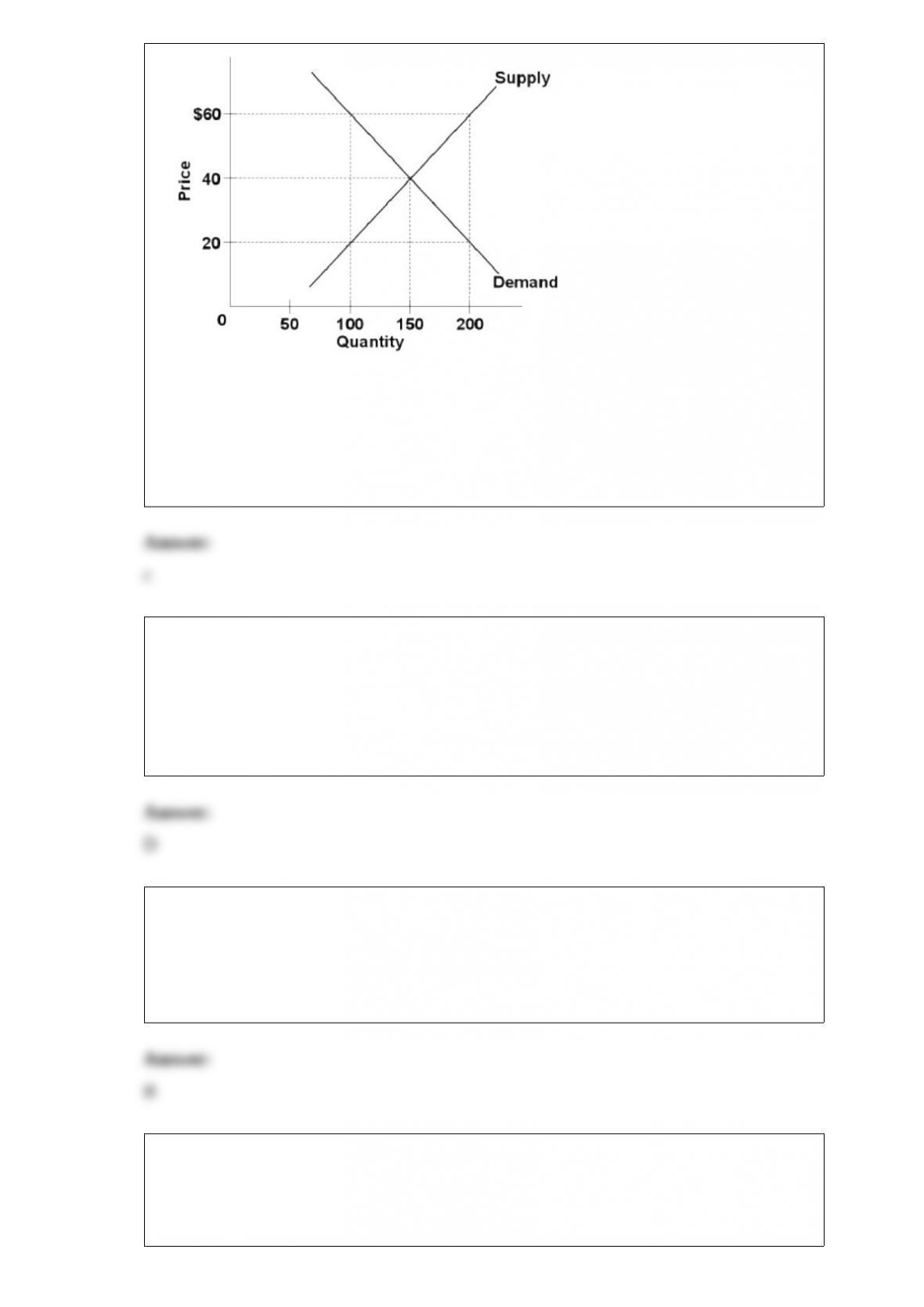
1)
refer to the above diagram. if this is a competitive market, price and quantity will move
toward:
a.$60 and 100 respectively.
b.$60 and 200 respectively.
c.$40 and 150 respectively.
d.$20 and 150 respectively.
2) The process by which new firms and new products replace existing dominant firms
and products is called:
A.monopolistic competition.
B.the inverted-U process.
C.process innovation.
D.creative destruction.
3) Social Security is financed:
A.by state income tax revenues.
B.by payroll taxes on employees and employers.
C.by Federal excise taxes.
D.out of general tax revenues.
4) the countries comprising nafta are:
a.canada, the united states, and puerto rico.
b.the united states, mexico, and chile.
c.the united states, united kingdom, and france.

d.canada, mexico, and the united states.
5) The World Bank:
A.is also known as the International Monetary Fund (IMF).
B.lends money to developing nations for basic infrastructure projects such as dams,
irrigation, health and sanitation, communications, and transportation.
C.is an affiliate of the World Trade Organization (WTO).
D.provides subsidies to private firms so they can improve their wages and working
conditions.
6) An effective expansionary fiscal policy will:
A.reduce a cyclical deficit, but necessarily increase the actual deficit.
B.reduce the standardized deficit.
C.increase the standardized deficit but reduce the cyclical deficit.
D.always result in a balanced actual budget once full-employment is achieved.
7) economists:
a.use both the economic perspective and the scientific method.
b.use the economic perspective but not the scientific method.
c.make positive economic statements, but not normative economic statements.
d.reject theorizing as being impractical.
8) The plus items below are “export-type” entries and the minus items are “import-type”
entries in the balance of payments for the hypothetical country of Zippo.
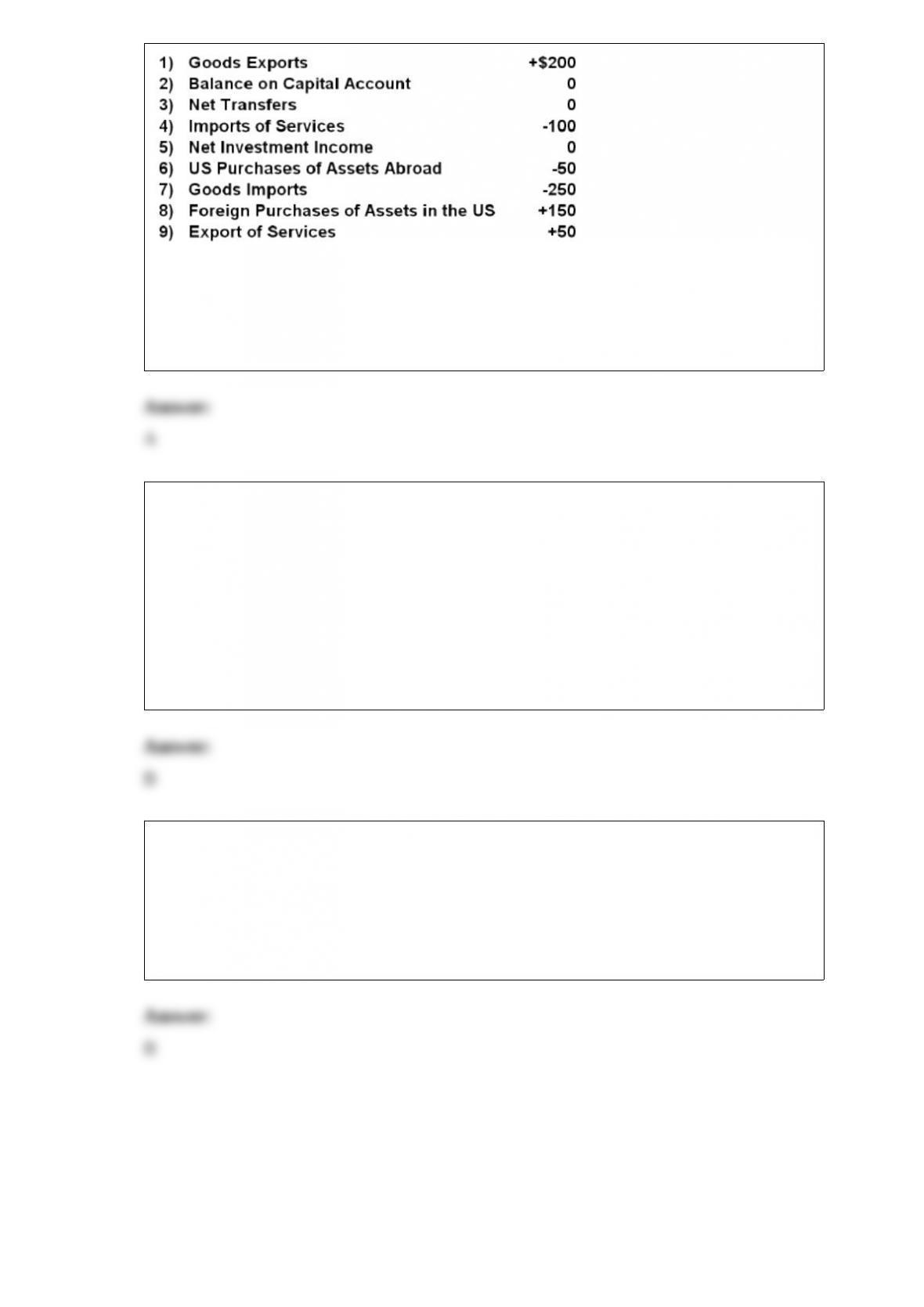
Refer to the above information. Zippo has a:
A.current account deficit.
B.capital account deficit.
C.balance of payments deficit.
D.trade surplus on goods and services.
9) In a cap-and-trade program:
A.government fixes the price of pollution rights and firms choose how many permits to
purchase.
B.government fixes the maximum amount of a pollutant that firms can discharge and
issues permits that firms can buy from and sell to each other.
C.each firm is provided a fixed number of permits for a particular pollutant and no
individual firm is allowed to acquire additional permits.
D.firms can emit whatever type of pollutant they want, so long as the total tonnage does
not exceed a government established quantity.
10) The ability of the DVCs to use the technologies of the IACs is somewhat limited
because:
A.the IACs have patents on most of their technologies.
B.the IACs and the DVCs have much different resource endowments.
C.the technologies of the IACs rely heavily on unskilled labor.
D.IAC technologies are labor-intensive, while DVC technologies are capital-intensive.