
When the government runs a deficit, which of the following is true?
A) T > TR – G
B) G > T + TR
C) G > TR – T
D) T < G + TR
As a percentage of GDP, federal expenditures ________ from 1950 to the early 1990s,
________ from 1992 to 2001, and have ________ since 2001.
A) rose; fell; risen
B) fell; fell; risen
C) rose; rose; fallen
D) fell; rose; fallen
If the GDP deflator rises from 185 to 190, what is the rate of inflation between the two
years?
A) 270%
B) 50%
C) 5%

D) 2.7%
If national saving decreases,
A) the sum of domestic investment and net exports must increase.
B) the sum of domestic investment and foreign investment must increase.
C) the sum of domestic investment and foreign investment must decrease.
D) foreign investment must increase to cover the loss.
A period of expansion in the business cycle ends when
A) real GDP is equal to potential GDP.
B) the business cycle reaches its peak.
C) the business cycle reaches its trough.
D) real GDP is less than potential GDP.

Households
A) purchase final goods and services in the factor market.
B) purchase final goods and services in the product market.
C) purchase resources in the product market.
D) purchase resources in the factor market.
If people assume that future rates of inflation will follow the pattern of inflation rates in
the past, they are said to have
A) rational expectations.
B) adaptive expectations.
C) unstable expectations.
D) accommodative expectations.
A decrease in interest rates can ________ the demand for stocks as stocks become
relatively ________ attractive investments as compared to bonds.
A) increase; more
B) decrease; less

C) decrease; more
D) increase; less
E) increase; similar
The gold standard is an example of
A) a floating exchange rate system.
B) a managed float exchange rate system.
C) a fixed exchange rate system.
D) a flexible exchange rate system.
E) the Bretton Woods System.
Which of the following models relies on emphasizing the importance of sticky wages
and prices?
A) the monetarist model
B) the new classical model
C) the real business cycle model
D) the new Keynesian model

If we want to use a measure of inflation that foreshadows price changes before they
affect prices at the retail level, we would base our measure of inflation on
A) the producer price index.
B) the consumer price index.
C) the GDP deflator.
D) the household price index.
Which of the following statements is false?
A) Not all individuals in both countries are made better off as a result of international
trade.
B) Within each country, some individuals are made better off as a result of international
trade, but one of the countries will be worse off overall.
C) Although some individuals may not be made better off as a result of international
trade, both countries may be made better off overall.
D) Each country as a whole is made better off as a result of international trade, but
individuals within each country may be made worse off.
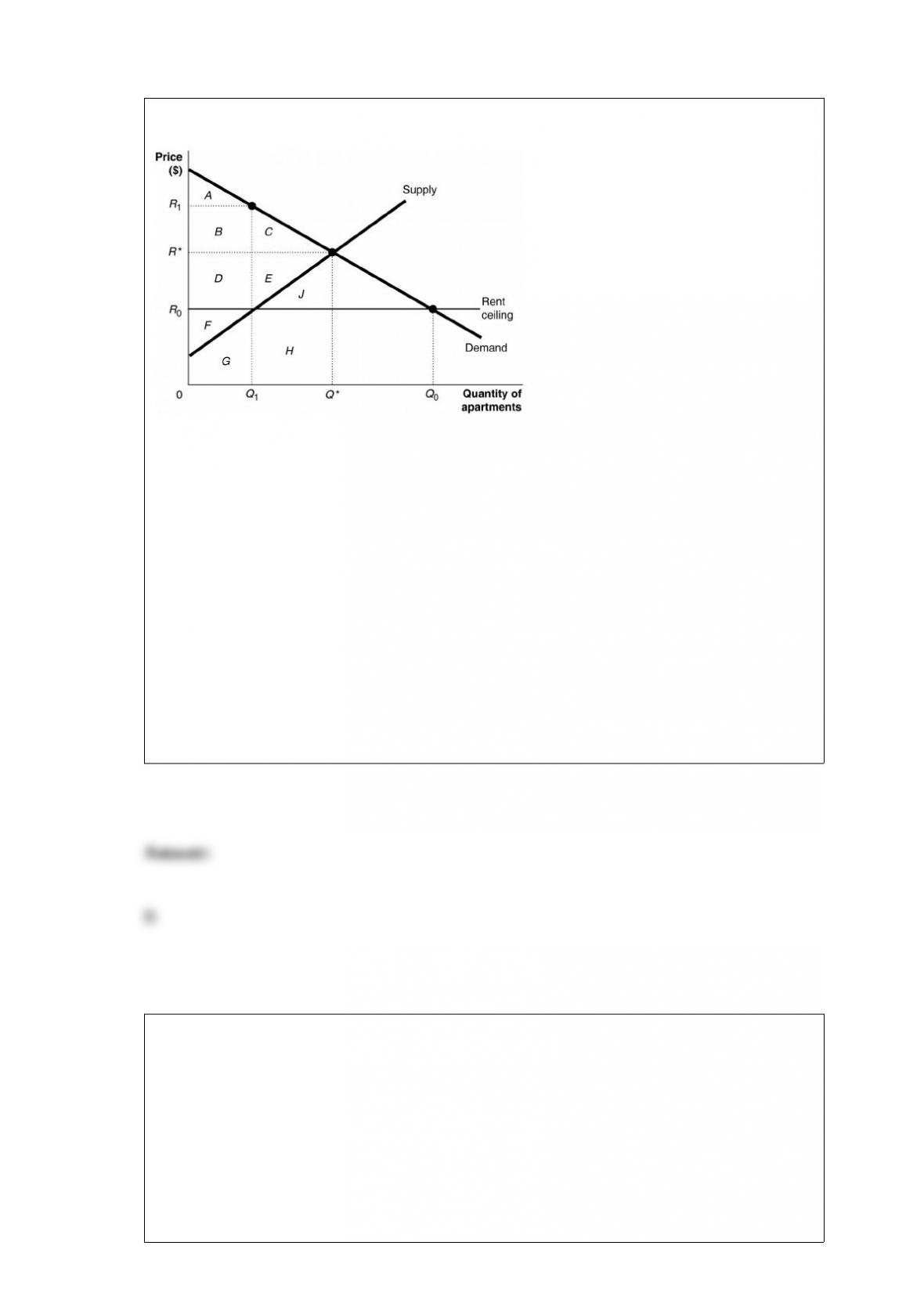
Figure 4-5
Figure 4-5 shows the market for apartments in Bay City. Recently, the government
imposed a rent ceiling at R0.
Refer to Figure 4-5. Suppose that instead of a price ceiling, the government imposed a
price floor of R1. What is the area representing producer surplus after the imposition of
the price floor?
A) A
B) B + D + F
C) C + E
D) B + C + D + E + F
A currency pegged at a value above the market equilibrium exchange rate is
A) overvalued.
B) undervalued.
C) achieving purchasing power parity.
D) depreciating in value relative to its pegged currency.

When inflation is very low, how do workers and firms adjust their expectations of
inflation?
A) They rapidly adjust their expectations of inflation upward.
B) They rapidly adjust their expectations of inflation downward.
C) They tend to ignore inflation.
D) They are more aggressive in asking for wage and price increases.
By 2012, Iceland’s real GDP ________, and the real GDPs of Italy, Spain, Greece, and
Ireland ________.
A) was still 5 percent lower than its level prior to the financial crisis; were more than 5
percent lower than their precrisis levels
B) had returned to its level prior to the financial crisis; were all higher than their
precrisis levels
C) was still 5 percent lower than its level prior to the financial crisis; had returned to
their precrisis levels
D) had returned to its level prior to the financial crisis; were still 5 percent or more
lower than their precrisis levels

If the required reserve ratio (RR) is 20 percent, the simple deposit multiplier is
A) 2.
B) 5.
C) 10.
D) 20.
Raising funds through financial intermediaries is called
A) direct finance.
B) corporate finance.
C) indirect finance.
D) dividend reinvestment.
The productivity slowdown of the mid-1970s can be explained by which of the
following?
A) excessive use of fiscal policy

B) large increases in research and development
C) a decline in labor quality
D) diminishing marginal returns