
Exhibit 38-3
Which of the two stocks has a bigger gap between its close price and net earnings per
share?
a. Stock ABC
b. Stock XYZ
c. Both stocks have the same gap between its close price and net earnings per share
d. There is not enough information provided to answer the question.
Situation 4-1
During the winter of 1973-74, a general system of wage and price controls (including a
price ceiling on gasoline) was in force in the United States. At the beginning of 1974,
some oil-producing countries imposed an oil embargo (a legal prohibition on
commerce) on the West. In the spring of 1974, price controls were] abolished.
Because price controls were in effect at the time the embargo occurred, an economist
would have most likely predicted that
a. the number of dollars one would need to pay at the pump (legally) for a full tank of
gasoline would increase sharply.
b. the number of dollars one would need to pay at the pump (legally) for a full tank of
gasoline would decline sharply.
c. long waiting lines and black markets would appear.
d. a surplus of gasoline would result.

The slope of a straight line is always equal to either 1.0 or -1.0.
a. True
b. False
A voter will tend to be more informed if the issue in question
a. affects everyone very little.
b. is complicated and difficult to understand.
c. has an intense and a direct effect on the voter.
d. is of special interest to a small group to which the voter does not belong.
For the consumer, a point on an indifference curve that lies farther from the origin is
preferable compared to those points that are closer to the origin.
a. True
b. False

If Jamal successfully and completely internalizes a negative externality, it follows that
a. transaction costs are zero.
b. his marginal private costs are equal to marginal social costs.
c. information is asymmetric.
d. information is symmetric.
e. none of the above
Some of our farm fields are being left unused. Does this have any implications for the
economy’s PPF diagram (with agricultural products on one axis and all other products
on the other axis)?
a. No implications, because the PPF deals only with resources in use.
b. The PPF cannot be drawn if some resources are idle.
c. With unemployed resources, we are at a point below the PPF.
d. The PPF would be upward sloping.
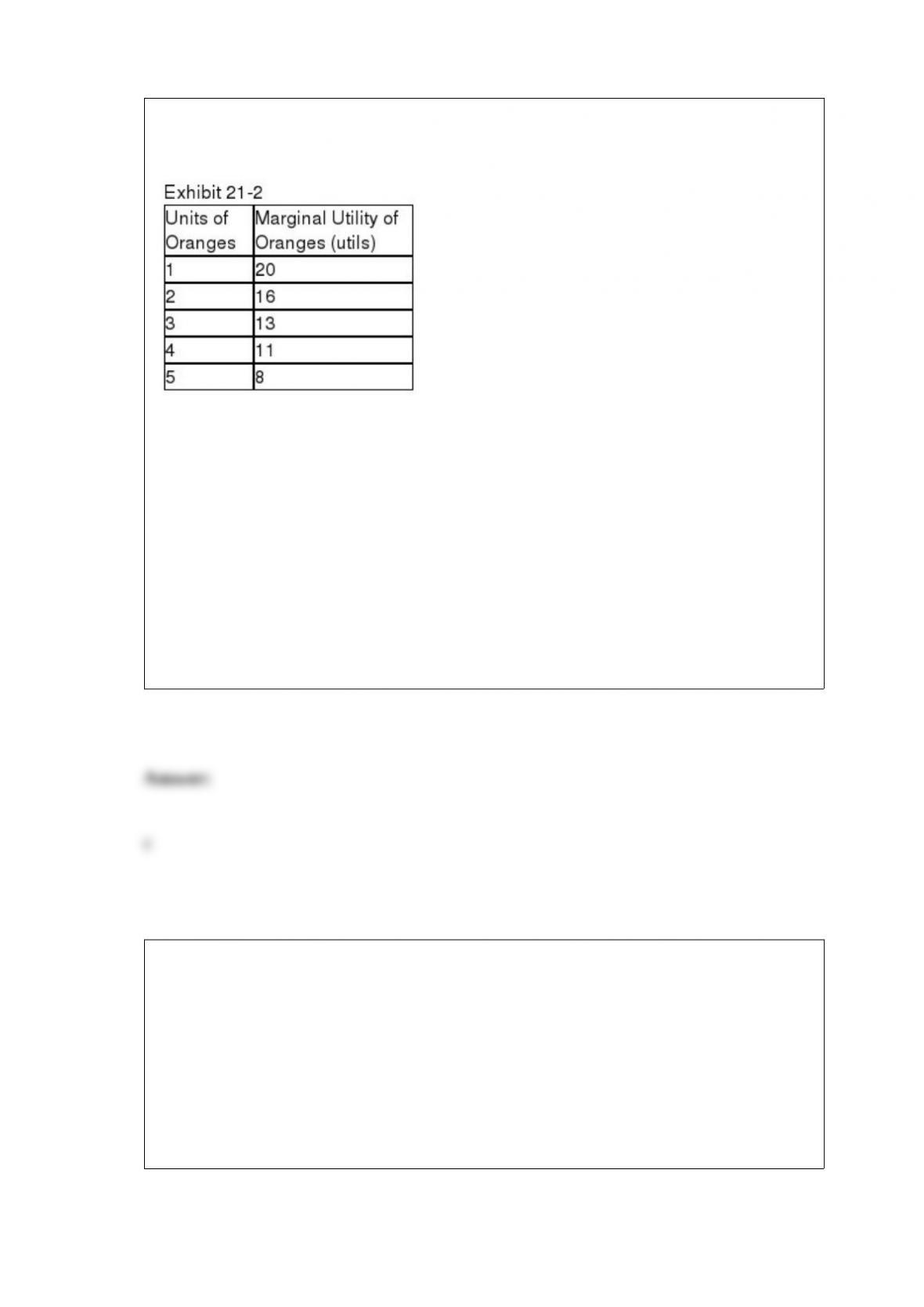
Total utility for the first three oranges is
a. 12 utils.
b. 62 utils.
c. 49 utils.
d. 15 utils.
e. 42 utils.
On a supply-and-demand diagram, quantity demanded equals quantity supplied
a. only at the single equilibrium price.
b. at every price at or above the equilibrium price.
c. at every price at or below the equilibrium price.
d. at every price.

If price elasticity of demand is 0.5, it follows that a _______ percent decrease in price
would cause a _______ percent increase in quantity demanded.
a. 50; 1
b. 0.5; 1
c. 0.5; 0.5
d. 100; 500
e. 2; 1
Suppose that a firm produces hard candies using both machines and labor, and that its
quantity of machines is currently fixed but it can vary the number of workers. As more
workers are added to operate the machines, output increases. Is this a refutation of the
law of diminishing marginal returns?
a. Yes, because the law definitely states that output will decrease as more workers are
added.
b. No, because we must be observing output in the long run if the stated scenario is
occurring.
c. Yes, because the only way that this could occur is if the number of machines being
used is also increasing.
d. No, because it is entirely possible for output to increase even when the law is in
operation.
A surplus will occur in a market when the price of the product is above the equilibrium
price.
a. True
b. False
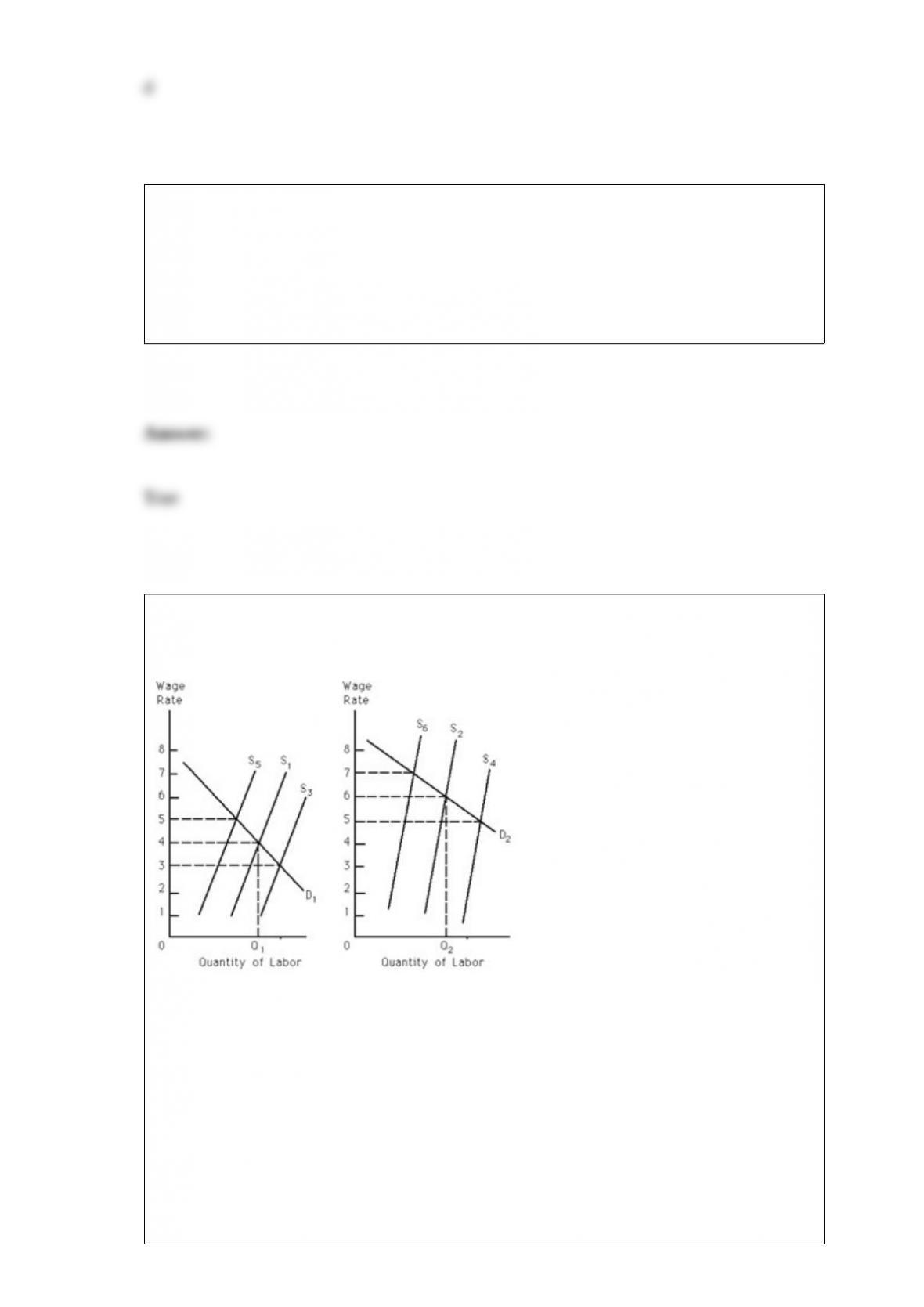
Exhibit 27-7
Market AMarket B
The exhibit shows two markets in which labor of identical skills is employed. Assume
that both markets are in equilibrium with Q1 and Q2 quantities of labor employed at the
respective prices of $4 and $6 per unit. If this equilibrium persists in the long run, an
economist would suspect that
a. nonpecuniary benefits are higher in market A.
b. nonpecuniary benefits are higher in market B.

c. there is discrimination in market A.
d. there is no cost of moving across markets.
e. b and c
If a perfectly competitive firm is a factor price taker, at the profit- maximizing factor
quantity
a. VMP = MRP.
b. MRP = MFC.
c. MFC = factor price.
d. both a and b
e. all of the above
Suppose there are only two countries in the world, Mexico and the United States. In the
foreign exchange market, it follows that the
a. demand for pesos is linked to the demand for dollars.
b. demand for pesos is linked to the supply of pesos.
c. supply of pesos is linked to the demand for dollars
d. supply of pesos is linked to the supply of dollars.

e. none of the above