
1) the rule of 70 is used to find how long it will take an economy to grow by 70 percent.
2) The Laffer Curve shows the tradeoff between the price level and tax rates.
3) The use of price support programs in agriculture has hastened the exodus of
resources from agriculture.
4) households spend a larger proportion of their incomes for services than for either
nondurable goods or durable goods.
5) Society’s optimal amount of pollution abatement is where society’s marginal benefit
of abatement is zero.
6) The future value of $3000 deposited today at 5 percent interest is $3646.52 four
years from now.
7) Agriculture is overcrowded because of absolute and relative increases in the size of
farm employment.

8) the real opportunity cost of producing product x is the amounts of products y, z, and
so forth, that might have been produced if resources had not been used to produce x.
9) Nearly all modern economists support the idea of a monetary rule.
10) Economic profits are the salaries received by the hired managers of business
corporations.
11) the basic source of state government’s revenue is the property tax.
12) Checkable deposits held in saving and loan institutions, mutual savings banks, and
credit unions are part of the M1 definition of the money supply.
13) removing all illegal immigrants would expand domestic-born employment by an
amount equal to the number of illegal immigrants removed.
14) an economy cannot produce at a point outside of its production possibilities curve
because human economic wants are insatiable.
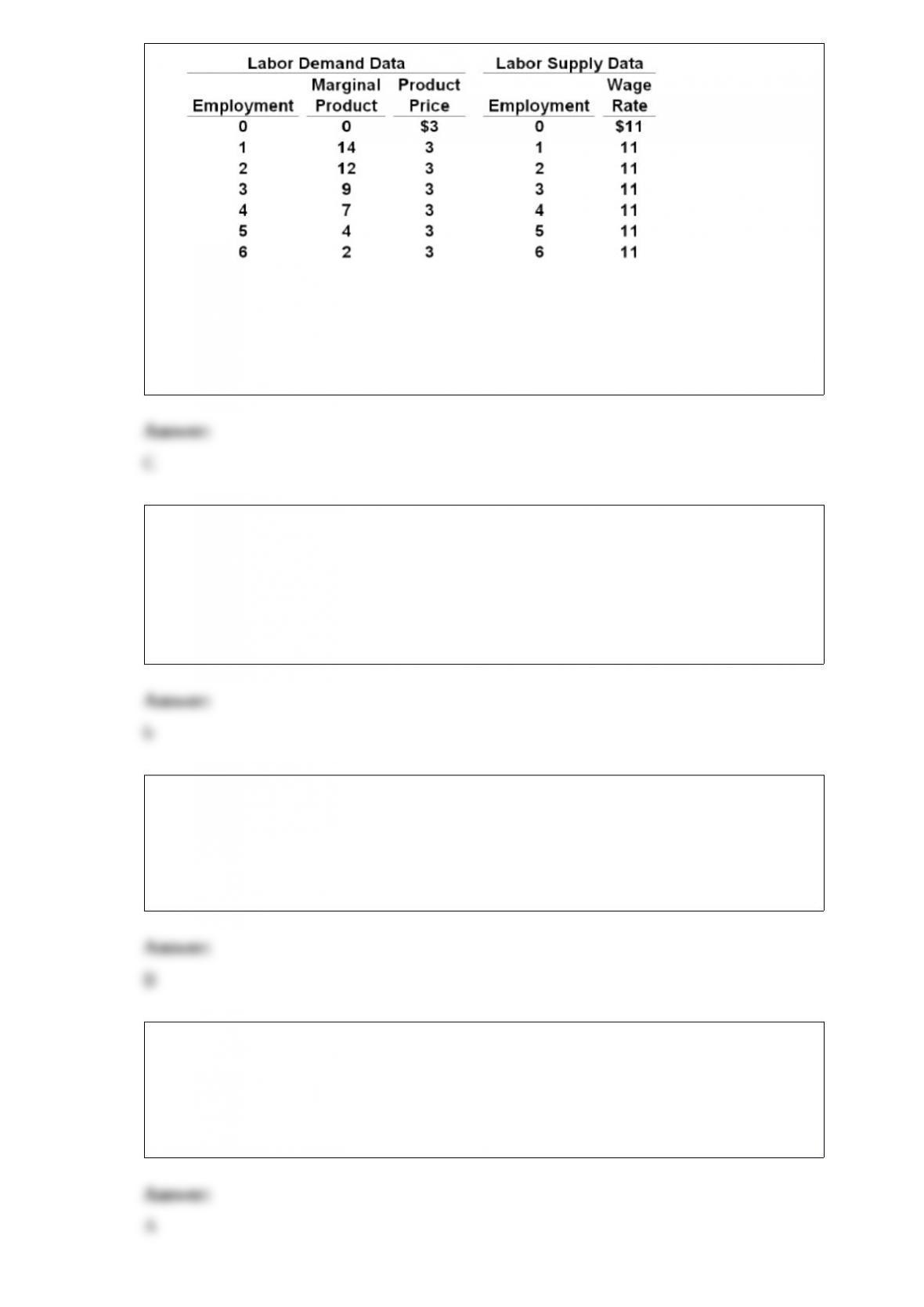
15)
On the basis of the above information we:
A.can say that the labor supply curve facing the firm is upsloping.
B.cannot say whether the firm’s product market is purely or imperfectly competitive.
C.can say that the firm is selling its product in a purely competitive market.
D.can say that the firm is selling its product in an imperfectly competitive market.
16) the negative slope of the production possibilities curve is a graphical way of
indicating that:
a.any economy “can have its cake and eat it too.”
b.to produce more of one product we must do with less of another.
c.the principle of increasing opportunity costs applies to only parts of the economy.
d.consumers buy more when prices are low than when prices are high.
17) Other things equal, a decrease in the real interest rate will:
A.expand investment and shift the AD curve to the left.
B.expand investment and shift the AD curve to the right.
C.reduce investment and shift the AD curve to the left.
D.reduce investment and shift the AD curve to the right.
18) A nation will neither export nor import a specific product when its:
A.domestic price (no-international-trade price) equals the world price.
B.export supply curve lies above its import demand curve.
C.export supply curve is upsloping.
D.import demand curve is downsloping.
19) A user cost of zero implies that:
A.a firm will extract all of a resource in the present.
B.a firm will extract resources at a faster rate than if the user cost was positive.
C.a firm will extract resources at a faster rate than if the user cost was negative.
D.the price of the resource will not change.
20) which of the following will not cause the demand for product k to change?
a.a change in the price of close-substitute product j
b.an increase in consumer incomes
c.a change in the price of k
d.a change in consumer tastes
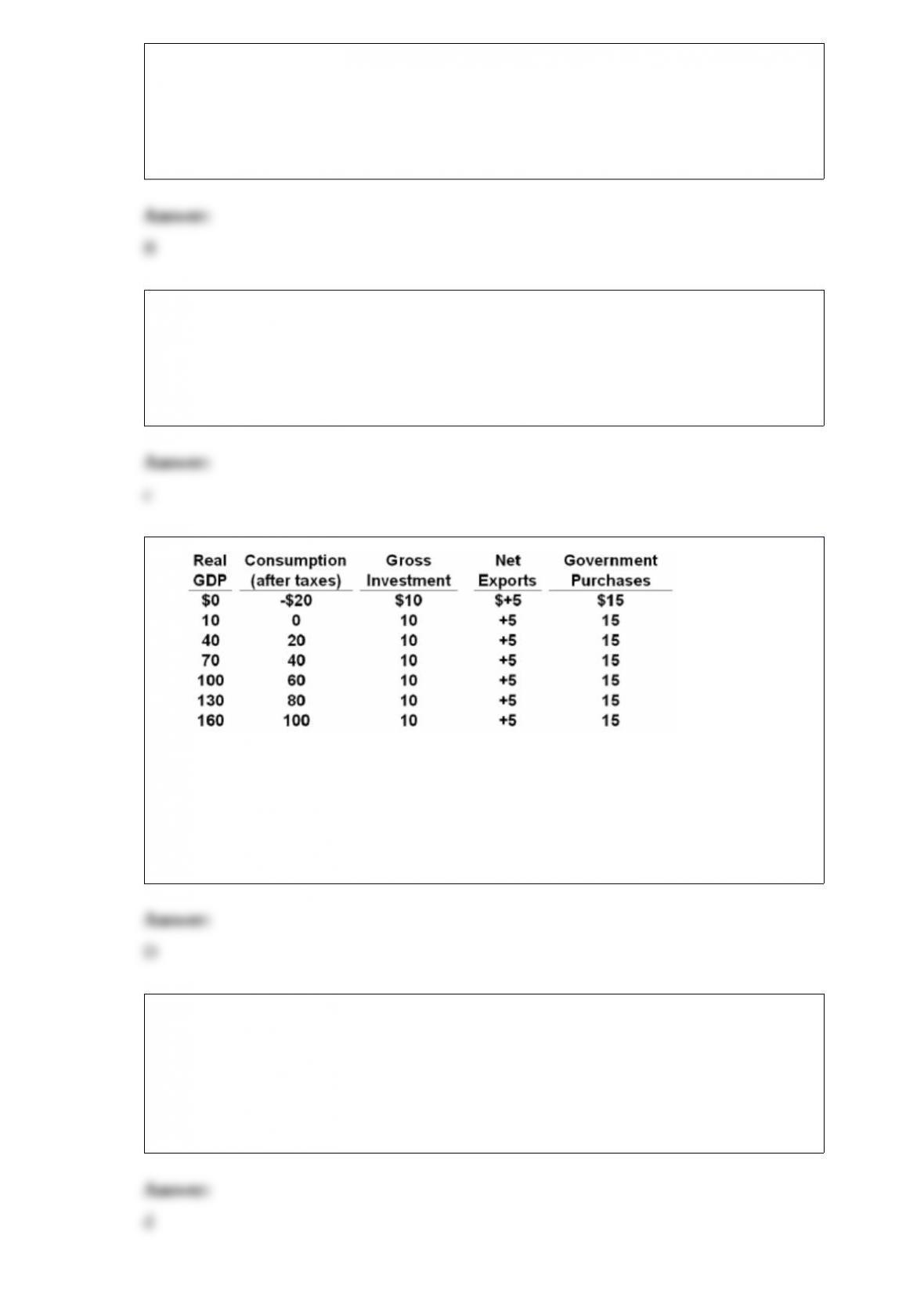
21)
Refer to the above table. The economy shown is a:
A.private economy.
B.private open economy.
C.mixed closed economy.
D.mixed open economy.
22) (consider this) newspapers dispensing devices seemingly “trust” people to take only
a single paper but the devices actually rely on the law of:
a.supply.
b.increasing opportunity costs.
c.demand.
d.diminishing marginal utility.

23) Under a system of freely flexible (floating) exchange rates a U.S. trade deficit with
Mexico will tend to cause:
A.the United States government to ration pesos to U.S. importers.
B.a flow of gold from the United States to Mexico.
C.an increase in the peso price of dollars.
D.an increase in the dollar price of pesos.
24) Suppose that real domestic output in an economy is 20 units, the quantity of inputs
is 10, and the price of each input is $4. Answer the following question(s) on the basis of
this information.
Refer to the above information. Given an increase in input price from $4 to $6, we
would expect the aggregate:
A.supply curve to shift to the left.
B.supply curve to shift to the right.
C.demand curve to shift to the left.
D.demand curve to shift to the right.
25) What is the Federal funds rate and how does the Fed target it?
26) Why are financial institutions required to keep reserves?

27) Why is it important to account for the net foreign factor income when calculating
domestic income instead of national income?
28) Do protectionist policies benefit producers, consumers, workers, or the
government? Explain.

29) How is price discrimination treated under antitrust laws?
30) What are the three different union strategies pursued to increase wages?