
1) although individual purely competitive firms can influence the price of their product,
these firms as a group cannot influence market price.
2) indifference curves are linear and budget lines are convex to the origin.
3) Mainstream economists say that recessions are unlikely to occur today because
prices and wages are highly flexible downward.
4) Financing wartime expenditures by increasing internally held public debt permits a
nation to defer a part of the economic cost of war.
5) Under freely flexible (floating) exchange rates, if the dollar price of pounds rises, the
pound price of dollars will fall.
6) average fixed costs diminish continuously as output increases.
7) An increase in wealth from a substantial increase in stock prices will move the
economy along a fixed aggregate demand curve.

8) Increases in incomes usually result in more than proportionate increases in the
demand for agricultural products in a growing economy.
9) The United States Treasury is the only source of money in the U.S. economy.
10) If prices received by farmers decline and prices paid by farmers increase, the parity
ratio will decline.
11) Which of the following groups has the lowest poverty rate?
A.married-couple families
B.whites
C.foreign-born (not citizens)
D.African-Americans
12) The number of countries belonging to the World Trade Organization (WTO), as of
2008, is about:
A.153.
B.135.
C.80.
D.202.
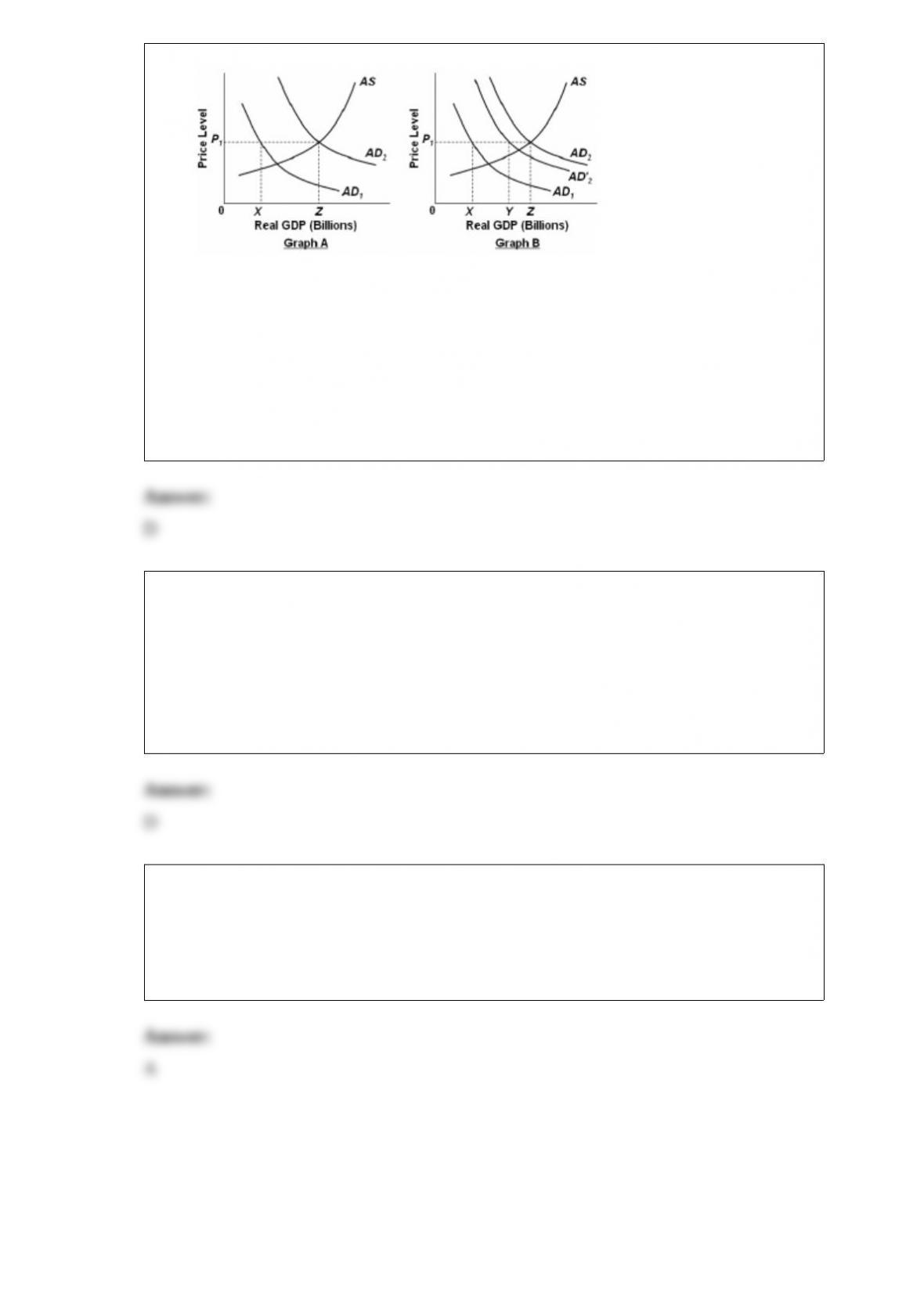
13)
Refer to the above diagrams. Suppose that government undertakes fiscal policy
designed to increase aggregate demand from AD1 to AD2 and thereby to increase GDP
from X to Z. In terms of graph B, which of the following might explain why GDP
increases to Y rather than to Z?
A.depreciation of the dollar.
B.reduction in tariffs imposed by our trading partners.
C.decrease in the saving schedule.
D.crowding-out effect.
14) Projecting that it might temporarily fall short of legally required reserves in the
coming days, the Bank of Beano decides to borrow money from its regional Federal
Reserve Bank. The interest rate on the loan is called the:
A.prime rate.
B.Federal funds rate.
C.Treasury bill rate.
D.discount rate.
15) An increase in net exports will shift the:
A.aggregate expenditures curve upward and the aggregate demand curve rightward.
B.aggregate expenditures curve upward and the aggregate demand curve leftward.
C.aggregate expenditures curve downward and the aggregate demand curve rightward.
D. aggregate expenditures curve downward and the aggregate demand curve leftward.
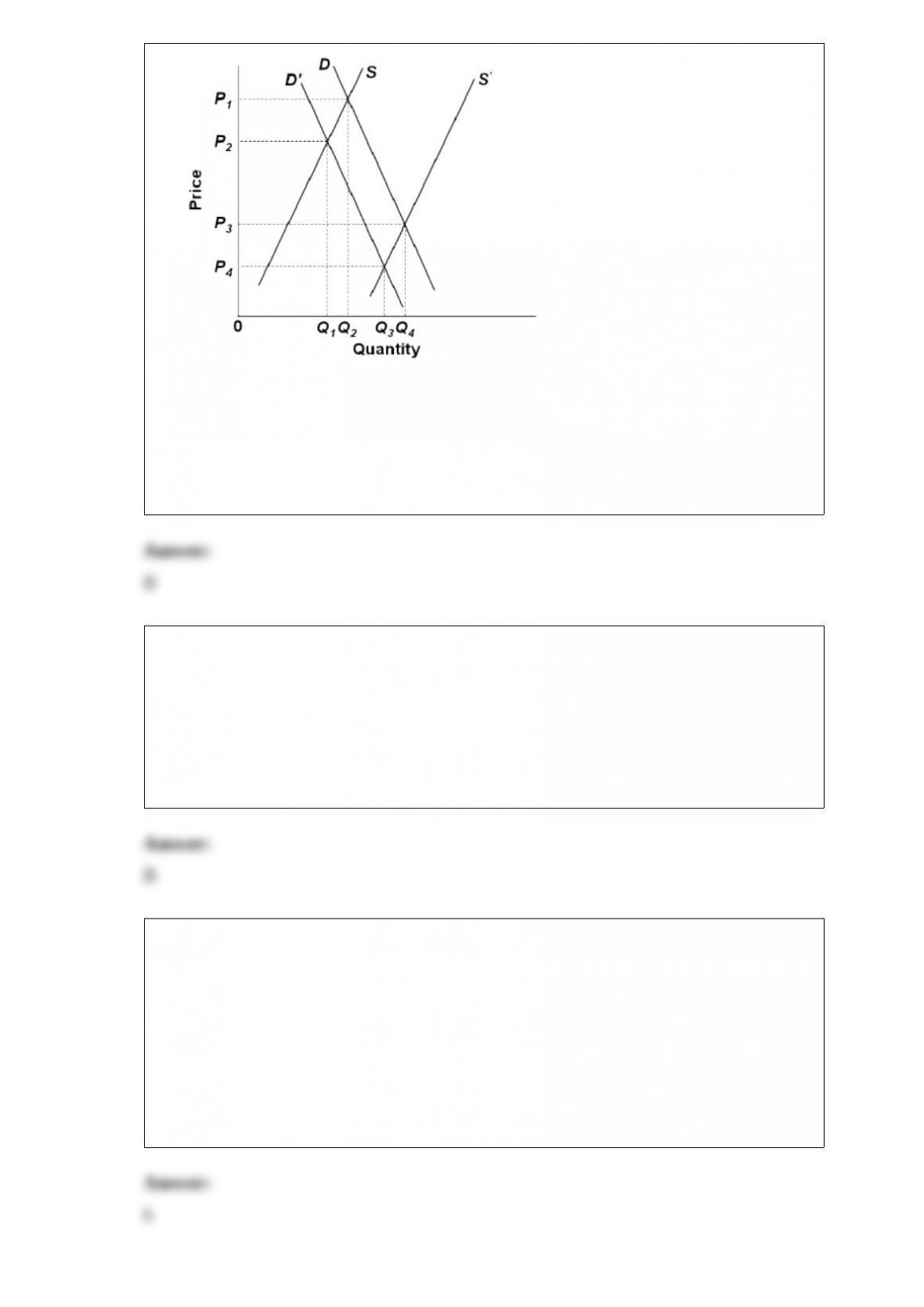
16)
Refer to the above diagram. Which of the following supply and demand shifts portray
the long-run problem that farms face?
A.S to S’ and D to D’
B.S to S’ and D’ to D
C.S’ to S and D’ to D
D.S’ to S and D to D’
17) Increases in the total real output of many DVCs do not increase the nation’s
standard of living because:
A.diminishing returns may be encountered in increasing total output.
B.population increases may dissipate the increase in real output.
C.disguised unemployment in agriculture will persist.
D.surplus farm labor may move from rural areas to industrial areas, causing
unemployment.
18) the budget line shows:
a.the amount of product a that a consumer is willing to give up to obtain one more unit
of product b.
b.all possible combinations of two goods that can be purchased, given money income
and the prices of the goods.
c.the minimum amount of two goods that a consumer can purchase with a given money
income.
d.all possible combinations of two goods that yield the same level of utility to the
consumer.

19) Which of the following taxes reflects the benefits-received principle of taxation?
A.cigarette taxes
B.gasoline taxes
C.sales taxes
D.Federal personal income taxes
20) economic theories:
a.are useless because they are not based on laboratory experimentation.
b.that are true for individual economic units are never true for the economy as a whole.
c.are generalizations based on a careful observation of facts.
d.are abstractions and therefore of no application to real situations.
21) given a downsloping demand curve and an upsloping supply curve for a product, an
increase in the price of a substitute good will:
a.increase equilibrium price and quantity.
b.decrease equilibrium price and quantity.
c.increase equilibrium price and decrease equilibrium quantity.
d.decrease equilibrium price and increase equilibrium quantity.
22) If resources A and B are complementary and employed in fixed proportions:
A.a change in the price of A will have no effect on the quantity of B employed.
B.an increase in the price of A may either increase or decrease the demand for B.
C.an increase in the price of A will increase the demand for B.
D.an increase in the price of A will decrease the demand for B.
23) Alex and Ben are both loggers wanting to harvest timber from the same forest. Alex
prefers to harvest and replant at a sustainable rate; Ben wants to harvest as many trees
as possible to maximize short-run profit, and then move on. They face the same
production costs.
Refer to the information above. If no explicit property right is given over the forest
land, then:
A.a property right will be established when trees are cut down and brought to market.
B.there is no property right over the harvested timber.
C.Alex and Ben will likely work out an agreement on harvesting and replanting the
land.
D.that implies that government owns and regulates its use.
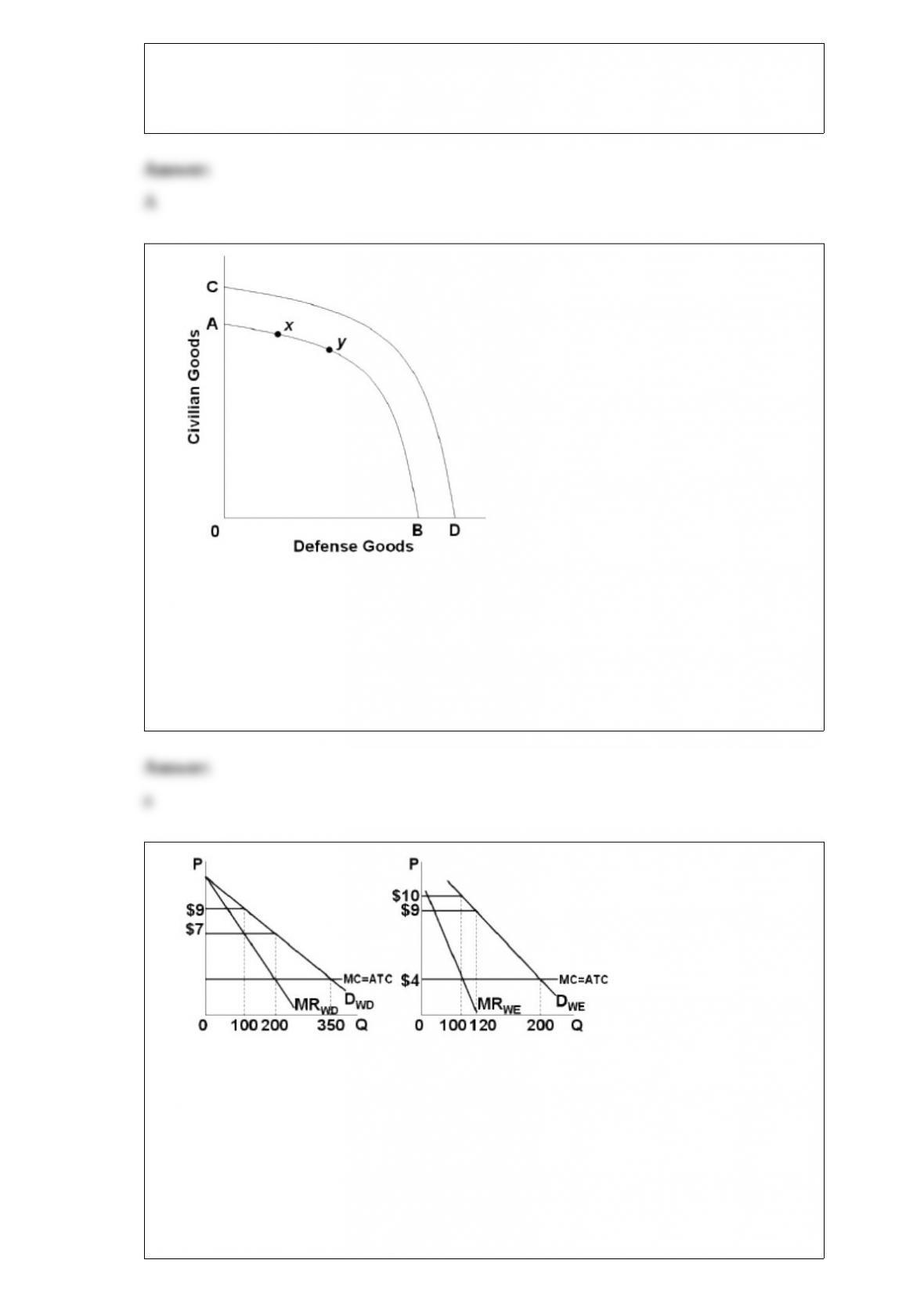
24)
(consider this) in response to the terrorist attacks of september 11, 2001, the
government decided to allocate more resources toward defense goods. the government’s
decision reflects their assessment that:
a.the marginal benefits of additional defense goods outweighed the marginal cost.
b.the marginal cost of additional defense goods outweighed the marginal benefit.
c.there cannot be too many defense goods.
d.civilian goods are not worth producing.
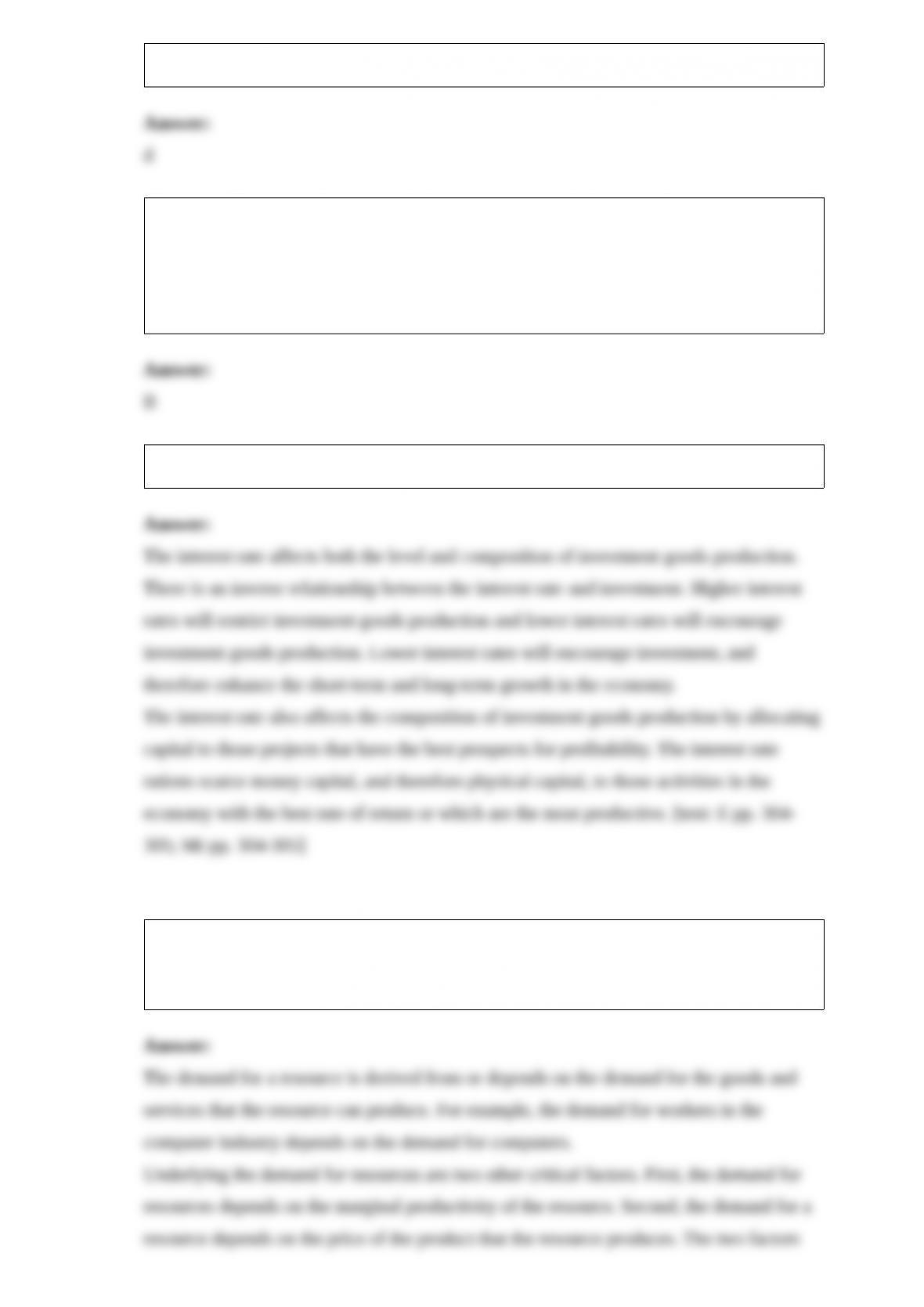
25)
refer to the figure above. suppose the graphs represent the demand for use of a local
golf course for which there is no significant competition (it has a local monopoly); p
denotes the price of a round of golf; q is the quantity of rounds ‘sold” each day. if the
left graph represents the demand during weekdays, and the right graph the weekend
demand, then over the course of a full seven-day week this price-discriminating,
profit-maximizing golf course should sell at total of:
a.300 rounds.
b.740 rounds.
c.900 rounds.
d.1,200 rounds.
26) If a U.S. importer can purchase 10,000 pounds for $20,000, the rate of exchange is:
A.$1 = 2 pounds in the United States.
B.$2 = 1 pound in the United States.
C.$1 = 2 pounds in Great Britain.
D.$.5 = 1 pound in Great Britain.
27) Why is the interest rate such an important price in the economy?
28) Why is the demand for resources called a derived demand? On what two factors
does the strength of the demand for resources depend? How are these two factors
related?
29) Compensating wage differentials will attract U.S. workers even to otherwise
undesirable work. Explain.
30) Why does pure competition provide consumers with the largest utility surplus?
31) Monopolists are not technologically competitive. Explain.
32) What has been the recent focus of monetary policy?
33) In Year 1, the standardized budget showed a deficit of about $100 billion and the
actual budget showed a deficit of $150 billion one year. In Year 2, the full employment
budget showed a deficit of about $125 billion and the actual budget showed a deficit of
$150 billion. Based on these data, what can be concluded about the direction of fiscal
policy?
34) What ways do firms have to finance R&D activities? What is the cost of these
forms of funding?
35) Job discrimination may actually result from rational decision making on the part of
firms and not because of prejudice. Explain this statement.