
When an economy faces diminishing returns,
A) the slope of the per-worker production function becomes steeper as capital per hour
worked increases.
B) the slope of the per-worker production function becomes flatter as capital per hour
worked increases.
C) the per-worker production function shifts to the left.
D) the per-worker production function shifts to the right.
If the short-run aggregate supply increases by less than the long-run aggregate supply,
then, at the short-run equilibrium,
A) GDP will be below potential GDP.
B) aggregate demand will increase.
C) GDP will be above potential GDP.
D) GDP will be equal to potential GDP.
The distribution of income primarily determines which of the fundamental economic
questions?
A) What goods and services are to be produced?
B) How the goods and services are to be produced?
C) Who will receive the goods and services produced?
D) How to plan the economy?
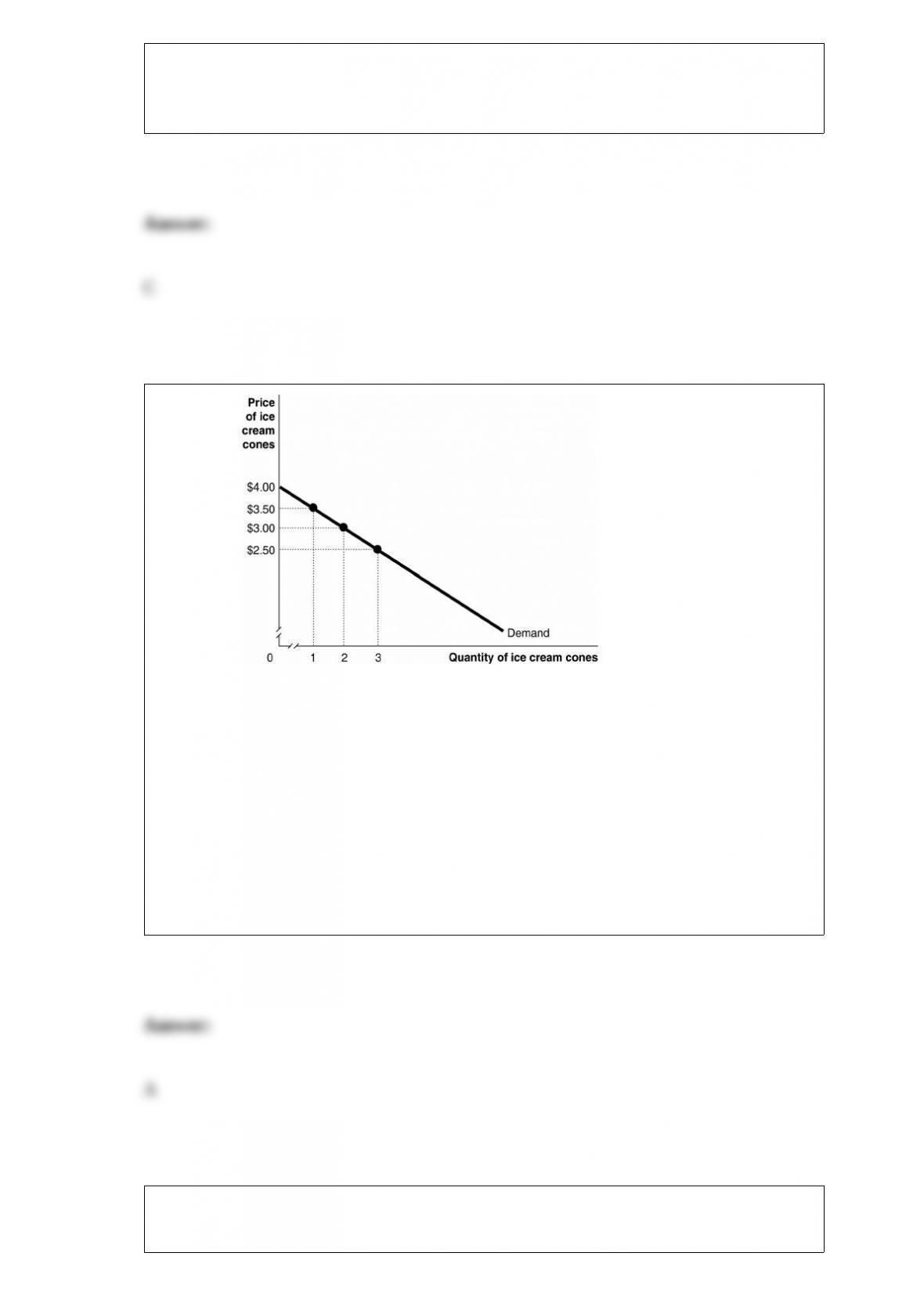
Figure 4-3 Figure 4-3 shows Kendra’s
demand curve for ice-cream cones.
If the market price is $3.00, what is the consumer surplus on the first ice cream cone?
A) $0.50
B) $1.00
C) $5.50
D) $9.00
Health insurance companies impose deductibles on policies and co-payments on claims

A) to increase sales.
B) to reduce moral hazard problems.
C) to reduces sunk costs.
D) to increase prices.
Since the Social Security system began in 1935, the number of workers per retiree has
A) stayed roughly the same.
B) continually risen.
C) continually declined.
D) risen and declined with different generations.
Stockholders
A) are liable for the debts of a corporation.
B) are the owners of a corporation.
C) control a corporation’s day-to-day activities.
D) hire the managers of a corporation.

Table 9-3
Bryce and Tina are artisans who produce homemade candles and soap. Table 9-3 lists
the number of candles and bars of soap Bryce and Tina can each produce in one month.
Select the statement that accurately interprets the data in the table.
A) Tina has a comparative advantage in making candles.
B) Bryce has an absolute advantage in making soap.
C) Bryce has a comparative advantage in making candles.
D) Bryce has a comparative advantage in making candles and making soap.
The branch of economics which studies how households and firms make choices,
interact in markets and how government attempts to influence their choices is called
A) macroeconomics.
B) microeconomics.
C) positive economics.
D) normative economics.
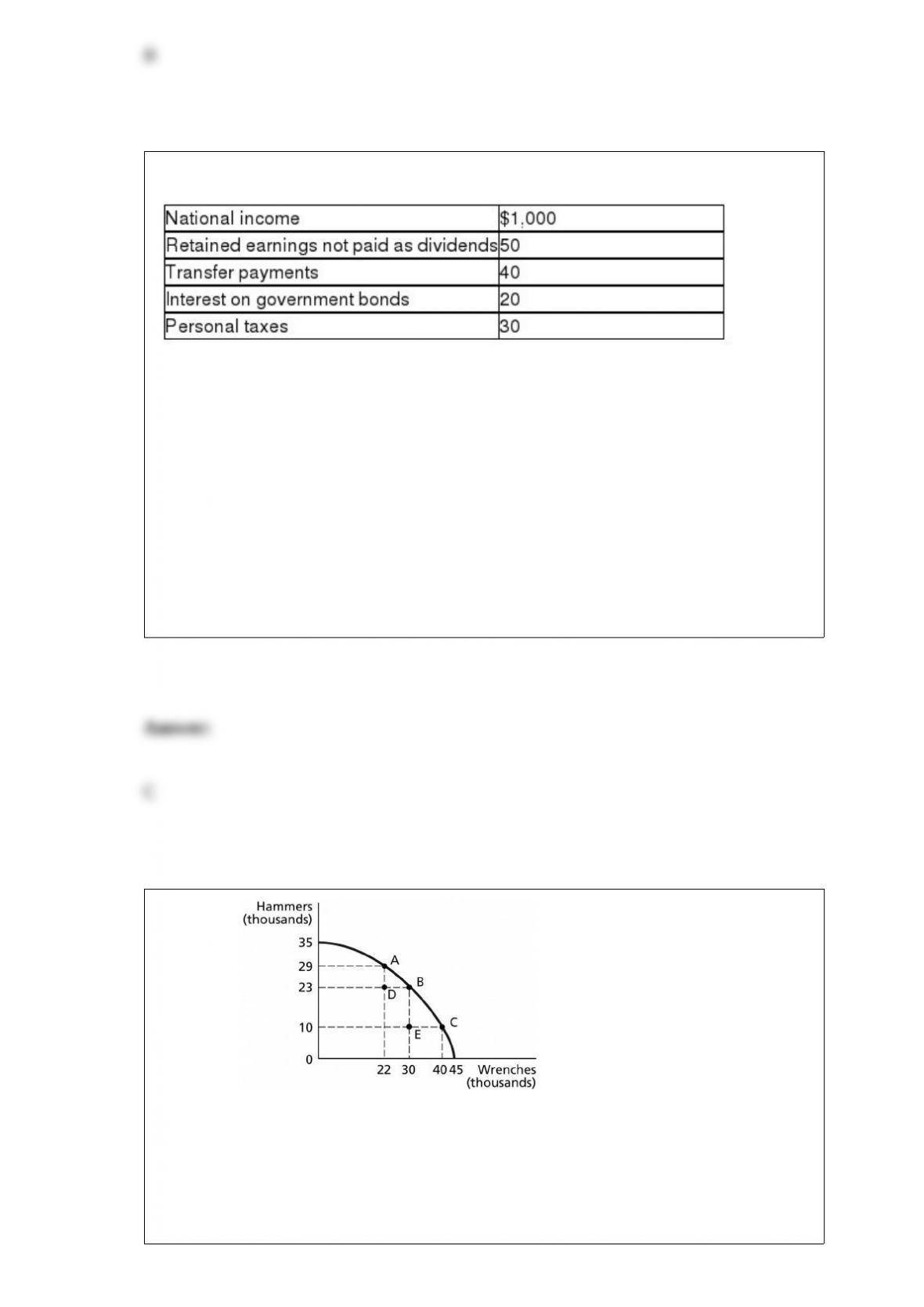
Table 19-27
The components of national income for an economy are represented in Table 19-27
above. All values are in billions of dollars.
What is the level of disposable personal income for this economy?
A) $1,080 billion
B) $1,010 billion
C) $980 billion
D) $860 billion
Figure 2-6
If the economy is currently producing at point D, what is the opportunity cost of
moving to point B?
A) 8 thousand wrenches

B) 23 thousand hammers
C) 30 thousand wrenches
D) 0 hammers
The labor supply curve
A) shows the relationship between the wage rate and the quantity of labor supplied.
B) shows the quantity of jobs supplied at various wage rates.
C) is unit-elastic.
D) is U-shaped.
________ is defined as a market outcome in which the marginal benefit to consumers of
the last unit produced is equal to the marginal cost of production, and in which the sum
of consumer surplus and producer surplus is at a maximum.
A) Economic efficiency
B) Consumer efficiency
C) Producer efficiency
D) Deadweight efficiency
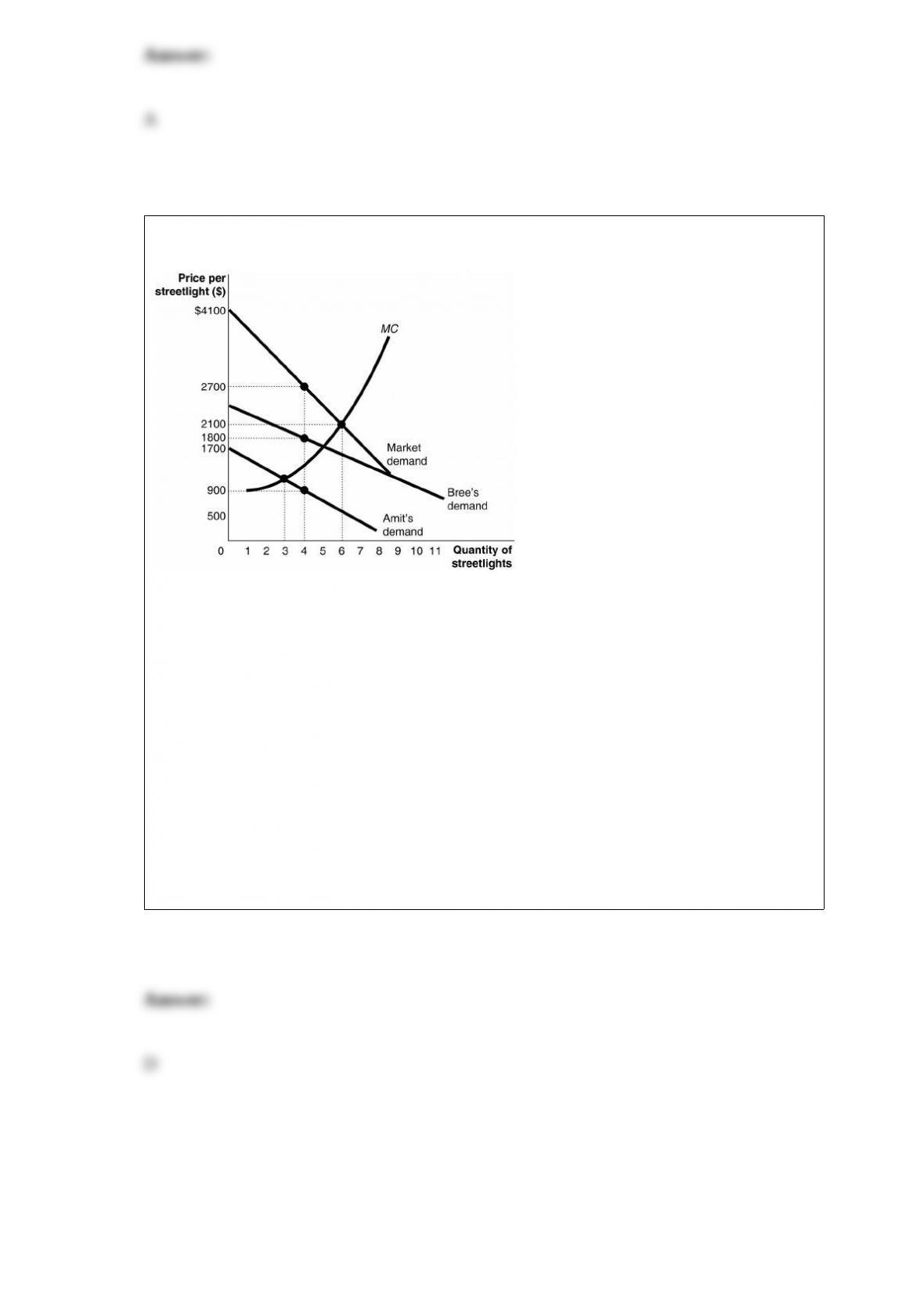
Figure 5-16
Amit and Bree are the only two
homeowners on an isolated private road. Both agree that installing street lights along
the road would be beneficial and want to do so. Figure 5-16 shows their willingness to
pay for different quantities of street lights, the market demand for street lights and the
marginal cost of installing the street lights.
How much is Amit willing to pay to have 4 street lights installed?
A) $3,600
B) $2,700
C) $1,800
D) $900