
1) DVCs might increase their rates of economic growth through privatization of state
industries, encouraging direct foreign investment, controlling population growth, and
opening economies to international trade.
2) About 20 percent of the labor force is in agriculture.
3) Mainstream economists say that recessions are unlikely to occur today because
prices and wages are highly flexible downward.
4) A monopsonistic employer may sell its product in a competitive market.
5) generally speaking, the smaller the percentage of one’s total budget devoted to a
particular product, the more price elastic will be the demand for that product.
6) In the aggregate expenditure model presented in the textbook, investment is assumed
to rise with increases in real GDP and fall with decreases in real GDP.
7) The closer the Lorenz curve is to the diagonal, the greater is the degree of income
inequality.
8) if price changes and total revenue changes in the opposite direction, demand is
relatively elastic.
9) rational individuals may make different choices because their preferences and
circumstances differ.
10) Between 1994 and 2000, annual budget deficits gave way to annual budget
surpluses.
11) The legal cartel theory indicates that, in any industry where market demand and the
long-run average total cost curve intersect close to the latter’s minimum, government
regulation is mandatory and desirable.
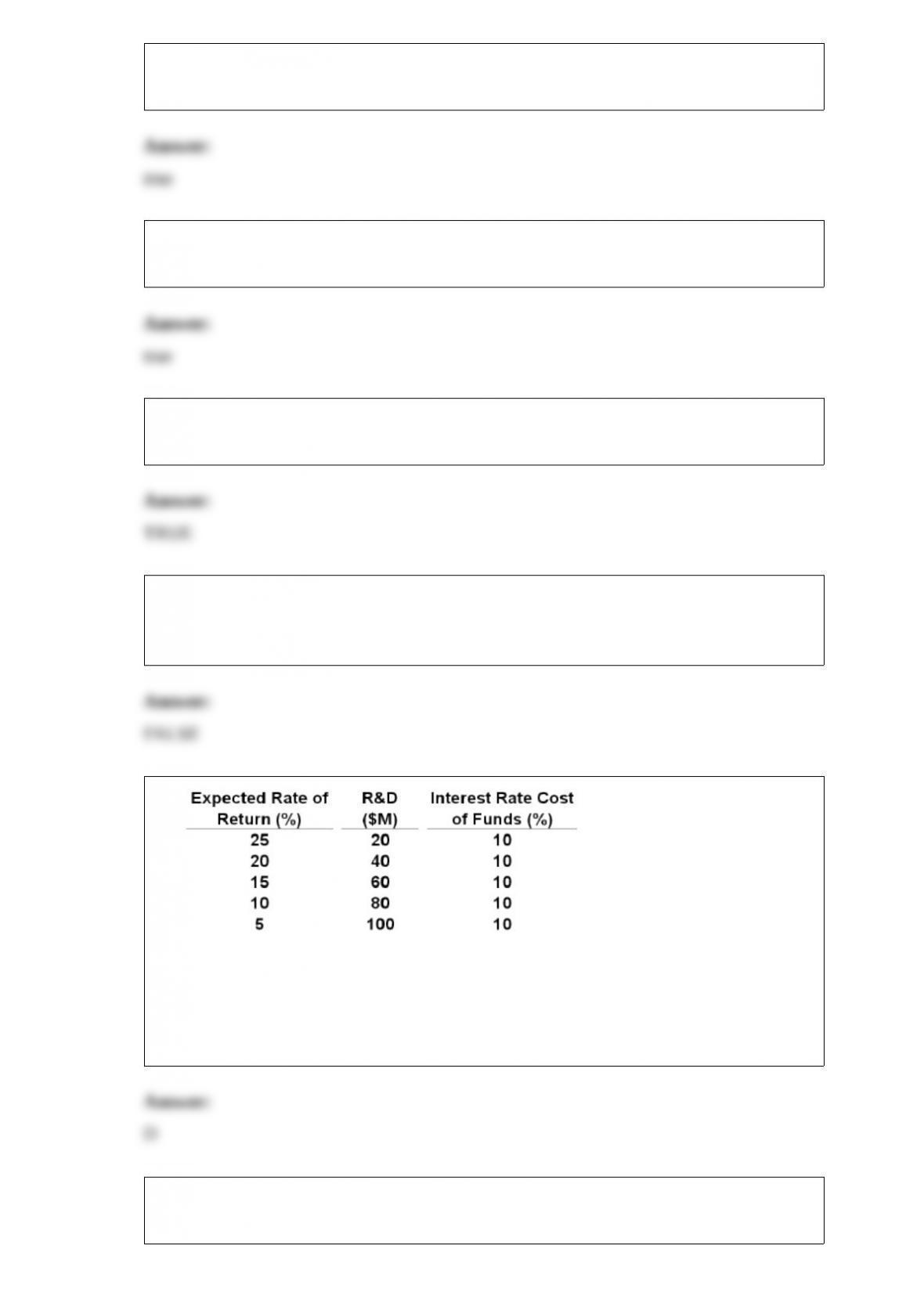
12)
Refer to the above data. The firm’s optimal amount of R&D spending is:
A.$20 million.
B.$40 million.
C.$60 million.
D.$80 million.
13) if a positive relationship exists between x and y:
a.an increase in x will cause y to decrease.
b.a decrease in x will cause y to increase.
c.the relationship will graph as an upsloping line.
d.the vertical intercept must be positive.
14) if potential gdp is $400 billion and there is a negative gdp gap of $15 billion, real
gdp is:
a.$415 billion.
b.$385 billion.
c.$15 billion.
d.$785 billion.
15) Suppose a commercial banking system has $100,000 of outstanding checkable
deposits and actual reserves of $35,000. If the reserve ratio is 20 percent, the banking
system can expand the supply of money by the maximum amount of:
A.$122,000.
B.$175,000.
C.$300,000.
D.$75,000.
16) Fill in the table below and answer the following questions. Assume the slope of the
SML = 0.5 for all investors.
(a)Suppose David is considering adding a new asset to his portfolio and is deciding
between two different assets. David deviates from the standard SML in that for any
asset riskier than his portfolio, he expects to earn at least 85%. The assets have betas of
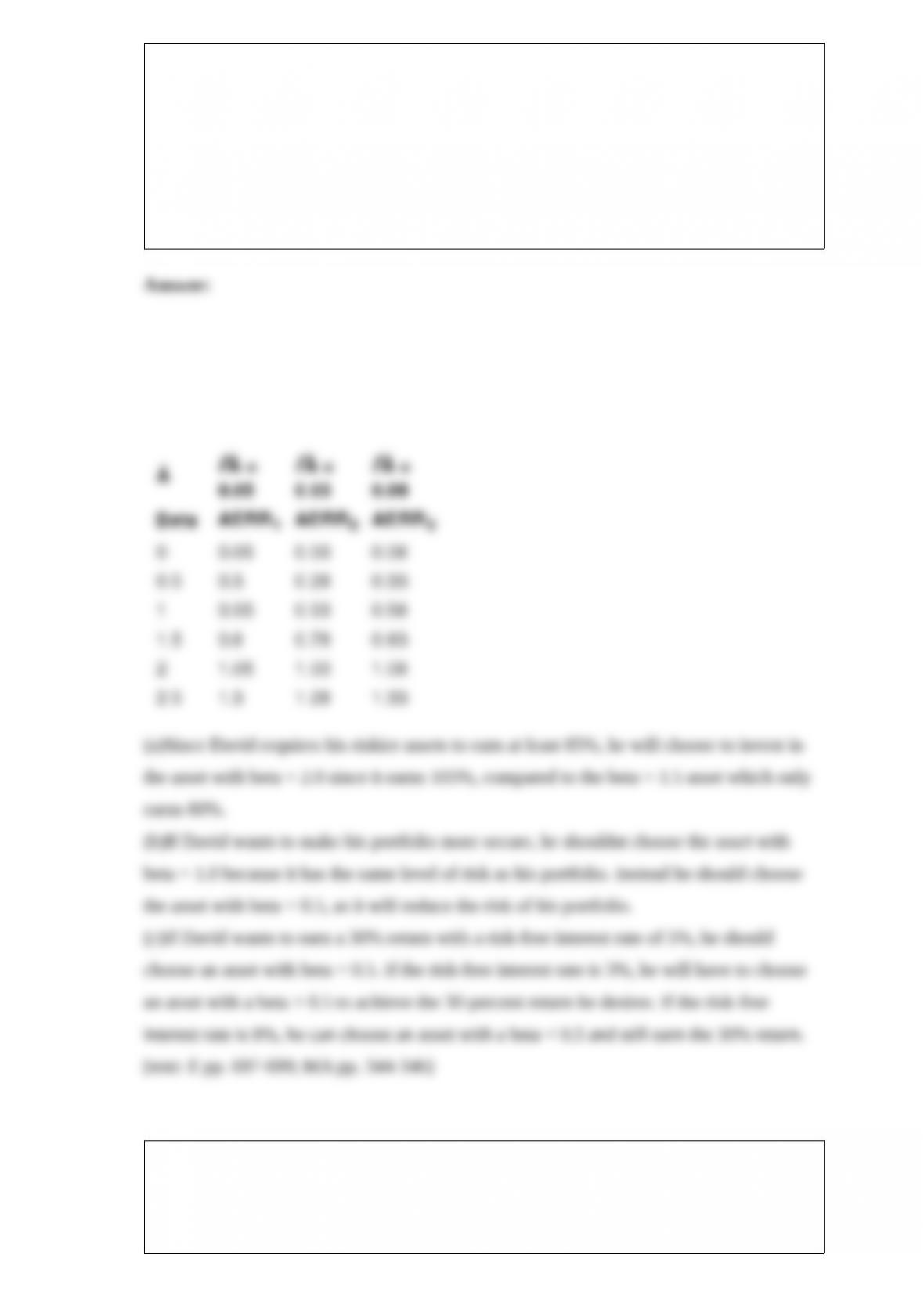
1.5 and 2 respectively and the risk-free interest rate at that time is 5%. Which asset
should he choose?
(b)Suppose David is now considering adding some more secure assets to his portfolio.
He is deciding between an asset that has a beta of 1.0 and an asset that has a beta of 0.5.
Which asset should he choose?
(c)Suppose David wants to invest in an asset that earns 30% with the lowest level of
risk possible. What asset should he choose if the risk-free interest rate is 5%? If it is
3%? If it is 8%?
17) Suppose the reserve requirement is 20 percent. If a bank has checkable deposits of
$4 million and actual reserves of $1 million, it can safely lend out:
A.$1 million.
B.$1.2 million.

C.$200,000.
D.$800,000.
18) a competitive market system:
a.encourages growth by allowing producers to make profitable investment decisions
based on market signals.
b.encourages growth by ensuring that everyone in society will receive a decent standard
of living.
c.discourages growth because firms busy competing have no time to innovate or invest.
d.discourages growth unless government protects domestic firms from foreign
competition.
19) which of the following types of unemployment is directly associated with
insufficient overall demand for goods and services?
a.search unemployment
b.wait unemployment
c.cyclical unemployment
d.frictional unemployment
20) A farmer who has fixed amounts of land and capital finds that total product is 24 for
the first worker hired; 32 when two workers are hired; 37 when three are hired; and 40
when four are hired. The farmer’s product sells for $3 per unit and the wage rate is $13
per worker.
Refer to the above information. The marginal revenue product of the second worker is:
A.$24.
B.$8.
C.$15.
D.$9.
21) we would expect the cross elasticity of demand for pepsi in relation to other soft
drinks to be greater than that for soft drinks generally because:
a.soft drinks are normal goods.
b.the income effect always exceeds the substitution effect.
c.there are fewer good substitutes for soft drinks as a whole than for pepsi specifically.
d.there are more good substitutes for soft drinks as a whole than for pepsi specifically.
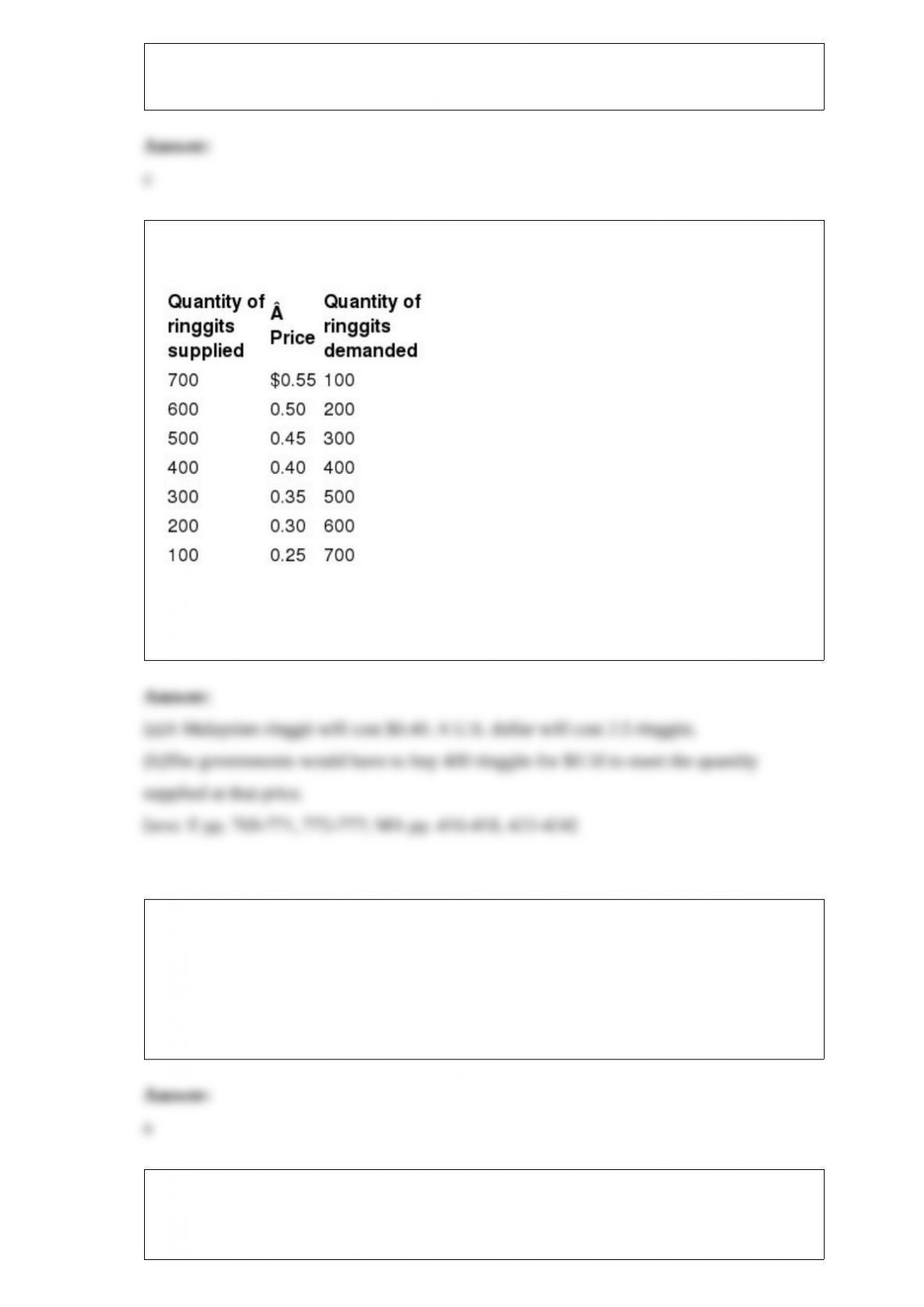
22) In the table below are the supply and demand schedules for Malaysian ringgits.
(a)What will be the rate of exchange for the Malaysian ringgit and for the U.S. dollar?
(b)What would happen if the U.S. and Malaysian governments wanted to fix or peg the
price of a ringgit at $0.50?
23) which of the following would not be appropriate if government were trying to
reduce high unemployment?
a.an increase in tax rates
b.an increase in subsidies to businesses
c.an increase in transfer payments to households
d.an increase in government spending
24) Total Allowable Catch (TAC):
A.explicitly limits the number of days in a season that particular fish may be caught.
B.explicitly limits the number of boats allowed to fish in a particular area.
C.explicitly limits the number or tonnage of fish that can be harvested from a particular
fishery.
D.issues tradable permits limiting the number of fish a particular fisher can catch.
25)
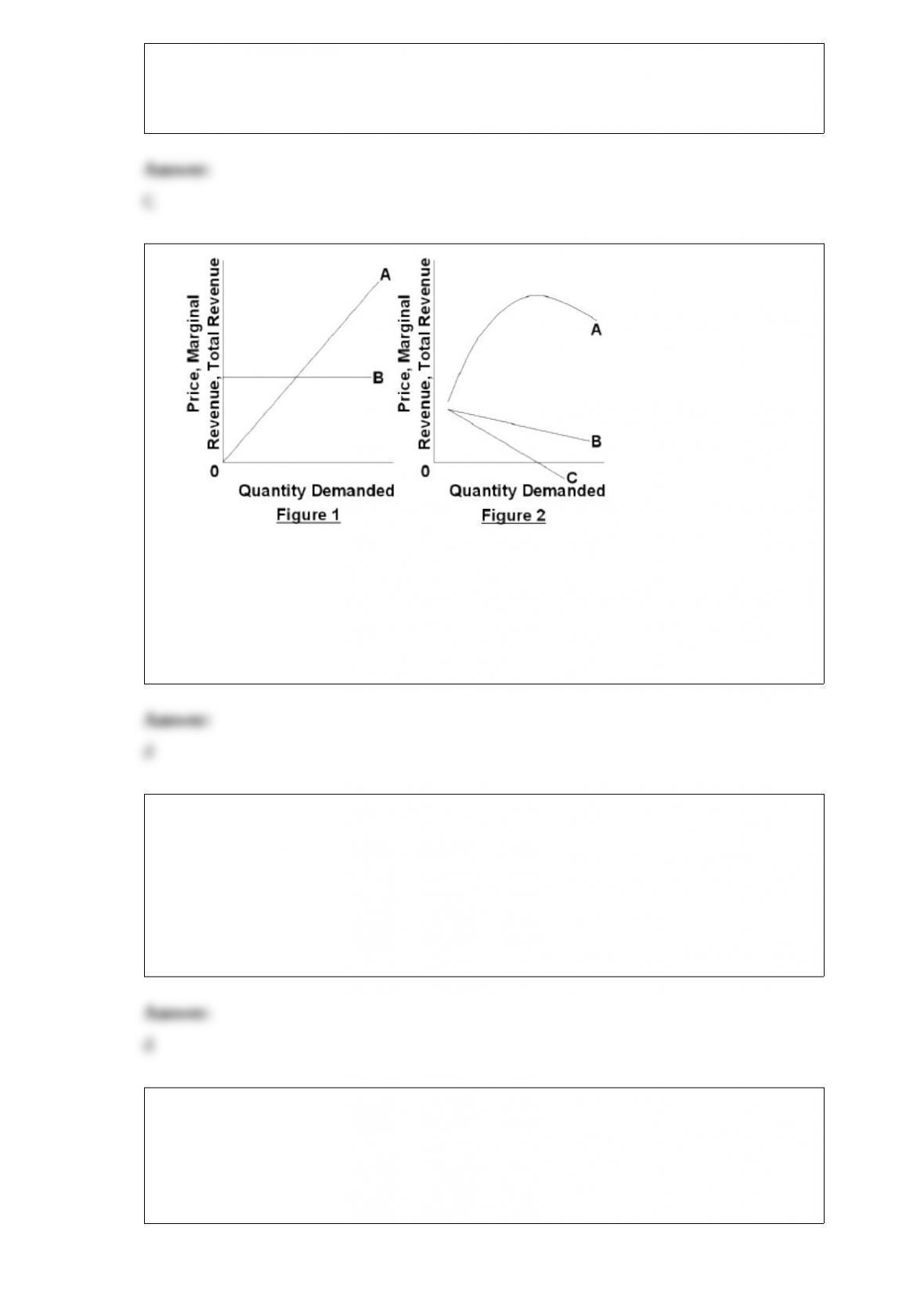
refer to the above two diagrams for individual firms. in figure 1, line a represents the
firm’s:
a.demand and marginal revenue curves.
b.demand curve only.
c.marginal revenue curve only.
d.total revenue curve only.
26) the rate of inflation can be found by subtracting:
a.the real income from the nominal income.
b.last year’s price index from this year’s price index.
c.this year’s price index from last year’s price index and dividing the difference by this
year’s price index.
d.last year’s price index from this year’s price index and dividing the difference by last
year’s price index.
27) Other things equal, an improvement in productivity will:
A.shift the aggregate demand curve to the left.
B.shift the aggregate supply curve to the left.
C.shift the aggregate supply curve to the right.
D.increase the price level.
28) mr. chan has an income of $20 that he is spending on donuts and cheese in such
amounts that he derives 25 utils of satisfaction from the donuts and 25 utils of
satisfaction from the cheese. on the basis of this information we:
a.cannot say whether or not chan is buying donuts and cheese in equilibrium amounts.
b.can say that chan should buy more cheese and fewer donuts.
c.can say that chan should buy more donuts and less cheese.
d.can say that chan is buying the utility-maximizing amounts of donuts and cheese.
29) if the law of diminishing returns applies to study time:
a.the 10th hour of study will likely be less productive than the 3rd.
b.this implies that longer lectures are less productive than shorter ones.
c.there is no benefit to studying a subject more than 5 hours in any given day.
d.people with less intelligence necessarily experience diminishing returns sooner than
those with greater intelligence.
30)
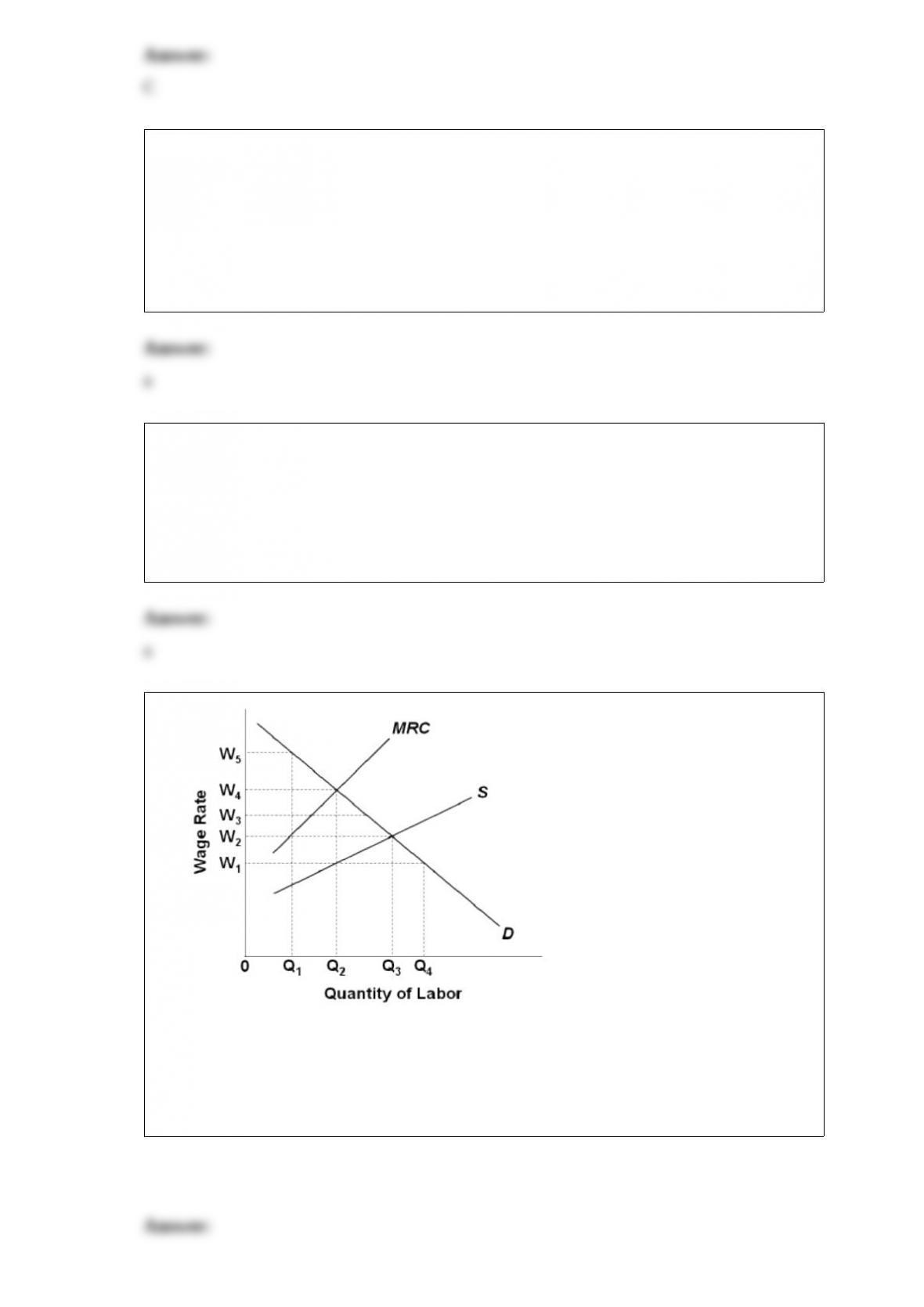
Refer to the above diagram. The MRC curve lies above the labor supply curve because:
A.any number of workers can be hired at the going equilibrium wage rate.
B.the firm must lower product price to increase its sales.
C.the higher wage needed to attract additional workers must also be paid to the workers
already employed.
D.there is an inverse relationship between wage rate and the amount of labor employed.
31) Describe how a market for externality rights would work in terms of supply and
demand.
32) How is price discrimination treated under antitrust laws?
33) Explain the logic behind the demographic transition view.
34) Draw a supply and demand graph on the below diagram that illustrates the market
for pollution rights. Label the axes and curves. Then show what happens to price and
quantity when the demand for pollution rights increases in the market.
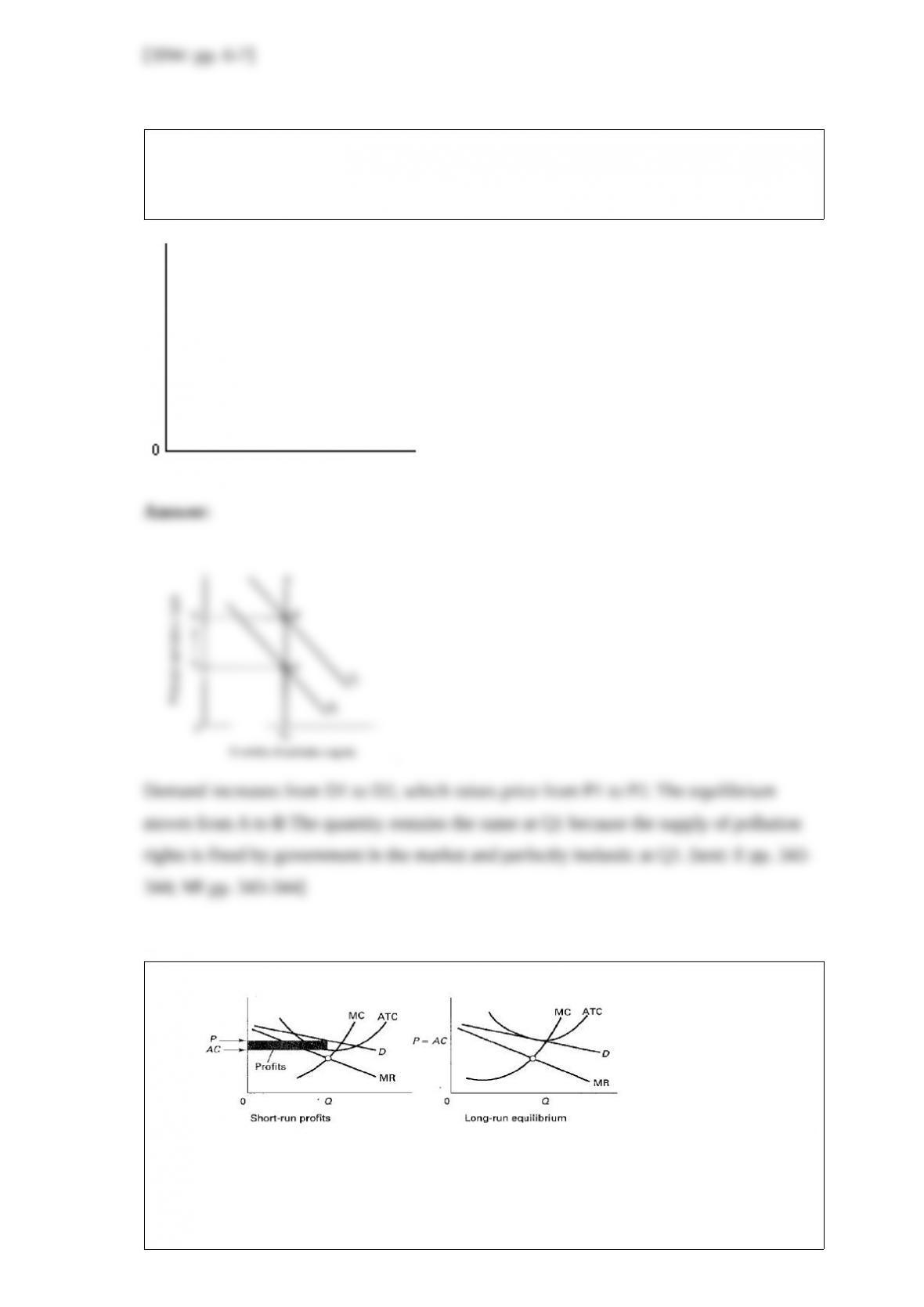
35)
In the first graph below, illustrate the cost curves and demand conditions for a
monopolistically competitive firm making short-run profits. In the second graph,
illustrate what those conditions are most likely to be in the long run. Explain the major
differences in the two graphs.
36) Explain the demand factor in economic growth.
37) Suppose a market basket of goods costs $2000 in the United States and 1500. What
is the purchasing power parity rate? Suppose the purchasing power parity rate was $1 =
1. What would one expect the dollar and the euro to do?
38) Is a Nash equilibrium stable? Explain.
39) Why are price fixing among firms and price discrimination treated differently under
antitrust legislation?
40) What is the difference between society’s view and an individual firms view of
economic rent?