
1) a price index can rise from one year to the next even though:
a.some individual prices in the economy fall.
b.nominal gdp falls.
c.real gdp falls.
d.all of these occur.
2) effectively removing all illegal immigrants from u.s. labor markets would:
a.reduce wages in the united states.
b.increase employment of domestic-born workers, but by a lesser amount than the
number of jobs lost by illegal workers.
c.increase employment of domestic-born workers at a rate of one-for-one with the jobs
lost by illegal workers.
d.increase employment of domestic-born workers by an amount greater than the
number of jobs lost by illegal workers.
3) Assume a DVC has a real per capita output of $1,000 as compared to $20,000 for an
IAC. If both nations realize a 4 percent growth of their real per capita outputs, the
absolute real per capita output gap will:
A.remain unchanged at $19,000.
B.increase by $760.
C.decrease by $1,000.
D.increase by $19,760.
4) Other things equal, interest rates are:
A.higher on large loans than on small loans.
B.higher on loans with tax-exempt interest payments.
C.lower on less risky loans than on riskier loans.
D.lower on short-term loans than on long-term loans.
5) Suppose that government imposes a specific excise tax on product X of $2 per unit
and that the price elasticity of demand for X is unitary (coefficient = 1). If the incidence
of the tax is such that consumers pay $1.80 of the tax and the producers pay $.20, we
can conclude that the:
A.supply of X is highly inelastic.
B.supply of X is highly elastic.
C.demand for X is highly inelastic.
D.demand for X is highly elastic.
6) long-run competitive equilibrium:
a.is realized only in constant-cost industries.
b.will never change once it is realized.
c.is not economically efficient.
d.results in zero economic profits.
7) an increasing-cost industry is associated with:
a.a perfectly elastic long-run supply curve.
b.an upsloping long-run supply curve.
c.a perfectly inelastic long-run supply curve.
d.an upsloping long-run demand curve.
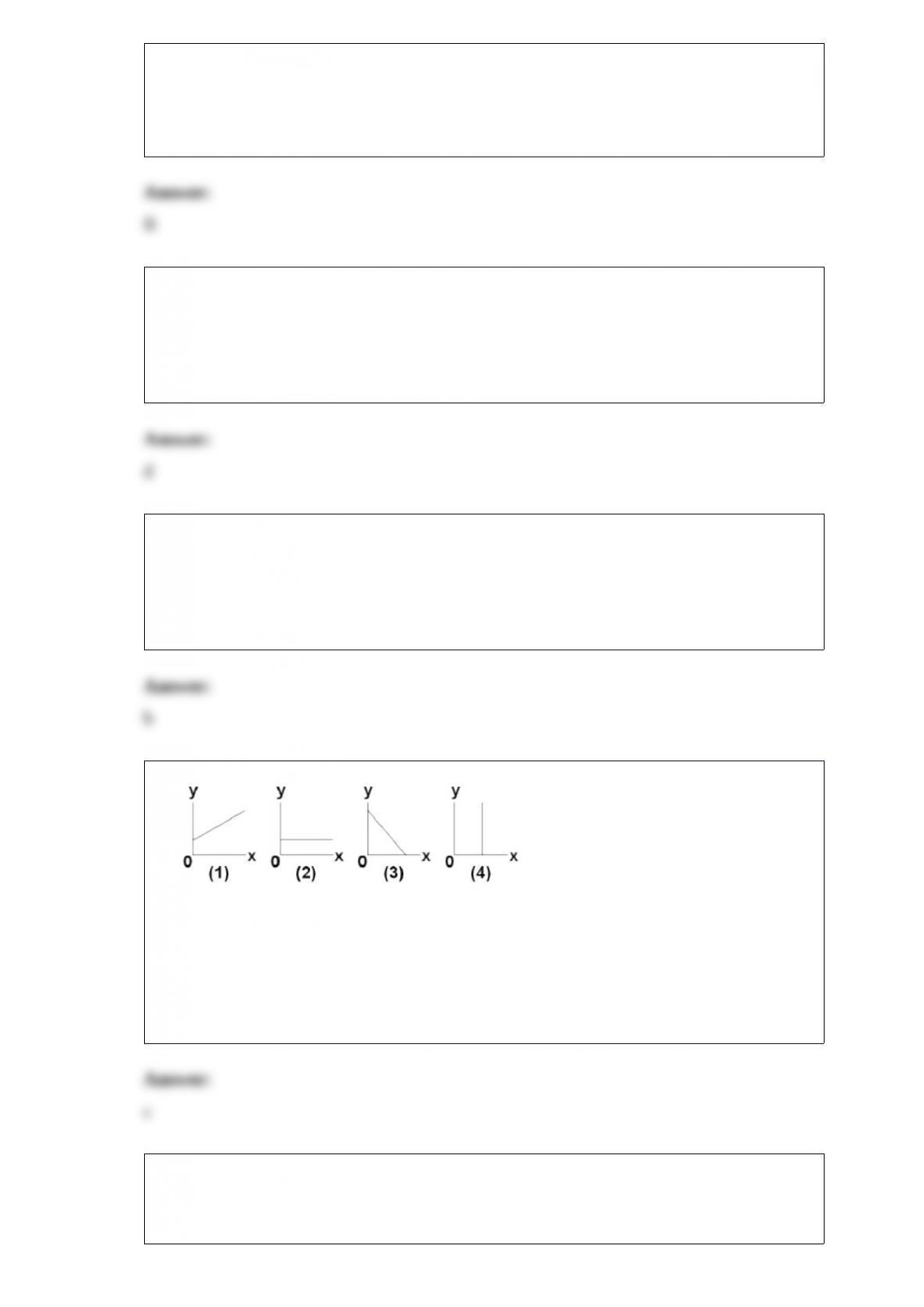
8)
answer on the basis of the relationships shown in the above four figures. the amount of
y is unrelated to the amount of x in:
a.both 2 and 4
b.3 only.
c.2 only.
d.1
9) which of the following is a recently passed law relating to health care?
a.establishment of health maintenance organizations to reduce health care costs
b.establishment of deductibles and copayments in health insurance policies

c.establishment of health savings accounts (hsas) to promote saving for routine medical
expenses
d.establishment of fixed medicare payment to hospitals based on one of several hundred
diagnostic categories
10) if real disposable income fell during a particular year, we can conclude that:
a.personal taxes increased.
b.inflation occurred.
c.transfer payments declined.
d. none of these necessarily occurred.
11) increases in product prices shift the consumer’s:
a.budget line to the right.
b.budget line to the left.
c.indifference curves to the left.
d.indifference curves to the right.
12) markets explained on the basis of supply and demand:
a.assume many buyers and many sellers of a standardized product.
b.assume market power so that buyers and sellers bargain with one another.
c.do not exist in the real-world economy.
d.are approximated by markets in which a single seller determines price.
13) the world trade organization:
a.is also known as the international monetary fund (imf).
b.is also known as nafta.
c.was established to resolve disputes arising under world trade rules.
d.enhances world trade by providing interest rate subsidies to foreign borrowers who
buy exports on credit.
14) the official unemployment rate:
a.involves people over 16 years of age who are not currently seeking employment.
b.is the ratio of unemployed to employed workers.
c.is the percentage of the labor force that is unemployed.
d. is the percentage of the total population that is not working.
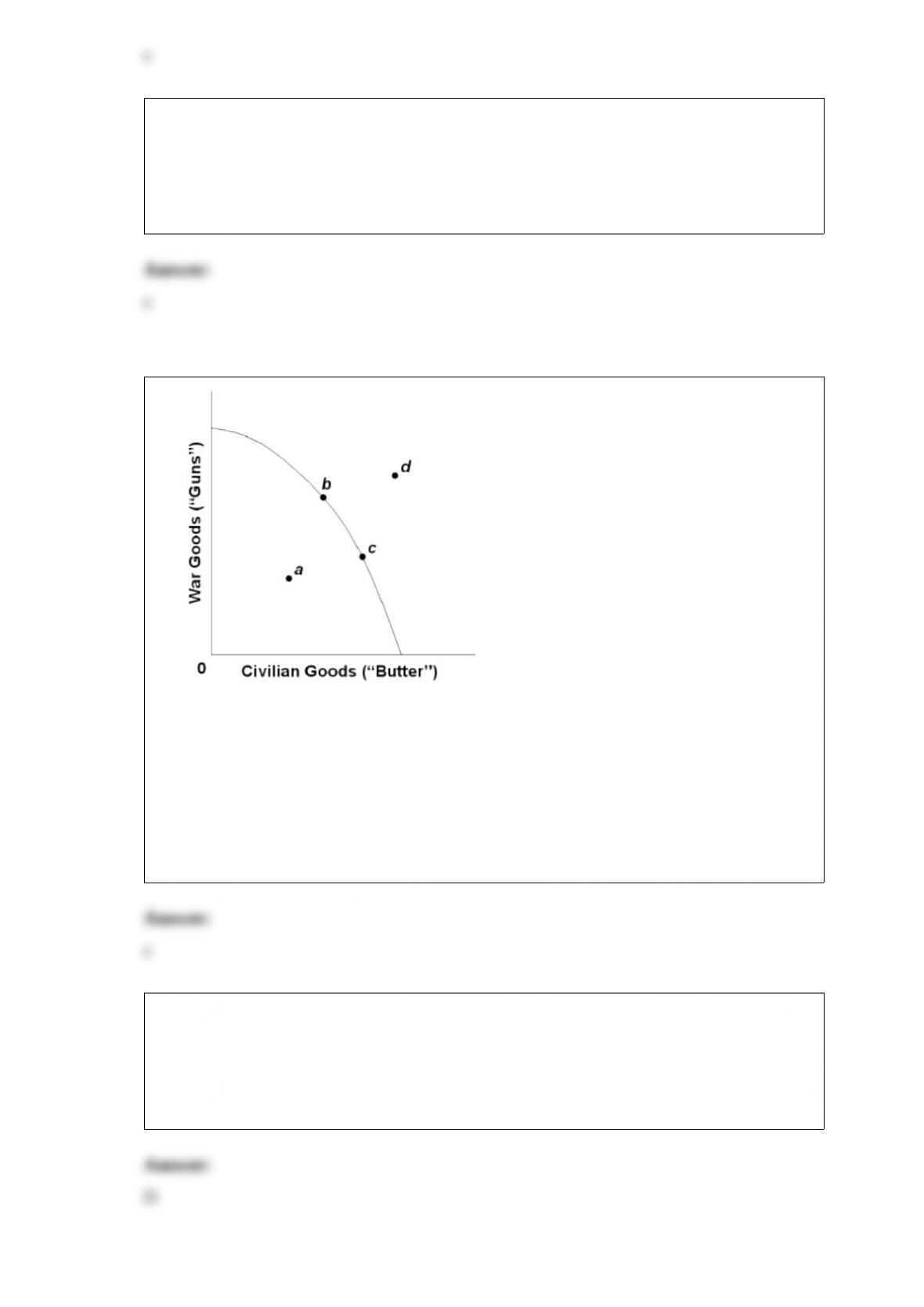
15)
refer to the above production possibilities curve. at the onset of the second world war
the united states had large amounts of idle human and property resources. its economic
adjustment from peacetime to wartime can best be described by the movement from
point:
a.c to point b.
b.b to point c.
c.a to point b.
d.c to point d.
16) That the economy has achieved aggregate equilibrium is indicated by:
A.an equality of saving and planned investment.
B.an equality of aggregate expenditures and GDP.
C.the absence of unplanned changes in inventories.
D.all of these.

17) suppose that gdp was $200 billion in year 1 and that all other components of
expenditures remained the same in year 2 except that business inventories fell by $10
billion. gdp in year 2 is:
a.$180 billion.
b.$190 billion.
c.$200 billion.
d.$210 billion.
18) The purchasing power of the dollar:
A.has been increasing in recent years because of economic growth.
B.varies directly with the cost-of-living index.
C.is inversely related to the level of aggregate demand.
D. is the reciprocal of the price level.