1) A major difference between social insurance and public assistance is that the:
A.former is regarded as an earned right while the latter is public charity.
B.latter is regarded as an earned right while the former is public charity.
C.latter is financed through earmarked payroll taxes and the former is financed by
general tax revenues.
D.former are state and local programs while the latter are Federal programs.
2) Which of the following would, other things equal, reduce the demand for U.S. farm
products?
A.poorer crops abroad
B.strong economic growth abroad
C.improved trade relations with China and Russia
D.appreciation of the U.S. dollar
3) a production possibilities curve shows:
a.that resources are unlimited.
b.that people prefer one of the goods more than the other.
c.the maximum amounts of two goods that can be produced assuming the full use of
available resources.
d.combinations of capital and labor necessary to produce specific levels of output.
4) critics of trade adjustment assistance argue that:
a.the small fraction of workers losing jobs to international trade are no more deserving
of assistance than others suffering job loss.
b.it raises price for consumers.
c.it keeps firms operating in industries where they are no longer competitive.
d.it reduces the incentive for firms to invest in new technologies to maintain
competitiveness.
5)
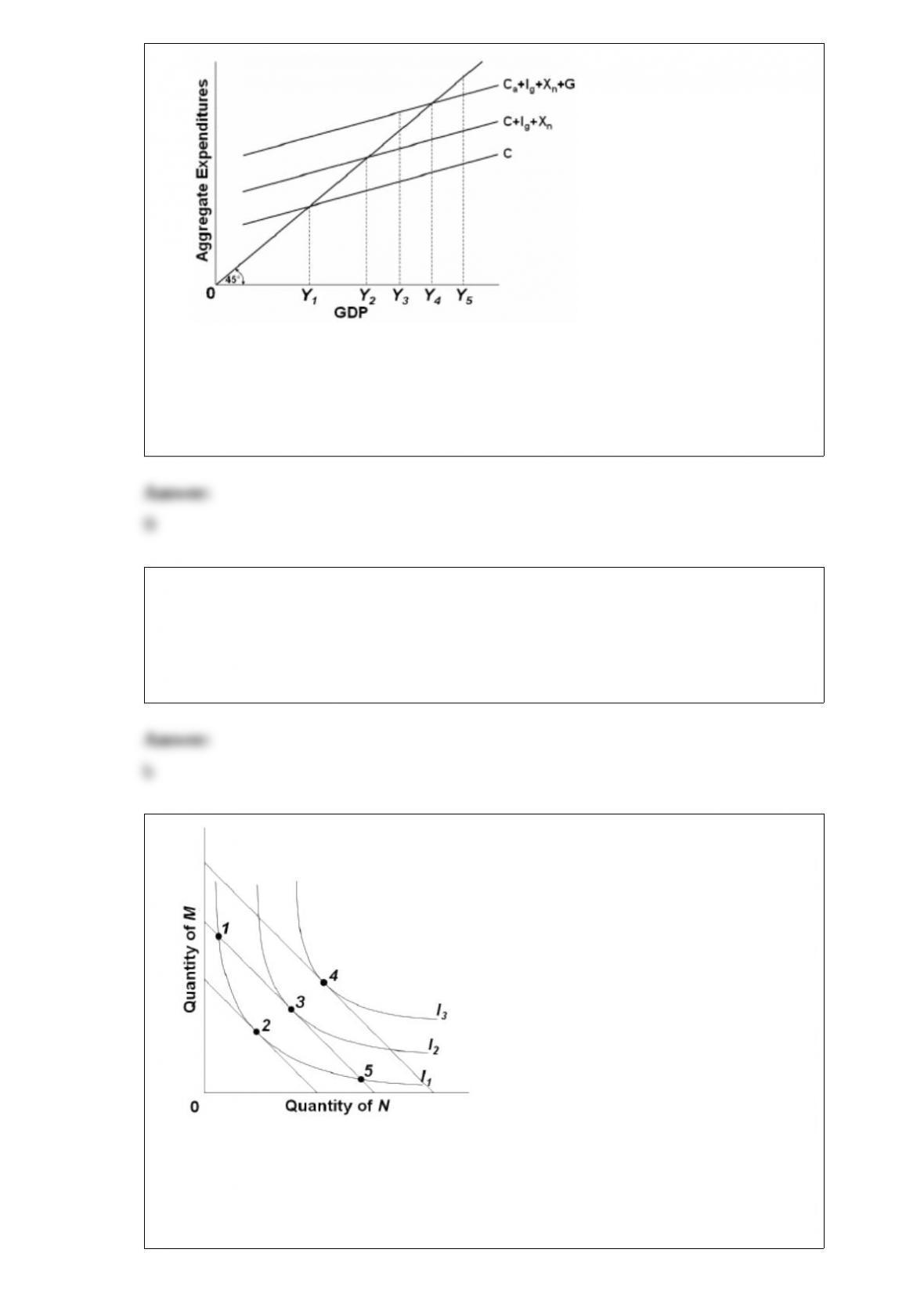
Refer to the above diagram. The equilibrium level of GDP is:
A.Y5.
B.Y4.
C.Y3.
D.Y2.
6) the presence of market failures implies that:
a.money is not an effective tool for exchange in a market system.
b.there is an active role for government, even in a market system.
c.individuals and firms should strive to be self-sufficient rather than specialize.
d.command systems are superior to market systems in the allocation of resources.
7)
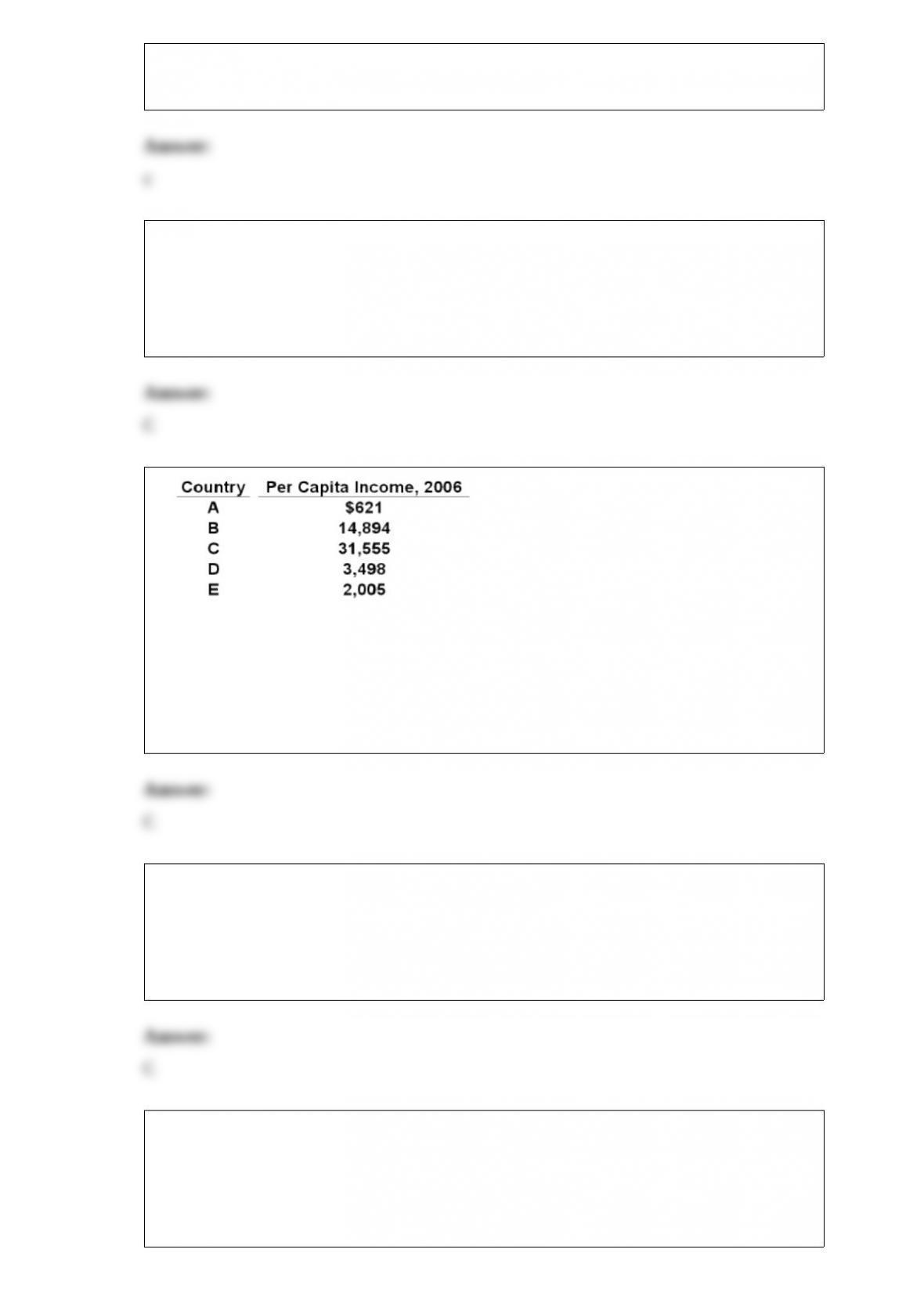
refer to the above diagram in which the downsloping linear lines are budget lines and
i1, i2, and i3 comprise an indifference map. the combinations of products m and n
indicated by points 1, 3, and 5 are such that:
a.all three imply the same level of utility.
b.1 and 5 imply a higher level of utility than does 3.
c.3 implies a higher level of utility than does 1 or 5.
d.the person is indifferent among the three combinations.
8) The government was successful in gaining an antitrust conviction in the:
A.U.S. Steel case.
B.IBM case.
C.Alcoa case.
D.DuPont cellophane case.
9)
Which of the above nations would be middle-income developing countries (DVCs),
according to the World Bank?
A.country E only
B.countries A, D, and E
C.countries D and E
D.countries D only
10) In 2007, the U.S. unionization rate was:
A.5.5 percent, down by nearly one-half from the mid-1950s.
B.15.7 percent, up by about one-fourth from the mid-1950s.
C.12.1 percent, down by nearly one-half from the mid-1950s.
D.21.2 percent, down by 4 percentage points from the mid-1950s.
11) If a technological advance expands output and requires a smaller investment in
capital goods, this technological advance:
A.is capital-using.
B.must involve nonfinancial investment.
C.is capital-saving.
D.must pertain to the infrastructure.
12) Suppose the government cuts taxes to keep the economy’s standardized budget in
balance when the economy is expanding. The government is engaging in a(n):
A.contractionary fiscal policy.
B.expansionary fiscal policy.
C.low-interest rate policy.
D.neutral fiscal policy.
13)
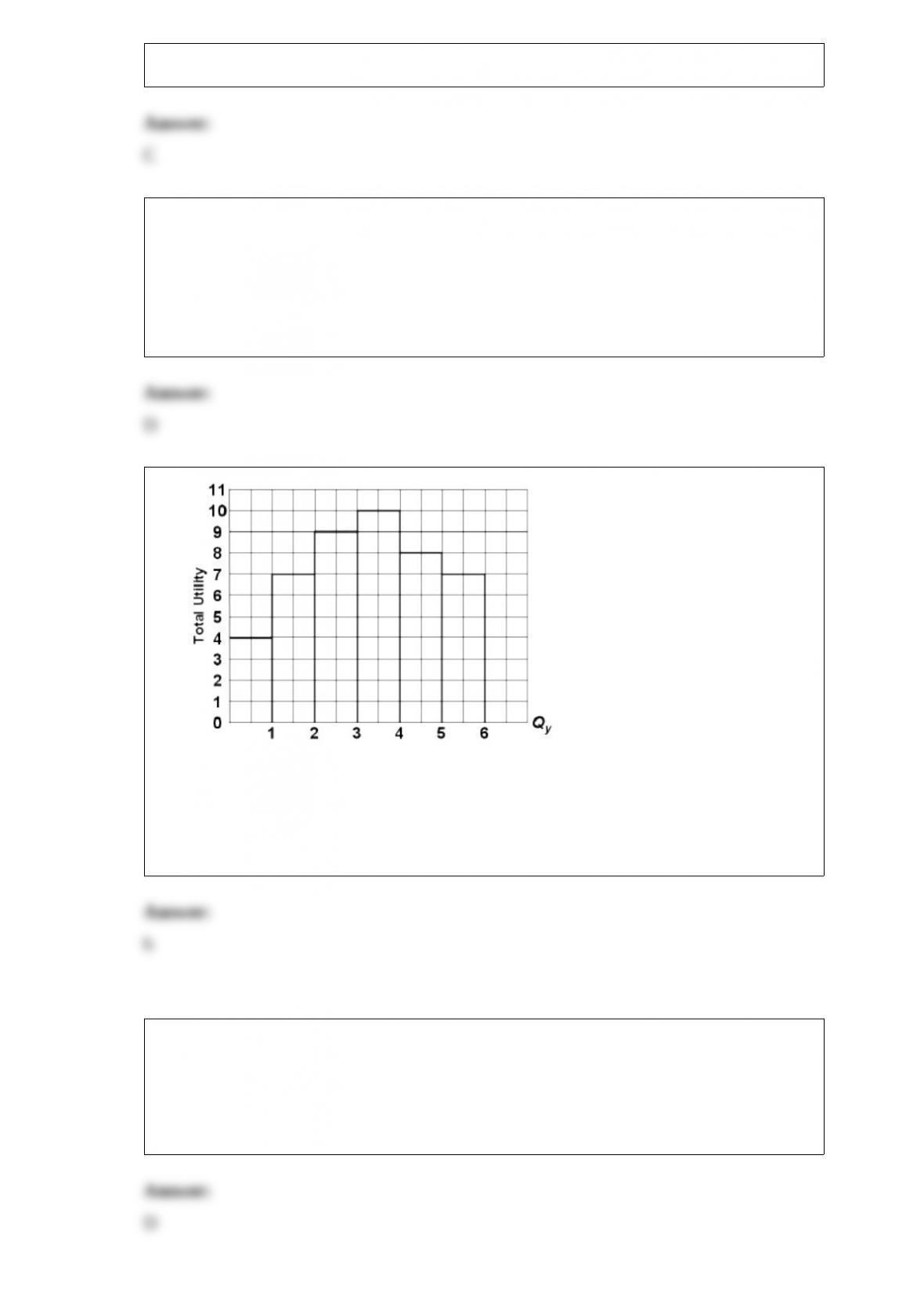
refer to the above diagram. marginal utility:
a.increases at an increasing rate.
b.becomes negative after consuming 4 units of output.
c.is found by dividing total utility by the number of units purchased.
d.cannot be calculated from the total utility information.
14) Which of the following antitrust cases is most recent?
A.the U.S. Steel case
B.the Alcoa case
C.the AT&T case
D.the Microsoft case
15) If a nation’s real output is growing by 5 percent per year, its real output will double
in approximately:
A.22 years.
B.20 years.
C.14 years.
D.8 years.
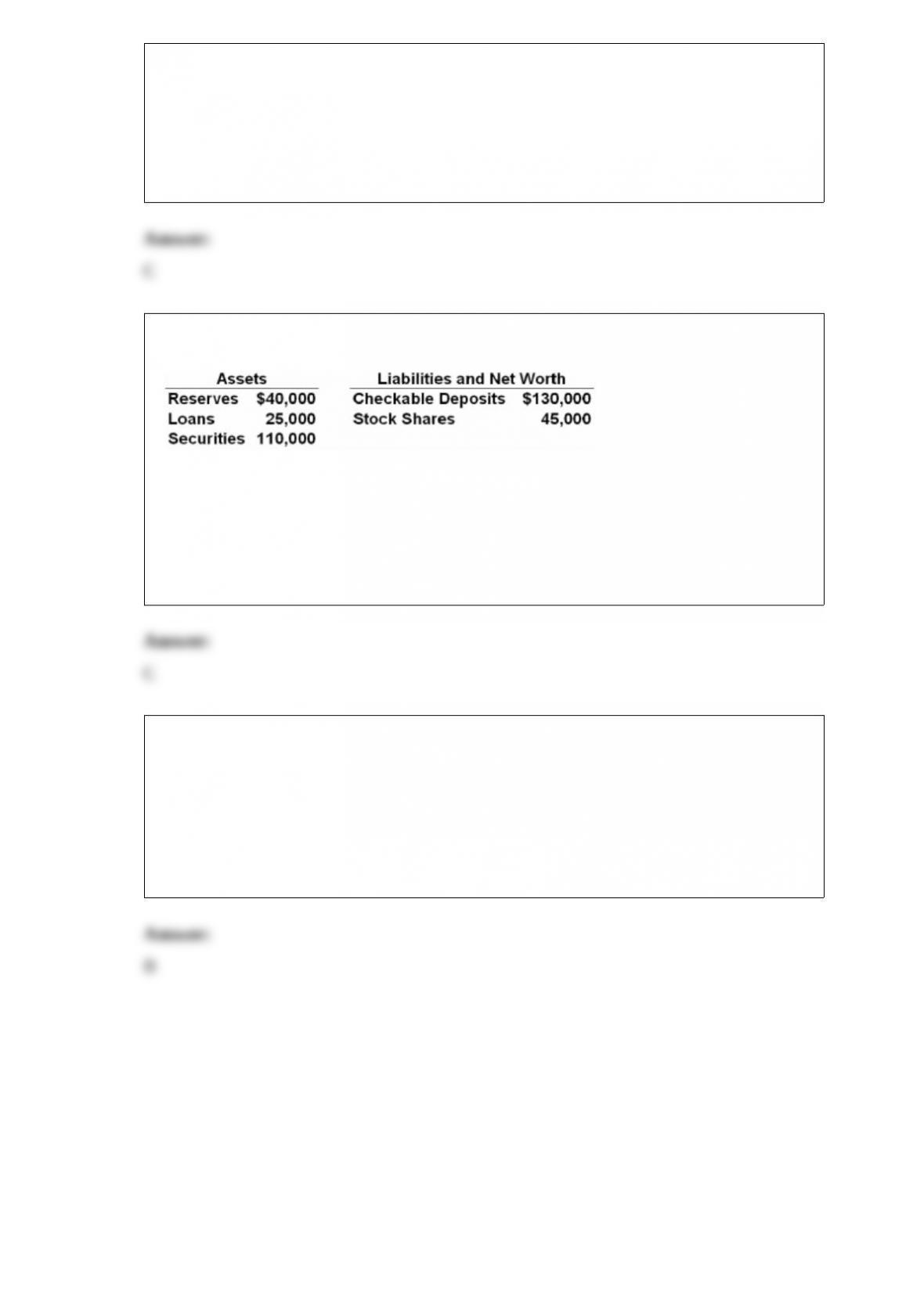
16) Assume the Continental National Bank’s balance statement is as follows:
Assuming a legal reserve ratio of 20 percent, how much in excess reserves would this
bank have after a check for $10,000 was drawn and cleared against it?
A.$3,000
B.$24,000
C.$6,000
D.$16,000
17) The portion of the public debt held outside Federal agencies and the Federal
Reserve is:
A.substantially larger than the portion held by Federal Agencies and the Federal
Reserve.
B.smaller than the portion held by Federal Agencies and the Federal Reserve.
C.equally split between U.S. and foreign lenders.
D.all held by foreign lenders.