The perfectly competitive firm’s short-run supply curve is the
a. upward-sloping portion of its average total cost curve.
b. horizontal portion of its marginal revenue curve.
c. portion of its average variable cost curve that lies above the average fixed cost curve.
d. upward-sloping portion of its marginal cost curve.
e. portion of its marginal cost curve that lies above its average variable cost curve.
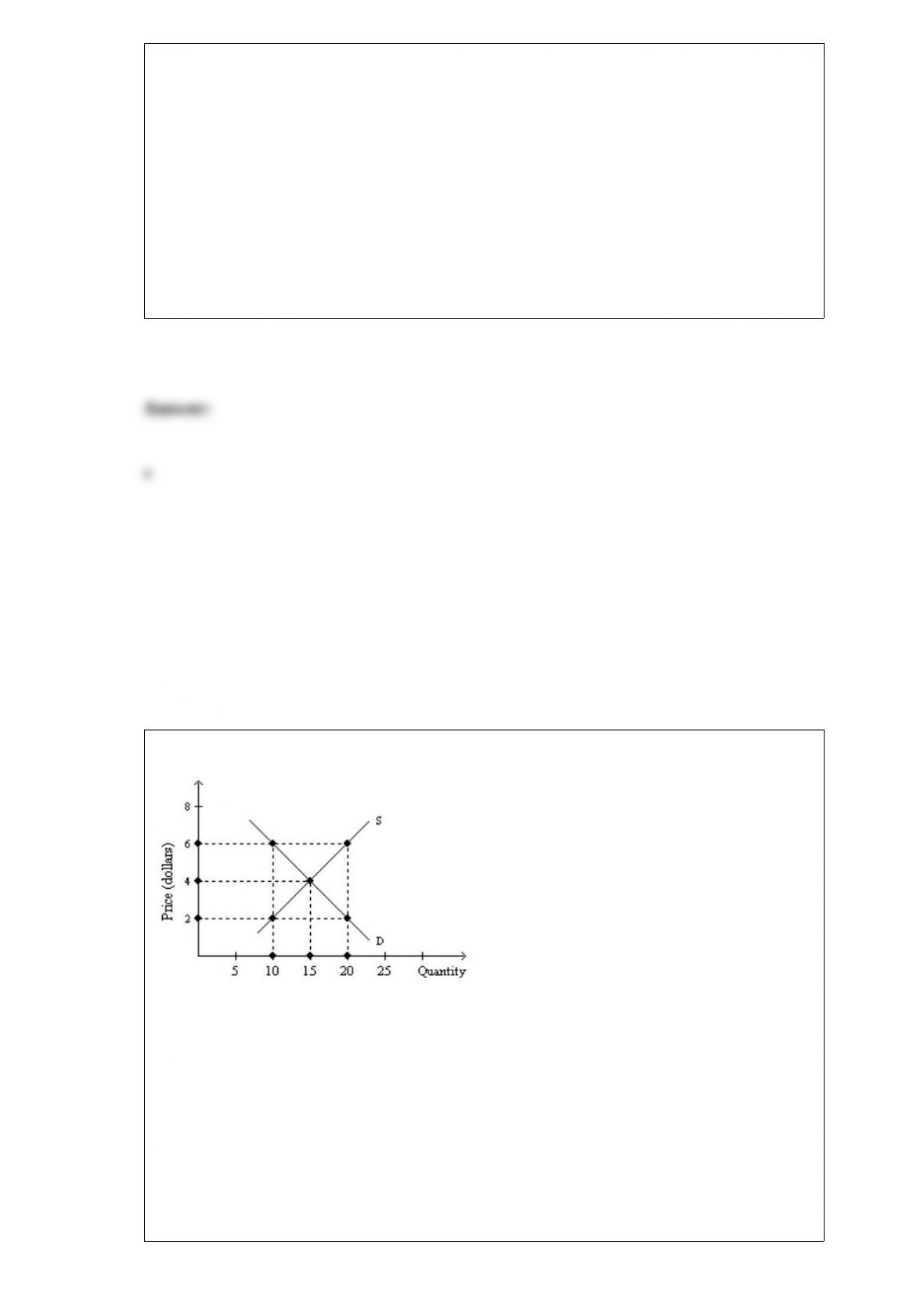
Exhibit 3-4
At a price of $2 _______________ units will be exchanged.
a. 5
b. 10
c. 15
d. 20

Which of the following statements is true?
a. Monopolistic competitive firms do not experience the law of diminishing marginal
returns when they produce output.
b. Monopolistic competitive firms face a downward-sloping demand curve and a
horizontal marginal cost curve.
c. There are many buyers and few sellers in the theory of monopolistic competition.
d. Monopolistic competitors are said to underutilize their present plant size.
e. none of the above
Suppose that for a given good demand increases and supply decreases at the same time.
If demand increases by a lesser amount than supply decreases, then equilibrium price
__________ and equilibrium quantity __________ for that good.
a. rises; falls
b. falls; falls
c. rises; rises
d. falls; rises

Ceteris paribus, the more risk associated with a loan,
a. the lower the interest rate.
b. the higher the interest rate.
c. the more likely the loan will be granted.
d. the bigger the loan.
A good is a nonexcludable if
a. its consumption by one person does not reduce its consumption by others.
b. it is impossible to prevent people from obtaining the benefits of the good once it has
been produced.
c. no negative externalities are associated with its production and consumption.
d. it is free in the first place; that is, it is so abundant that people can get all they want at
zero price.
If demand for a given good is perfectly elastic, it follows that
a. as price changes, quantity demanded does not change.

b. as price changes, quantity demanded changes by a larger percentage.
c. as price changes only a small percentage, quantity demanded falls to zero.
d. as income changes only a small percentage, quantity demanded changes by a very
large percentage.
e. none of the above
If the percentage change in quantity demanded is equal to the percentage change in
price for good Z, then demand for good Z is
a. inelastic.
b. unit elastic.
c. elastic.
d. perfectly elastic.
e. perfectly inelastic.
If Dan’s marginal utility from eating one apple is 100 utils and Jorge’s marginal utility
from eating one apple is 200 utils, it follows that Jorge likes apples more than Dan,
assuming that Dan and Jorge measure the marginal utility of apples in exactly the same
way.
a. True

b. False
If the U.S. government imposes a more restrictive import quota on Japanese video
gaming systems, the ____________ curve for Japanese video gaming systems in the
U.S. will shift ___________.
a. supply; leftward
b. supply; rightward
c. demand; leftward
d. demand; rightward
Ceteris paribus, the nominal rate of interest will increase when the
a. real rate of interest falls.
b. expected rate of inflation increases.
c. expected rate of inflation falls.
d. a and b
e. a and c
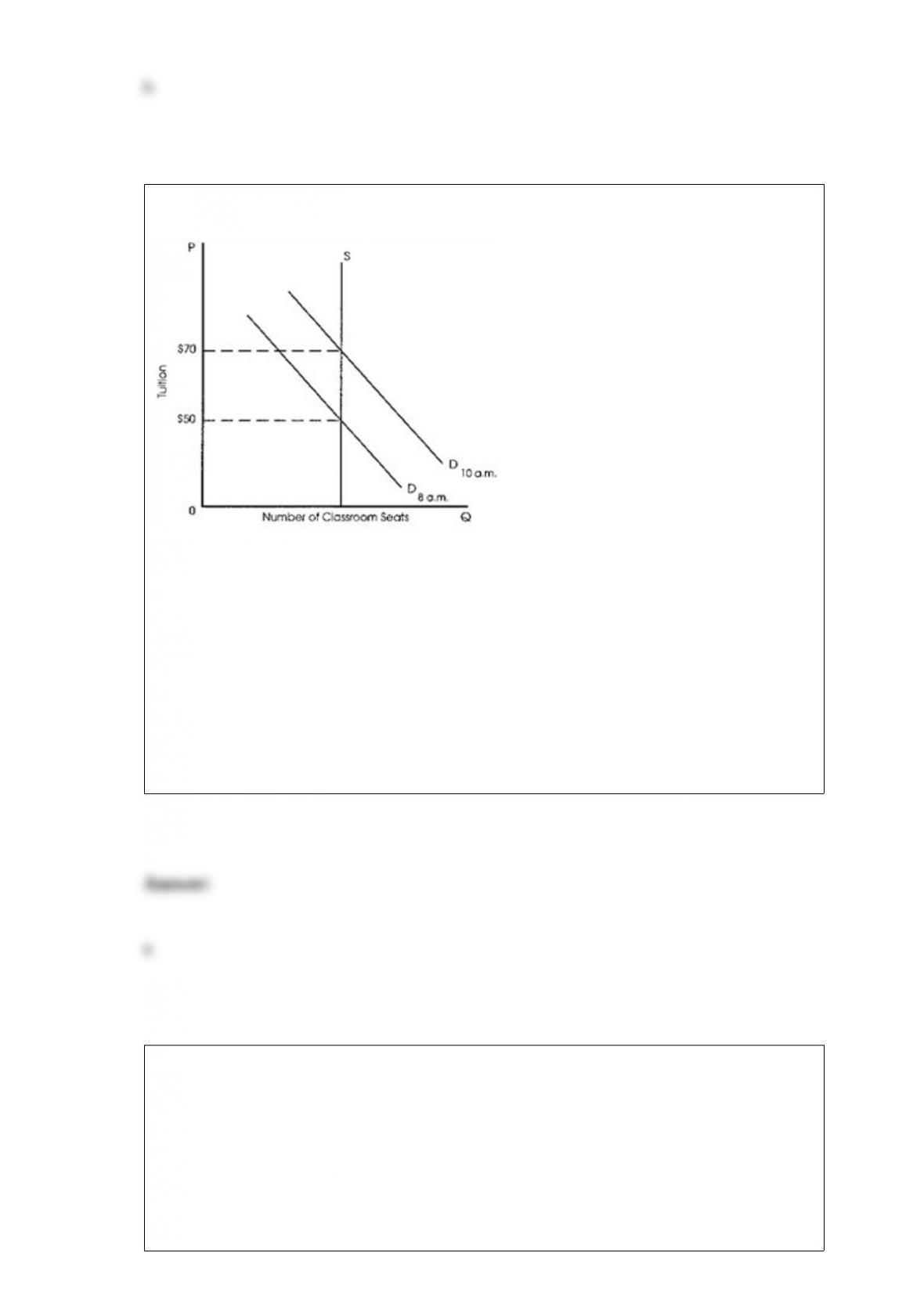
Exhibit 5-2
If the tuition is set at $60 there will be
a. a shortage at 10 a.m. and a surplus at 8 a.m.
b. a surplus at 10 a.m. and a shortage at 8 a.m.
c. equilibrium at both 10 a.m. and 8 a.m. because the price is half-way between their
individual equilibria.
d. none of the above
You go on vacation to Mexico and take $1,000 with you. During your time in Mexico,
the peso appreciates in value relative to the dollar. It follows that
a. you will be able to buy more goods and services in Mexico after the peso appreciates.
b. you will be able to buy fewer goods and services in Mexico after the peso
appreciates.

c. the purchasing power parity theory is incorrect.
d. Mexican workers, paid in pesos, will be able to buy fewer goods and services in
Mexico after the peso appreciates.
At the beginning of the 20th century one farmer in the U.S. produced enough to feed
____________ people, and at the end of the century, one farmer produced enough to
feed ____________ people.
a. 20; 40
b. 7; 15
c. 12; 42
d. 8; 35