
Diminishing marginal returns implies that:
A) marginal costs are decreasing.
B) marginal costs are increasing.
C) marginal costs are constant.
D) marginal costs may be increasing or decreasing.
If a natural monopoly is forced to follow a policy of average-cost pricing, the
monopolist will:
A) earn economic profits greater than zero.
B) charge a higher price than if the monopolist were not regulated.
C) charge a lower price than if the monopolist were not regulated.
D) decrease output below that in an unregulated pricing policy.
We can use microeconomic analysis to:
A) learn how to balance a checkbook.
B) evaluate the merits of public policies.
C) understand marginal changes in the macroeconomy.
D) All of the above are correct.
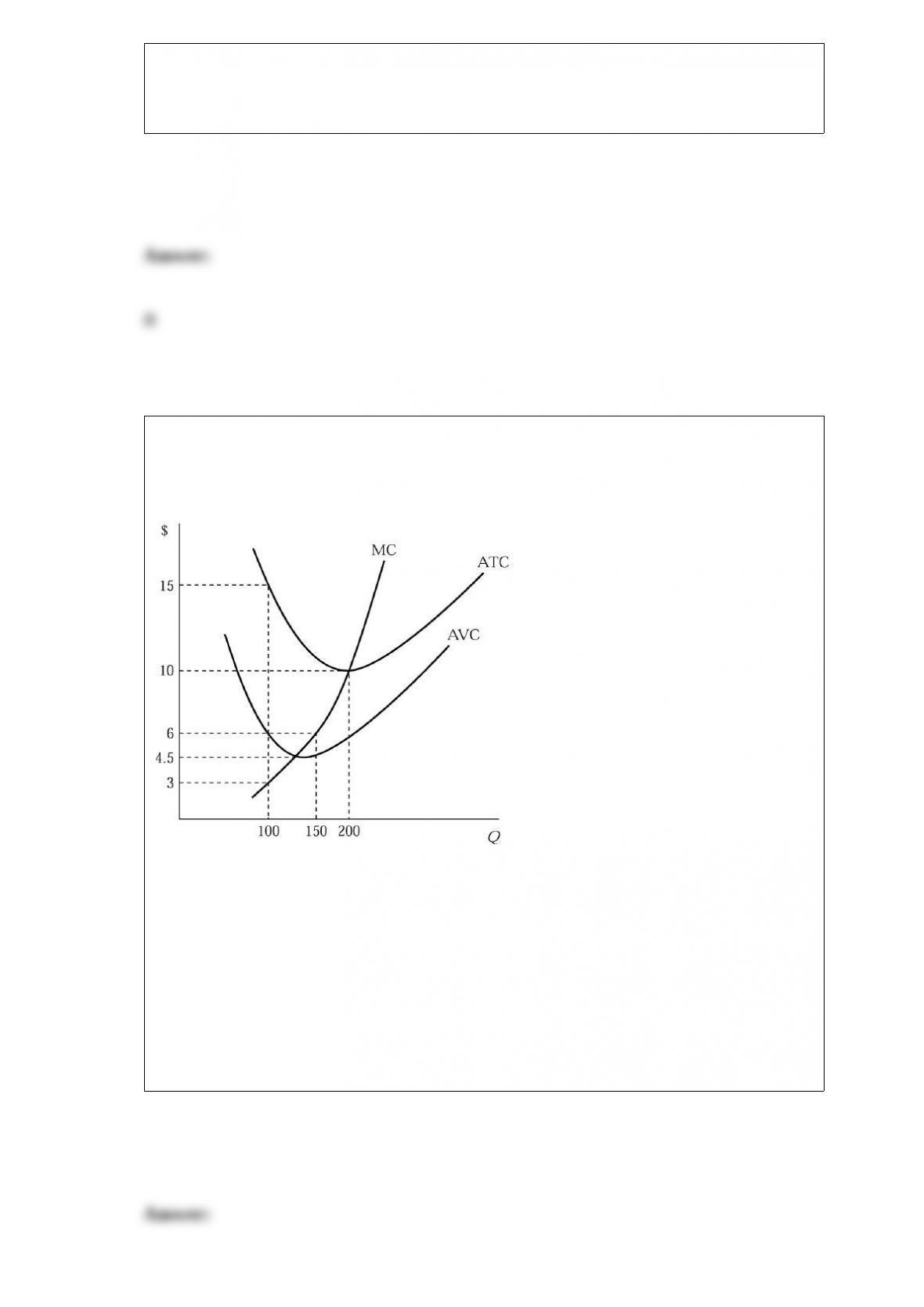
Figure 9.3 shows the cost structure of a firm in a perfectly competitive market. The firm
will stay in the market in the long run only if the market price is greater than or equal
to:
Figure 9.3
A) $4.5.
B) $6.
C) $10.
D) $15.
Considering how a change in one variable affects the value of another variable is called:
A) the Peter Principle.
B) the marginal principle.
C) the principle of supply and demand.
D) functional decision making.
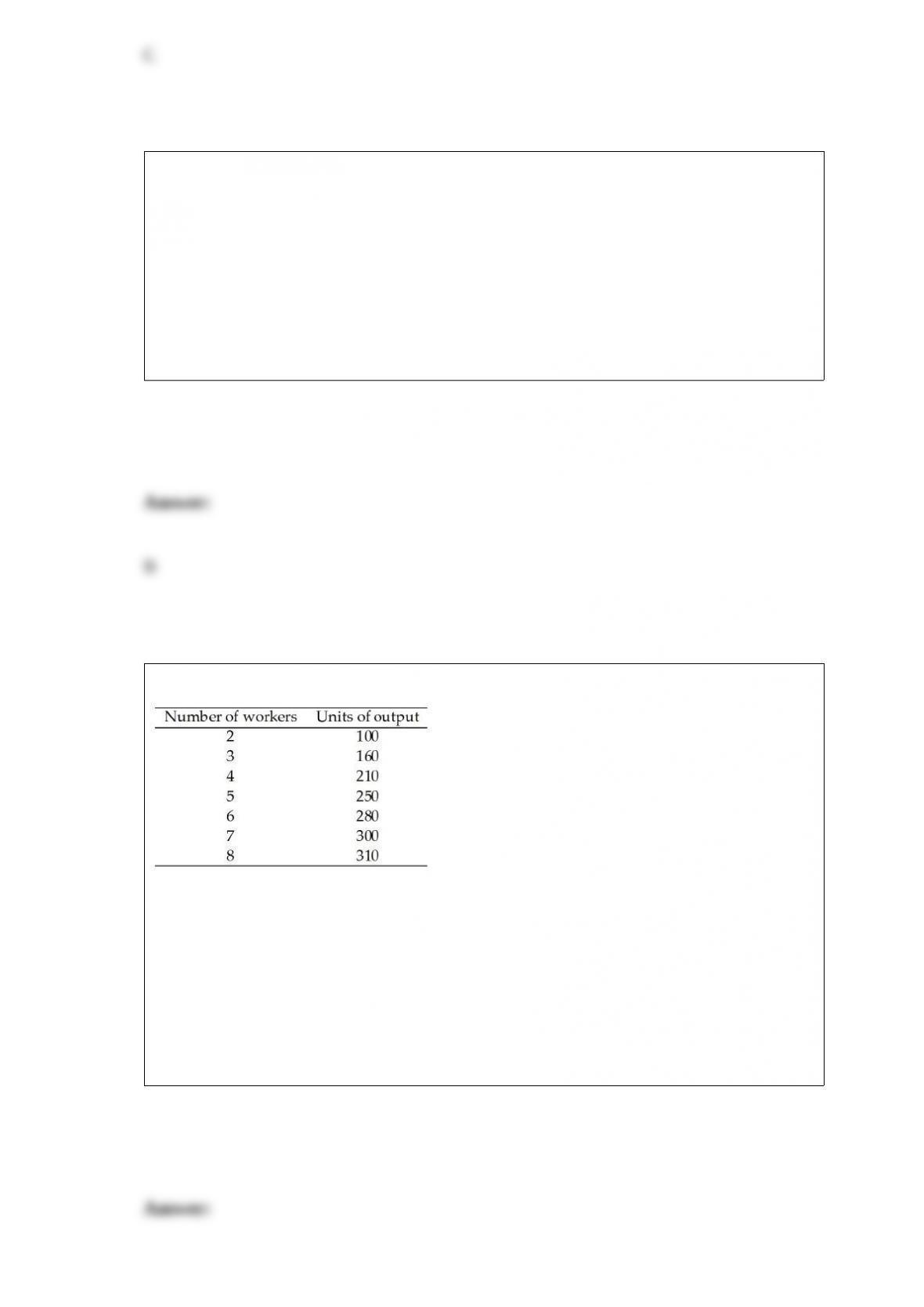
Refer to Table 17.1. The marginal product of the fifth unit of labor is:
Table 17.1
A) 8.
B) 40.
C) 50.
D) 250.

If a perfectly competitive firm charges a price that is equal to its average total cost:
A) the firm is earning an economic profit equal to zero.
B) the firm is earning an economic profit greater than zero.
C) the firm is earning an economic profit less than zero.
D) It is not possible to determine anything about the firm’s profits.
An import quota is illegal under the rules of the:
A) World Trade Organization.
B) Congress.
C) Federal Reserve.
D) World Wide Web.
Recall Application 6, “Why Lower Drug Prices?” to answer the following

questions:
In the Application, what did Ted Koppel identify as the explanation for why (illegal)
drug prices have been dropping?
A) an increase in the supply
B) an increase in demand
C) a decrease in supply
D) a decrease in demand
What does the price elasticity of supply measure?
A) the responsiveness of the quantity supplied to changes in price
B) the responsiveness of the quantity demanded to the change in price
C) the responsiveness of total revenue to the change in price
D) none of the above
Suppose that the percentage change in supply is 20%, the price elasticity of demand is
3, and the price elasticity of supply is 2. What is the percentage change in the
equilibrium price?

A) 4%
B) 5%
C) 15%
D) 20%
Suppose that there are two firms, each generating three tons of SO2. Suppose also that
the government has set a target abatement level of two tons. Under a policy of uniform
abatement with permits the firm with the lower marginal abatement cost:
A) will abate exactly the same amount of SO2 as the firm with the higher marginal
abatement cost.
B) will abate less SO2 than the firm with the higher marginal abatement cost.
C) will abate more SO2 than the firm with the higher marginal abatement cost.
D) will sell its pollution permit to the firm with the higher marginal abatement cost.
To increase income by $120 when the slope of the curve showing the relationship
between your income and work hours is 8, how many extra hours will you need to
work?
A) 8

B) 15
C) 112
D) 960
Which of the following would result from a quota imposed on the quantity of cars that
can be imported into the U.S.?
A) an increase in the total surplus
B) an increase in producer surplus
C) Consumers will pay higher prices.
D) an increase in consumer surplus
Which of the following characteristics of the monopolistically competitive and the
perfectly competitive market will cause the firm to earn zero profits in the long run?
A) no barriers to entry
B) many buyers
C) price taker
D) homogeneous product
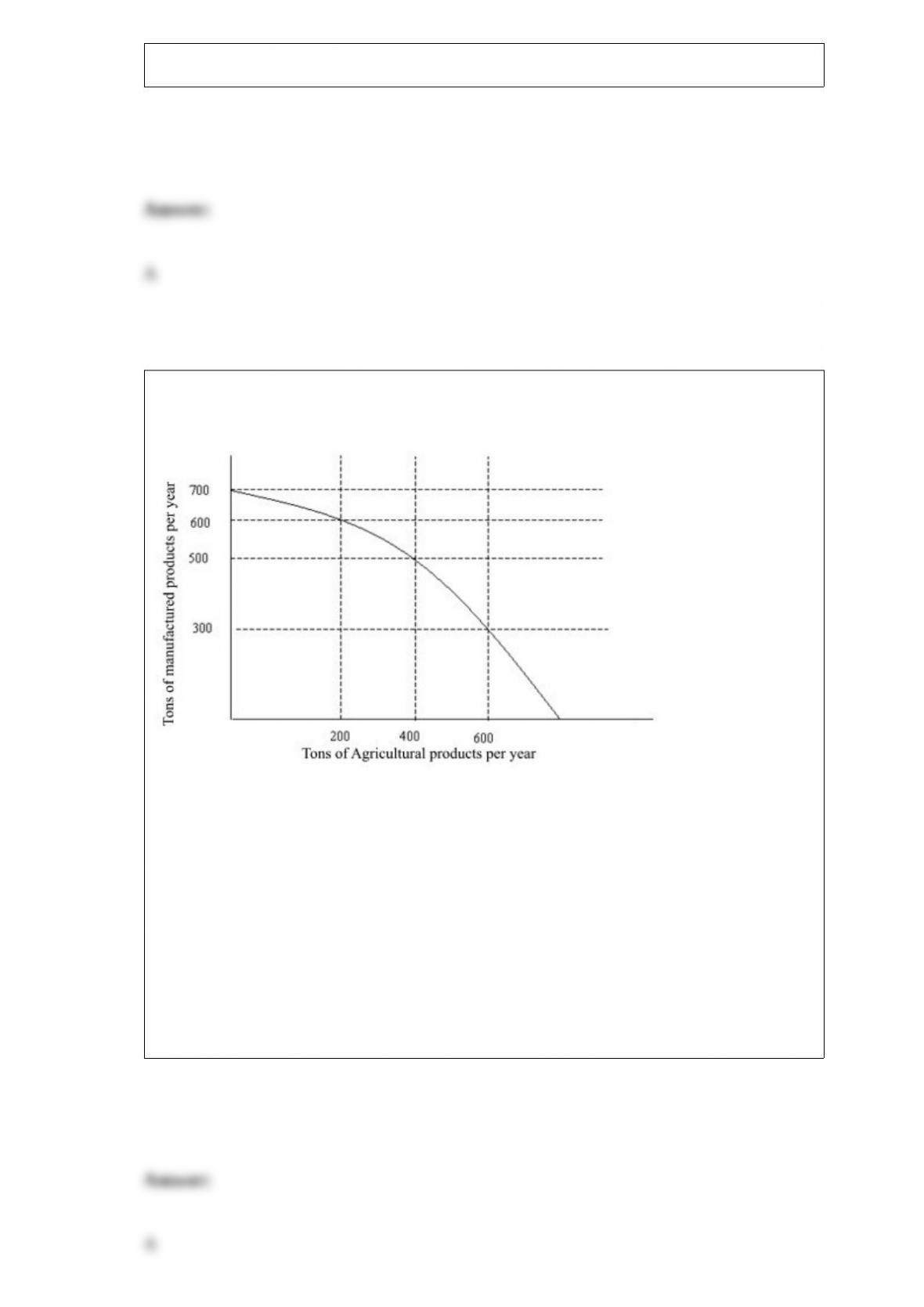
Figure 2.1
What is the opportunity cost of increasing production of manufactured products from
500 tons to 600 tons per year?
A) 200 tons of agricultural products per year
B) 400 tons of agricultural products per year
C) 500 tons of agricultural products per year
D) 600 tons of agricultural products per year

The principle that what matters to people is the real value or purchasing power of
money is the:
A) marginal principle.
B) principle of diminishing returns.
C) spillover principle.
D) real-nominal principle.
Recall the Application about labor agreements and salaries in the NBA to answer
the following question(s).
Recall the Application. In the absence of collective bargaining agreements regarding
NBA salaries, salaries based on the market equilibrium would tend to benefit ________
the most, whereas with collective bargaining, salaries based on the median voter rule
would generate gains for ________.
A) a small number of superstar players; all players with salaries below the median
salary
B) all players; all players with salaries above the median salary
C) the lowest salaried players; a small number of superstar players
D) players with salaries closest to the median salary; all players

Economic profit is equal to:
A) the amount received from the sale of the product.
B) total revenue divided by average costs.
C) the opportunity cost of each factor of production.
D) total revenue minus total economic cost.
When the government provides its citizens an unemployment insurance program, it is:
A) trying to reduce economic uncertainty.
B) trying to create new jobs for the unemployed.
C) trying to increase economic uncertainty.
D) encouraging workers to look for jobs in the government sector.
If the number of wine producers decreases:
A) the demand for wine increases.
B) the demand for wine decreases.
C) the supply of wine increases.
D) the supply of wine decreases.
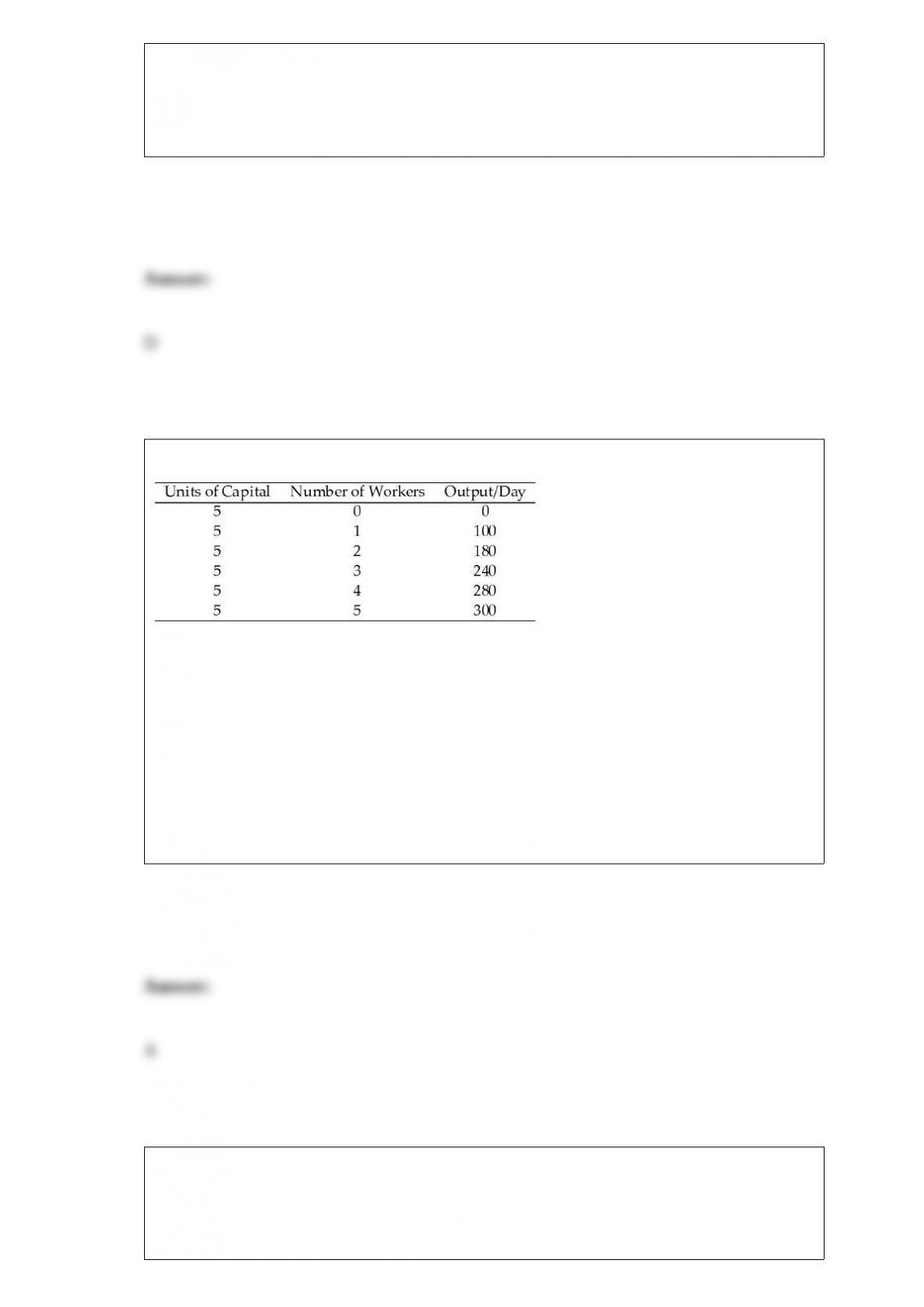
Refer to Table 2.3. The marginal product of the 1st worker is:
Table 2.3
A) 100 units of output.
B) 80 units of output.
C) 60 units of output.
D) 40 units of output.
When sellers have more information about the quality of a good than buyers do, a
relatively large share of the goods in the market will be low-quality goods. This is the
________ problem.
A) free-rider
B) law of diminishing returns
C) adverse selection
D) moral hazard
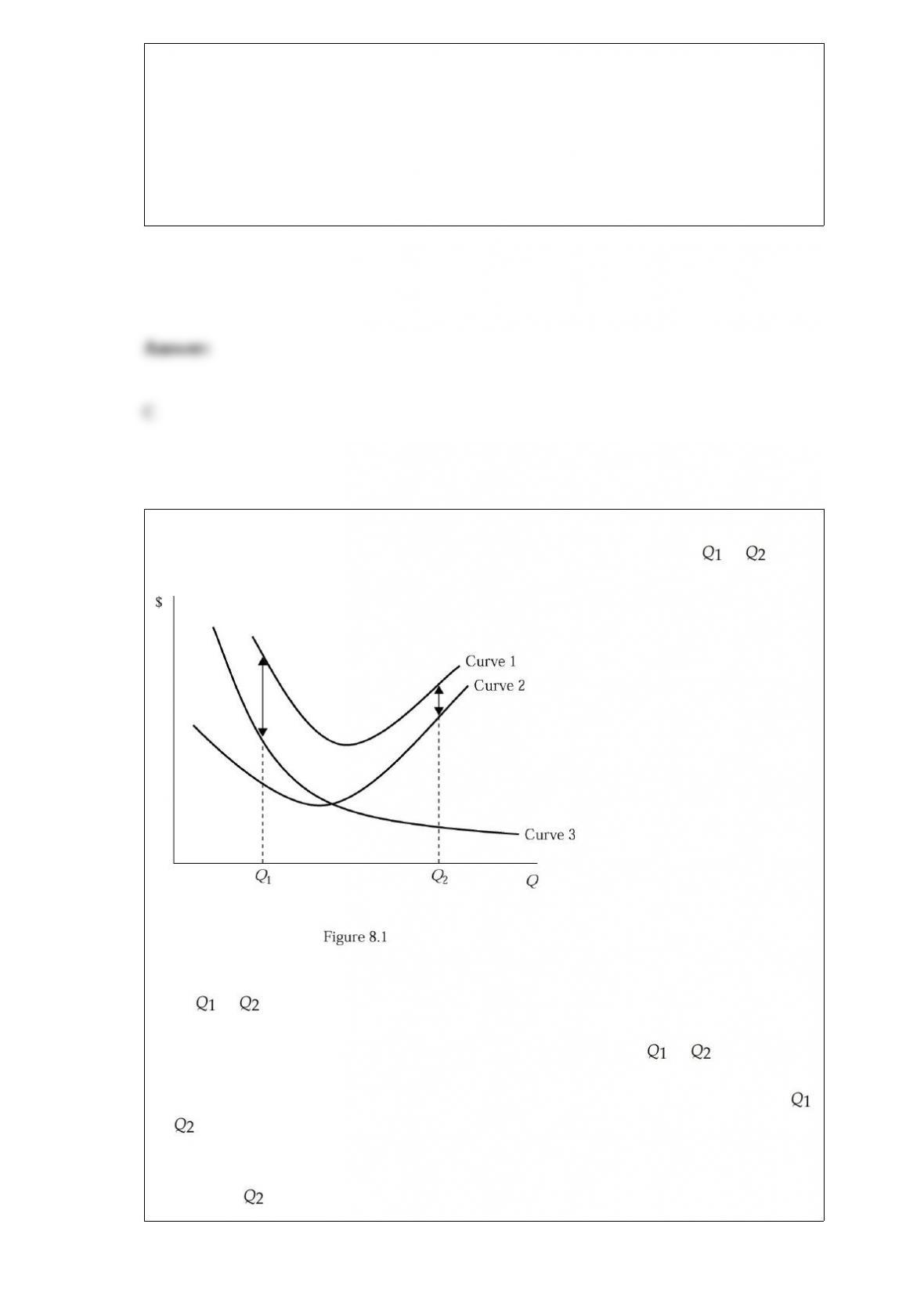
Refer to Figure 8.1, which shows a family of average cost curves. Why does the vertical
distance between Curve 1 and Curve 2 decrease as output increases from to ?
A) Because average variable cost first decreases, then increases as output increases
from to .
B) Because average fixed cost decreases as output increases from to .
C) Because average total cost first decreases, then increases as output increases from
to .
D) Because average variable cost increases faster than average fixed cost as output level
approaches .

Recall the Application about towns that built clock towers to help their citizens keep
track of time to answer the following question(s).
Recall the Application. A town tried to prevent free riding by:
A) not putting a clock face on the tower in the direction of those the one who refused to
contribute to building the clock tower.
B) setting the time wrong on the face of the tower in the direction of those who refused
to contribute to building the clock tower.
C) making it illegal for those who did not contribute to the clock tower to use it.
D) taxing those who would not contribute to the clock tower project.
Scenario 8.1: Ana used to work for a Advertising agency where she earned a yearly
salary of $60,000. She got tired of working for another company so she opened his own
Advertising company. Ana now pays her designer $40,000 per year and spends $25,000
for rent and utilities. She earns $120,000 in annual revenue.
Refer to Scenario 8.1. Ana’s economic profit is:
A) -$55,000.
B) -$15,000.
C) -$5,000.
D) -$120,000.
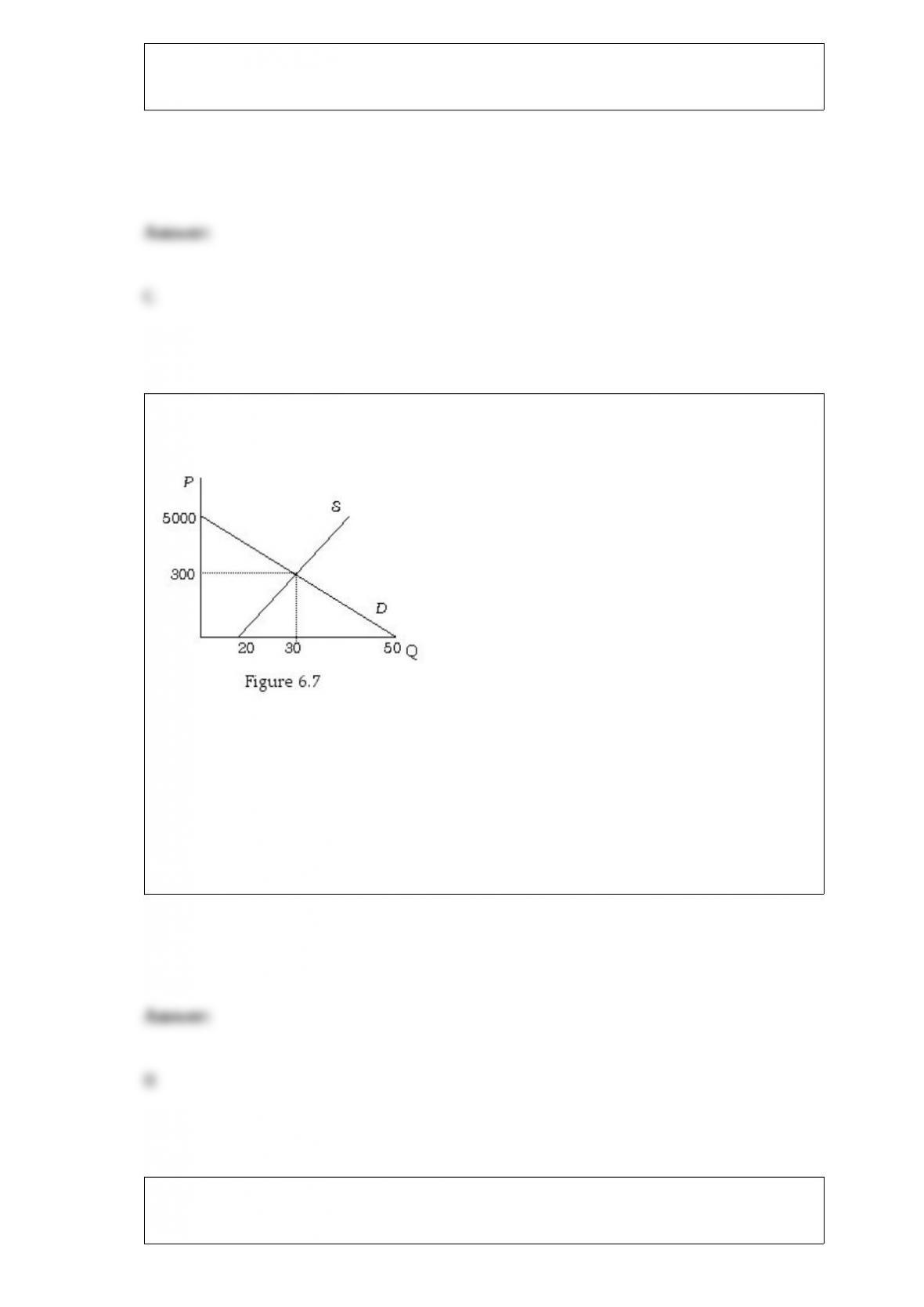
Figure 6.7 shows the supply and demand curves for human kidneys. If the government
allowed the market to seek equilibrium, then:
A) 50 kidneys are donated.
B) 30 kidneys are donated.
C) 20 kidneys are donated.
D) 0 kidneys are donated.
Which of the following is a variable?
A) your GPA
B) your hourly wage
C) the price of gasoline
D) All of the above are correct.
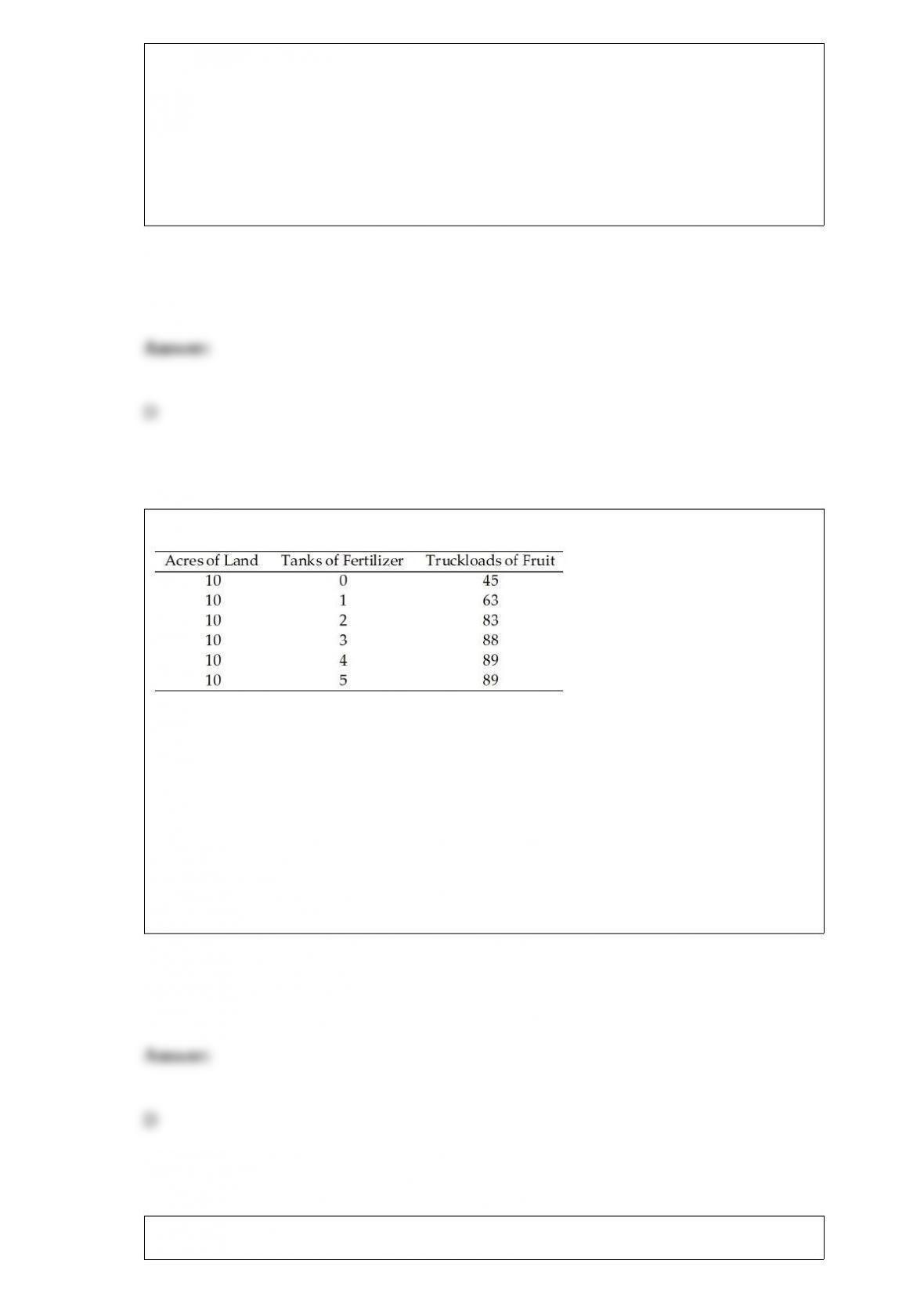
Refer to Table 2.4. The marginal product of the 3rd tank of fertilizer is:
Table 2.4
A) 29.33 truckloads of fruit.
B) 1.67 truckloads of fruit.
C) 20 truckloads of fruit.
D) 5 truckloads of fruit.

Recall the Application about the group of large restaurant owners in France
requesting that the government lower the VAT on restaurant meals to answer the
following question(s).
Recall the Application. What would happen if there is a VAT cut on restaurant meals?
A) Competitiveness will be decreased in the restaurant industry.
B) There will be a decrease in the sales of restaurant meals.
C) Restaurant owners will cut the prices of restaurant meals.
D) none of the above
When a company increases output and accepts a lower price to keep new companies
from entering the market, it is engaging in:
A) cartel team up.
B) limit pricing.
C) collusion.
D) price ceiling.
If the marginal benefit from water pollution abatement increases, then it is efficient to:

A) reduce water pollution to zero.
B) allow more water pollution.
C) let the market determine water pollution
D) reduce water pollution further, but maybe not to zero.
Which of the following situations will arise in the domestic market following the
removal of an import quota?
A) imports increase, domestic production increases, prices increase
B) imports increase, domestic production decreases, prices decrease
C) imports decrease, domestic production increases, prices decrease
D) imports decrease, domestic production decreases, prices increase
Julianne runs a business and needs to decide how many hours to stay open. Table 2.2
illustrates her marginal costs of staying open for each additional hour. Suppose that
Julianne’s marginal benefit of staying open per hour is $16. If she is following the
marginal principle, how many hours should Julianne stay open?

Table 2.2
A) 3 hours
B) 4 hours
C) 5 hours
D) 7 hours
Minimum-wage laws:
A) increase the efficiency of labor markets.
B) are always effective at alleviating poverty.
C) force an imbalance between the supply of and demand for labor.
D) result in an increase in employment.