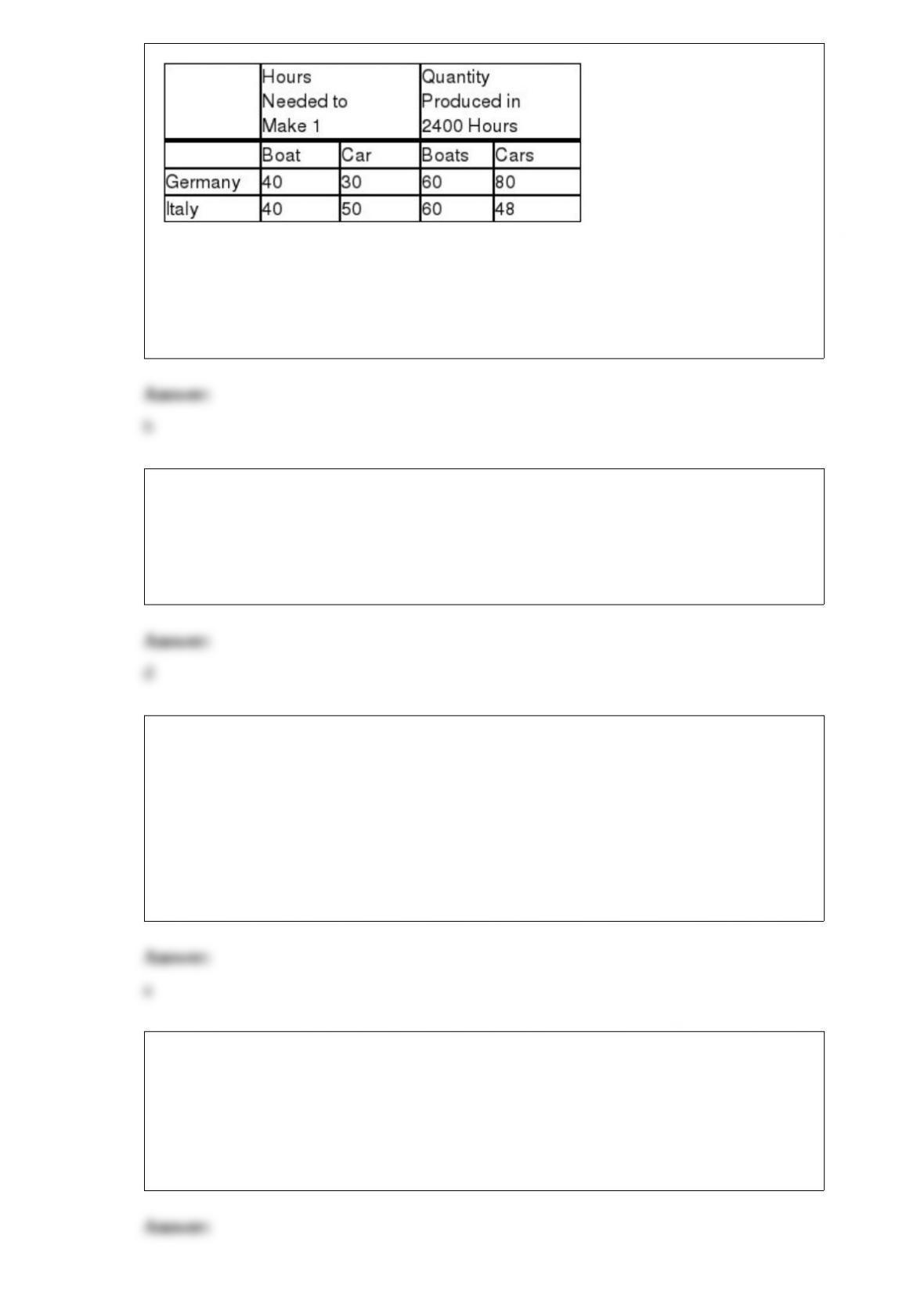
1) Germany should specialize in the production of
a.boats and import cars.
b.cars and import boats.
c.both goods and import neither good.
d.neither good and import both goods.
2) Which of the following would cause price to increase?
a.an increase in supply
b.a decrease in demand
c.a surplus of the good
d.a shortage of the good
3) Consider the market for capital equipment. Suppose the price of firms’ output
increases. Holding all else constant, the equilibrium rental price of capital equipment
will
a.increase.
b.decrease.
c.not change.
d.It is not possible to determine what will happen to the equilibrium rental price of
capital equipment.
4) Which of the following could be the for a good for which a decrease in price would
increase revenue?
a.0
b.0.4
c.1
d.4
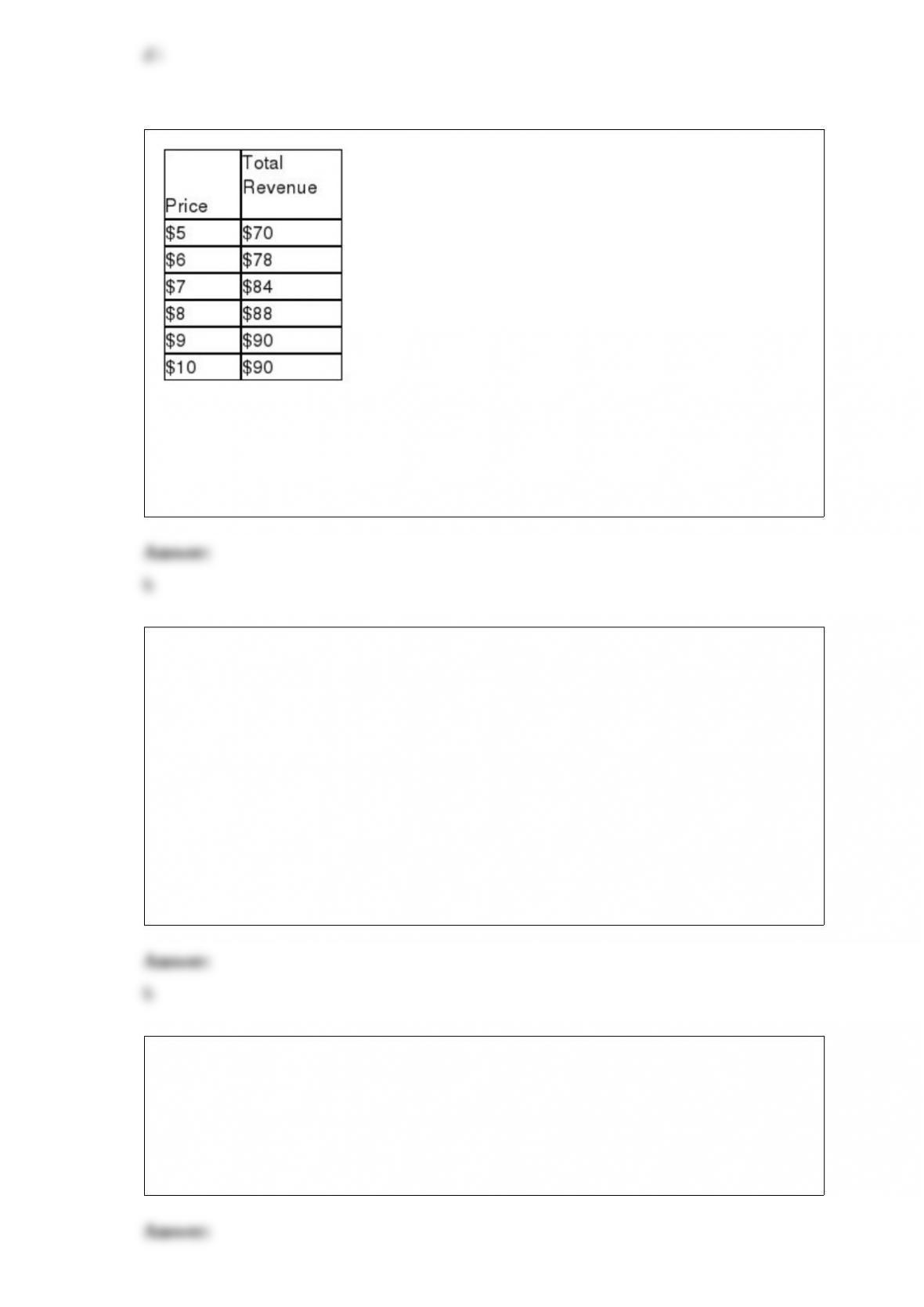
5) Demand is unit elastic when quantity demanded changes from
a.9 to 8
b.10 to 9
c.10 to 11
d.There is not enough information given to determine the correct answer.
6) Domingo is a contestant on a trivia quiz show. For every state capital he can
correctly identify, he will win $1,000. However, before identifying any capitals, he must
decide how many he thinks he can correctly identify. If he cannot identify as many as
he has wagered, Domingo will not win any money. Suppose Domingo says that he can
correctly identify 42 state capitals for a potential payoff of $42,000. According to
studies of human decision-making, what is most likely to happen?
a.Domingo will be able to identify 42 state capitals and he will win $42,000.
b.Domingo will be able to identify fewer than 42 state capitals and will not win any
money.
c.Domingo will not be able to identify any state capitals and will not win any money.
d.Domingo will choose to save all of the money he wins on the quiz show for his
retirement.
7) Compared to other firms, firms that sell highly differentiated products likely incur
significant costs associated with
a.advertising.
b.the product-variety externality.
c.intermediate materials.
d.taxes and regulation.
8) A firm can earn economic profits in the long run
a.only when the market is a monopoly.
b.only when the market is a monopoly or monopolistically competitive.
c.only when the market is monopolistically competitive or perfectly competitive.
d.when the market is perfectly competitive, monopolistically competitive, or
monopolistic.
9) Tax revenues increase in direct proportion to increases in the size of the tax.
a.True
b.False
10) When a government imposes a tariff on a product, the domestic price will equal the
world price.
a.True
b.False
11) If a higher price means a greater quantity supplied, then the supply curve slopes
upward.
a.True
b.False
12) The diagram below pertains to the demand for turkey in the United States.
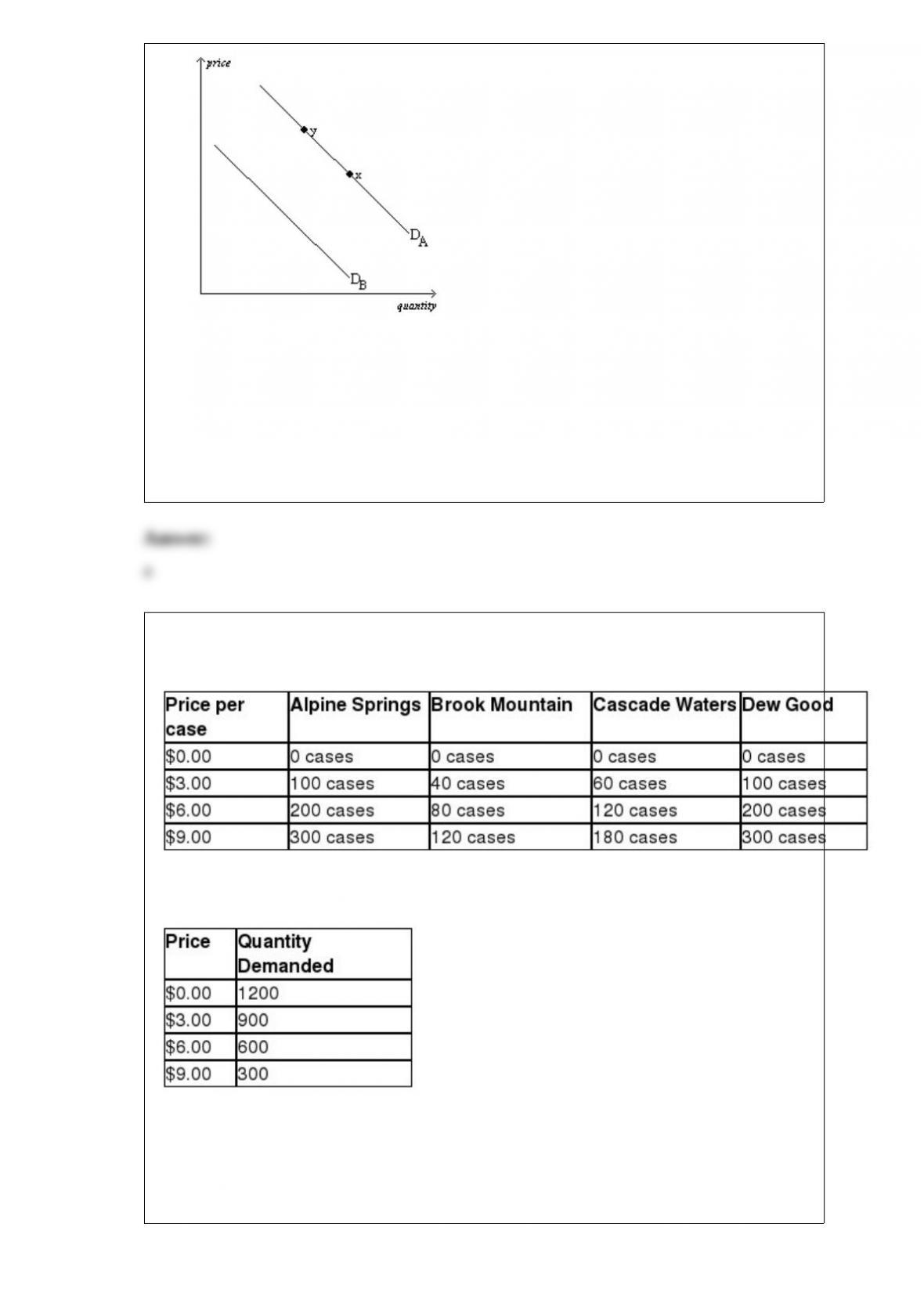
All else equal, an increase in the income of buyers who consider turkey to be an inferior
good would cause a move from
a.DA to DB.
b.DB to DA.
c.x to y.
d.y to x.
13) The following table shows the number of cases of water each seller is willing to sell
at the prices listed.
If the four suppliers listed are the only suppliers in this market and the market demand
schedule is:
the equilibrium price and quantity are
a.$0.00 and 1200 cases
b.$3.00 and 300 cases
c.$6.00 and 600 cases
d.$9.00 and 600 cases

14) Private solutions may not be possible due to the costs of negotiating and enforcing
these solutions. Such costs are called
a.transaction costs.
b.corrective costs.
c.input costs.
d.private costs.
15) When taxes are imposed on a commodity,
a.there is never a deadweight loss.
b.some consumers alter their consumption by not purchasing the taxed commodity.
c.tax revenue will rise by the amount of the tax multiplied by the before-tax level of
consumption.
d.the taxes do not distort incentives.
16) For a particular good, an 8 percent increase in price causes a 12 percent decrease in
quantity demanded. Which of the following statements is most likely applicable to this
good?
a.There are no close substitutes for this good.
b.The good is a necessity.
c.The market for the good is broadly defined.
d.The relevant time horizon is long.
17) Scenario 12-2
Suppose that Bob places a value of $10 on a movie ticket and that Lisa places a value of
$7 on a movie ticket. In addition, suppose the price of a movie ticket is $5.
Suppose the government levies a tax of $1 on each movie ticket and that, as a result, the
price of a movie ticket increases to $6.00. If Bob and Lisa both purchase a movie ticket,
what is total consumer surplus for Bob and Lisa?
a. $0.00
b. $0.50
c. $5.00
d. $6.00

18) Suppose a nation is currently producing at a point inside its production possibilities
frontier. We know that
a.the nation is producing beyond its capacity, so inflation will occur.
b.the nation is not using all available resources or is using inferior technology or both.
c.the nation is producing an efficient combination of goods.
d.there will be a large opportunity cost if the nation tries to increase production of any
good.
19) The gains from trade are
a.evident in economic models, but seldom observed in the real world.
b.evident in the real world, but impossible to capture in economic models.
c.a result of more efficient resource allocation than would be observed in the absence of
trade.
d.based on the principle of absolute advantage.