1) Scenario 13-14
If Farmer Brown plants no seeds on his farm, he gets no harvest. If he plants 1 bag of
seeds, he gets 5 bushels of wheat. If he plants 2 bags, he gets 9 bushels. If he plants 3
bags, he gets 12 bushels. A bag of seeds costs $120, and seeds are his only cost.
Farmer Brown’s totalcost curve is
a.increasing at an increasing rate.
b.increasing at a decreasing rate.
c.increasing at a constant rate.
d.decreasing.
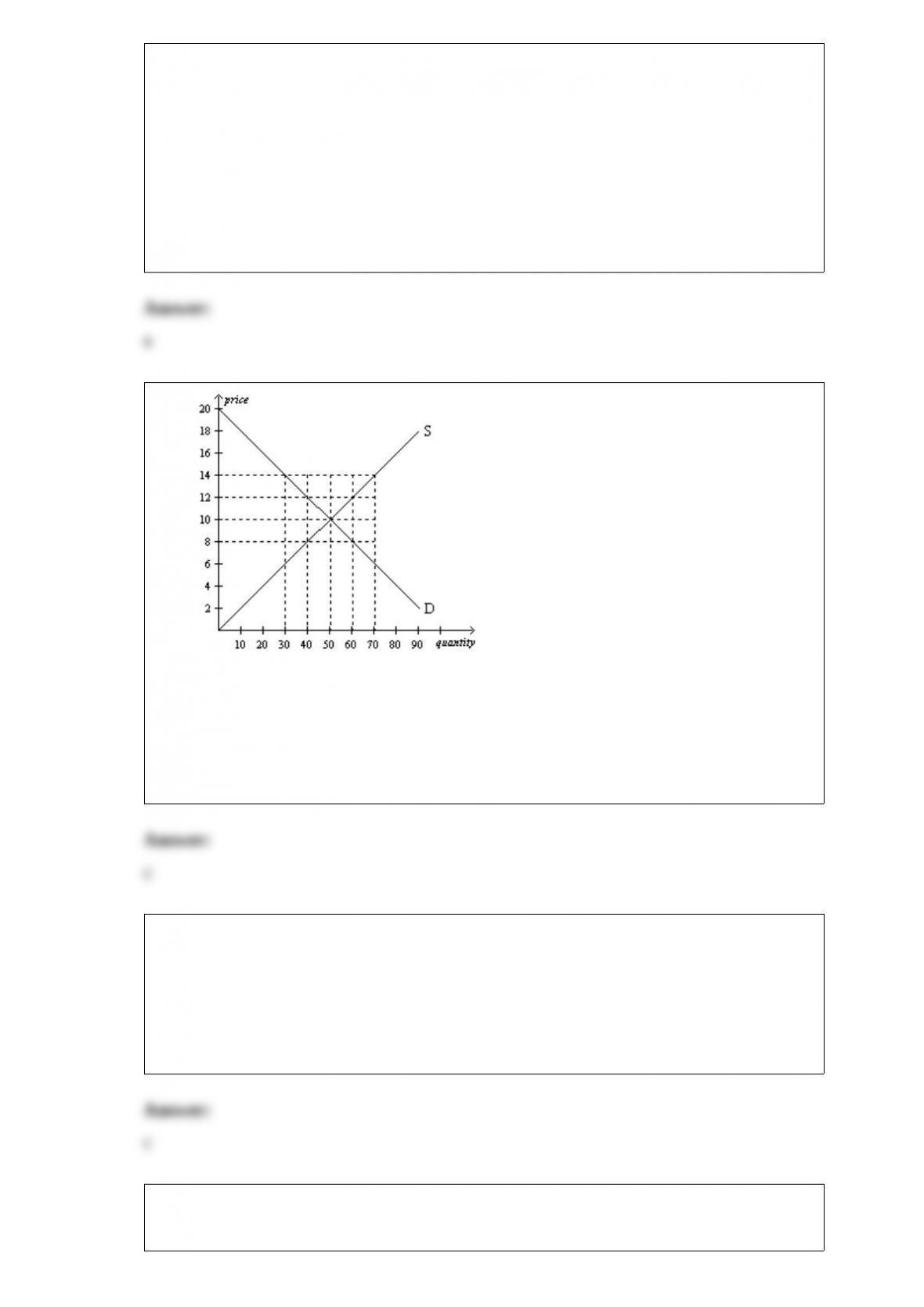
2) If there is currently a shortage of 20 units of
the good, then the law of
a.demand predicts that the price will rise by $2 to eliminate the shortage.
b.supply predicts that the price will rise by $2 to eliminate the shortage.
c.supply and demand predicts that the price will rise by $2 to eliminate the shortage.
d.supply and demand predicts that the price will fall by $2 to eliminate the shortage.
3) Cashews and asparagus are normal goods. When the price of asparagus falls, the
substitution effect by itself causes
a.the consumer to feel richer, so the consumer buys more cashews.
b.the consumer to feel richer, so the consumer buys less cashews.
c.cashews to be relatively more expensive, so the consumer buys less cashews.
d.cashews to be relatively less expensive, so the consumer buys more cashews.
4) The term invisible hand was coined by
a.Adam Smith.

b.David Ricardo.
c.Karl Marx.
d.Benjamin Franklin.
5) When a firm operates under conditions of monopoly, its price is
a.not constrained.
b.constrained by marginal cost.
c.constrained by demand.
d.constrained only by its social agenda.
6) The “other” category of federal spending consists of many less expensive functions
of government, including all of the following except
a.housing credit programs.
b.farm support programs.
c.funding for the National Institutes of Health.
d.the federal court system.
7) Policymaking in a representative democracy
a.is straightforward and does not involve any disagreement.
b.benefits from the input of economists, even if their advice is not always followed.
c.is conducted without the input of economists.
d.is always based exclusively on the results of economic analysis.
8) John Maynard Keynes believed the ideas of economists to be
a.generally incorrect.
b.powerful.
c.academic and without practical application.
d.rantings of madmen.
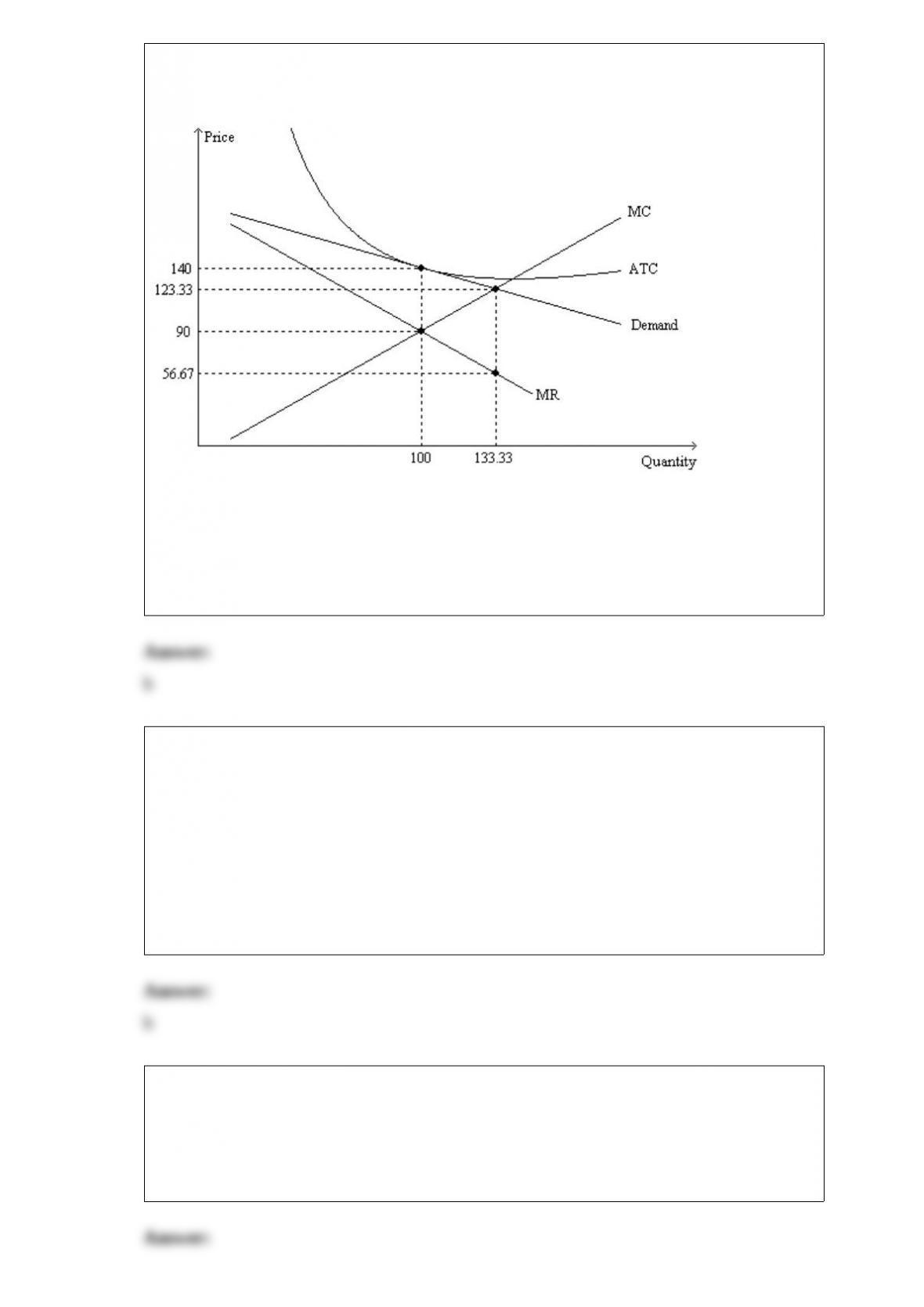
9) Figure 16-9
The figure is drawn for a monopolistically-competitive firm.
In order to maximize its profit, the firm will choose to produce
a.100 units of output, and its profit will be positive.
b.100 units of output, and its profit will be zero.
c.133.33 units of output, and its profit will be negative.
d.133.33 units of output, and its profit will be zero.
10) As a summer job, some teenagers choose to detassle corn, a job requiring long
hours walking corn fields in the summer heat. Other teens take jobs working as
lifeguards. Given that detassling corn is a more difficult job than working as a lifeguard,
we would expect a difference in wages between the two jobs. This difference is known
as
a.an efficiency wage.
b.a compensating differential.
c.a wage adjustment.
d.a minimum wage.
11) As firms exit a monopolistically competitive market, profits of remaining firms
a.decline, and product diversity in the market decreases.
b.decline, and product diversity in the market increases.
c.rise, and product diversity in the market decreases.
d.rise, and product diversity in the market increases.

12) Equality refers to how the pie is divided, and efficiency refers to the size of the
economic pie.
a.True
b.False
13) If a consumer purchases more of good A when her income falls, good A is an
inferior good.
a.True
b.False
14) Of the theories listed below, which do the best job of explaining why educated
people are paid more than uneducated people?
a.human-capital and price-fixing
b.human-capital and signaling
c.wage-differential and signaling
d.wage-differential and compensating-differentials
15) If a tax takes a smaller fraction of income as income rises, it is
a.proportional.
b.regressive.
c.progressive.
d.based on the ability-to-pay principle.
16) Scenario 16-4
Delish, a moderately priced restaurant, has recently announced intentions to open a
restaurant in Boston, MA. Assume that the restaurant market in Boston is characterized
by monopolistic competition.
As a result of the new restaurant, diners in Boston are likely to experience a
a.product-variety externality, which is a negative externality.
b.product-variety externality, which is a positive externality.
c.business-stealing externality, which is a negative externality.
d.business-stealing externality, which is a positive externality.
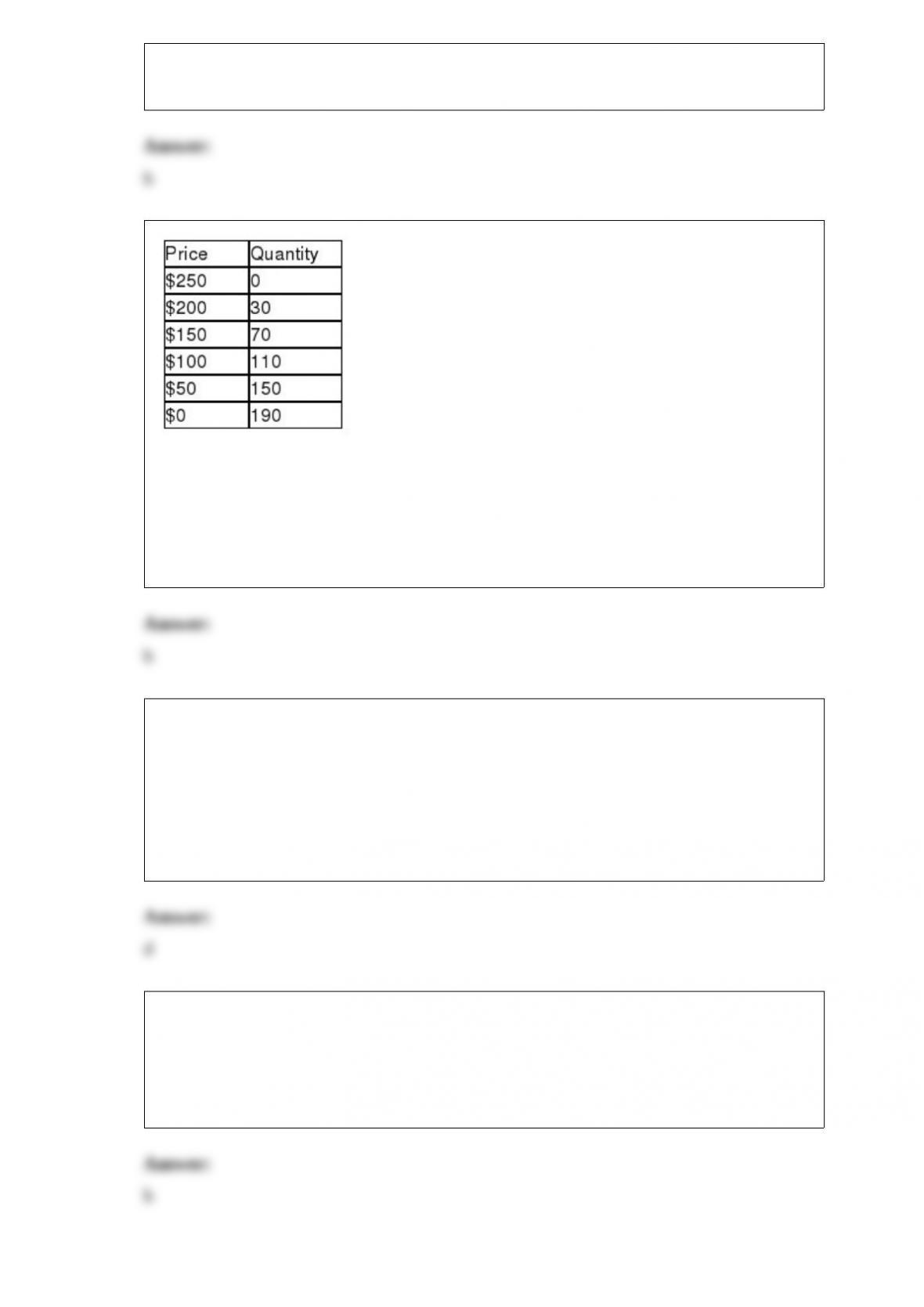
17) Using the midpoint method, if the price falls from $200 to $150, the absolute value
of the is
a.5.3.
b.2.8.
c.0.8.
d. 0.36.
18) Which of the following statements is true?
a.Free trade benefits a country when it exports but harms it when it imports.
b.”Voluntary” limits on Canadian exports of hogs are better for the United States than
U.S. tariffs placed on Canadian hog exports.
c.Tariffs and quotas differ in that tariffs work like a tax and therefore impose
deadweight losses, whereas quotas do not impose deadweight losses.
d.Free trade benefits a country both when it exports and when it imports.
19) The life cycle effect characterizes a lifetime income profile in which income
a.tends to follow a seasonal pattern.
b.rises as a worker gains maturity and experience.
c.rises and falls in conjunction with the business cycle.
d.falls during the early years of market activity and peaks at retirement.
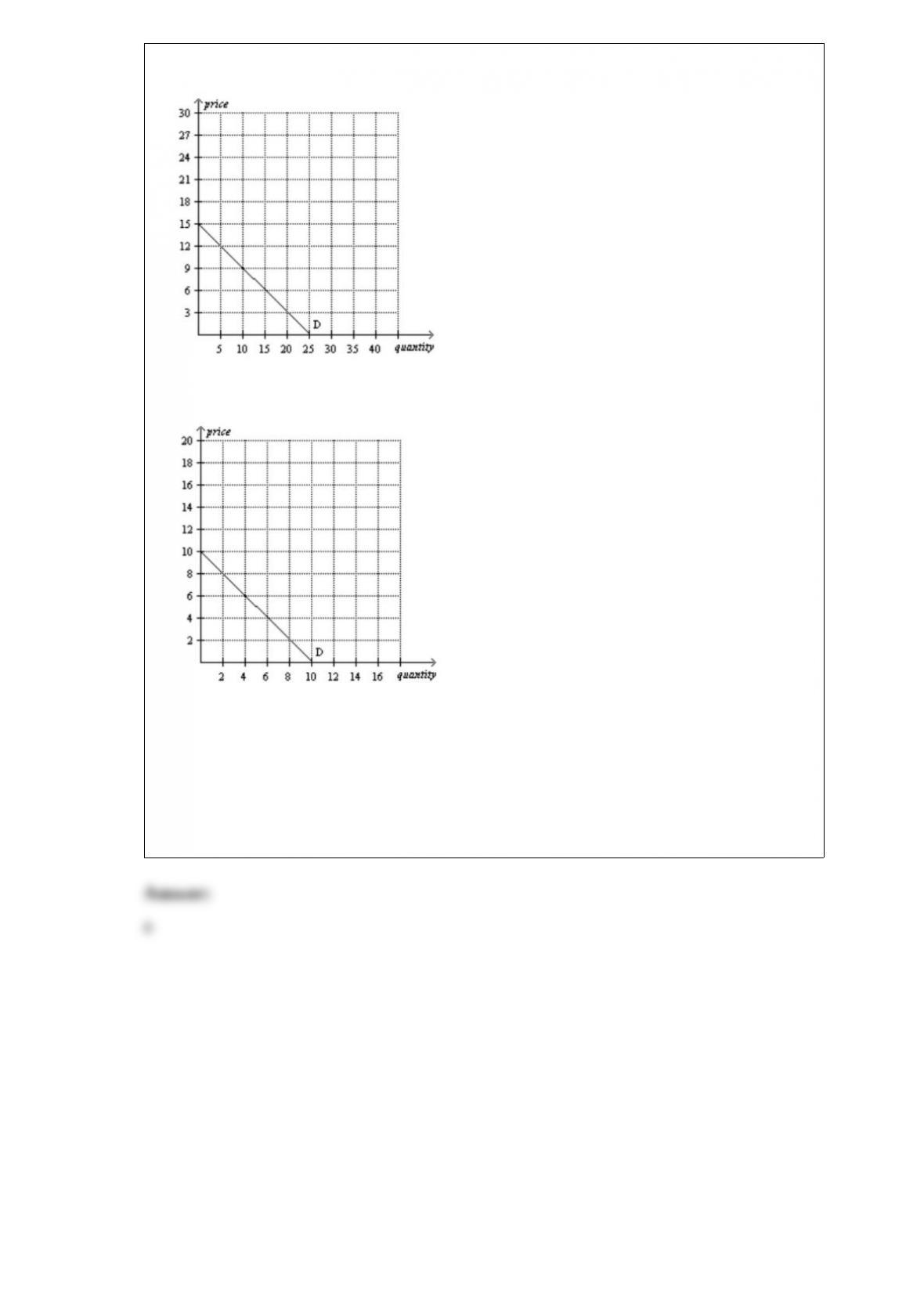
20) Consumer 1
Consumer 2
If these are the only two consumers in the market, then the market quantity demanded
at a price of $15 is
a.0 units.
b.10 units.
c.15 units.
d.25 units.