
Health insurance companies impose deductibles on policies and co-payments on claims
to reduce the problem of adverse selection.
An increase in the supply of capital, which is a substitute to labor, will lead to a
decrease in the demand for labor.
If marginal cost is above the average variable cost, then average variable cost is
decreasing.
Consumers in monopolistically competitive markets face a tradeoff between paying
prices greater than marginal costs and purchasing products that are more closely suited
to their tastes.

Gross national product (GNP) is the value of all goods and services imported into a
country over a one-year period.
One of the main sources of comparative advantage is internal economies.
When a monopolistically competitive firm breaks even in the long run, this is
equivalent to earning a zero accounting profit.

If the demand for a product increases and the supply of the same product increases, the
equilibrium price will increase.
For a given quantity, the total profit of a perfectly competitive firm is equal to the
vertical distance between the firm’s total revenue curve and its total cost curve.
A network externality refers to a situation in which the usefulness of a product
decreases with the number of consumers who use it.
The term “trust” in antitrust refers to a board of trustees that has collusive control over
different companies.

The income effect results in consumers increasing the quantity of normal goods
demanded when the price falls.
One example of human capital is the amount of skills that you have.
Optimal decisions are made at the point where marginal cost equals zero.

All else equal, as the price of a product falls, the quantity supplied increases.
The payment received by suppliers of entrepreneurial skills is called interest.
When the majority of voters have preferences very different from those of the median
voter, then the median voter theorem will lead to accurate predictions of the outcomes
of elections.
If the population increases and input prices decrease, the equilibrium quantity of a
product will definitely increase.

Suppose there are economies of scale in the production of a specialized memory chip
that is used in manufacturing microwaves. This suggests that the microwave industry is
a decreasing-cost industry.
Productive efficiency does not hold for a profit-maximizing, monopolistically
competitive firm in the long-run equilibrium because the firm operates along the
diseconomies-of-scale region of its average total cost curve.
In the circular flow model, households demand resources such as labor services in the
factor market.

The success of Walt Disney’s animated film The Lion King in 1994, increased
production of animated films, increasing the demand for animators much faster than the
supply of animators was increasing. As a result, in the market for animators, the
equilibrium wage fell and the equilibrium quantity increased.
If the marginal tax rate is greater than the average tax rate, the tax structure is described
as regressive.
Economic efficiency is a market outcome in which the marginal benefit of consumers is
equal to the marginal cost of production and the sum of consumer surplus and producer
surplus is maximized.
To increase gas mileage, automobile manufacturers make cars small and light. Large

cars absorb more of the impact of an accident than small cars but yield lower gas
mileage. These facts suggest that a negative relationship exists between safety and gas
mileage.
A tariff is a numerical limit on the quantity of a good that can be imported.
If, after hiring the 6th worker, a firm’s output falls, then the marginal product of the 6th
worker is negative.
As the number of firms in a market decreases, the supply curve will shift to the left and
the equilibrium price will rise.

The most important factor contributing to wage differences in the labor market is
differences in the level of education and training among workers.
In response to a surplus the market price of a good will fall; as the price falls, the
quantity demanded will increase and quantity supplies will decrease until equilibrium is
reached.
If a monopolist’s marginal revenue is $15 per unit and its marginal cost is $25, then to
maximize profit the firm should decrease output.

Suppose the extra cost to a doctor of keeping his office open on Saturdays is $1,200.
Then, the doctor should stay open on Saturdays if keeping the office open brings in
additional revenue of $1,200 or more.
In the United States, partnership profits are taxed at the business level and then are
taxed again as personal income in the form of dividend payments.
A snack shop inside a hotel in a busy city has a monopoly on food sales if it is the only
food vendor in the hotel that is open 24 hours a day.
Early adopters are consumers who will pay a high price to be among the first to own
new products.

Suppose at a price of $50, Yoshi’s Jazz Bar sells 20 tickets to its nightly jazz
performance and
at a price of $40, it sells 25 tickets. Based on this information, the demand for Yoshi’s
jazz performance is elastic.
The marginal product of labor is the increase in output as a result of hiring an additional
worker while the marginal revenue product of labor is the increase in profit as a result
of hiring an additional worker.
Adverse selection is a situation in which one party to a transaction takes advantage of
knowing more than the other party to the transaction.
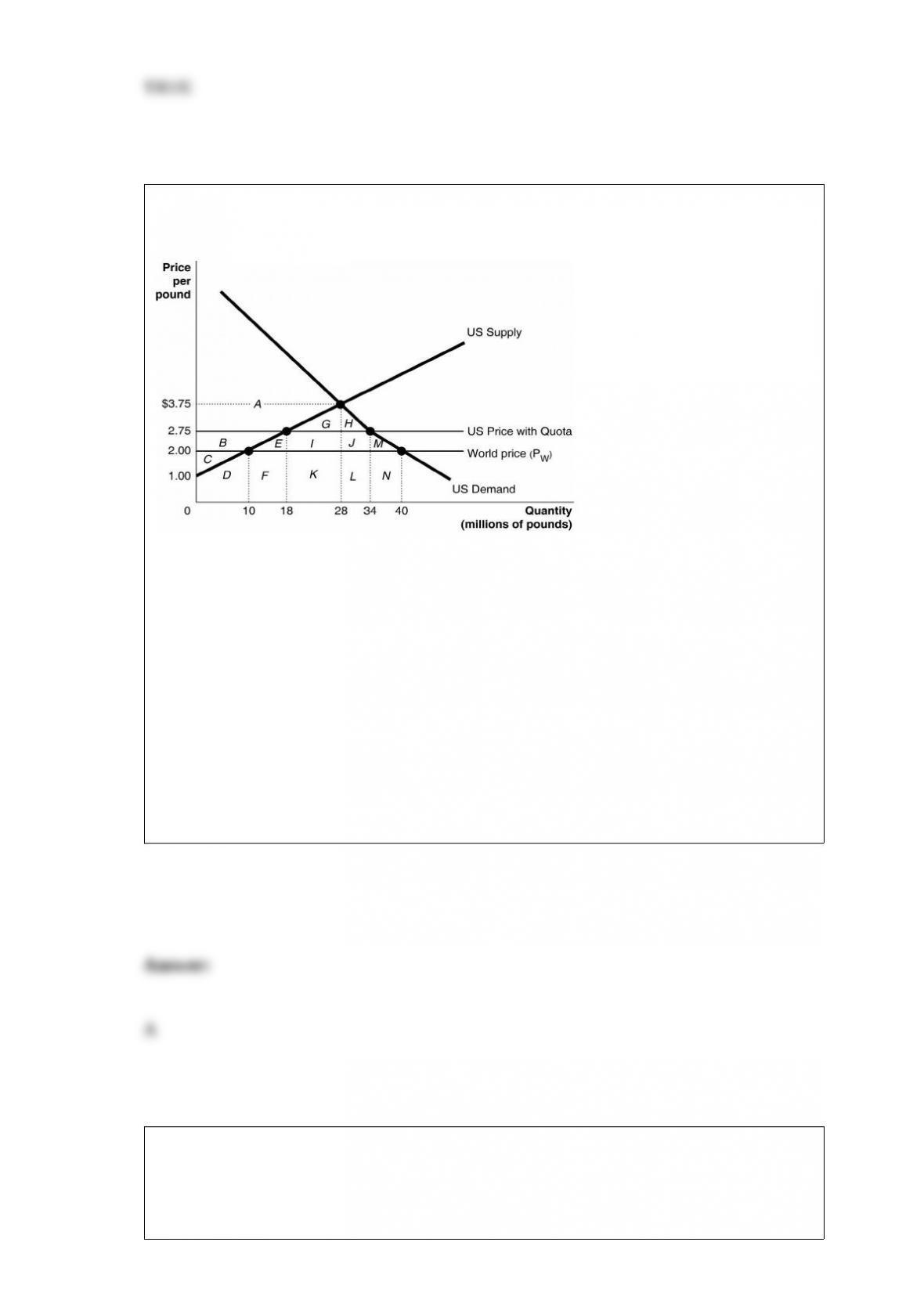
Figure 9-3
Since 1953 the United States has imposed a quota to limit the imports of peanuts.
Figure 9-3 illustrates the impact of the quota.
Refer to Figure 9-3. What is the area of consumer surplus after the imposition of the
quota?
A) A + G + H
B) G + H + E + I+ J + M
C) G + H
D) A
Which of the following conditions holds in an economically efficient competitive
market equilibrium?
A) The deadweight loss is positive but at a minimum.

B) Producer and consumer surplus are exactly equal in size.
C) There are no positive and no negative external effects from consumption and
production.
D) The marginal benefit of the last unit produced and consumed is maximized.
________ involves the idea that a nation-state is autonomous, cannot intervene in the
affairs of other nations, and can enter into binding international agreements.
A) National sovereignty
B) Authoritarianism
C) Cultural liberalism
D) Communalism
Suppose when the price of laptops fall, college students buy more laptops. This implies
that
A) there is a positive relationship between laptop prices and quantities purchased by
college students.
B) there is a negative relationship between laptop prices and quantities purchased by
college students.

C) there is a direct relationship between laptop prices and quantities purchased by
college students.
D) there is a one-to-one relationship between laptop prices and quantities purchased by
college students.
The price elasticity of the supply of teenage labor services is approximately 1.36.
Suppose the minimum wage rises from $7.25 per hour to $8.75. Using the midpoint
formula, calculate the approximately change in the quantity supplied of teenage labor.
A) 7.3 percent
B) 14.4 percent
C) 25.5 percent
D) There is insufficient information to answer the question.
If the number of employees who quit, are fired, or retire increases while the hiring of
new employees declines, this indicates that the
A) labor demand curve is shifting to the right.
B) labor supply curve is shifting to the right.
C) labor demand curve is shifting to the left.
D) labor supply curve and labor demand curve are both shifting to the right.
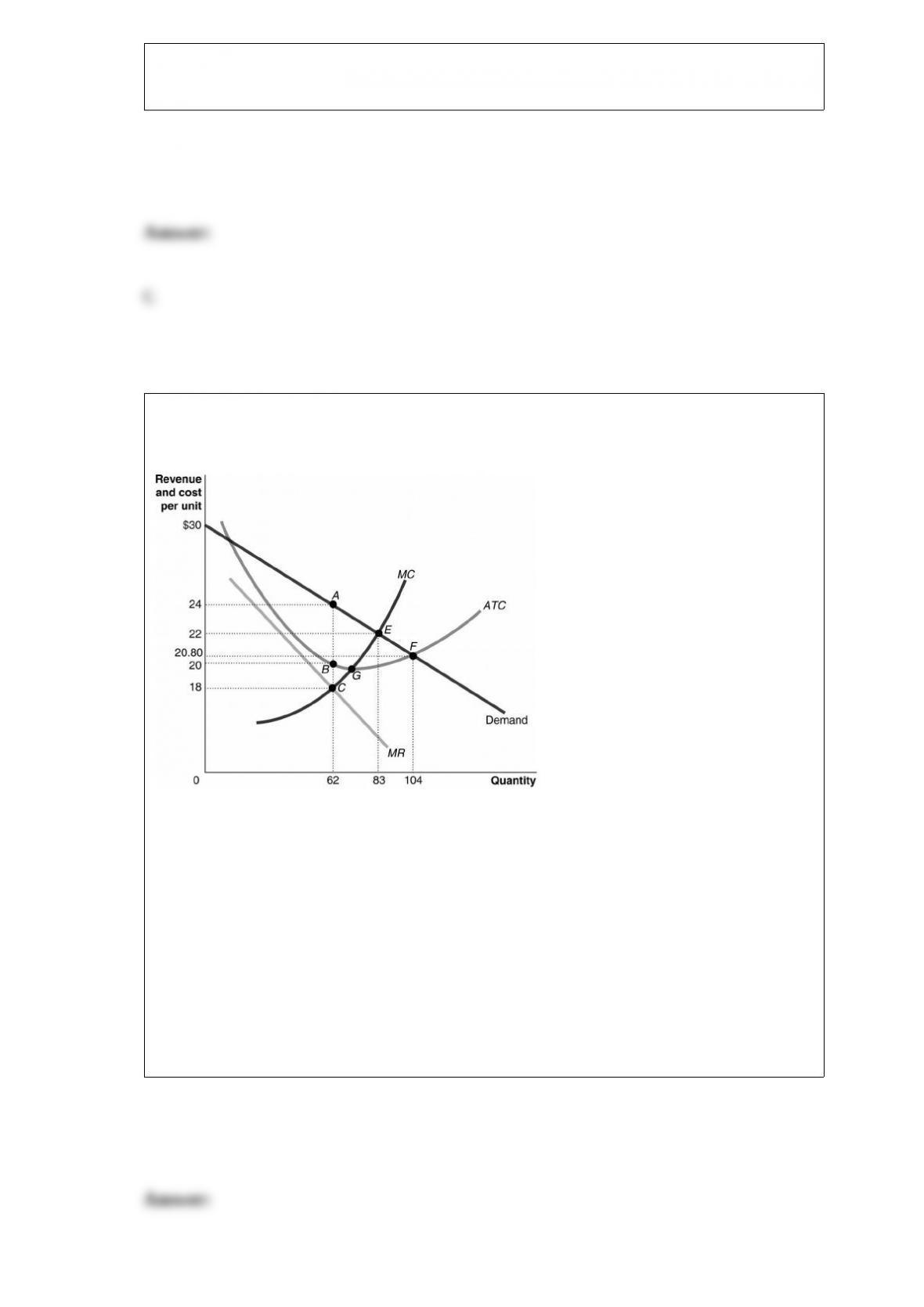
Figure 15-12
Figure 15-12 shows the cost and demand curves for a monopolist.
Refer to Figure 15-12. Assume the firm maximizes its profits. What is the amount of
consumer surplus?
A) $21
B) $124
C) $186
D) $332
Productive efficiency is achieved when
A) firms add a low profit margin to the goods and services they produce.
B) firms produce the goods and services that consumers value most.
C) firms produce goods and services at the lowest cost.
D) there are no shortages or surpluses in the market.
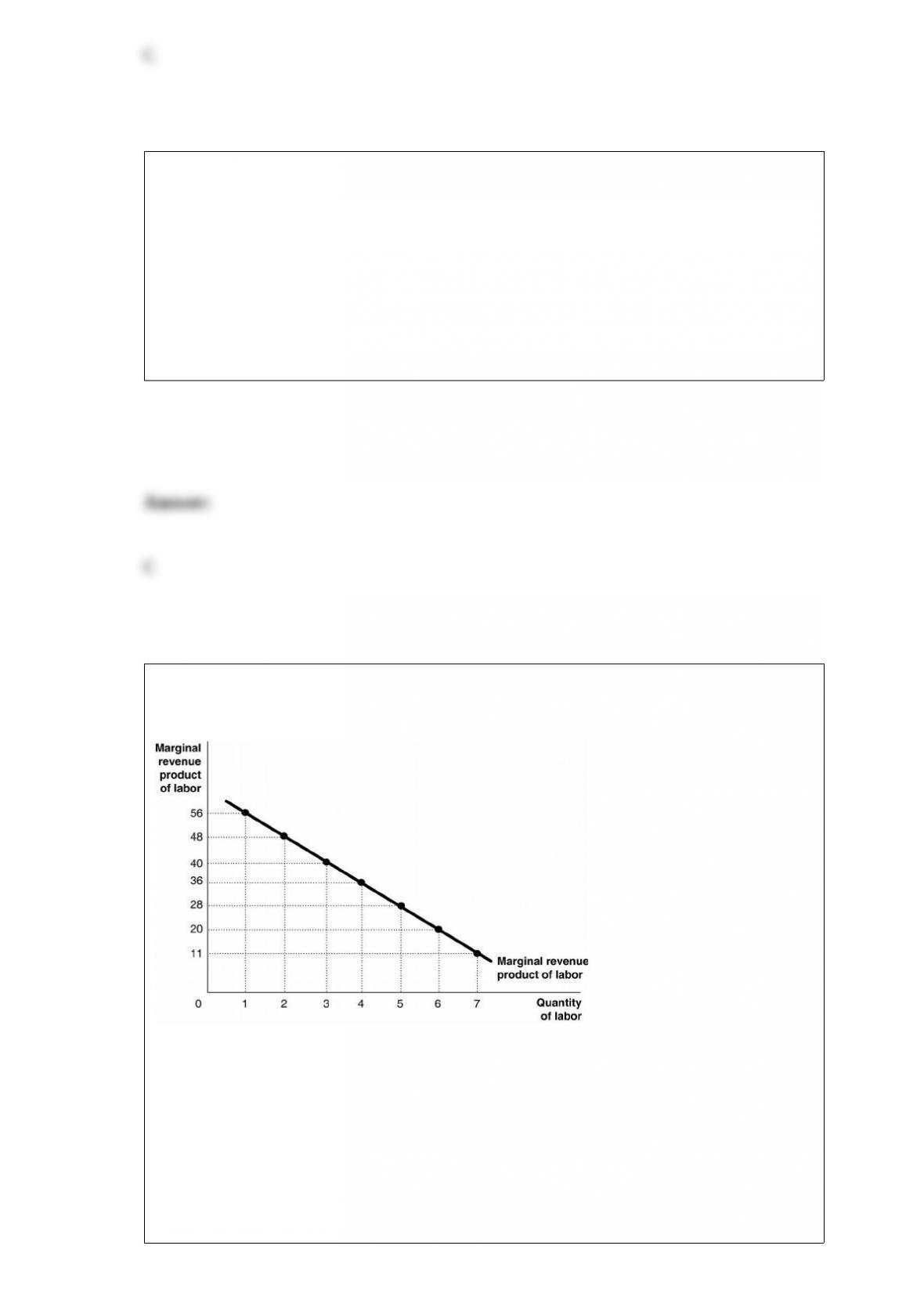
Figure 17-2
Figure 17-2 shows the marginal revenue product for Becca’s Baubles, a producer of
hand-beaded bracelets.
Refer to Figure 17-2. If Becca can sell her bracelets at $3 each, what is the marginal
product of the 4th worker?
A) $36
B) 12 bracelets

C) 36 bracelets
D) $144
Suppose the absolute value of the price elasticity of demand for meals at Fortune Buffet
House is ∞. What happens to sales revenue if the restaurant increases its price by 5
percent?
A) Sales revenue falls by less than 5 percent.
B) Sales revenue remains unchanged.
C) Sales revenue falls by 100 percent.
D) It cannot be determined without information on prices.
A firm’s net worth is calculated as
A) the difference between a firm’s revenues and explicit costs.
B) the difference between a firm’s revenues and implicit costs.
C) the difference between a firm’s assets and liabilities.
D) the difference between a firm’s liabilities and outstanding equities.
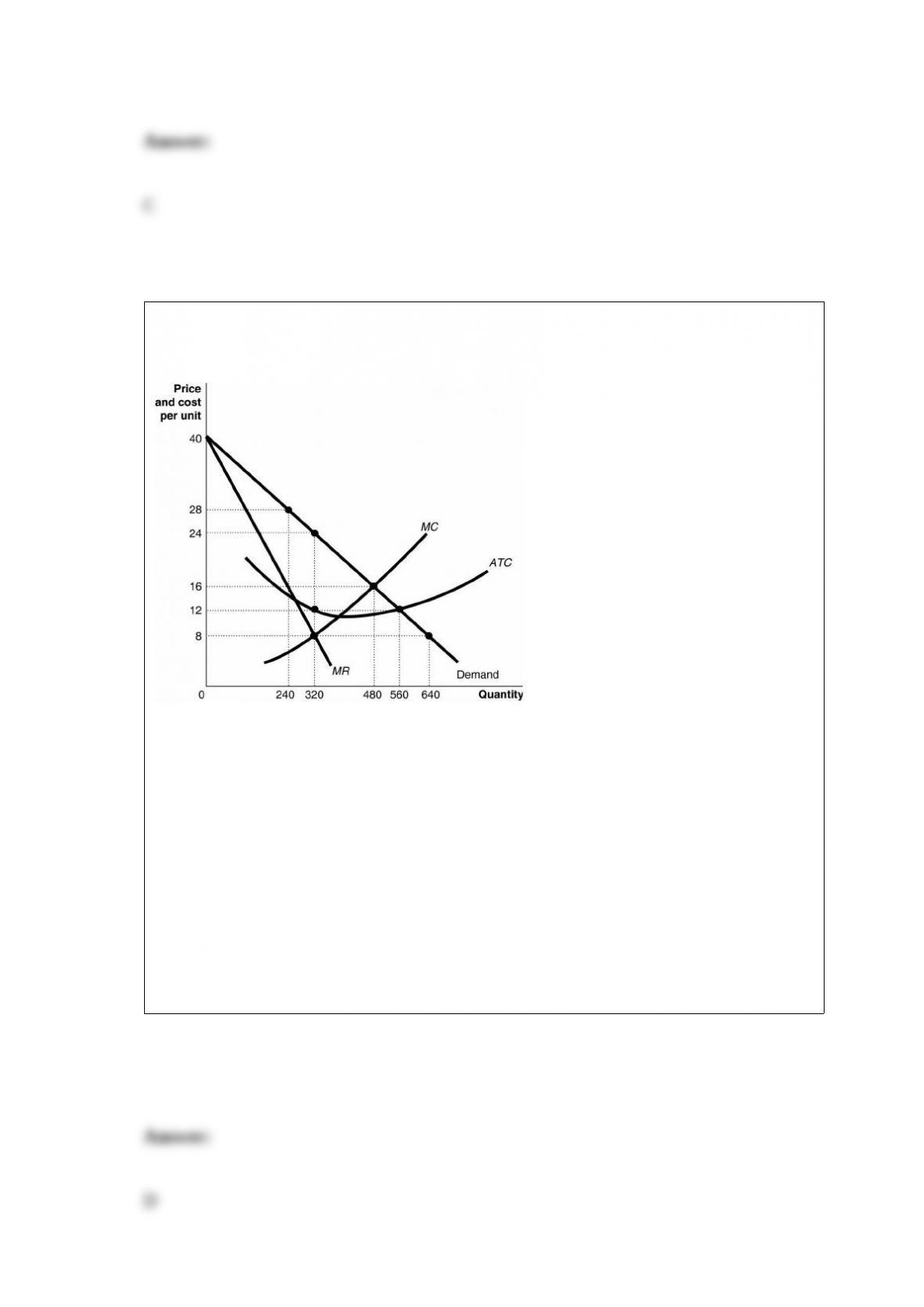
Figure 16-5
Refer to Figure 16-5. Suppose the firm represented in the diagram decides to use a
two-part pricing strategy such that it charges a fixed fee and a per-unit price equal to the
competitive price. (This is also called an optimal two-part tariff.) What is the per-unit
price it should charge, if any?
A) It should not charge a price per unit; just a flat fee to consume as much of the
product as desired.
B) It should charge a range of prices from $40 to $12.
C) $12
D) $16
Arthur buys a new cell phone for $150. He receives consumer surplus of $150 from the
purchase. How much does Arthur value his cell phone?
A) $0
B) $150
C) $225
D) $300
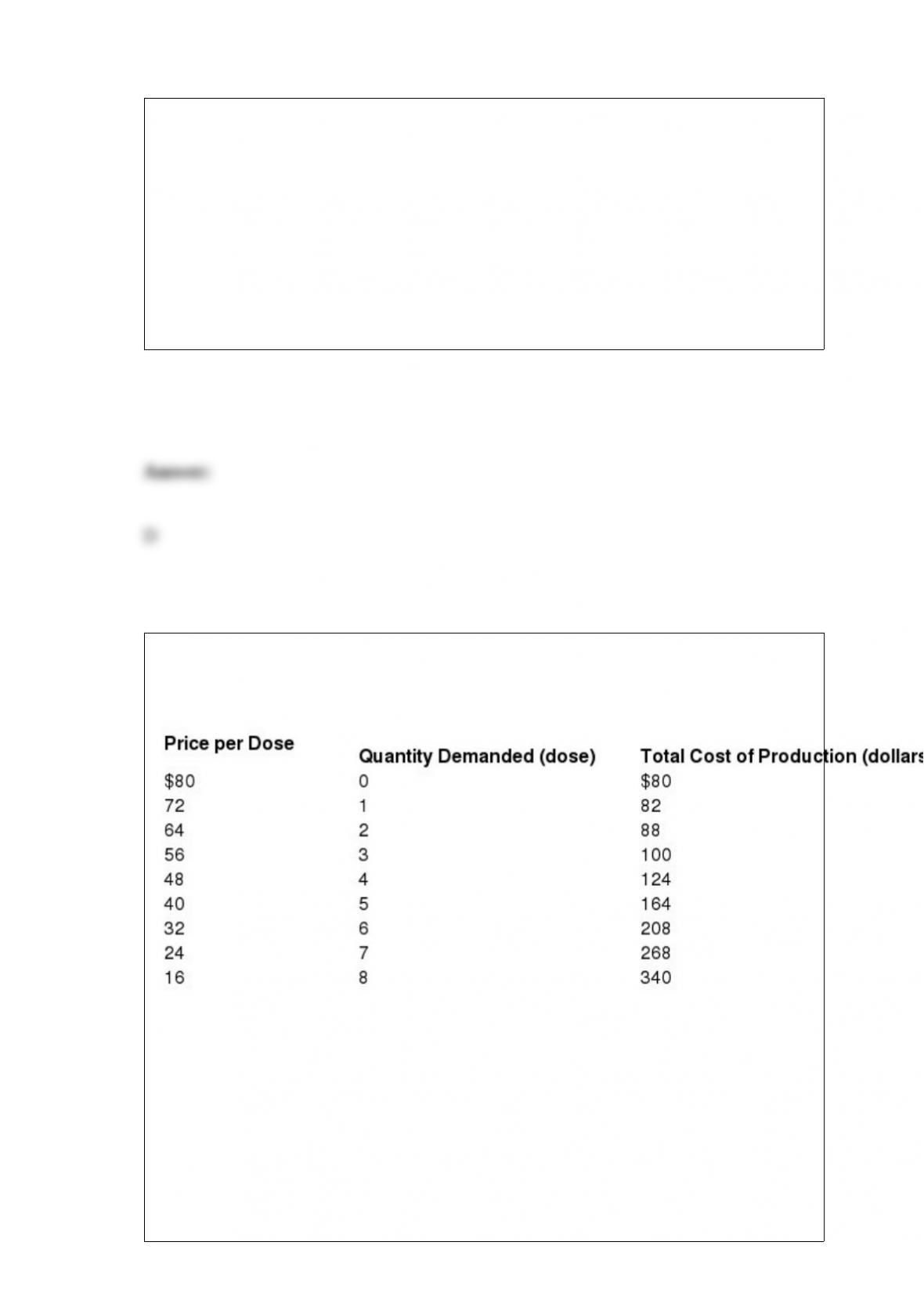
Table 15-4
Shakti Inc. has been granted a patent for its Arnica toothache balm. Table 15-4 shows
the demand and the total cost schedule for the firm.
Refer to Table 15-4. What is the amount of Shakti’s profit?
A) $68
B) $72
C) $124

D) $192
Book publishers often use a cost-plus pricing strategy. One reason for this is
A) most publishers do not hire economists who can determine the number of books they
must sell to equate marginal cost and marginal revenue.
B) publishers do not want to incur the expense of determining the profit-maximizing
strategy. They prefer cost-plus pricing because of its lower cost.
C) much of the cost of publishing textbooks is difficult to assign to any particular book.
D) bookstores, not publishers, ultimately determine how many books will be produced.
Which of the following statements is false?
A) Marginal cost will equal average total cost when marginal cost is at its lowest point.
B) When marginal cost is less than average total cost, average total cost will fall.
C) When marginal cost is greater than average total cost, average total cost will rise.
D) Marginal cost will equal average total cost when average total cost is at its lowest
point.
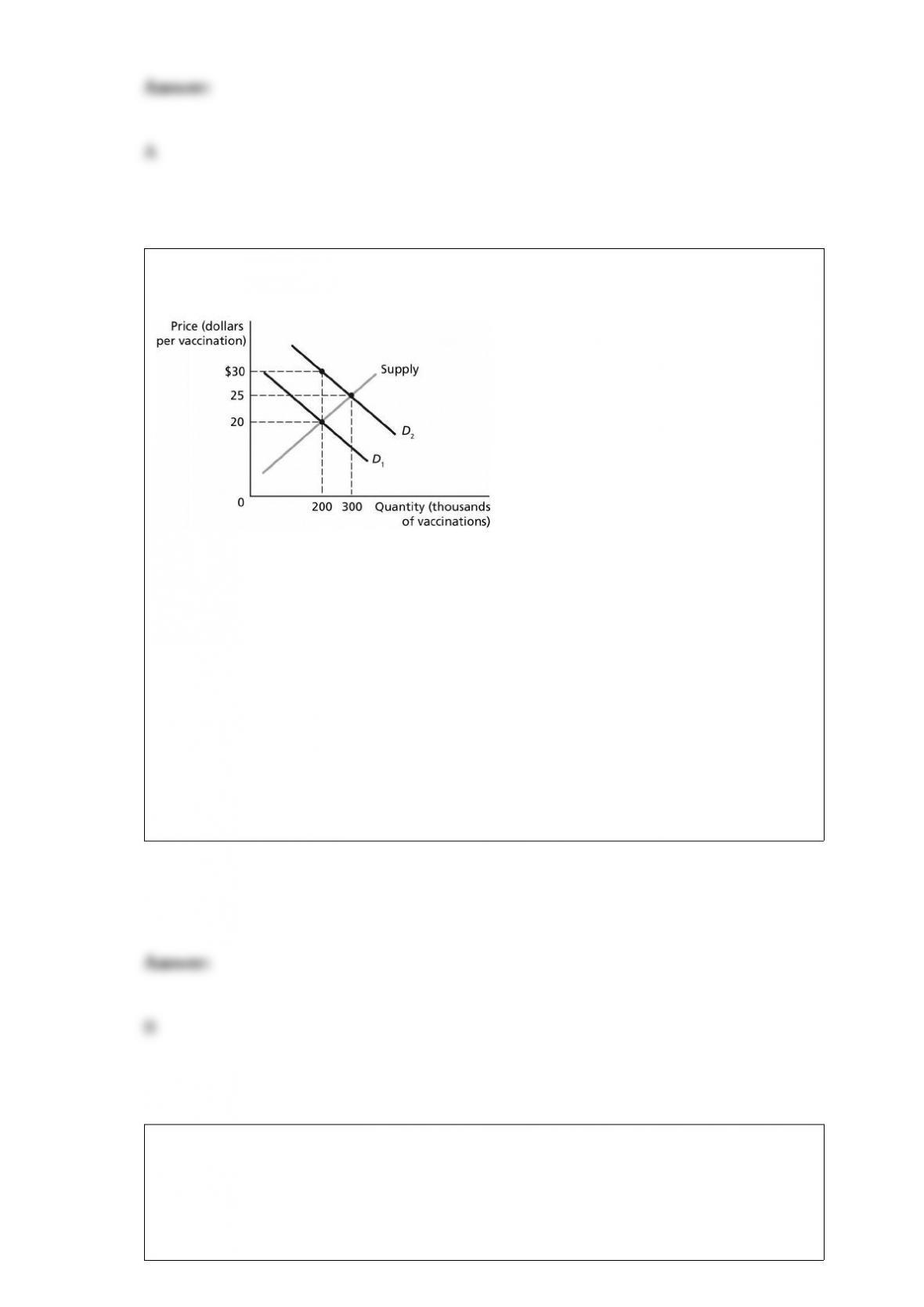
Figure 7-1
Figure 7-1 represents the market for vaccinations. Vaccinations are considered a benefit
to society, and the figure shows both the marginal private benefit and the marginal
social benefit from vaccinations.
Refer to Figure 7-1. At the market equilibrium
A) the marginal benefit is equal to the marginal cost.
B) the marginal benefit is greater than the marginal cost.
C) the marginal benefit is less than the marginal cost.
D) the marginal benefit is zero.
Assume a hypothetical case where an industry begins as perfectly competitive and then
becomes a monopoly. As a result of this change
A) Price will be higher, output will be lower and the deadweight loss will be eliminated.

B) Consumer surplus will be smaller, producer surplus will be greater and there will be
a reduction in economic efficiency.
C) Price will be higher, consumer surplus will be greater and output will be greater.
D) Consumer surplus will be smaller and producer surplus will be greater. There will be
a net increase in economic surplus.
In 2012, employees covered by company-provided health insurance paid ________
percent of the cost of their own health insurance.
A) 3
B) 18
C) 37
D) 65
Table 14-2

Table 14-2 shows the payoff matrix for Wal-Mart and Target from every combination of
pricing strategies for the popular PlayStation 3. At the start of the game each firm
charges a low price and each earns a profit of $7,000.
Refer to Table 14-2. Suppose pricing PlayStations is a repeated game in which
Wal-Mart and Target will be selling the game system in competition over a long period
of time. In this case, what is the most likely outcome?
A) a noncooperative equilibrium in which each firm charges the high price
B) a cooperative equilibrium in which each firm charges the high price
C) a noncooperative equilibrium in which each firm charges the low price
D) a cooperative equilibrium in which each firm charges the low price
As more output is produced, the marginal product of labor declines
A) because of the law of diminishing returns.
B) if firms reduce the wage paid to labor.
C) if the firm’s output supply curve is inelastic.
D) because the firm’s marginal revenue declines.

Which of the following correctly comments on the following statement? “The only way
to increase the revenue from selling a product is to increase the product’s price.”
A) It is not true. Revenue will increase as the price of the product increases only if
demand is elastic.
B) This statement is not true. Revenue will increase as the price of the product increases
only if demand is inelastic.
C) The statement is true.
D) This statement is not true. Revenue will decrease as the price of the product
increases because quantity demanded will fall.
The actual division of the burden of a tax is called
A) tax credit.
B) tax incidence.
C) excess burden.
D) tax dispersion.
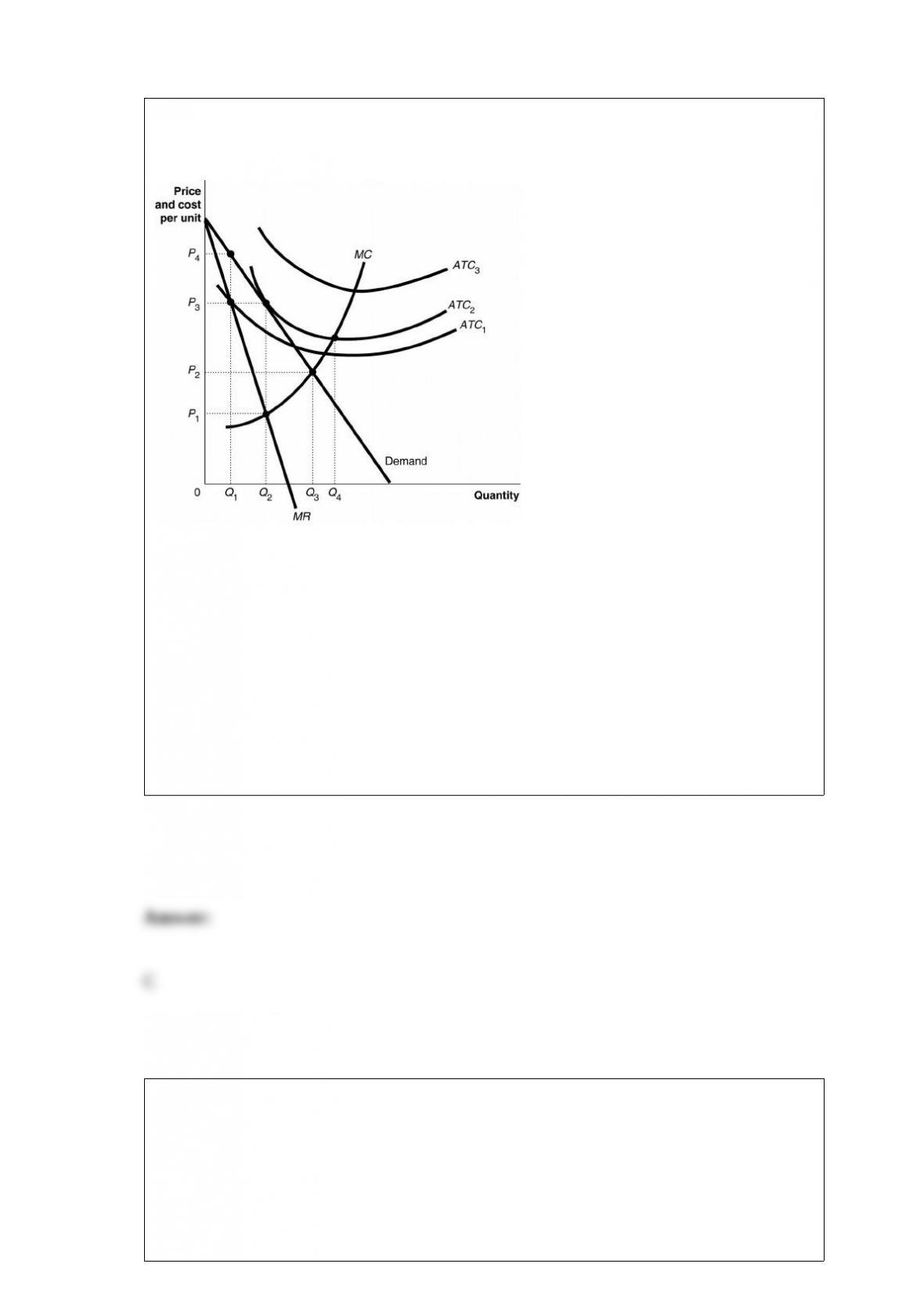
Figure 15-2
Figure 15-2 above shows the demand and cost curves facing a monopolist.
Refer to Figure 15-2. If the firm’s average total cost curve is ATC1, the firm will
A) suffer a loss.
B) break even.
C) make a profit.
D) face competition.
When someone takes out a mortgage loan to buy a house, the mortgage lender can take
possession of the house and sell it if the borrower defaults by failing to make payments
on the loan because the house is being pledged as ________ for the loan.
A) goodwill
B) a liability

C) insurance
D) collateral
Which of the following is not part of an oligopolist’s business strategy?
A) meeting worker health and safety standards required of all firms
B) deciding the level of total output of a new product
C) determining the amount of advertising a new product needs
D) setting the product’s price after considering what rivals will do
Stricter laws and regulations to protect intellectual property rights
A) will help to create a more successful market system.
B) will only benefit those companies whose intellectual property rights have in the past
been ignored.
C) will tend to have little impact on an economy since intellectual property is not
tangible.
D) will create a stronger and more successful black market for intellectual property.

What happens in the primary market?
A) primary inputs like electricity are sold
B) a corporate financial manager will resell previously issued shares of stock
C) newly issued claims are sold by the borrowing firm to the initial buyer
D) already issued claims are sold from one investor to another
A marginal tax rate is calculated as
A) total taxable income by taxes paid.
B) taxes paid total taxable income.
C) change in taxes paid the change in total taxable income.
D) change in taxable income change in taxes paid.
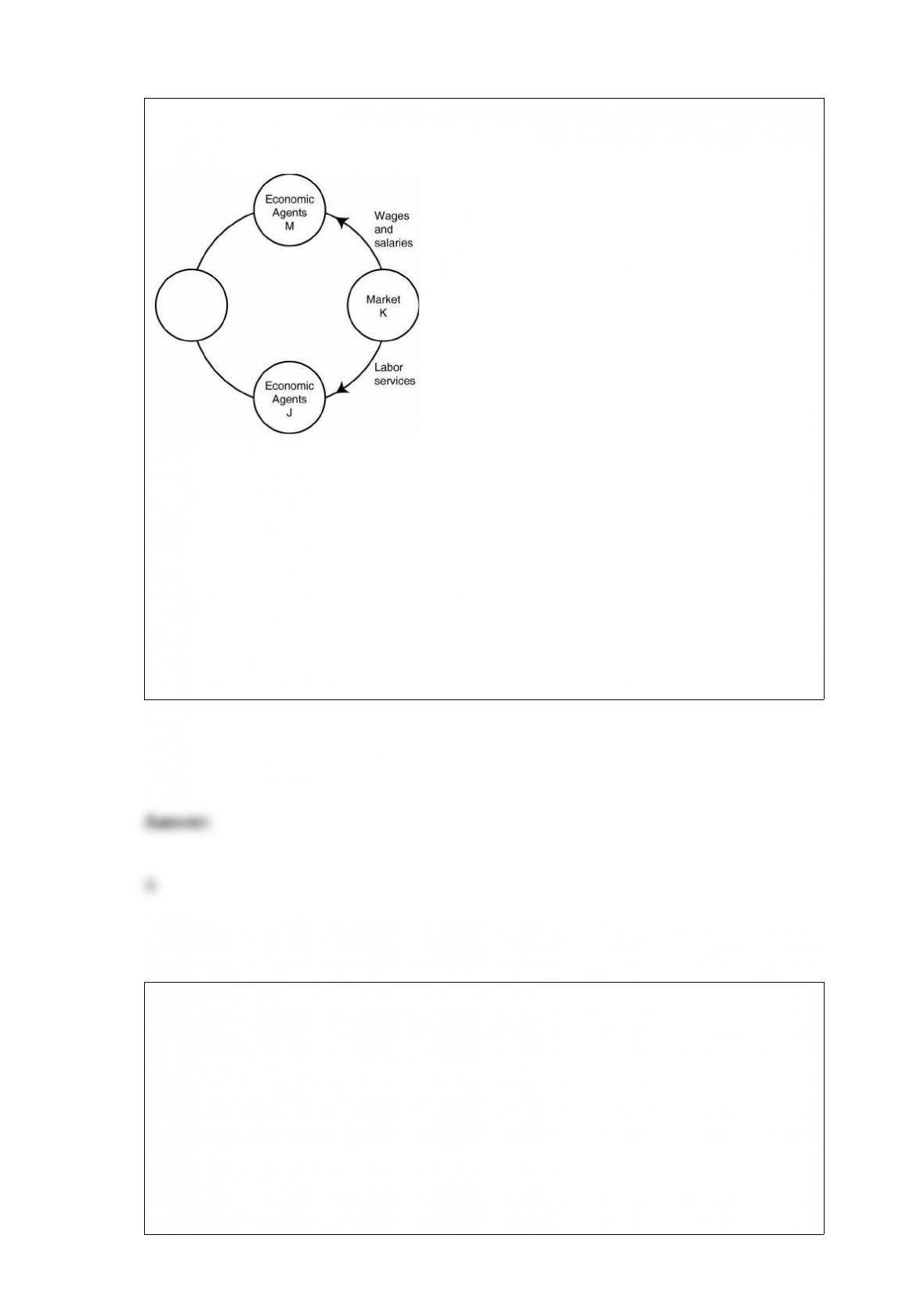
Figure 2-11
Refer to Figure 2-11. One segment of the circular flow diagram in the figure shows the
flow of wages and salaries from market K to economic agents M. What is market K and
who are economic agents M?
A) K = factor markets; M = households
B) K = product markets; M = households
C) K = factor markets; M = firms
D) K = product markets; M = firms
If a corporate bond with face value of $5,000 has an interest rate of 4 percent paid once
a year for a term of 30 years, what is the size of the coupon payment?
A) $4
B) $200
C) $1,250
D) $5,000

The development of a new good or a new process for making a good is called
A) an innovation.
B) an invention.
C) a factor of production.
D) a service.
Because of the shortcomings of concentration ratios, some economists prefer another
measure of competition called
A) the Competition Index.
B) the Marginal Revenue-Marginal Cost Index.
C) the Economic Profit Index.
D) the Herfindahl-Hirschman Index.

A decrease in the price of GPS systems will result in
A) a smaller quantity of GPS systems supplied.
B) a larger quantity of GPS systems supplied.
C) a decrease in the demand for GPS systems.
D) an increase in the supply of GPS systems.
If the demand for iPods is price elastic, then
A) the percentage change in quantity demanded is greater than the percentage change in
price (in absolute value).
B) the percentage change in quantity demanded is less than the percentage change in
price (in absolute value).
C) the percentage change in quantity demanded is equal to the percentage change in
price.
D) quantity demanded is not responsive to changes in price.
What are the four main sources of comparative advantage? Briefly explain each source
and provide examples.
What is a Pigovian tax? What happens to deadweight loss when a Pigovian tax is
implemented?
List the five key determinants of price elasticity of demand and explain how each
determinant indicates if demand tends to be elastic or inelastic.

Scott is a manager at a pool cleaning business. He has hired 10 workers to clean pools
for him and is considering what type of payment scheme he should set up for his
workers. He can pay each of his workers $10 per hour to clean pools, or he can pay his
workers $20 for each pool a worker cleans. (It takes 2 hours, on average, for an
employee to clean a pool thoroughly.) If Scott wants to maximize the number of pools
his workers clean in one day, which payment scheme should he use? Explain.
Wally, Vijay, Sandra and Consuela make up a software development team at Javasoft.
The firm is considering implementing one of two incentive compensation schemes. In
scheme A, each programmer receives an annual bonus if he or she meets all individual
programming deadlines. In scheme B, members of the team share equally in a joint
bonus if the team meets all of its product delivery deadlines. All four employees are
equally talented but Wally is a slacker who does as little work as he can get away with.
Which scheme might team members prefer? Which scheme will management prefer?
What is the difference between a monopoly’s marginal revenue curve and a perfect
competitor’s marginal revenue curve?
In 2004, hurricanes destroyed a large portion of Florida’s grapefruit crop. How did this
affect the market price and market quantity of grapefruit?
What are some of the limitations of the Coase theorem in practice?
What is the difference between product markets and factor markets?
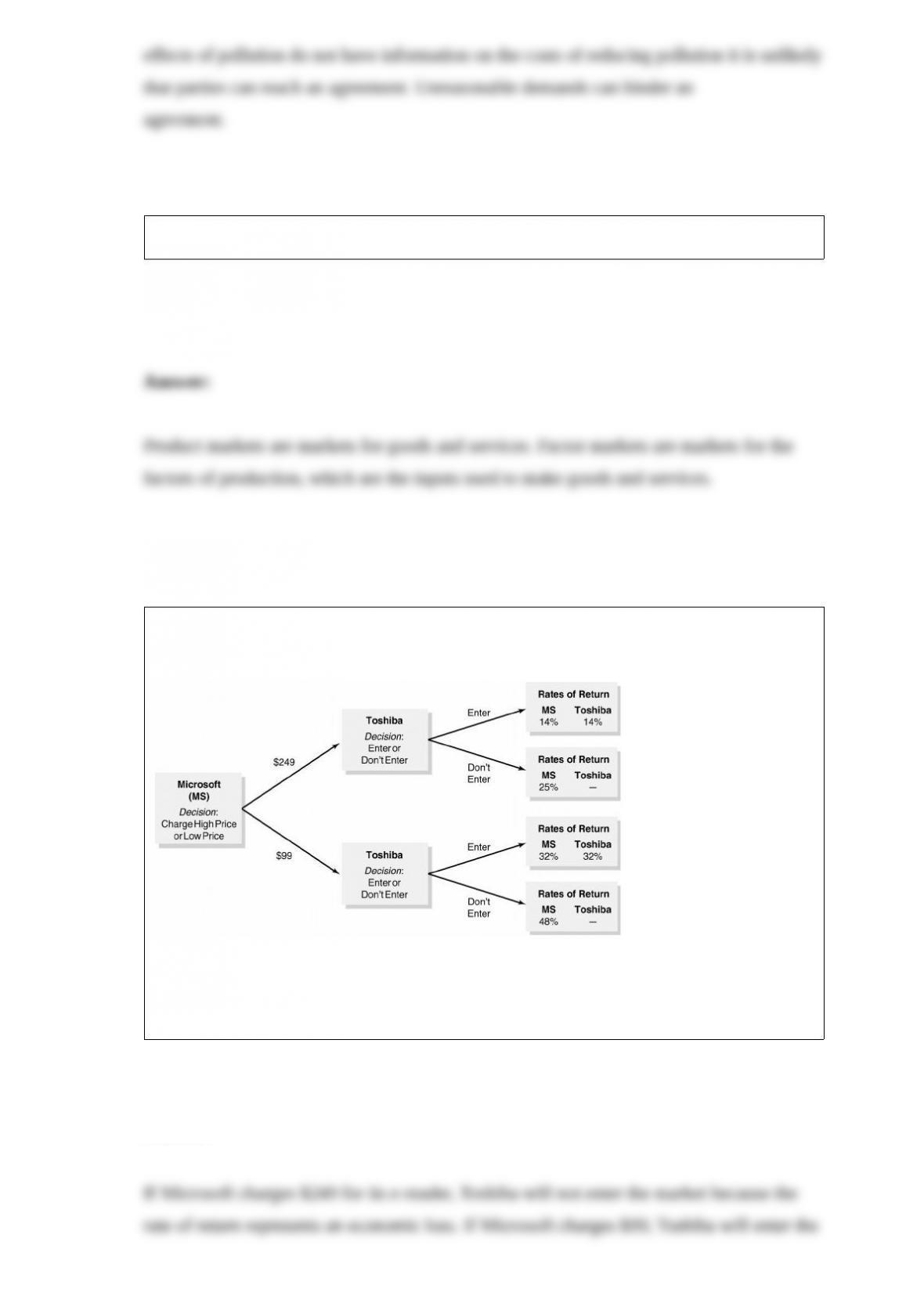
Figure 14-8
Refer to Figure 14-8 Use the decision tree to determine whether Microsoft should deter
Toshiba from entering the market for electronic book readers (e-readers). Assume that
each firm must earn a 20% return on investment to break even. Explain Microsoft’s
decision process.

How can a sole proprietorship raise funds needed for firm expansion?
Why might a young, healthy person choose not to buy health insurance?
What is meant by the term “internalizing an externality”? How does a Pigovian tax or
subsidy internalize an externality?

In Michael Porter’s five competitive forces model, what do the competitive forces
determine?
Describe the relationship between marginal cost and average total cost.
How do firms raise external funds through indirect finance?

How is economic profit found?
Suppose that if a local McDonald’s restaurant reduces the price of a Big Mac from
$4.00 to $3.25, the number of Big Macs it sells per day will increase from 4 to 5.
Explain the output effect and the price effect resulting from this change. Using a graph,
illustrate both the loss in revenue from selling each of the first 4 Big Macs for $0.75
less and the additional revenue from selling 1 more Big Mac. What is the total change
in revenue received which results from this price decrease?