
Economists have used the ultimatum game and the dictator game in experiments
designed to determine
A) whether consumers care about fairness when they make decisions.
B) whether consumers believe it is fair for producers to raise the price of a product for
which there is excess demand.
C) whether consumers understand the difference between implicit costs and explicit
costs.
D) whether consumers understand the rule of equal marginal utility per dollar spent.
If a firm’s long-run average total curve shows that it can produce 5,000 DVDs at an
average cost of $2.00 and 15,000 DVDs at an average cost of $1.50 this is evidence of
A) diminishing returns.
B) economies of scale.
C) diseconomies of scale.
D) the law of supply.
Why do most firms in monopolistic competition typically make zero profit in the long
run?

A) because firms produce differentiated products
B) because the lack of entry barriers would compete away profits
C) because firms do not produce at their minimum efficient scale
D) because the total market is not large enough to accommodate so many firms
Allocative efficiency is achieved when firms produce goods and services
A) at the lowest possible cost.
B) that consumers value most.
C) at the lowest opportunity cost.
D) at a marginal cost of zero.
When the price of audio books, a normal good, falls, causing your purchasing power to
rise, you buy more of them due to
A) the substitution effect.
B) the income effect.
C) the deadweight loss effect.

D) the elasticity effect.
If a monopolistically competitive firm has excess capacity
A) it has exhausted all economies of scale.
B) it is producing beyond the minimum efficient scale.
C) it is experiences diseconomies of scale.
D) it produces an output rate that places it on the negatively sloped portion of its
average total cost curve.
Table 18-1
Suppose $1 billion is available in the budget and Congress is considering allocating the
funds to one of the following three alternatives: 1. Subsidies for education, 2. Research
on Alzheimer’s or 3. Increased border security. Table 18-1 shows three voters’ rankings
of the alternatives.
Refer to Table 18-1.Suppose a series of votes are taken in which each pair of
alternatives is considered in turn. The first pair considered is between subsidies for

education and research on Alzheimer’s. The second pair considered is between
Alzheimer’s research and increased border security. The third pair considered is
between education subsidies and increased border security. In this case, the collective
preferences of the voters
A) turn out to be transitive and will yield a consistent outcome.
B) turn out to be transitive but will not result in a consistent outcome.
C) turn out not to be transitive and will not result in a consistent outcome.
D) turn out not to be transitive but will yield a consistent outcome.
Once a country has lost its comparative advantage in producing a good, its income will
be ________ and its economy will be ________ if it switches from producing the good
to importing it.
A) higher; less efficient
B) higher; more efficient
C) lower; less efficient
D) lower; more efficient
The term “early adopters” refers to

A) firms that are the first to implement a new technology that is used to produce new
goods or services.
B) book clubs that are first to recommend best-selling books to their members.
C) consumers who respond quickly to fads, seasonal changes, etc.
D) consumers who are willing to pay high prices to be among the first to own new
products.
In the United States from 1981 to 2011, deaths from diabetes increased largely due to
the effects of
A) foreign-produced insulin.
B) stress in the workplace.
C) a larger immigrant population.
D) increasing obesity.
Which of the following describes how a negative externality affects a competitive
market?
A) The externality causes a difference between the private cost of production and the
social cost.

B) The externality causes a difference between the private cost of production and the
private benefit from consumption.
C) The externality causes consumer surplus to exceed producer surplus.
D) The externality causes a difference between the private cost of production and the
equilibrium price.
All of the following are ways by which existing firms can deter the entry of new firms
into an industry except
A) continuously producing new and improved products.
B) earning less than maximum profit.
C) advertising products aggressively.
D) threatening to raise prices.
Economists John Cogan, Glenn Hubbard, and Daniel Kessler have estimated that
repealing the tax preference for employer-provided health insurance would
A) significantly reduce the effectiveness of the health care received by those enrolled in
these programs.
B) increase overall spending on health care as consumers would have to pay a higher
price for medical services.

C) drive up prices for health care coverage since insurance reimbursements to doctors
would be reduced.
D) reduce spending by people enrolled in these programs by 33 percent.
Compared to a monopolistic competitor, a monopolist faces
A) a more elastic demand curve.
B) a more inelastic demand curve.
C) a more elastic demand curve at higher prices and a more inelastic demand curve at
lower prices.
D) a demand curve that has a price elasticity coefficient of zero.
Table 4-2

Refer to Table 4-2. The table above lists the highest prices five consumers are willing to
pay for a theater ticket. If the price of one ticket rises from $10 to $19
A) only three tickets will be sold.
B) consumer surplus decreases from $31 to $6.
C) consumer surplus increases from $44 to $71.
D) no one will buy a ticket.
Over the past 160 years in the United States, life expectancy
A) has remained fairly constant.
B) has slightly declined.
C) has more than doubled.
D) increased up to the 1950s and then declined for the next 60 years.
Which of the following is not a determinant of a good’s price elasticity of demand?
A) the slope of the demand curve
B) the share of the good in the consumer’s total budget
C) whether the good is a luxury or a necessity
D) the passage of time
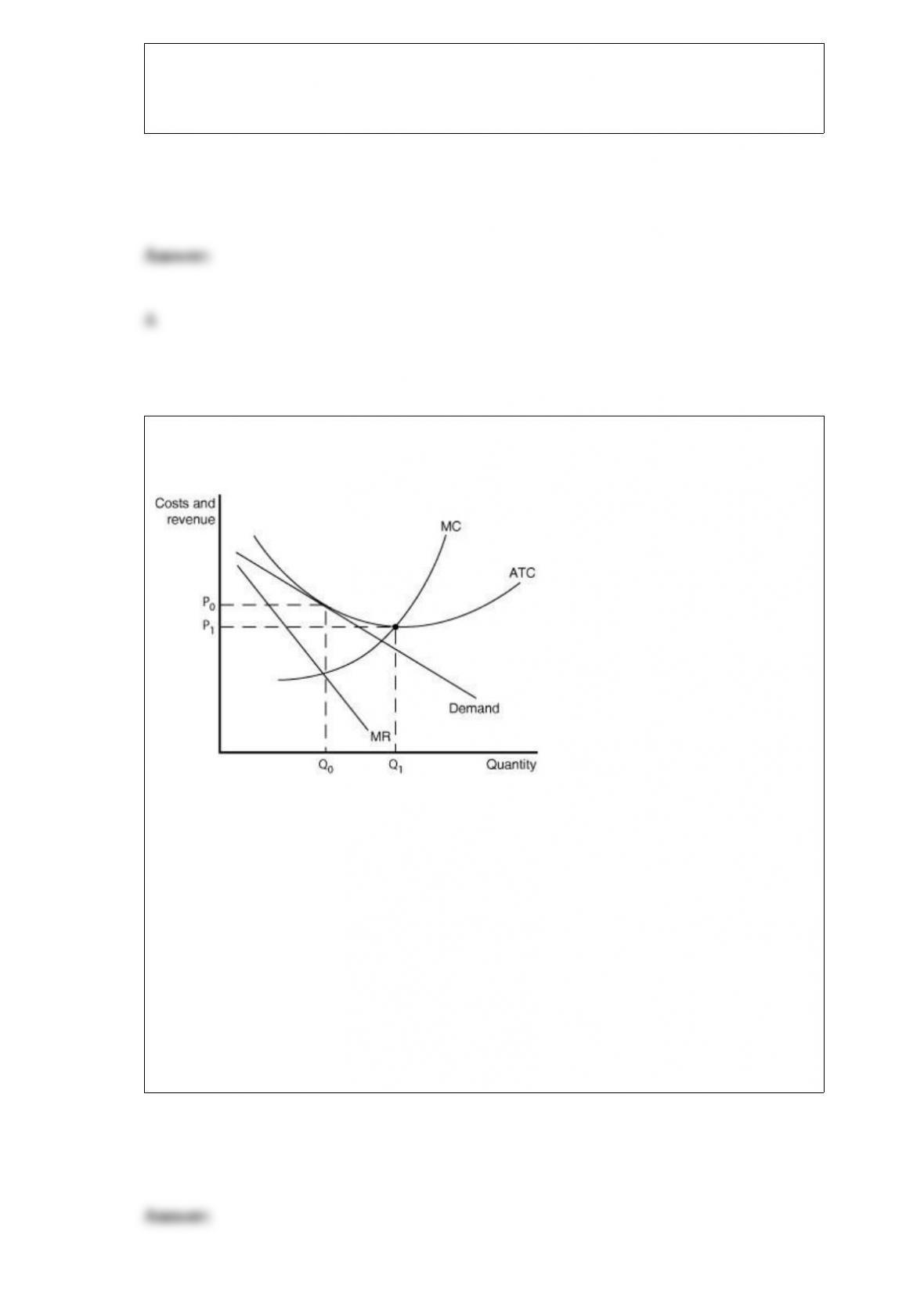
Figure 13-14
Figure 13-14 illustrates a monopolistically competitive firm.
Refer to Figure 13-14. It is possible to lower the average cost of production by
expanding output beyond Q0 to Q1. Why wouldn’t a firm expand its output to Q1?
A) The firm wants to maximize accounting profit rather than economic profit.
B) The firm would suffer an economic loss at Q1 while it would break even at Q0.
C) The firm’s marginal revenue would be negative at Q1.
D) Demand is not sufficient for consumers to buy Q1.

Consider three pricing strategies that the firm can pursue:
a. optimal two-part tariff pricing
b. perfect price discrimination
c. single-price monopoly pricing
Of these three strategies, which method gives the firm the highest profit?
A) optimal two-part tariff pricing
B) perfect price discrimination
C) single-price monopoly pricing
D) The profit is the same under optimal two-part tariff pricing and perfect price
discrimination and the profit is higher than under single-price monopoly pricing.
Why might a producer practice price discrimination?
A) to make its products more affordable to those with low incomes
B) to maximize economic efficiency
C) to maximize profits
D) to maximize quantity demanded
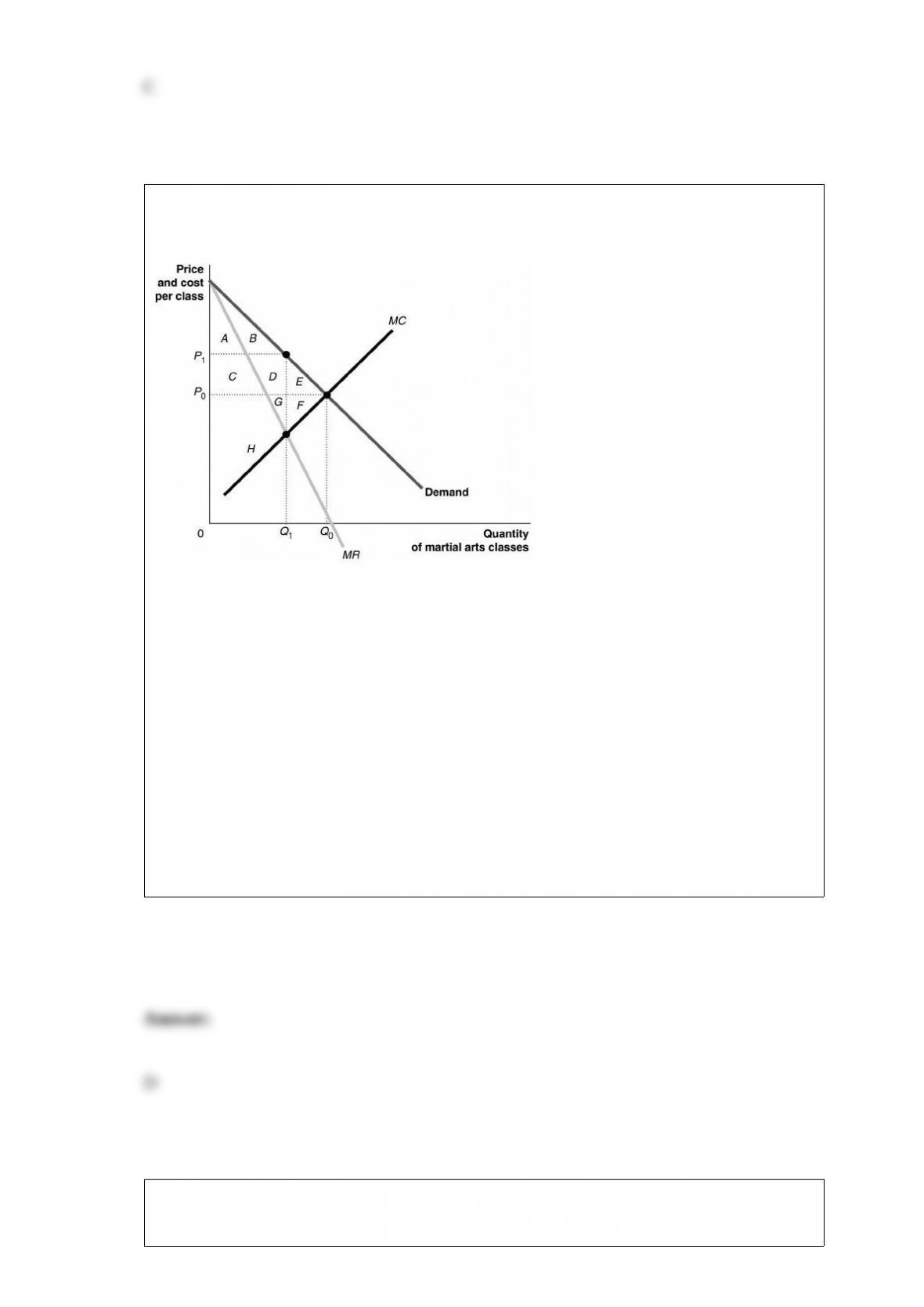
Figure 16-6
Watanabe Sensei operates the only martial arts school in Hartfield. For simplicity,
assume that consumers have identical demand curves and that Sensei knows what this
demand curve is. Figure 16-6 shows this demand curve.
Refer to Figure 16-6. With this pricing scheme – a competitive price for the classes and
a one-time membership fee – what amount of producer surplus will Sensei earn?
A) the area A + B + C + D + E.
B) the area E + F.
C) the area H + G + F.
D) the area A + B + C + D + E + F + G + H
The existence of ________ increases the risk of buying stock in a corporation.

A) the principal-agent problem
B) corporate governance
C) unlimited personal liability
D) employee-owned corporations
Of the following, which has most likely contributed the most to the rapid rise in health
care costs in the United States?
A) the cost of malpractice insurance
B) the cost to treat uninsured patients
C) slow growth in labor productivity in health care
D) the cost of malpractice lawsuit settlements
If a perfectly competitive firm’s total revenue is less than its total variable cost, the firm
A) should raise its price above its average variable cost.
B) should continue to produce and increase its demand.
C) should stop production by shutting down temporarily.

D) should adopt new technology in order to lower its costs of production.
DeShawn’s Detailing is a service that details cars at the customers’ homes or places of
work. DeShawn’s cost for a basic detailing package is $40, and he charges $75 for this
service. For a total price of $90, DeShawn will also detail the car’s engine, a service that
adds an additional $20 to the total cost of the package. Should DeShawn continue to
offer the engine detailing service?
A) yes, he still makes a profit by selling the engine detailing service with the basic
detailing package
B) yes, but only if he raises the price of the basic detailing package
C) no, his marginal benefit is less than his marginal cost
D) More information is needed for DeShawn to make this decision.
Figure 18-6
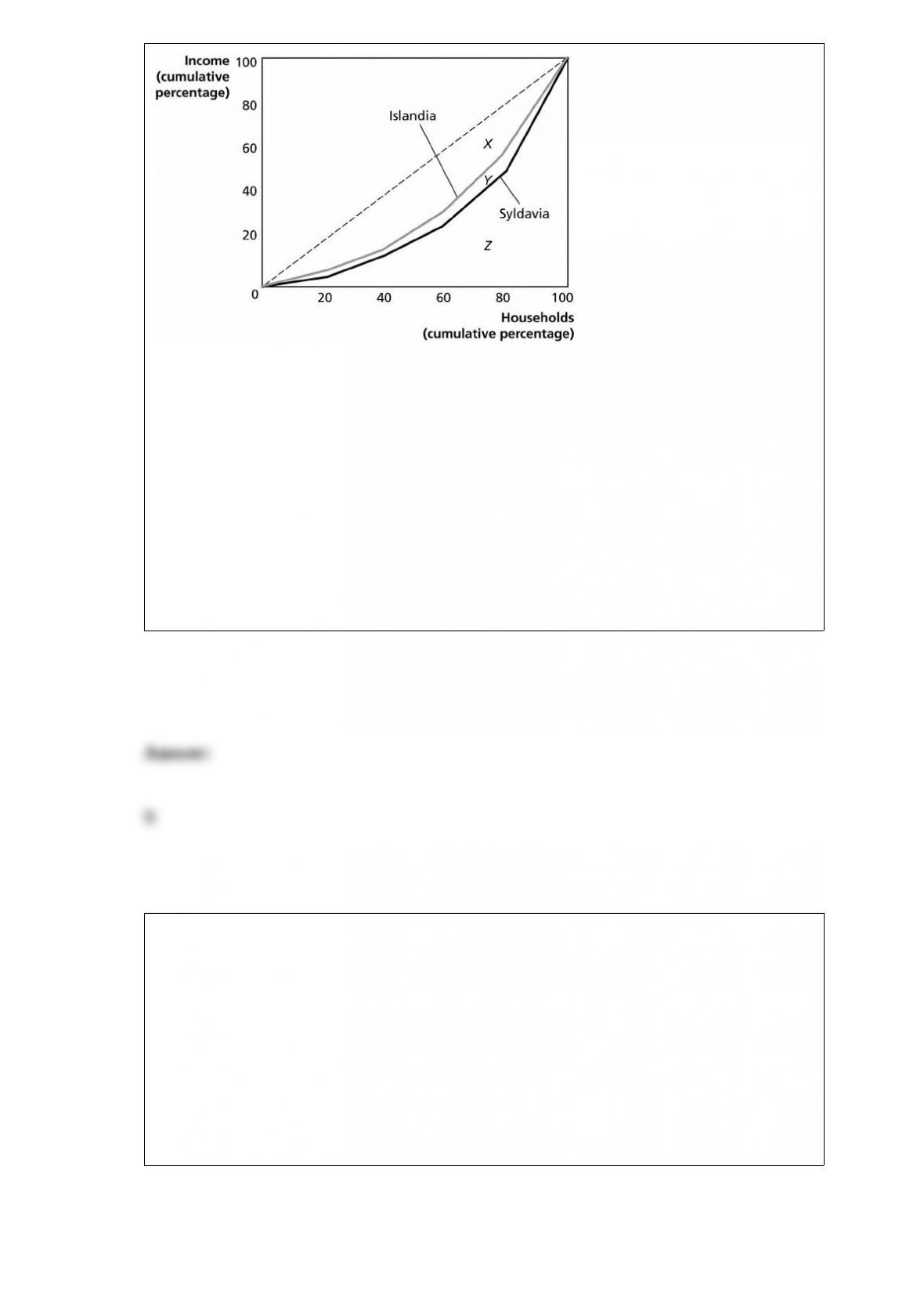
Figure 18-6 shows the Lorenz curves for Islandia and Syldavia.
Refer to Figure 18-6. Which country has the more unequal distribution of income?
A) Islandia
B) Syldavia
C) They may have the same absolute income distribution although their relative income
distribution is different.
D) There is insufficient information to answer the question.
If a straight line passes through the point x = 14 and y = 3 and also through the point x =
4 and y = 10, the slope of this line is
A) negative 11 divided by 6.
B) seven tenths.
C) negative seven tenths.
D) 6 divided by 11.
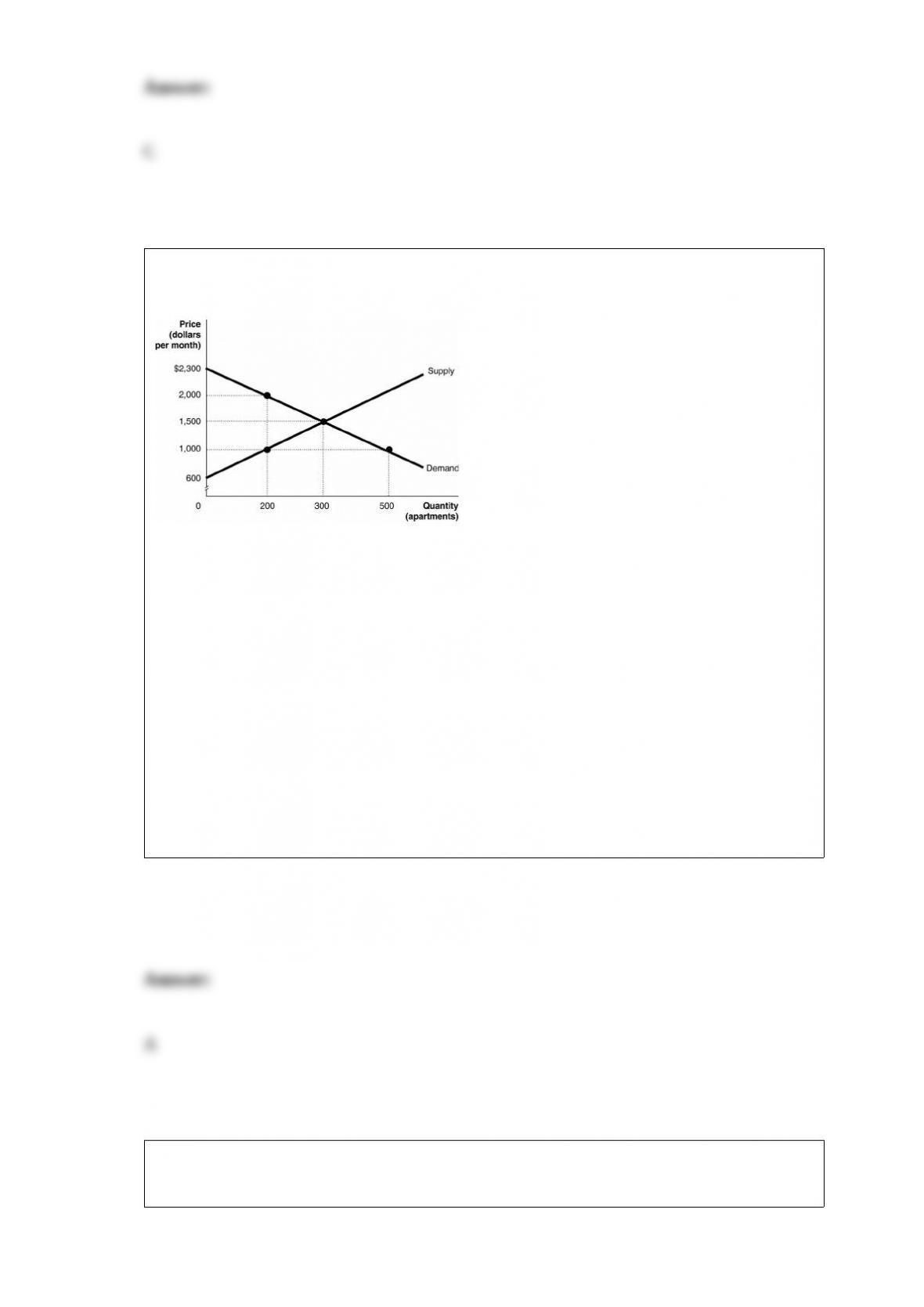
Figure 4-5
Figure 4-5 shows the market for apartments in Springfield. Recently, the government
imposed a rent ceiling of $1,000 per month.
Refer to Figure 4-5. Suppose that instead of a rent ceiling, the government imposed a
price floor of $2,000 per month for apartments. What is the value of the deadweight
loss after the imposition of the price floor?
A) $50,000
B) $125,000
C) $175,000
D) $260,000
Figure 16-7

The Lizard Lounge is well known for its exotic cocktails. Figure 16-7 shows its
estimated demand curve for cocktails.
Refer to Figure 16-7. The owners of the Lizard Lounge are considering the following
four pricing options:
a. A single price scheme where the cocktail price equals the monopoly price.
b. A single price scheme where the cocktail price equals the competitive price.
c. A two-part tariff: a monopoly price for cocktails and a cover charge that will generate
total revenue equal to the area X.
d. A two-part tariff: a competitive price for cocktails and a cover charge that will
generate total revenue equal to the area X + Y + Z.
Under which scheme are the Lounge customers better off?
A) scheme a
B) scheme b
C) scheme c
D) scheme d
Figure 12-2
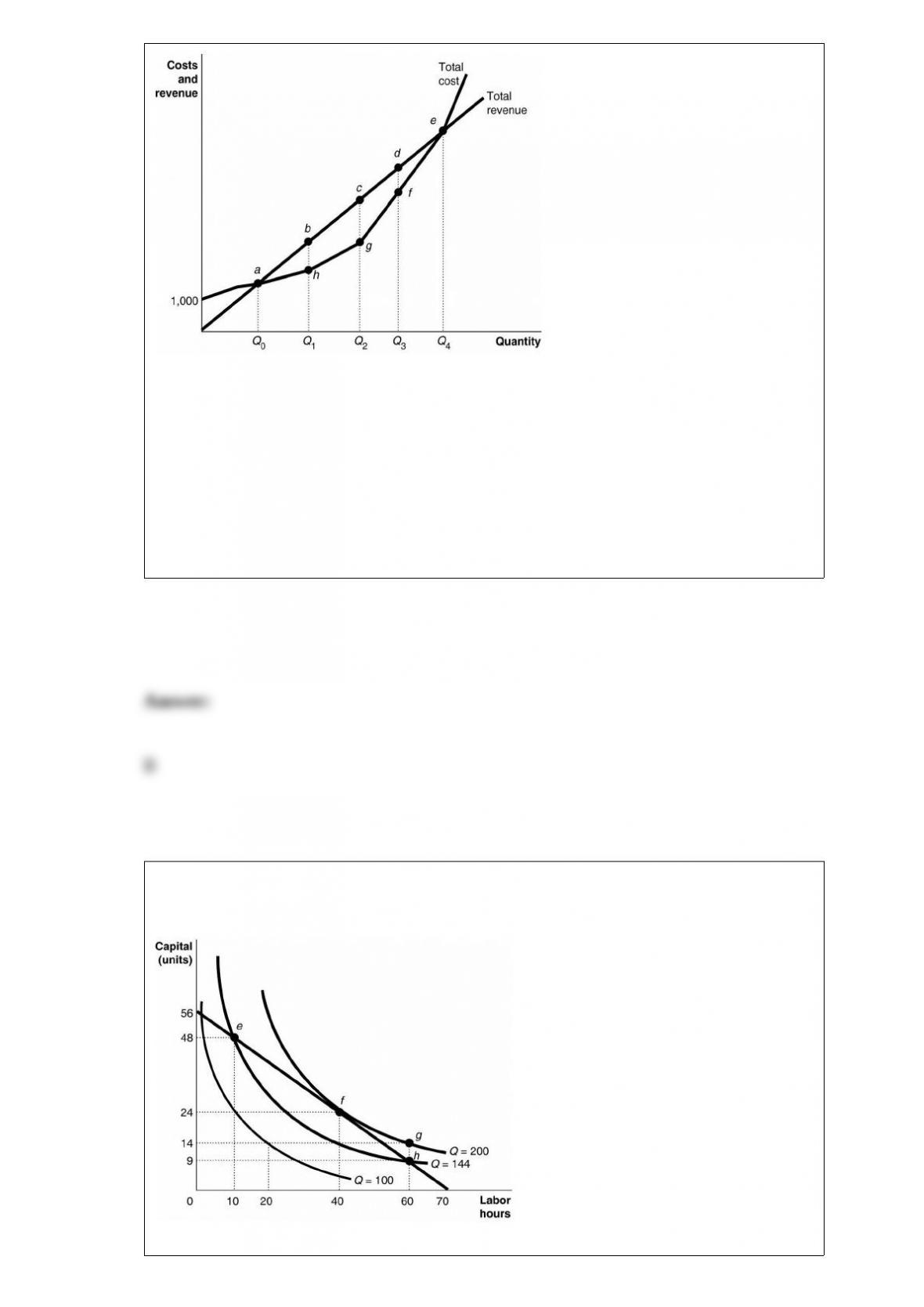
Refer to Figure 12-2. What happens if the firm produces more than Q4 units?
A) Its profit increases.
B) It makes a loss.
C) Its total revenue is increasing faster than its total cost.
D) It could make a profit or a loss depending on what happens to demand.
Figure 11-15
Refer to Figure 11-15. What is the combination of inputs that produces 200 gooseberry

pies at the lowest cost?
A) combination e: 10 hours of labor and 48 units of capital
B) combination f: 40 hours of labor and 24 units of capital
C) combination g: 60 hours of labor and 14 units of capital
D) combination h: 60 hours of labor and 9 units of capital
Which of the following is not an advantage cost-plus pricing?
A) It leads to profit maximization.
B) It is an easy method to implement if a firm produces multiple products and has
overhead costs that are difficult to allocate to a particular good.
C) It could lead to price stability if the industry is made up of identical firms all using
the same method of pricing.
D) It is easy to justify price increases when total costs of production increase.
Figure 12-10

Refer to Figure 12-10. The firm’s short-run supply curve is its
A) marginal cost curve.
B) marginal cost curve from b and above.
C) marginal cost curve from c and above.
D) marginal cost curve from d and above.
If another worker adds 9 units of output to a group of workers who had an average
product of 7 units, then the average product of labor
A) will remain the same.
B) will increase.
C) will decrease.
D) and what will happen to it cannot be determined.