
When a banker accepts a deposit of $1,000 in cash and puts $200 aside as required
reserves and then makes a loan of $800 to a new borrower, this set of transactions
a. decreases the money supply by $1,000.
b. decreases the money supply by $200.
c. does not change the money supply.
d. increases the money supply by $200.
e. increases the money supply by $800.
In price-taker markets, individual firms have no control over price. Therefore, the firm’s
marginal revenue curve is
a. a downward-sloping curve.
b. indeterminate.
c. constant at the market price of the product.
d. precisely the same as the firm’s total revenue curve.
The share of college degrees earned by women was ____ in 2013 compared to ____ in
1961.
a. 50 percent; 50 percent
b. 47 percent; 30 percent

c. 57 percent; 39 percent
d. 51 percent; 48 percent
Black markets that operate outside the legal system are often characterized by
a. low profits for suppliers.
b. lower opportunity costs for suppliers and buyers.
c. decreased prices.
d. the use of violence as a means of settling disputes.
Which of the following is part of the modern view of the Phillips curve?
a. When inflation exceeds what was anticipated, unemployment falls below the natural
rate.
b. When inflation is less than anticipated, unemployment will rise above the natural
rate.
c. Demand stimulus policies can temporarily reduce unemployment, but in the long run,
their primary impact will be on prices (inflation).
d. All of the above are correct.
Starting from an initial long-run equilibrium, under the adaptive expectations
hypothesis, a shift to a more expansionary policy will increase
a. prices and unemployment in the long run.
b. real output in the short run but not in the long run.
c. real output in the long run but not in the short run.
d. real output in both the long run and the short run.
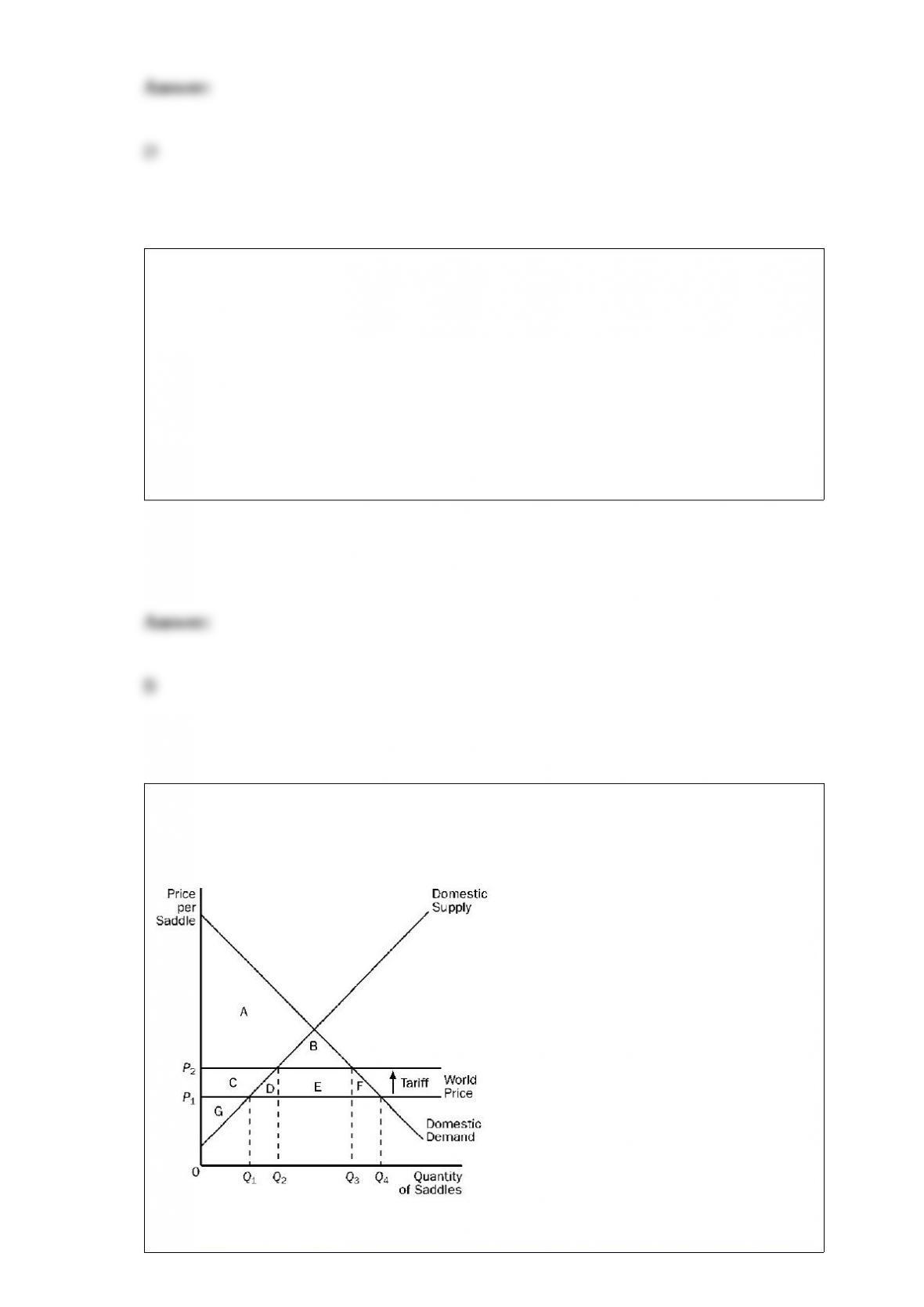
Figure 17-10
Refer to Figure 17-10. A result of the tariff is that, relative to the free-trade situation, the
quantity of saddles imported decreases by

a. Q2 Q1.
b. Q3 Q2.
c. Q4 Q3.
d. Q4 Q3 + Q2 Q1.
A decrease in the demand for a product will cause output of that product to
a. increase and the demand for and prices of the resources used to produce the product
to rise.
b. decrease and both the demand for and prices of the resources used to produce the
product to fall.
c. decline; the demand for the resources used to produce the product will remain
constant.
d. increase; the price of resources used to produce the product will rise if their supply is
elastic but fall if supply is inelastic.
Answer the following questions:
a. What are the three types of unemployment, and which two compose the natural rate?
b. Give an example of a person who would be counted in each type.
c. Would an economy with 2 percent actual unemployment be in a recession? Why or

why not?
When deciding whether to buy a second car, the economic way of thinking indicates
that the purchaser should compare
a. the benefits expected from two cars with the cost of both.
b. the additional benefits expected from a second car with the cost of the two cars.
c. the dollar cost of the two cars with the potential income that the cars will generate.
d. the additional benefits of the second car with the additional cost of the second car.
The Economic Freedom of the World index is a measure of the consistency of a nation’s
institutions and policies with

a. political democracy.
b. economic freedom.
c. an Egalitarian distribution of income.
d. economic nationalism.
Measured as a share of the economy, the size of the trade sector (exports plus imports)
of the United States has
a. been increasing since 1980, but it declined during 1960-1980.
b. been relatively constant during the last four decades.
c. increased by about 10 percent during the last four decades.
d. approximately doubled since 1980 and tripled since 1960.
When the production possibilities curve is bowed out, resources are
a. equally well-suited to production of both goods.
b. not being used efficiently.
c. not equally suited to the production of both goods.
d. available in larger and larger quantities as more of one good is produced.
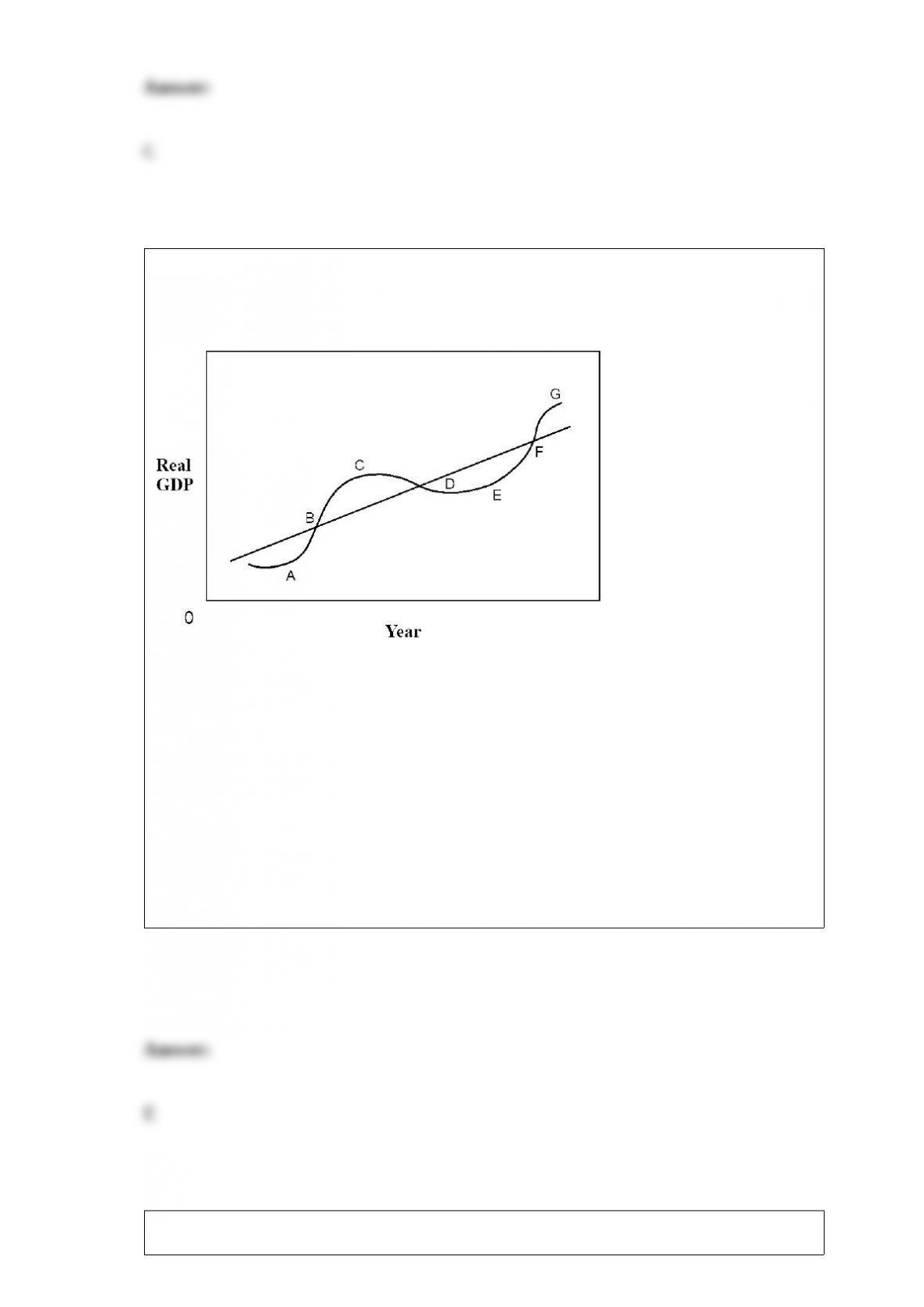
Figure 8-1
In Figure 8-1, the recovery phase of the business cycle can be represented by points:
a. A.
b. C.
c. E.
d. C to E.
e. E to G

Which of the following is a difference between corporations and partnerships?
a. Partnerships are subject to double taxation; corporations are not.
b. With partnerships, ownership rights are divisible and easily transferable; this is not
true for corporations.
c. Corporate owners face limited liability; owners of partnerships do not.
d. Corporations always have more owners than partnerships.
A hotel in New Hampshire charges $150 per room in the winter ski season and $90
during the summer months. The number of rooms and operating costs are constant year
round. These prices indicate
a. a rightward shift in the demand in the summer.
b. a rightward shift in demand in the winter.
c. a leftward shift in the supply curve in the summer.
d. a leftward shift in demand in the winter.
Suppose the market equilibrium price of corn is $5 per bushel, and the government sets
a price ceiling of $4 per bushel. What is the most likely result of this action?
a. There will be a shortage of corn.
b. There will be a surplus of corn.
c. There will be a decrease in the quantity of corn demanded as the result of the price
ceiling.
d. There will be an increase in the quantity of corn supplied as the result of the price

ceiling.
The interest rate in the federal funds market
a. is determined by the imposition of price controls imposed by the Fed.
b. will tend to rise when the quantity of funds demanded by banks seeking additional
reserves exceeds the quantity supplied by banks with excess reserves.
c. will tend to fall if the Fed sells bonds and, thereby, reduces the reserves available to
banks.
d. is an interest rate that is largely unaffected by the policies of the Fed.
If DeShawn only pays $25,000 to purchase a new car even though he would have been
willing to pay as much as $35,000 for the car, this indicates that
a. DeShawn is an irrational consumer.
b. The seller earned a $10,000 profit on the sale of the car.
c. DeShawn reaped $10,000 of consumer surplus from the transaction.
d. The seller received $10,000 worth of producer surplus on the transaction.

The supply of resources, level of technology, and the quality of an economy’s
institutional arrangements provide the constraint that determines the shape of the
a. short-run aggregate supply curve.
b. long-run aggregate supply curve.
c. supply of loanable funds.
d. aggregate demand curve.
If policy makers believe that an inflationary boom is about to begin, the Keynesian
view indicates that they should
a. increase the budget deficit.
b. increase government spending and hold taxes constant.
c. decrease government spending and/or raise taxes.
d. hold government spending constant and decrease taxes.
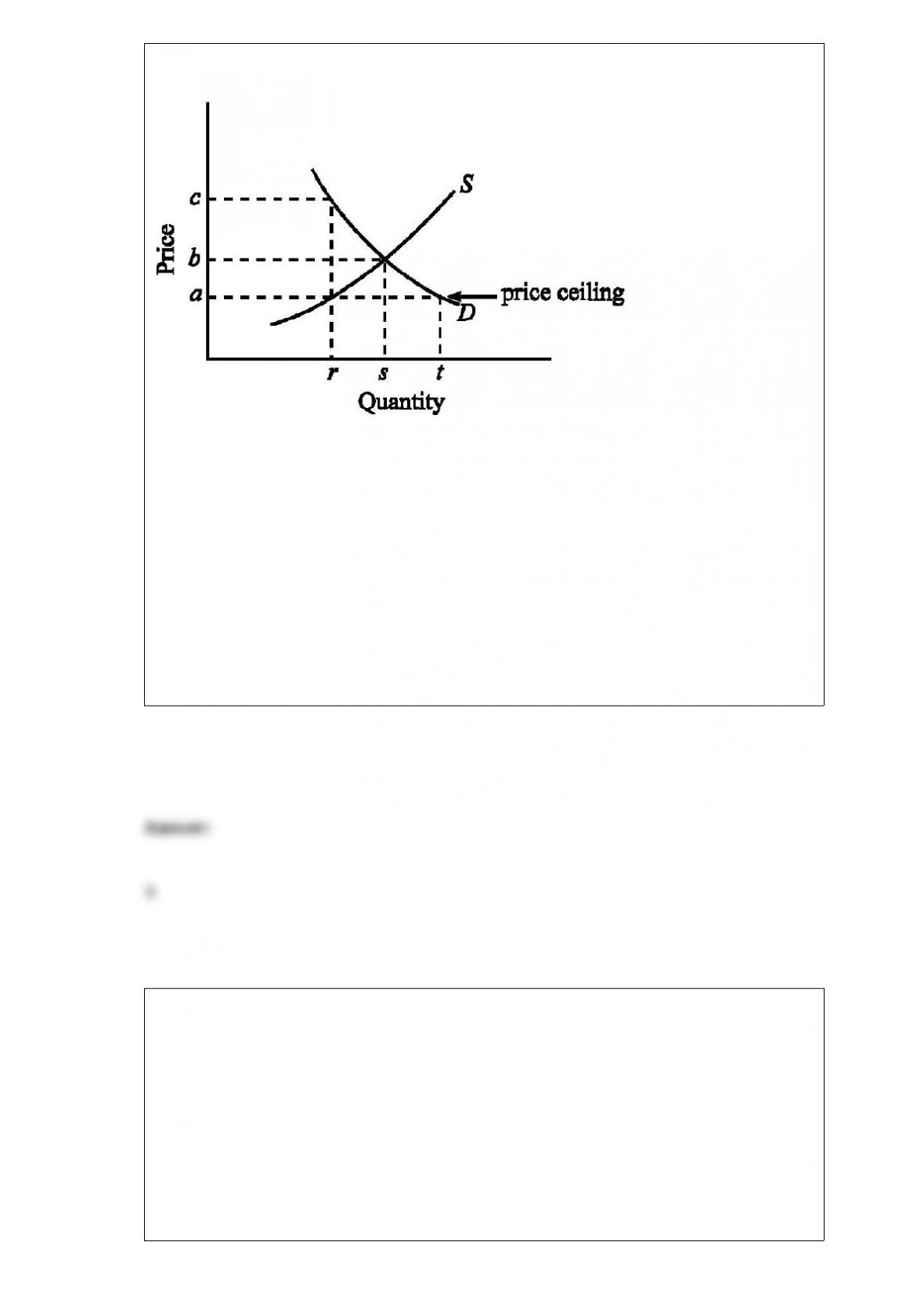
Figure 4-2
Given the demand and supply conditions shown in Figure 4-2, if the government
imposes a price ceiling of a, indicate the quantity consumers would like to buy and the
amount producers would be willing to supply.
a. Consumers would want to buy t; producers would be willing to sell r.
b. Consumers would want to buy r; producers would be willing to sell t.
c. Consumers would want to buy t; producers would be willing to sell s.
d. Consumers would want to buy s; producers would be willing to sell s.
Isabella is contemplating investing $10,000 in an investment. It is expected to yield
$4,000 at the end of each of the next three years. The interest rate is 5 percent. What is
the net present value of the expected revenues from the investment?
a. $8,426
b. $9,947
c. $10,893

d. $12,000
According to the official measure of poverty, in 2010 the poverty rate of families in the
United States was
a. 4.2 percent.
b. 11.1 percent.
c. 18.5 percent.
d. 22 percent
Most studies indicate that the degree of income inequality in the United States has
a. been increasing in recent decades.
b. been declining in recent decades.
c. been constant since 1970.
d. fluctuated widely from year to year.

What impact did the National Industrial Recovery Act (NIRA) of 1933 have on
industrial output?
a. Industrial output had been declining, but it stabilized during the months following
passage of the NIRA.
b. Industrial output increased sharply after the passage of the NIRA.
c. Industrial output had begun to increase, but it fell sharply following the passage of
the NIRA.
d. Industrial output and employment declined during the months prior to passage of the
NIRA, and the legislation was unable to stop the decline.
In which statement(s) are “supply” and “quantity supplied” used correctly?
(I) “An increase in the price of toasters will increase the quantity supplied of toasters.”
(II) “A technological advance that lowers the cost of producing toasters will increase the
supply of toasters.”
a. in both statements I and II
b. in statement I only
c. in statement II only
d. in neither statements I nor II
Since 1980, income inequality (as measured by the income share of the highest 20
percent of income earners relative to the lowest 20 percent) has

a. been virtually unchanged.
b. increased.
c. decreased.
d. fluctuated in a random pattern.
Consumers buy less of a good as its price increases because
a. production costs have risen.
b. substitute goods are now relatively cheaper.
c. the income of consumers has effectively risen.
d. the higher price will make the good more valuable to each consumer.
Which of the following is the clearest evidence of employment discrimination against
minority employees?
a. the average wage of minority workers is lower than the average wage of whites.
b. the average hours worked by minority employees exceeds the hours worked by
whites.
c. the mean number of years of schooling of minority workers is lower than that of
whites.
d. the average wages of minority employees are lower than the average wages of whites
with similar productivity characteristics.

A competitive capital market is important to society because it directs resources toward
projects that
a. can be completed quickly.
b. create wealth.
c. have an outcome that is known with certainty.
d. reduce the value of the resources employed.