Answer the following questions.
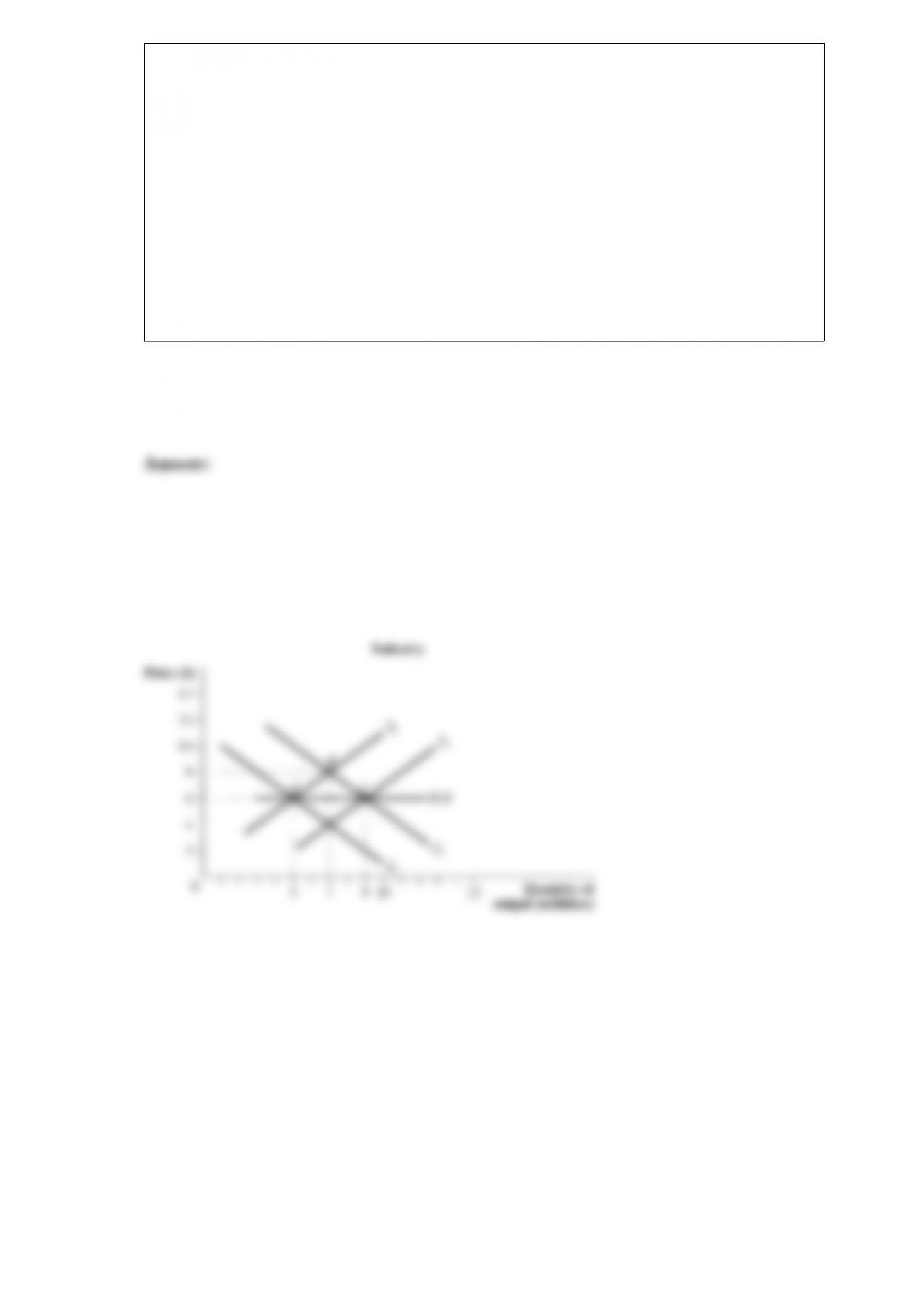
a. Graphically illustrate an industry in long-run equilibrium. You should use two
diagrams: one for the industry supply and demand curves and another for a
representative firm.
b. Starting from the position of long-run equilibrium, graphically illustrate the short-run
effect of an increase in demand on the industry and one of its representative firms.
c. Starting from the position of long-run equilibrium, graphically illustrate the long-run
effect of an increase in demand on the industry and one of its representative firms.
Make sure to identify the long-run industry supply curve.
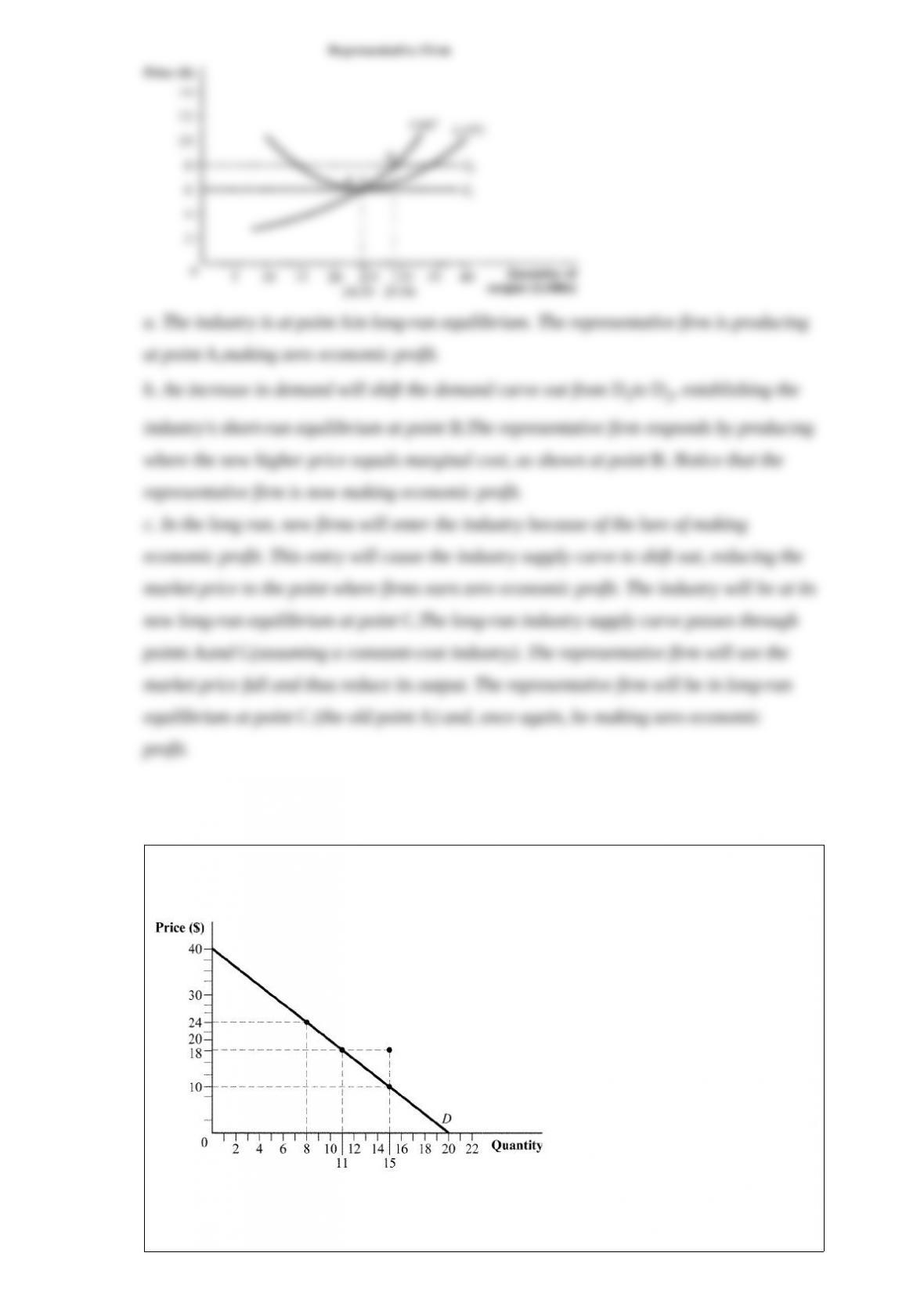
Figure 10.5
(Figure 10.5) Suppose that a firm offers customers either (1) the ability to buy any
quantity they desire for $24 per unit or (2) a price of $18 per unit if purchasing 15 or

more units. Consumer surplus under the quantity discount is ______ than under the
$24-per-unit pricing scheme, so the plan to charge these types of consumers a price of
$24 per unit is ______ compatible.
A) $64 more; incentive
B) $32 less; not incentive
C) $53 less; incentive
D) $41 more; not incentive
In a perfectly competitive market, each firm has a long-run total cost given by
and long-run marginal cost curve given by LMC = 100 “20Q + Q2. What is the market’s
long-run equilibrium price?
A) $8.50
B) $33
C) $70
D) $25
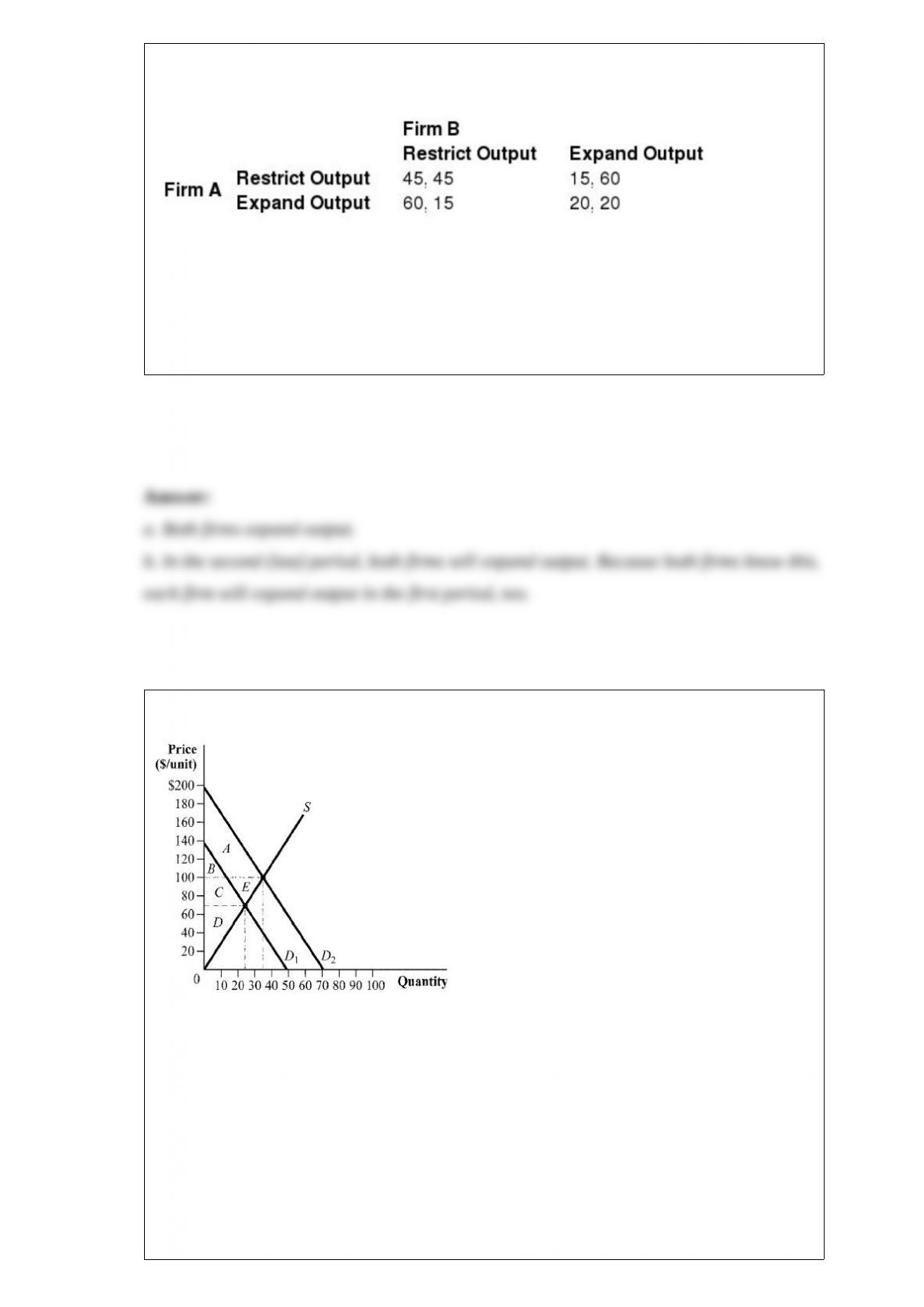
Table 12.31
(Table 12.31)
a. In a one-period simultaneous game, what is the Nash equilibrium?
b. If this simultaneous game is played twice, once in each period, what will be the
outcome in the first period? In the second period?
Figure 3.20
(Figure 3.20) Refer to Figure 3.20to answer the following questions:
a. Which letter(s) represent(s) the area of consumer surplus before the price increase?
b. Which letter(s) represent(s) the area of producer surplus before the price increase?
c. Which letter(s) represent(s) the area of consumer surplus after the price increase?
d. Which letter(s) represent(s) the area of producer surplus after the price increase?

e. Which letter(s) represent(s) the area of the deadweight loss after the price increase?
If a 5% increase in income increases quantity demanded by 4%, the income elasticity of
demand is:
A) 1.25.
B) 0.80.
C) 2.0.
D) 0.02.
Suppose the demand for lobster decreased from a fall in consumer income, while the
supply of lobster increased from a record harvest. What effect would these supply and
demand changes have on the equilibrium price and quantity of lobsters?
A) Both the equilibrium price and quantity would decrease.
B) The equilibrium price would fall, but the effect on the equilibrium quantity could not
be predicted.
C) The equilibrium price would fall and the equilibrium quantity would increase.
D) The equilibrium quantity would increase, but the effect on price could not be
predicted.
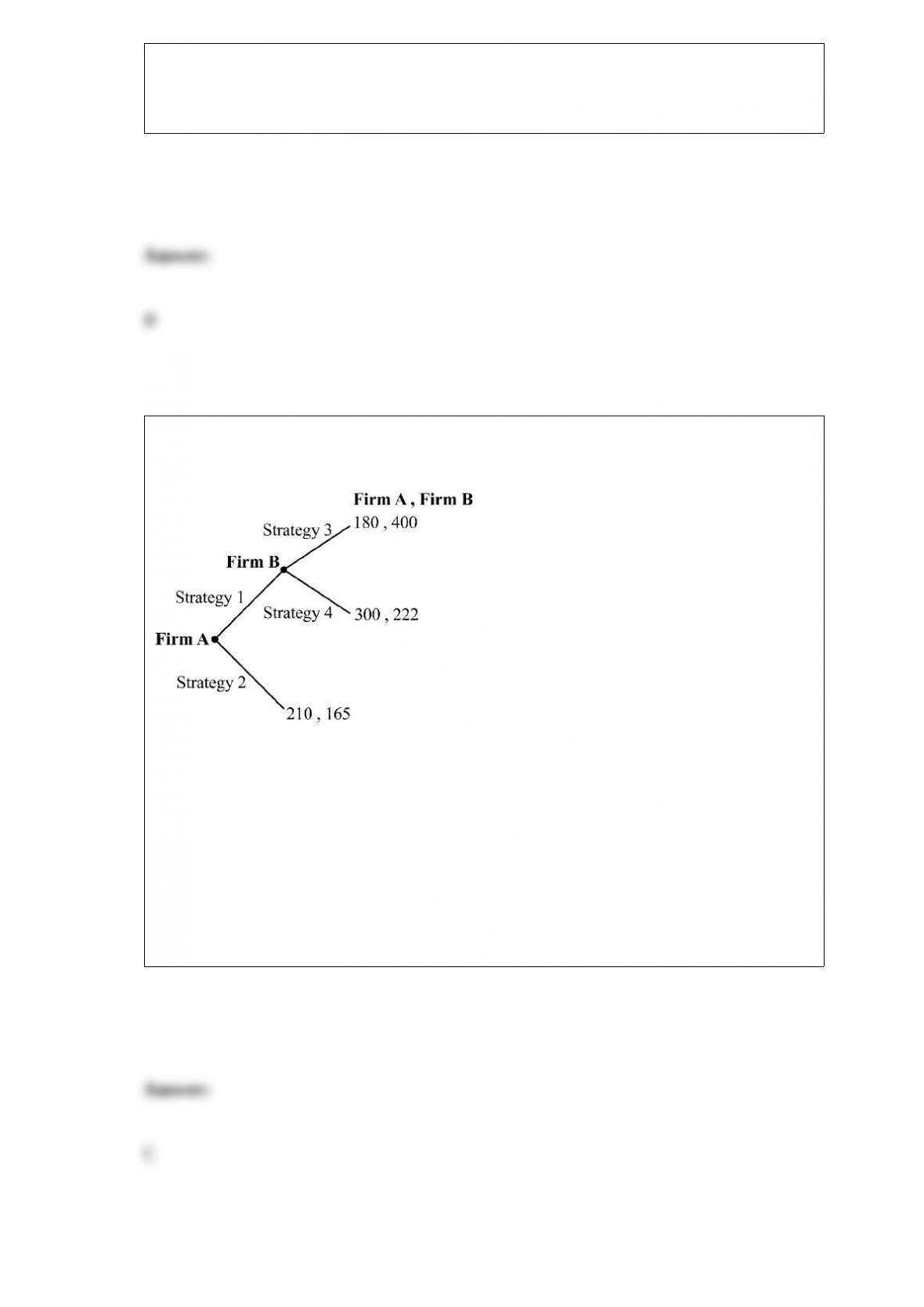
Figure 12.5
(Figure 12.5) The outcome of this game is for:
A) Firm B to choose strategy 3.
B) Firm A to choose strategy 1 and then Firm B to choose Strategy 3.
C) Firm A to choose strategy 2.
D) Firm A to choose strategy 1 and then Firm B to choose Strategy 4.

A change in household tastes and preferences causes the rate of saving to fall. What
happens in the market for capital?
A) The market interest rate increases and the quantity of capital increases.
B) The market interest rate increases and the quantity of capital decreases.
C) The market interest rate decreases and the quantity of capital decreases.
D) The market interest rate decreases and the quantity of capital increases.
Big Earth and District 13 are two producers of neodymium, a rare earth mineral. If both
firms agree to restrict output, each firm earns $100 million per year. If both firms
expand output, each firm earns $50 million per year. If one firm restricts output and the
other firm expands output, the firm that expands output earns $150 million per year and
the other firm earns only $30 million per year. Assume that Big Earth and District 13
will compete infinitely, with each firm following a grim trigger strategy. Which of the
following statements is TRUE?
A) If d = 0.50, Big Earth is indifferent between agreeing to restrict output and cheating
by expanding output.
B) If d = 0.40, Big Earth would be better off restricting output.
C) If d = 0.90, Big Earth is indifferent between agreeing to restrict output and cheating
by expanding output.
D) If d = 0.75, Big Earth would be better off cheating by expanding output.

Suppose that last year the equilibrium price and the quantity of good X were $10 and 5
million pounds. Because of strong demand this year, the equilibrium price and the
quantity of good X are $12 and 7 million pounds, respectively. Assuming that the
supply curve of good X is linear, what happened to producer surplus in the market?
A) Producer surplus decreased from $8 million to $6 million.
B) Producer surplus increased from $12.5 million to $24.5 million.
C) Producer surplus increased from $3 million to $7 million.
D) Producer surplus increased from $4.2 million to $5.6 million.
Hamid and Lee are neighbors. Hamid has a barking dog that he keeps in his backyard
for property protection; he values the dog at $600. Lee despises the constant barking,
because it costs him $800 in lost sleep.
a. If Hamid has a legal right to own a barking dog, is there a Coase solution to this
problem?
b. Because Hamid speaks Farsi and Lee speaks Korean, they need an interpreter to
handle negotiations regarding the barking dog. Is there a Coase solution to this problem
if the interpreter costs $70? How about if the interpreter charges $210?

Table 12.13
(Table 12.13) In the table, the payoffs represent dollars. If both players follow their
maximin strategy, the outcome of this game is:
A) (“500, “500).
B) (15, “25).
C) (25, “15).
D) (0, 0).
Which of the following is an example of a Cobb”Douglas production function?
A) Q = f(K, L)
B) Q = 5K + 2.5L
C) Q = K0.50L0.75
D) Q = 2K/3L
A firm’s demand curve is given by Q = 100 ” P. What is the firm’s
corresponding marginal revenue curve?
A) 150 ” 0.67Q
B) 100 ” 0.67Q
C) 150 ” 3Q
D) 150 ” 1.5Q
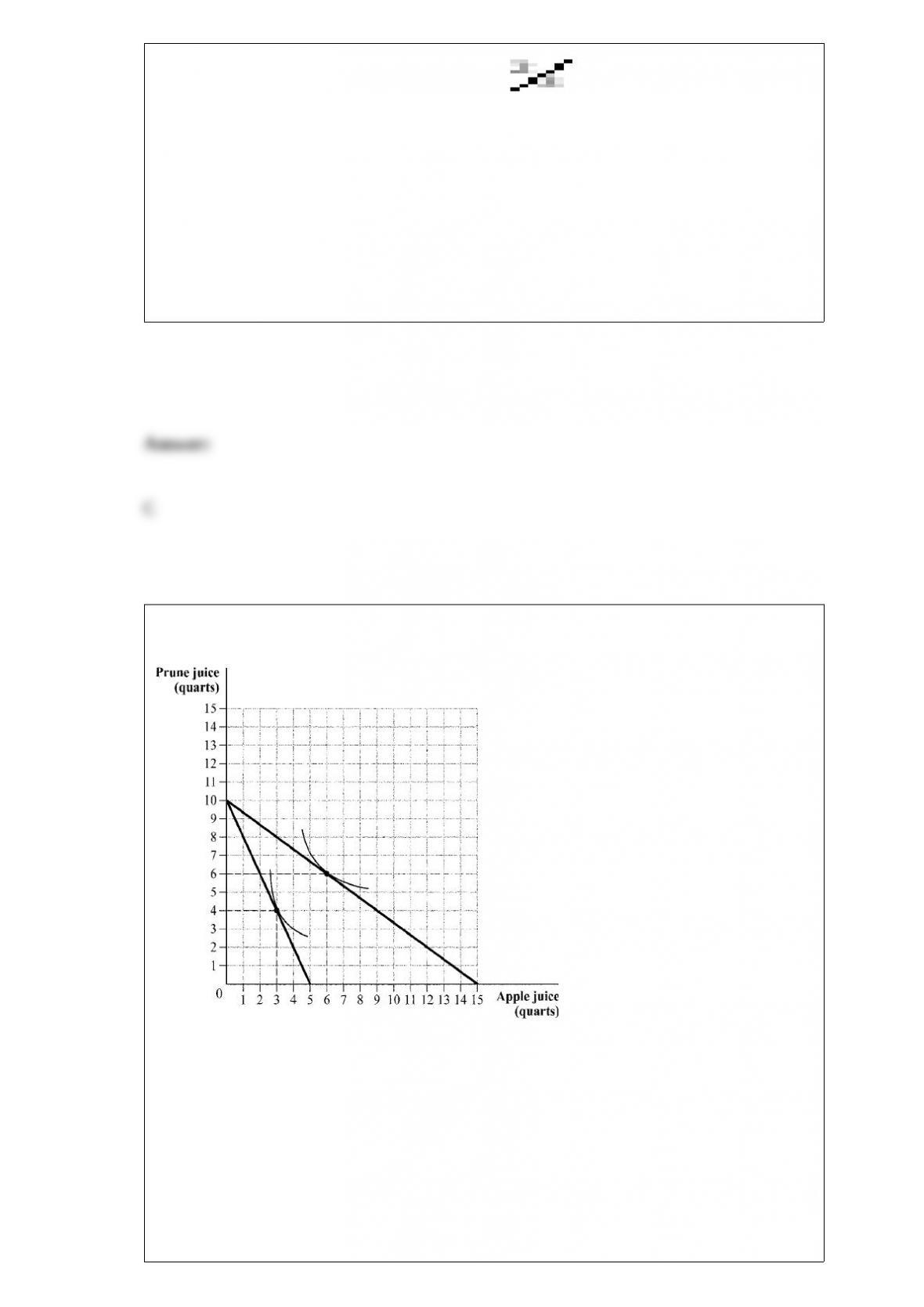
Figure 5.8
(Figure 5.8) Refer to Figure 5.8, depicting the consumer’s indifference curves and
budget constraints. Suppose the consumer has $20 of income to spend on apple and
prune juice. Which of the following statements is TRUE?
I. At a price of $2 per quart of apple juice, the consumer buys 3 quarts of apple juice.
II. At a price of $4 per quart of apple juice, the consumer buys 3 quarts of apple juice.
III. At a price of $1.33 per quart of apple juice, the consumer buys 6 quarts of apple

juice.
IV. At a price of $0.75 per quart of apple juice, the consumer buys 6 quarts of apple
juice.
A) I and II
B) II and III
C) II and IV
D) I only
To calculate the market demand curve from individual demand curves, we:
A) vertically sum the individual demand curves.
B) horizontally sum the individual demand curves.
C) exponentiate the individual demand curves.
D) add up the prices of the individual demand curves, holding the quantities constant.
Which of the following statements is TRUE?
I. A club good, such as golf, is nonexcludable and rival.
II. A private good is excludable and rival.
III. School is an example of a public good.
IV. Common resources are excludable and nonrival.
A) I and II
B) II, III, and IV
C) II only
D) II and IV
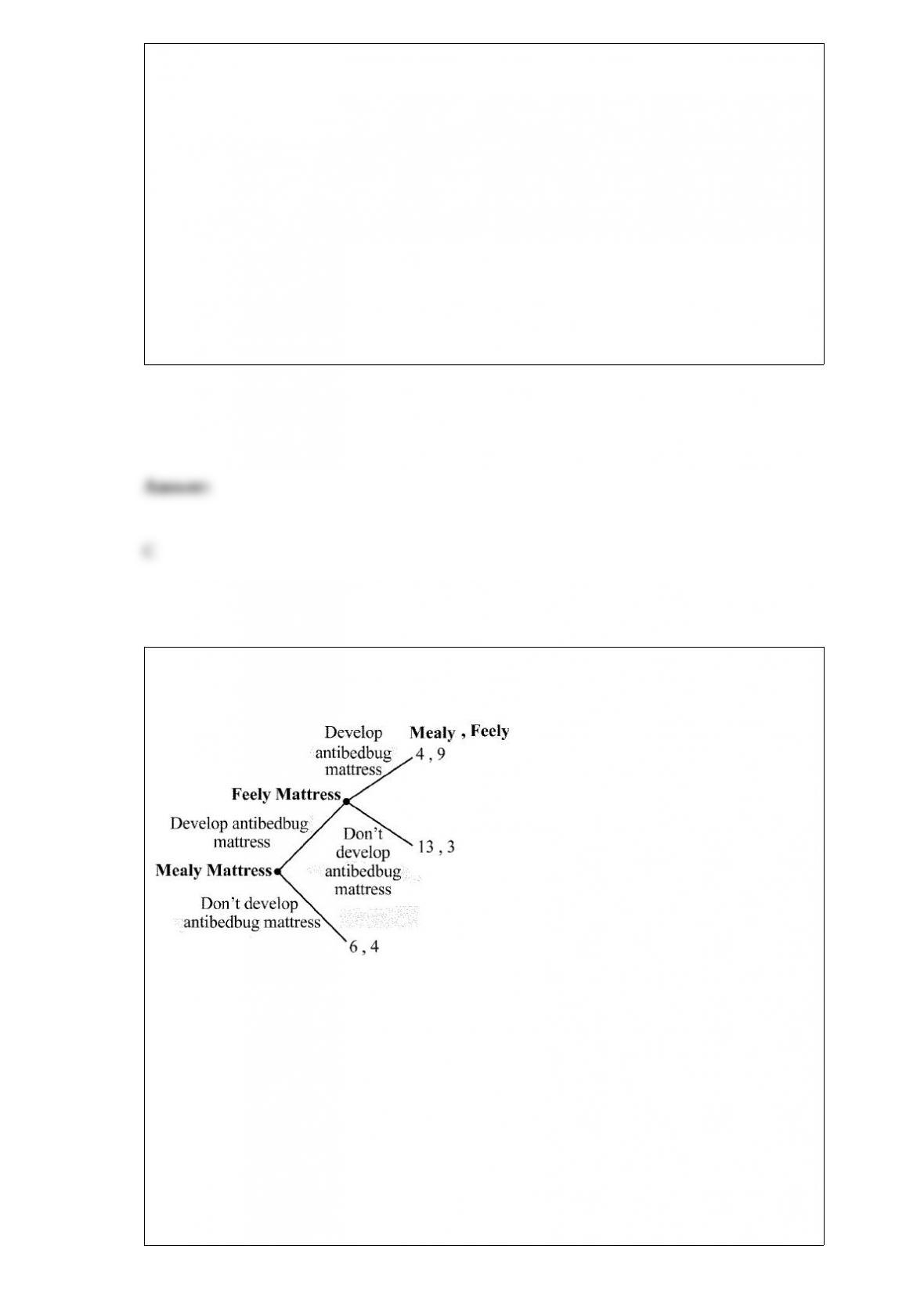
Figure 12.10
(Figure 12.10) In the figure, payoffs are profits in millions of dollars. Should Mealy
Mattress release its antibedbug mattress if Feely Mattress promises not to release its
own antibedbug mattress?
A) Yes, Feely’s promise is credible, causing Mealy’s profits to increase from $6 million
to $13 million.
B) Yes, Feely’s promise is credible, causing Mealy’s profits to increase from $4 million
to $13 million.
C) No, Feely’s promise is not credible, so Mealy should not develop the antibedbug

mattress and earn $6 million.
D) No, Feely’s promise is not credible, so Mealy should develop the antibedbug
mattress and earn $13 million.
Ester has income of $80, and she consumes pizza (P) and soda (S). The price of pizza is
$10 and the price of soda is $4.
a. Graph Ester’s budget constraint.
b. Graph Ester’s budget constraint assuming that there is a buy-one-get-one-free pizza
special.
c. Graph Ester’s budget constraint assuming that there is a buy-two-get-one-free pizza
special.

Martha loves to eat chili, especially an award-winning chili recipe that calls for using 2
tablespoons of chili powder for 1 pound of ground buffalo. What is Martha’s utility as a
function of tablespoons of chili powder (P) and pounds of ground buffalo (B)?
A) U = min{2B, P}
B) U = min{0.50B, P}
C) U = 2P + B
D) U = 2PB
Lilly’s Lumber Yard had the following revenues and costs last year:
If Lilly did not own a lumber yard, she would earn $115,000 per year as a store
manager for Home Depot. Lilly’s lumber yard had an economic cost of ______ and an
economic profit of ______.
A) $225,000; ” $75,000
B) $400,000; $35,000
C) $405,000; ” $5,000
D) $210,000; $0

An entrepreneur gathers the following information to make a decision on whether to
stay open for business or to shut down permanently:
Future operating revenues = $18 million
Future operating costs = $14 million
Sunk costs = $8 million
What should the entrepreneur do?
A) The entrepreneur should continue to operate the business, because the operating
revenues exceed the operating costs.
B) The entrepreneur should shutdown the business, because the operating revenues are
insufficient to cover the operating costs and sunk costs.
C) The entrepreneur should shutdown the business, because the sunk costs are greater
than zero.
D) The entrepreneur should continue to operate the business to help pay off the sunk
costs.
Suppose there are two types of fruit pickers in the economy. The high-productivity
pickers collect more than 10 units of fruit per day, while the low-productivity pickers
collect less than 10 units per day. Johnson Farm pays pickers a flat rate of $50 per day,
and Henry Farm pays pickers $5 for every unit picked. The pickers know their
productivity level, but the farms don’t know a picker’s productivity until he or she starts
working.
a. At which farm will the low-productivity pickers choose to apply?
b. At which farm will the high-productive pickers choose to apply?
c. Which farm will experience adverse selection in the application process?
The inverse market demand curve is P = 170 ” 4Q. Currently, there are two firms in this
market that are acting like a monopolist and evenly splitting the market output. Each
firm produces the product at a constant marginal cost of $10. Which of the following
statements is TRUE?
I. If one firm cheats on the cartel agreement and produces 2 more units of output, its
profits will rise to $864.
II. If neither firm cheats on the cartel agreement, each firm will earn a profit of $800.
III. If one firm cheats on the cartel agreement and produces 3 more units of output, the
noncheating firm’s profits will fall to $680.
A) I and III
B) II and III
C) I and II
D) I, II, and III
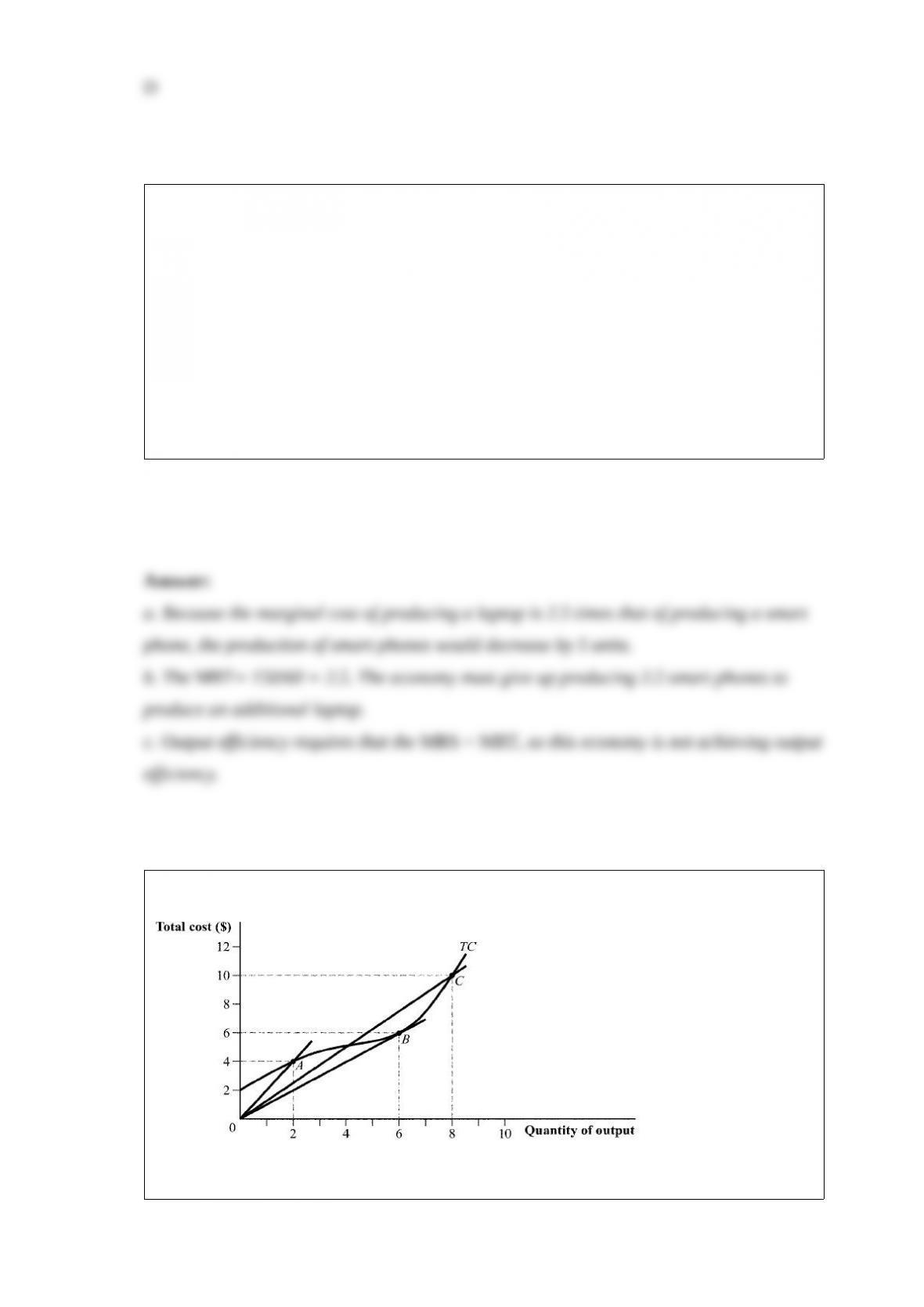
In a small economy that produces smart phones and laptops, the marginal cost of a
smart phone is $60 and the marginal cost of a laptop is $150.
a. If the economy wanted to produce two more laptops, what would happen to the
production of smart phones?
b. What is the marginal rate of transformation from smart phones to laptops? Interpret
your answer.
c. The marginal rate of substitution of smart phones for laptops is 1/2. Is this economy
achieving output efficiency?
Figure 7.5
(Figure 7.5) The firm’s average total cost curve appears in which of the following?
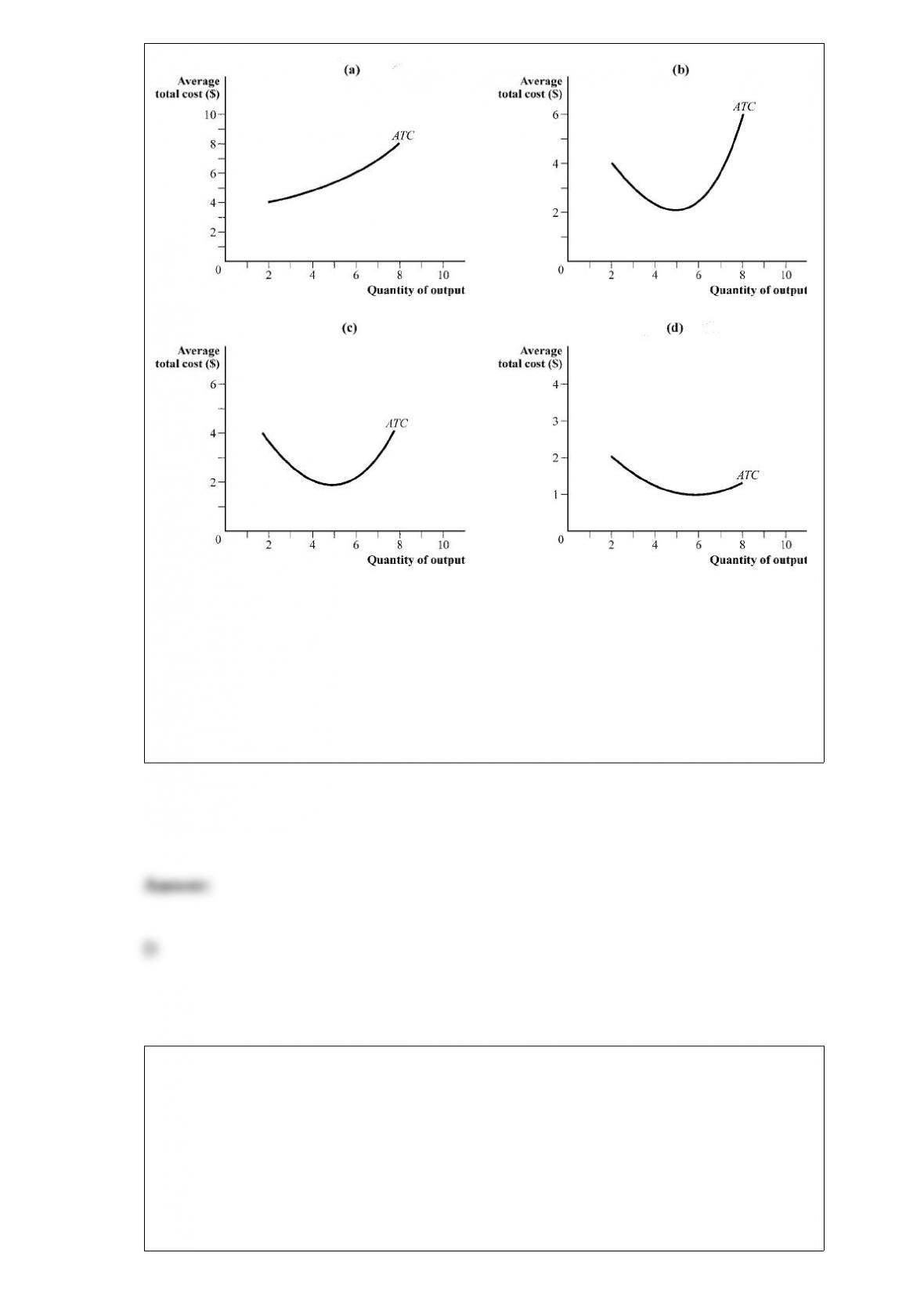
A) panel (a)
B) panel (b)
C) panel (c)
D) panel (d)
What is the option value of waiting?
A) the increase in the net present value from postponing an investment until uncertainty
about the investment returns is reduced
B) the use of a risk-free discount rate for the evaluation of risky investments
C) the difference between the present discounted value calculated from using the

nominal interest rate and the real interest rate
D) the interest rate that causes the net present value of an investment to equal zero
Minnesota has two oil refineries that emit methane gas. The Bend refinery emits 300
units of methane and the Park refinery emits 900 units of methane. Government
regulators would like to reduce total methane emissions from 1,200 to 900 units. Bend’s
total abatement and marginal abatement cost are TCB = 400QB + 4QB
2 and MACB =
400 + 8QB, where Q is units of methane. Park’s total abatement cost and marginal
abatement cost are TCP = 40QP + 2QP
2 and MACP = 10 + 4QP.
a. Suppose that government regulators require each refinery to remove 150 units of
methane. What is the total cost of removing these 300 units (TCB + TCP)?
b. Now suppose that the government regulators evenly split 900 methane pollution
permits between the two refineries. What is the total cost of removing 300 units of
methane, using a tradable permit system?
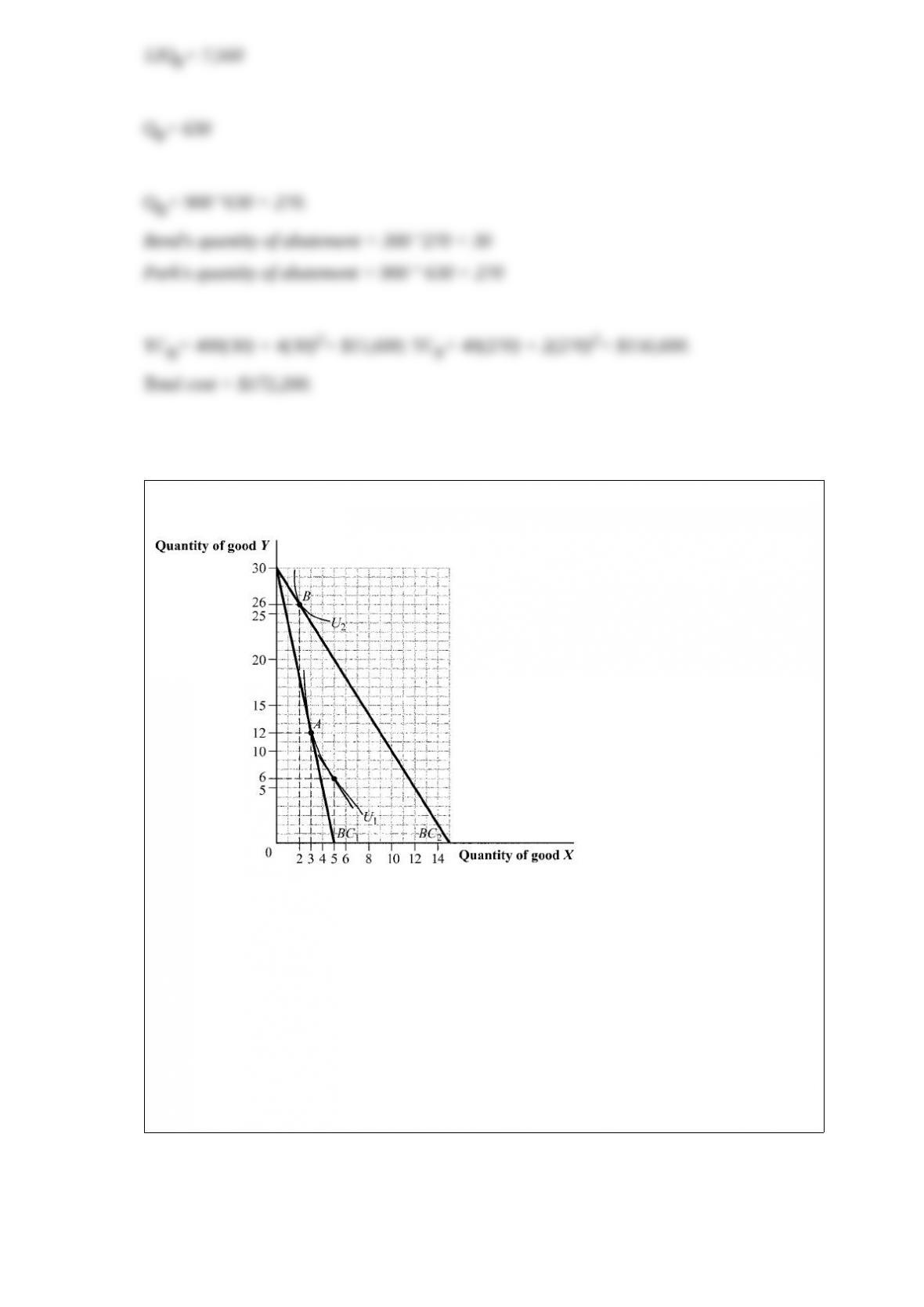
Figure 5.15
(Figure 5.15) What is the size of the income effect associated with the decrease in the
price of good X?
A) The quantity of good X purchased increases from 3 to 5.
B) The quantity of good X purchased decreases from 5 to 2.
C) The quantity of good X purchased decreases from 3 to 2.
D) The quantity of good X purchased decreases from 5 to 3.
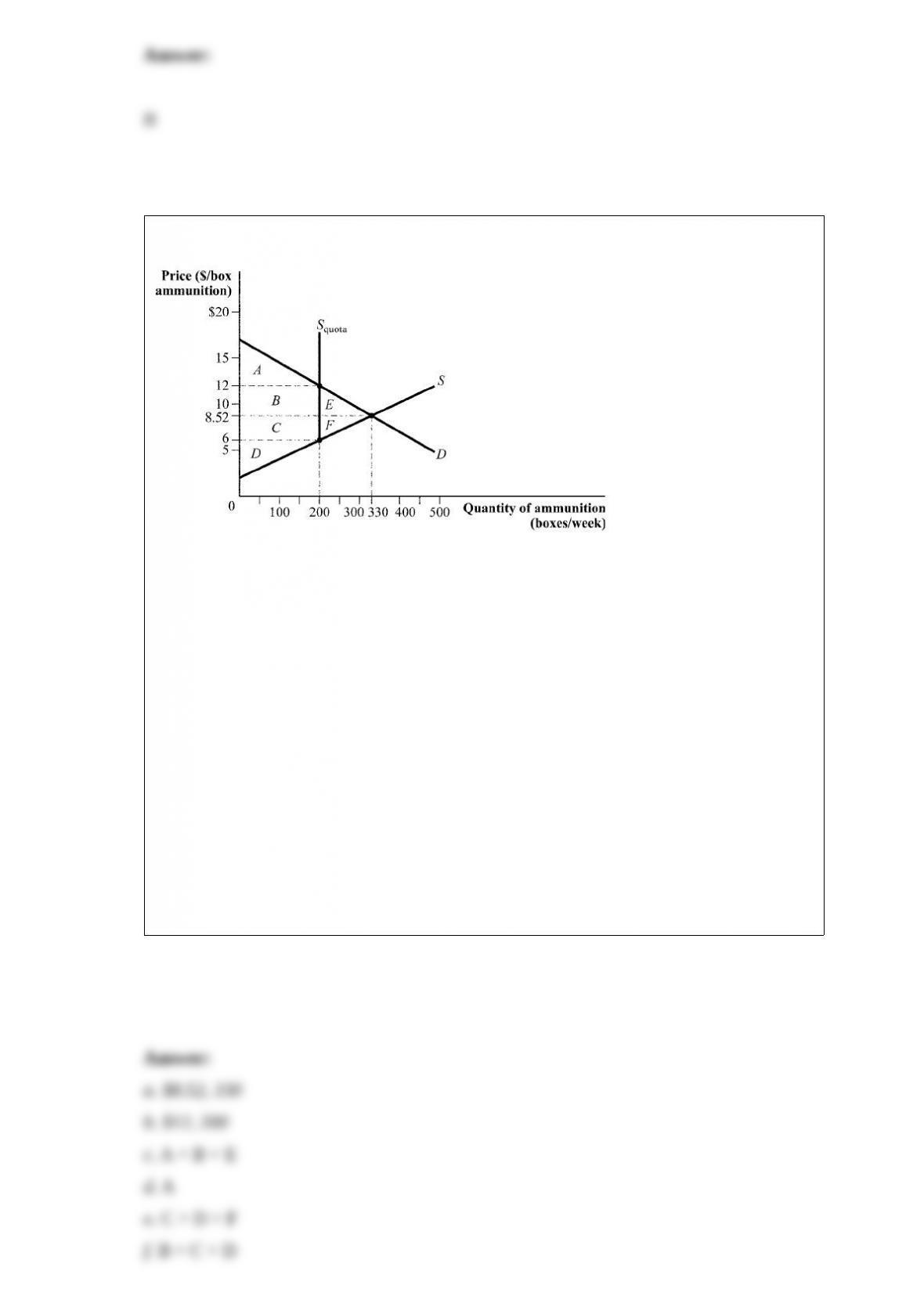
Figure 3.23
(Figure 3.23) Use Figure 3.23 to answer the following questions:
a. In the free market, what is the equilibrium price and quantity of ammunition?
b. If the government imposes a 200-box quota on ammunition, what is the new
equilibrium price and quantity?
c. Which letters represent the area of consumer surplus before the quota?
d. Which letters represent the area of consumer surplus after the quota?
e. Which letters represent the area of producer surplus before the quota?
f. Which letters represent the area of producer surplus after the quota?
g. Which letters represent the deadweight loss from the quota?

Suppose a college student was gifted a university mug that sells for $4 in the university
bookstore, and now he is unwilling to sell it even for $10. Which of the following
statements best reflects the student’s behavior?
A) Indifference curves are quasi-concave.
B) The more you have of something, the more you want to get rid of it.
C) The act of owning a good makes it more valuable.
D) Preferences are not always logically consistent, violating the assumption of
transitivity.
Figure 14.8
(Figure 14.8). Suppose the food industry is using 4 capital inputs and 4 labor inputs,
while the clothing industry is using 1 capital input and 4 labor inputs. Which of the
following input reallocations would be a Pareto improvement?
A) The food industry gives 1 capital input to the clothing industry in exchange for 1
labor input.
B) The clothing industry gives 1 capital input to the food industry in exchange for 1
labor input.
C) The food industry gives 2 capital inputs to the food industry in exchange for 2 labor
inputs.
D) The clothing industry gives 1 capital input to the food industry in exchange for 2
labor inputs.
A monopolist serves market A with an inverse demand curve of P = 12 ” Q. Another
monopolist serves market B with an inverse demand curve of P = 22 ” 2Q. Suppose that
both monopolists have a constant marginal cost of $2. Calculate the producer surplus
earned in each market. Why is producer surplus higher in market B than in market A?

Figure 14.6
(Figure 14.6) Which of the following allocations represents a Pareto improvement from
point A?
I. Eliza consumes 3 cups of tea and 3 crumpets, and Henry consumes 3 cups of tea and
4 crumpets.
II. Eliza consumes 3 cups of tea and 4 crumpets, and Henry consumes 3 cups of tea and
3 crumpets.
III. Eliza consumes 2 cups of tea and 4 crumpets, and Henry consumes 4 cups of tea
and 3 crumpets.
A) II and III
B) II only
C) I and III
D) I, II, and III
List the four properties of utility functions, giving an example of each property.
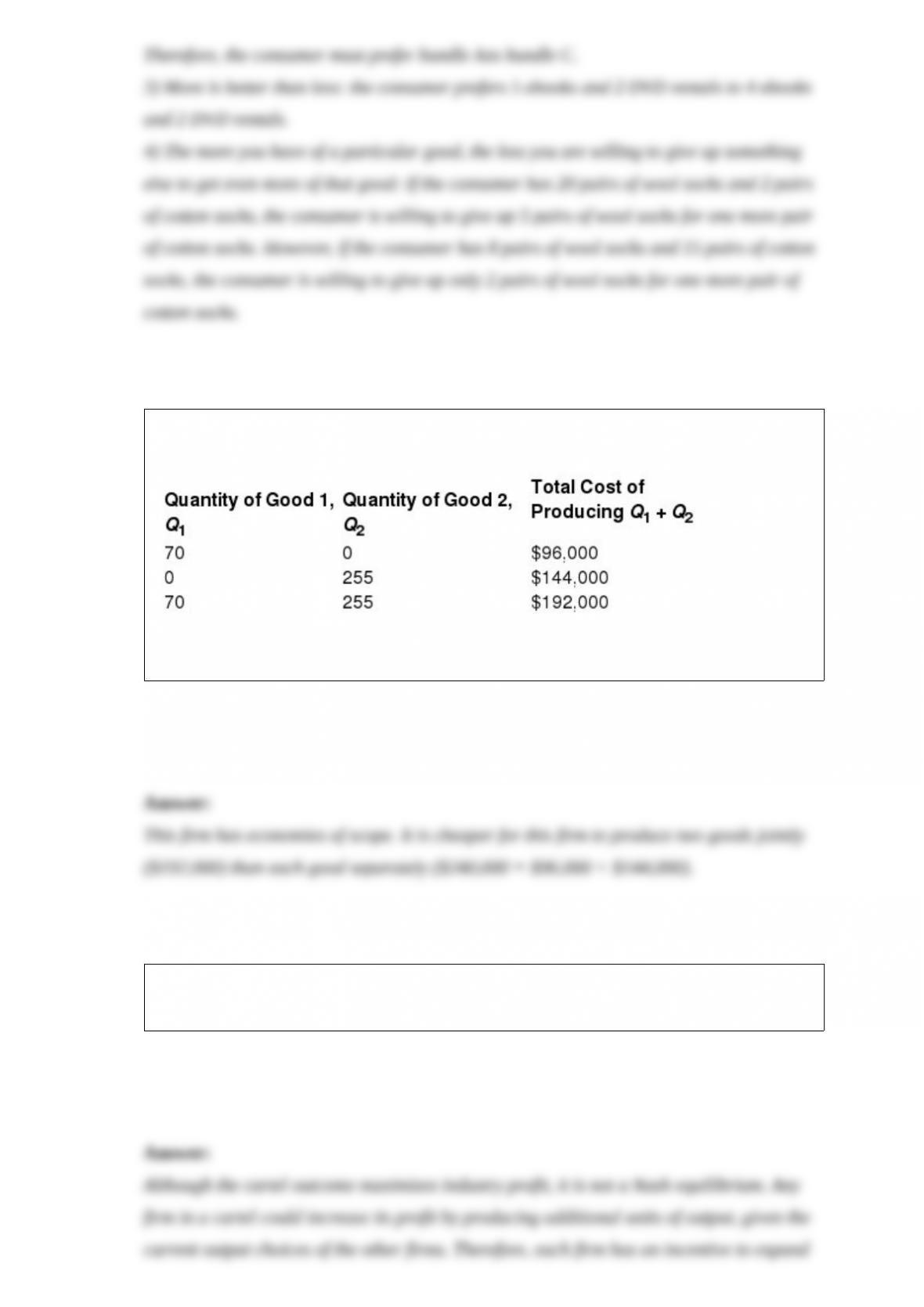
Consider the preceding table. What important characteristic describes this firm’s
production process?
Using the concept of a Nash equilibrium, explain why cartels are difficult to maintain.
What factors make it easier to maintain a cartel?
What are the shortcomings of lab experiments?
Figure 14.10
(Figure 14.10) Suppose the economy is achieving output efficiency at point I, where the
marginal rate of transformation (MRT) is 1/4 and the marginal product of labor in the
cereal industry is 12. Which of the following statements is TRUE?
A) The marginal rate of substitution (MRS) between pancakes and cereal is 4.
B) The marginal product of capital in the pancake industry divided by the marginal
product of capital in the cereal industry is 4.
C) The marginal product of capital in the pancake industry is 3.
D) The MRS/MRT = 1/4.
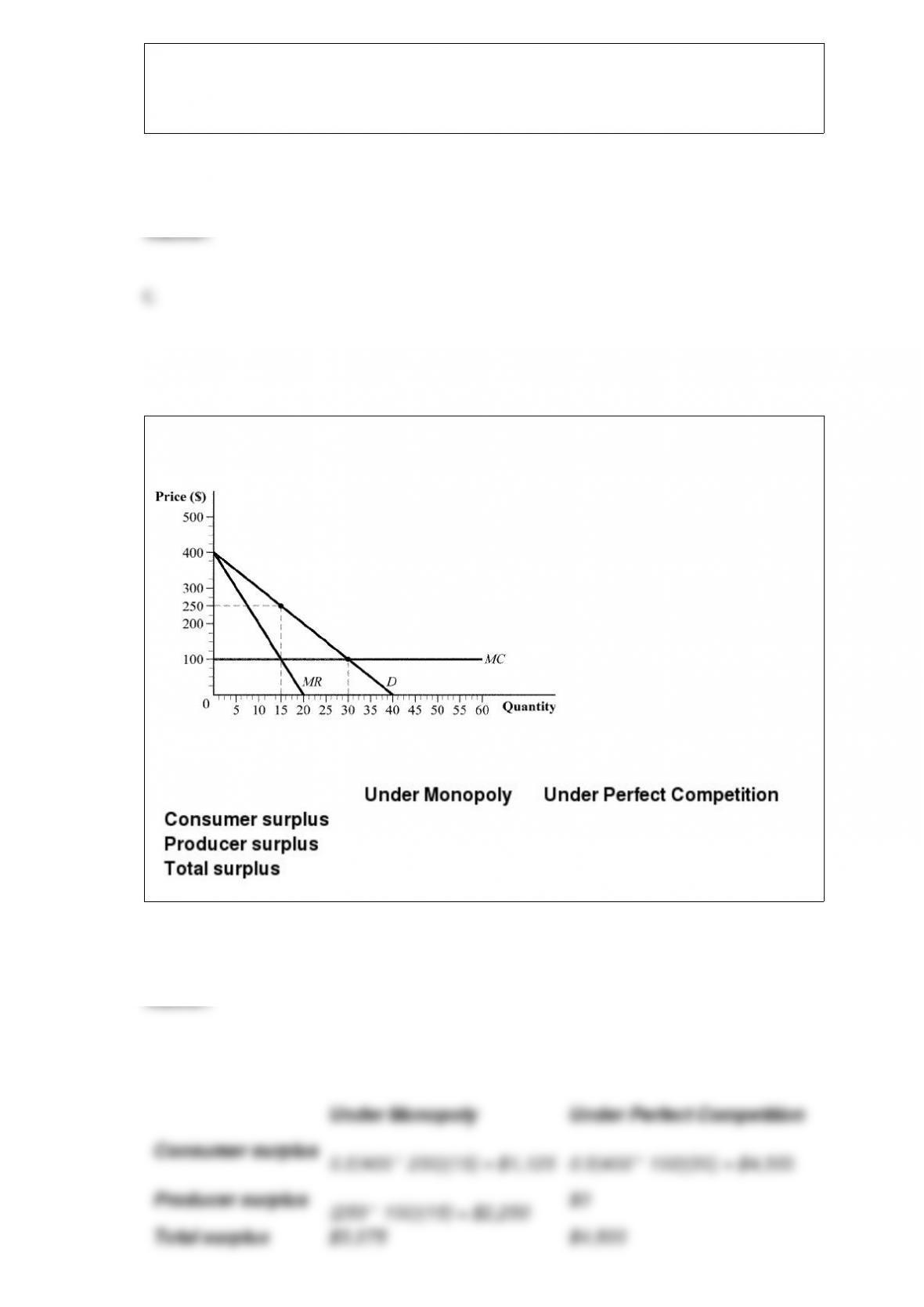
Figure 9.14
(Figure 9.14) Fill in the table using the graph.
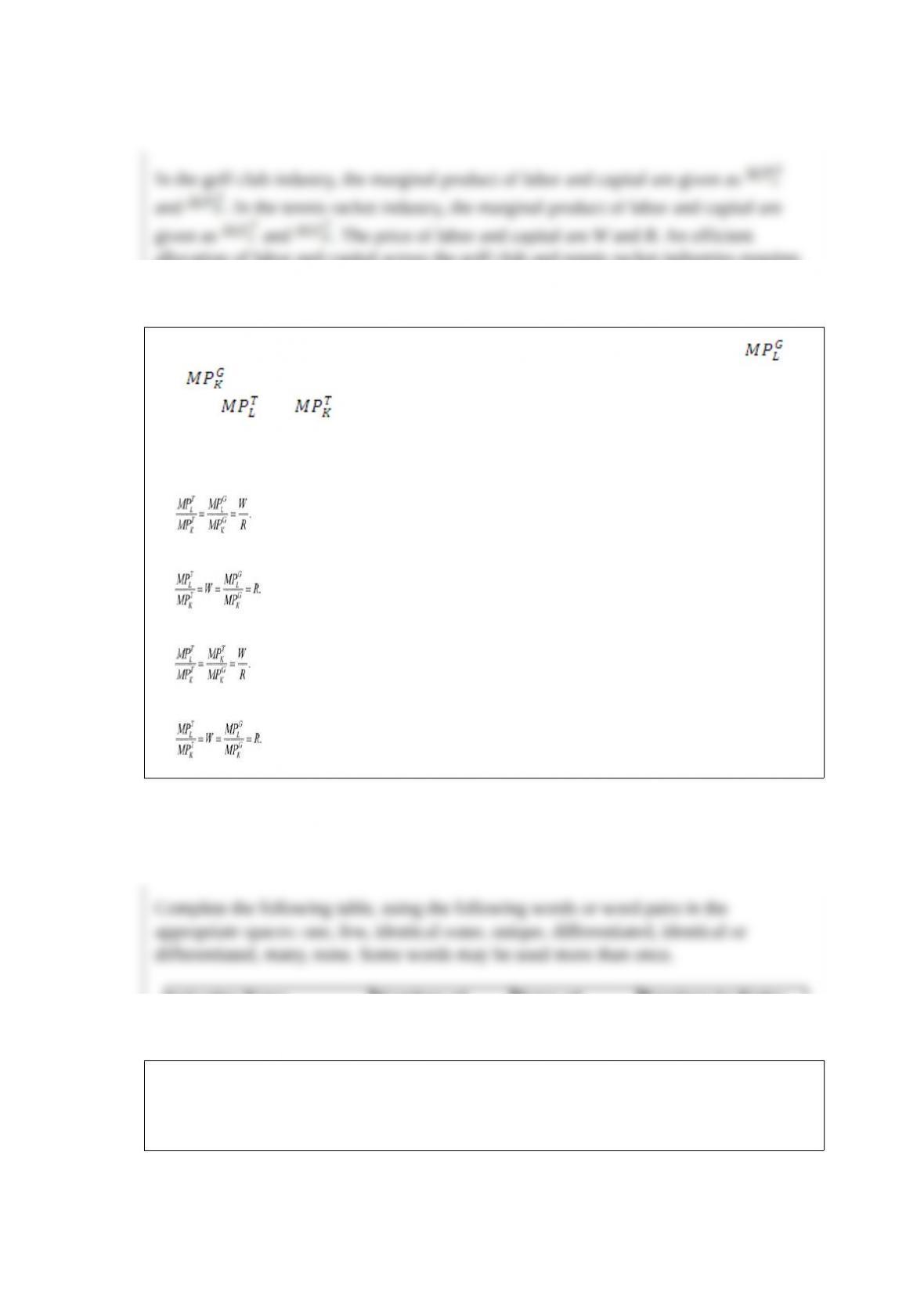
In the golf club industry, the marginal product of labor and capital are given as
and . In the tennis racket industry, the marginal product of labor and capital are
given as and . The price of labor and capital are W and R. An efficient
allocation of labor and capital across the golf club and tennis racket industries requires
the following condition:
A)
B)
C)
D)
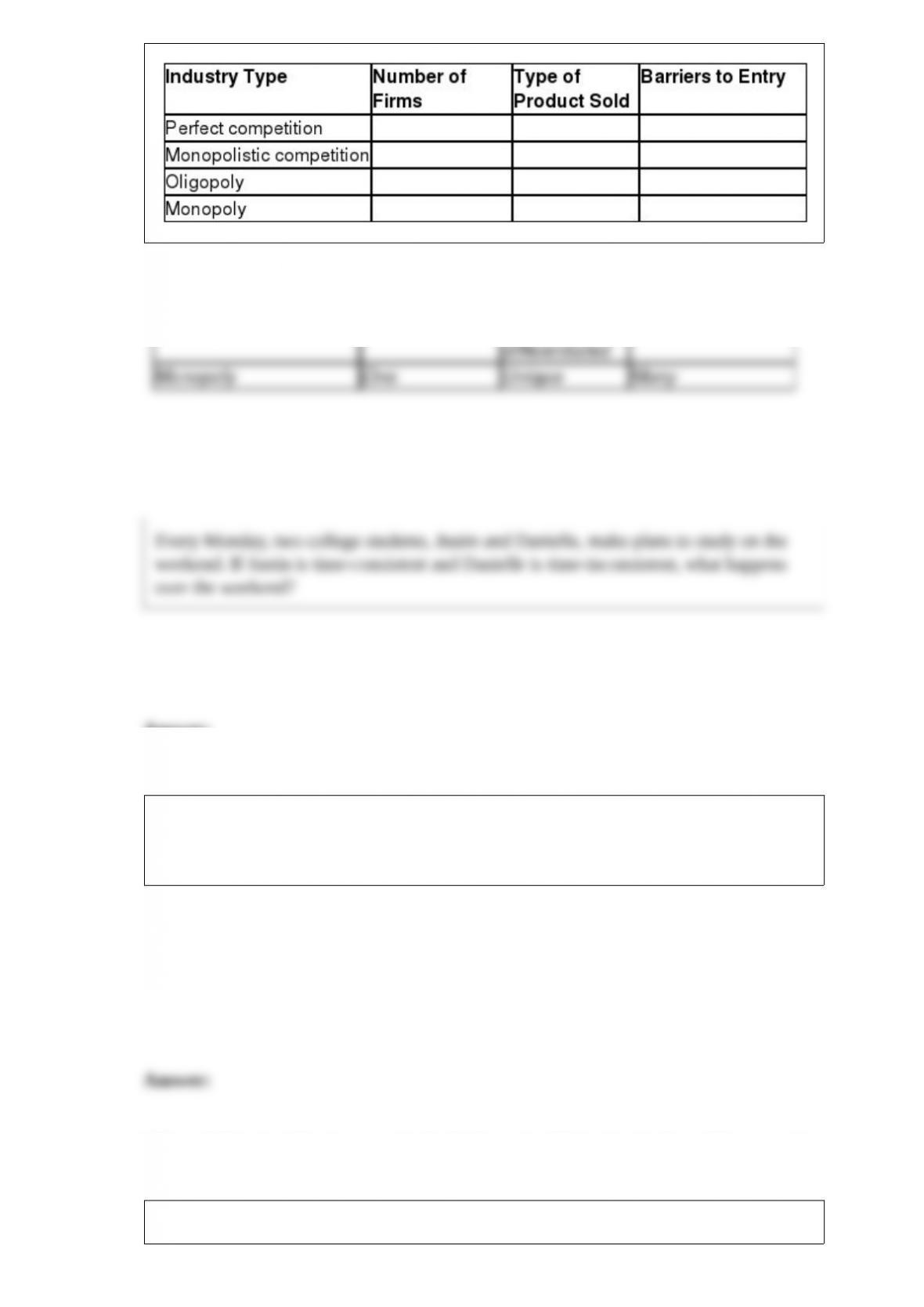
Complete the following table, using the following words or word pairs in the
appropriate spaces: one, few, identical some, unique, differentiated, identical or
differentiated, many, none. Some words may be used more than once.
Every Monday, two college students, Justin and Danielle, make plans to study on the
weekend. If Justin is time-consistent and Danielle is time-inconsistent, what happens
over the weekend?
Peter’s utility function is U = 5X + 2Y. What is Peter’s marginal utility of good X and
good Y? Interpret your answer.
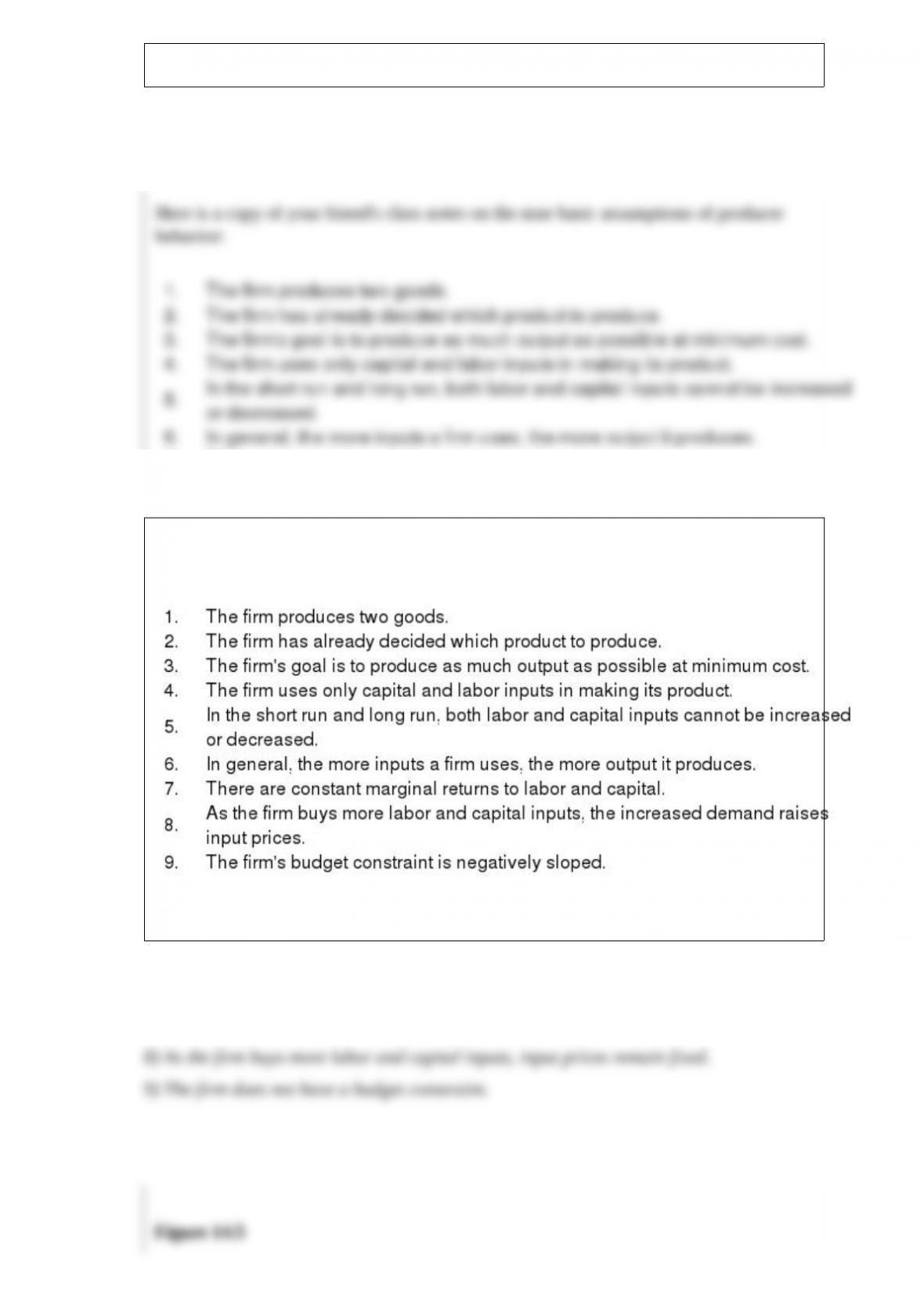
Here is a copy of your friend’s class notes on the nine basic assumptions of producer
behavior:
Because your friend was half-asleep during class, she may have errors in her notes.
Correct the errors in her notes where necessary.

Figure 14.5
(Figure 14.5) Suppose that Elaine currently has 1 pancake and 4 bowls of cereal, which
gives her a marginal utility of pancakes equal to 20 and marginal utility of cereal equal
to 5. Jerry has 7 pancakes and 6 bowls of cereal, which gives him a marginal utility of
pancakes equal to 6 and marginal utility of cereal equal to 18. Which of the following
statements is TRUE?
A) The current allocation of pancakes and cereal between Elaine and Jerry is
Pareto-efficient.
B) Elaine and Jerry could both be made better off if Elaine traded 1 pancake for 1 bowl
of Jerry’s cereal.
C) A Pareto improvement would be for Elaine to give Jerry 2 bowls of cereal in
exchange for 1 pancake.
D) Elaine and Jerry could both be made better off if Elaine traded 1/2 pancake for 1
bowl of Jerry’s cereal.
According to political journalist Michael Kinsley, “The price of oil shoots up; we start
using less; reduced demand sends the price down; we start using more; pretty soon it’s
shooting up again.” Explain whether you agree or disagree with Kinsley’s assessment of
oil markets.
If the initial allocation of goods is not efficient in the market, consumers will:
A) not be able to trade goods and achieve Pareto efficiency.
B) buy and sell goods at market prices until the marginal rate of substitution is
equalized across all consumers.
C) be required to consume somewhere along their contract curve.
D) change their tastes and preferences via their utility function to match the market’s
marginal rate of substitution.
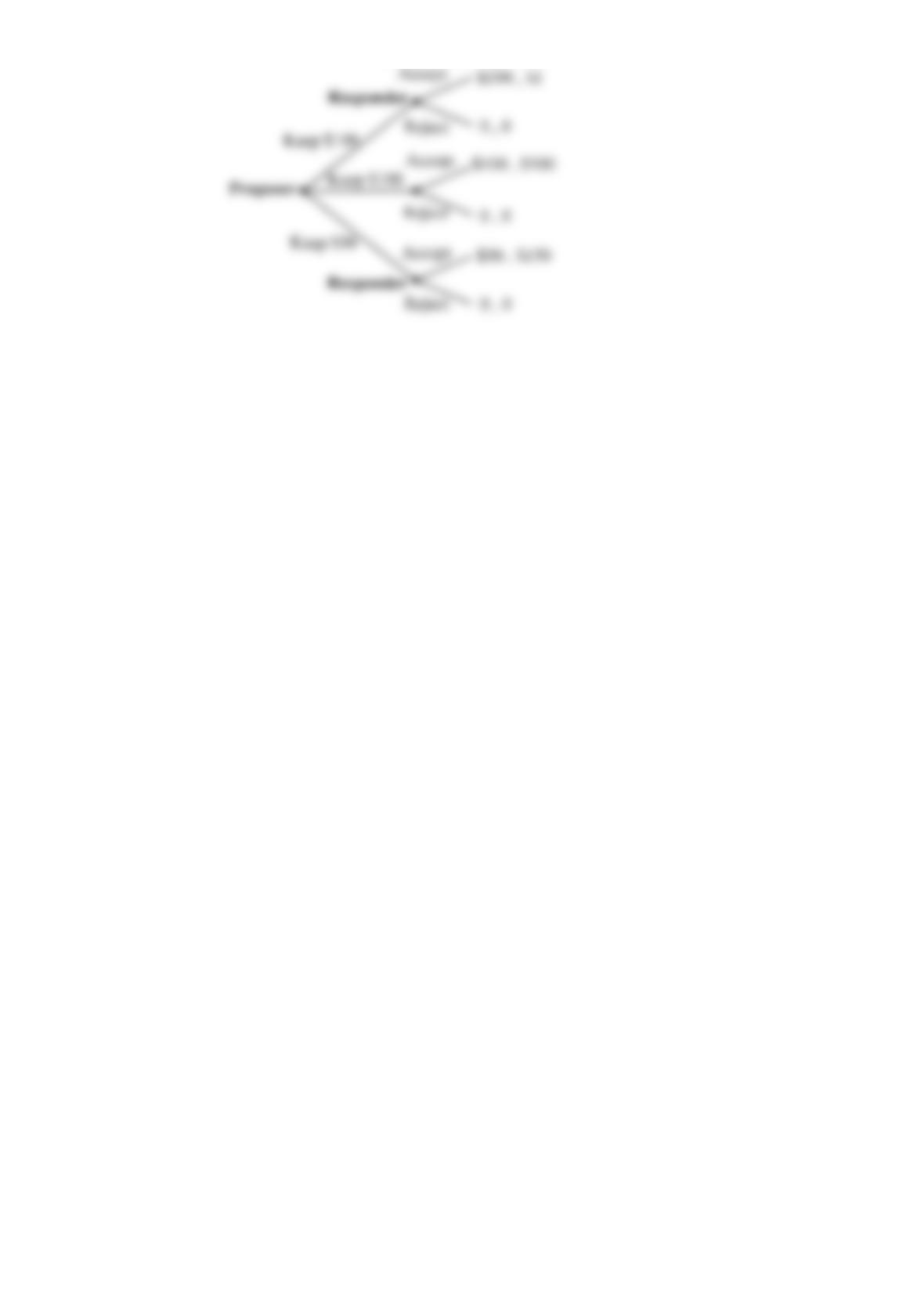
Consider a game in which a person called the proposer is given $200. The proposer
must choose to split the money with a person called the responder. The money must be
split in one of three ways:
(1) Proposer keeps $199, responder gets $1,
(2) Proposer keeps $100, responder gets $100, or
(3) Proposer keeps $50 and responder gets $150.
The responder can either accept or reject the proposer’s offer. If the responder rejects
the offer, both players get nothing. Illustrate this game in extensive form. Using
backward induction, what is the outcome of this game?