
One factor that reduces the natural rate of unemployment is:
A) a binding minimum wage.
B) the recent proliferation of temporary employment agencies.
C) a slowdown in productivity growth.
D) government policies such as those that produced Eurosclerosis.
When a corporation borrows money from lenders in exchange for a fixed rate of return
and a given maturity, the corporation is:
A) taking out a loan.
B) issuing bonds.
C) issuing stocks.
D) liquidating a bank deposit.
If the Federal Reserve wants to increase the monetary base, it might:
A) engage in an open market purchase of Treasury bills.
B) increase the discount rate.

C) increase the reserve ratio.
D) decrease personal income taxes.
Which of the following acts to protect depositors from a bank run by insuring all
deposits up to $250,000?
A) the FDIC
B) the Department of Justice
C) the Federal Reserve
D) the Office of Management and Budget
Traveler’s checks and checkable deposits are:
A) part of M1.
B) considered near-moneys.
C) part of the monetary base.
D) not considered part of the M grouping.

If technology advances:
A) GDP per capita declines.
B) physical capital is less productive.
C) workers can produce more with fixed amounts of physical and human capital.
D) human capital is less useful.
Figure: Shifts in Demand and Supply III
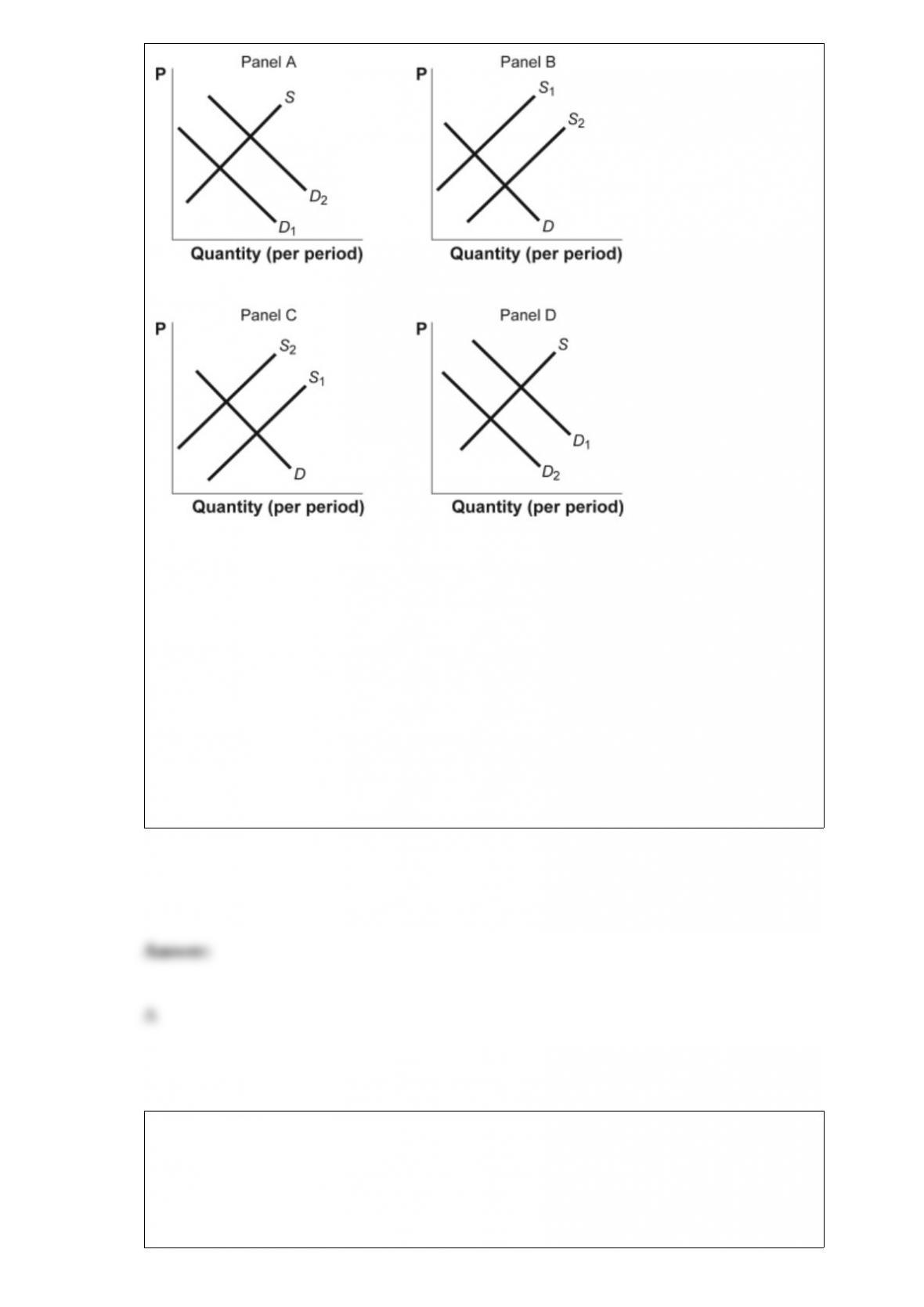
Look at the figure Shifts in Demand and Supply III. The figure shows how supply and
demand might shift in response to specific events. Suppose consumer incomes increase.
Which panel BEST describes how this will affect the market for designer boots, a
normal good?
A) panel A
B) panel B
C) panel C
D) panel D
Frictional unemployment exists because of all of the following reasons EXCEPT:
A) that new jobs are continually being created.
B) that some old jobs are always being destroyed.

C) that new workers are always entering the labor market.
D) for the minimum wage.
The effect of a government deficit is:
A) contractionary.
B) expansionary.
C) neutral.
D) biased.
A change in taxes or a change in government transfers affects consumption through its
effect on:
A) autonomous consumption.
B) the marginal propensity to save.
C) disposable income.
D) government spending.

As a consequence of the Irish banking crisis:
A) the budget surplus of the Irish government is growing to record levels.
B) the Irish government had to pay high interest rates on money it borrowed in
international markets, and its solvency was in question.
C) unemployment fell to less than 3%.
D) Ireland has been forced to leave the European Union.
The market for corn is in equilibrium. Which of the following is most likely to
INCREASE the equilibrium price of corn?
A) a bountiful harvest
B) increasing production of corn-based ethanol
C) decreasing household incomes, with corn being a normal good
D) a decrease in the price of wheat, a substitute in consumption
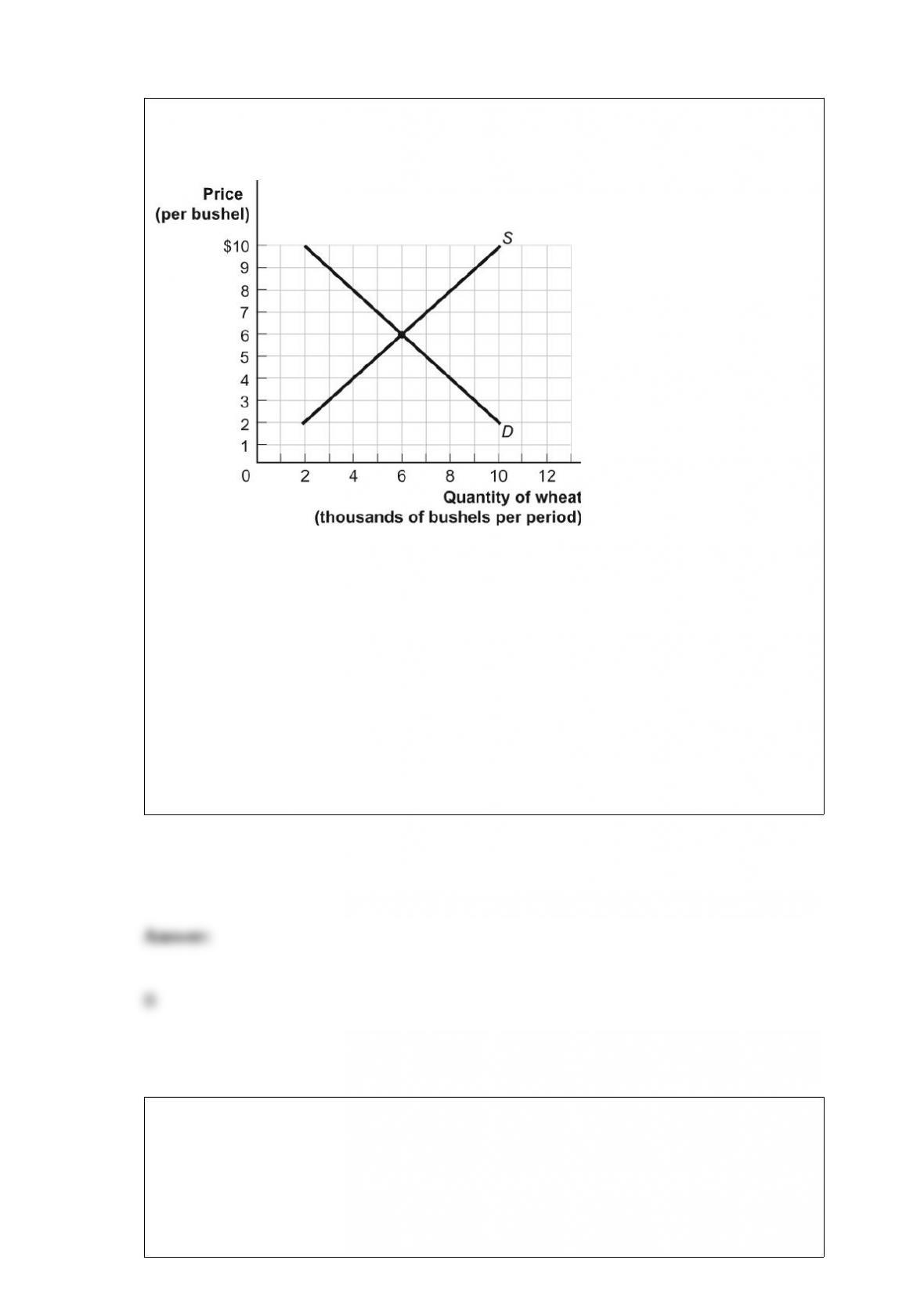
Figure: The Demand and Supply of Wheat
Look at the figure The Demand and Supply of Wheat. If there is a decrease in supply of
2,000 bushels at each price, the equilibrium price and quantity will be _____ and _____
bushels, respectively.
A) $5; 5,000
B) $7; 5,000
C) $6; 4,000
D) $8; 6,000
The intersection of an economy’s aggregate demand and long-run aggregate supply
curves:
A) determines its equilibrium real GDP in both the long run and the short run.
B) determines its equilibrium price level in both the long run and the short run.

C) occurs at the economy’s potential output.
D) occurs at high levels of cyclical unemployment.
Marginal analysis:
A) refers to decisions about whether to do a bit more or a bit less of an activity.
B) helps when making a “how much” choice.
C) involves trade-offs.
D) refers to decisions about whether to do a bit more or a bit less of an activity, helps
when making a “how much” choice, and involves trade-offs.
Fannie Mae and Freddie Mac are the government agencies that insure deposits at
financial institutions.
A) True
B) False

If a country’s currency depreciates, all other things equal, exports _____ and imports
_____ .
A) increase; increase
B) increase; decrease
C) decrease; increase
D) decrease; decrease
Economists mostly agree that the problem of climate change necessitates government
action in the form of market-based incentives such as:
A) tax rebates to those causing negative externalities.
B) a reduction in the amount of gasoline that each person is allowed to purchase.
C) a carbon tax or a cap and trade system.
D) a reduction in the price of green cars and appliances.

If a country has a working-age population of 200 million, 135 million people with jobs,
and 15 million people unemployed and seeking employment, then its labor force is:
A) 335 million.
B) 200 million.
C) 155 million.
D) 150 million.
Suppose that the U.S. economy is in a severe recession. Most households are trying to
save more of their income than before. This increase in private savings will lead to:
A) an increase in real GDP, as more savings means more funds for business investment.
B) a fall in real GDP, as more savings means people will spend less.
C) no change in real GDP, because there is no savings multiplier.
D) an increase in real GDP, as an increase in savings will make people wealthier.
Japan’s economy:
A) had higher real GDP per capita than that of most European countries in 2010.
B) relies on high consumption to spur its economic growth.
C) grew but not as fast as Mexico’s economy over the long run.
D) had the same real GDP per capita as Mexico in 1820.
The balance sheet effect is the:
A) increase in a firm’s net worth from increasing asset prices.
B) decrease in a firm’s net worth from decreasing asset prices.
C) change in financial statements when firms borrow money.
D) change in financial statements when firms buy their own stock.
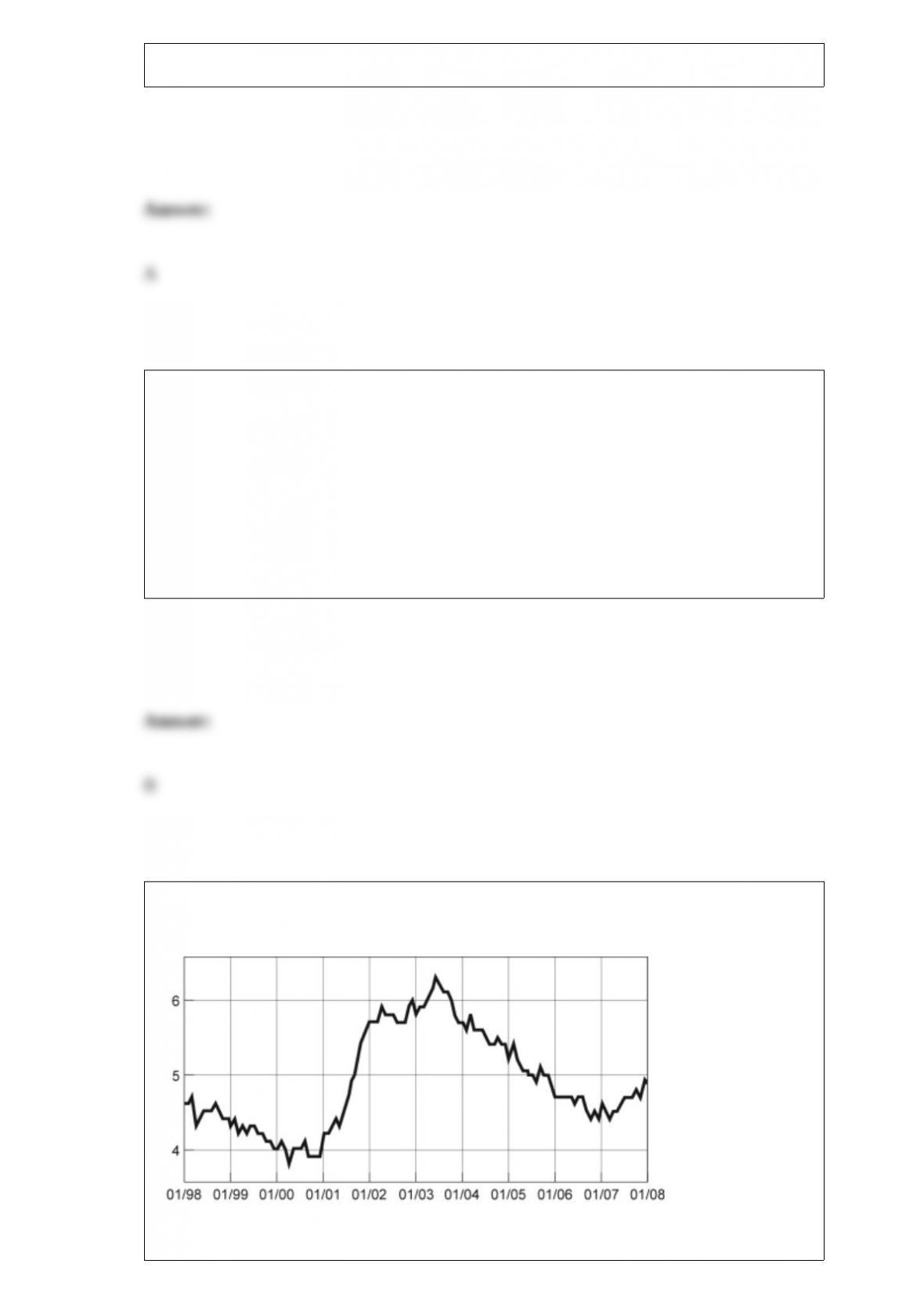
Figure: Seasonally Adjusted Unemployment Rate
Look at the figure Seasonally Adjusted Unemployment Rate. The distance between

each labeled point on the horizontal axis is one year. What is the approximate slope of
the graph between 1/2001 and 1/2003?
A) 2
B) 1
C) “1
D) “2
If GDP increases from $10 trillion to $12 trillion in a year, it could mean that aggregate
output grew by 20%, that prices increased 20%, or that prices and aggregate output both
increased.
A) True
B) False
In the United States, the institution that is charged with determining the size of the
monetary base and with regulating the banking system is the:
A) Treasury Department.
B) Commerce Department.
C) U.S. Senate Banking Committee.

D) Federal Reserve.
Scenario: Growth Rates in Two Countries
India is growing at a rate of 9% per year, and its real GDP per capita is about $3,500,
while the United States is growing at a rate of 3% per year, and its real GDP per capita
is about $47,000.Look at the scenario Growth Rates in Two Countries. How long will it
take the United States to double its real GDP per capita?
A) 10.5 years
B) 23.3 years
C) 30 years
D) 50 years
Suppose the reserve ratio is 20%. If Holly deposits $1,000 of cash in her checking
account and her bank lends $600 to Freda, the money supply:
A) remains the same.
B) decreases by $1,000.
C) decreases by $600.
D) increases by $600.
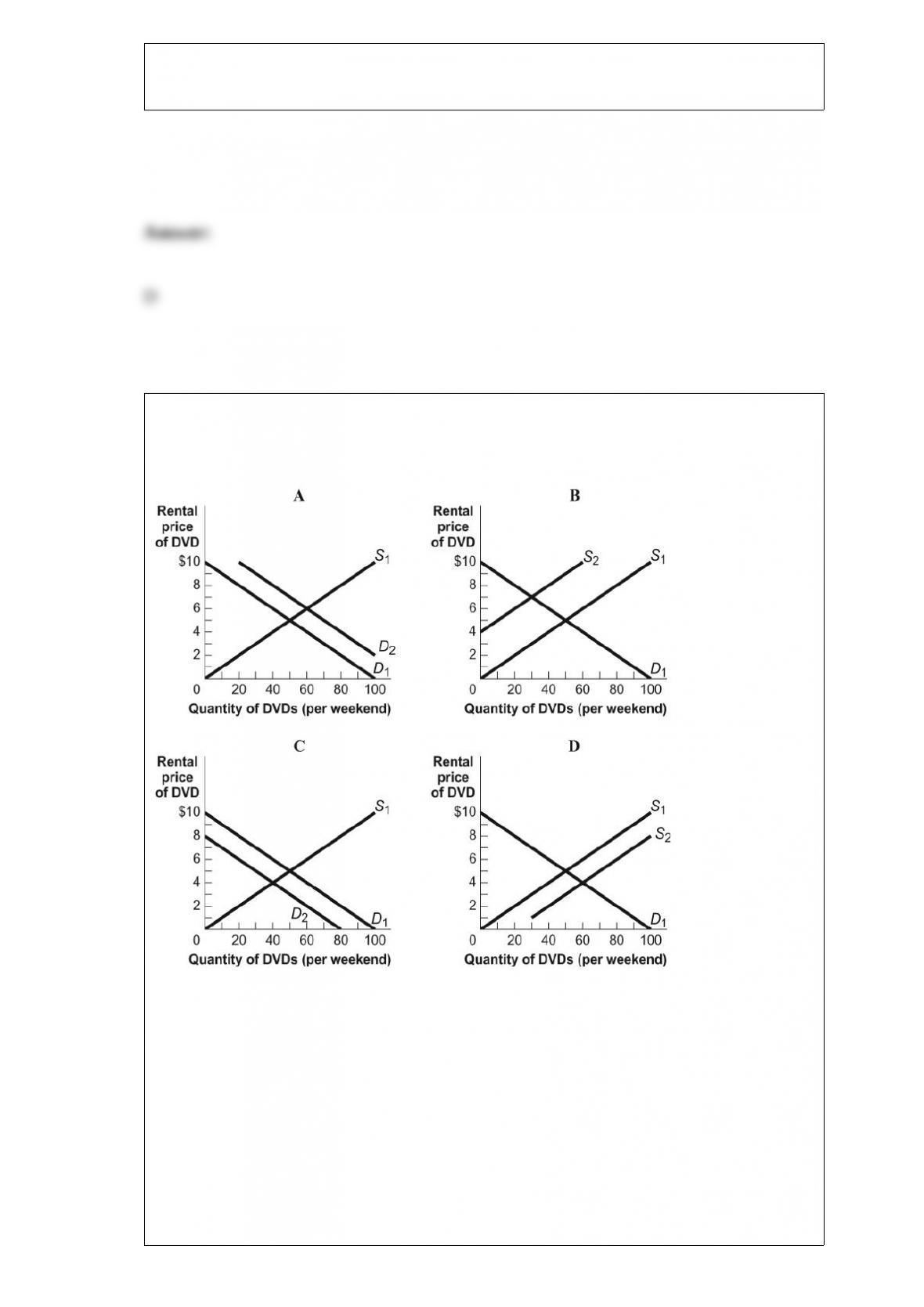
Figure: Four Markets for DVDs
Look at the figure Four Markets for DVDs. If D1 or S1 is the original curve and D2 or
S2 is the new curve, which of the graphs shows a change that results in a decrease in the
quantity of DVDs supplied?
A) A
B) B
C) C

D) D
National savings in a closed economy is all of the following EXCEPT:
A) the sum of private savings plus the government budget balance.
B) the total savings in the economy.
C) GDP ” C ” G.
D) government spending minus consumption.
If you decide to go to Cancún with your friends during spring break, you cannot go to
Paris with your sister in the summer. This statement best represents this economic
concept:
A) The real cost of something is what you must give up to get it.
B) “How much” is a decision at the margin.
C) People usually exploit opportunities to make themselves better off.
D) There are gains from trade.