1) Which of the following represents a change in today’s banking policies that should
prevent a recurrence of the bank panics of 1930-1933?
A.banks are more cautious lenders
B.banks keep large amounts of excess reserves on hand
C.the FDIC insures bank deposits and therefore depositors do not panic and rush to
withdraw money when individual banks have financial problems
D.the President now has the authority to close banks whenever panics occur
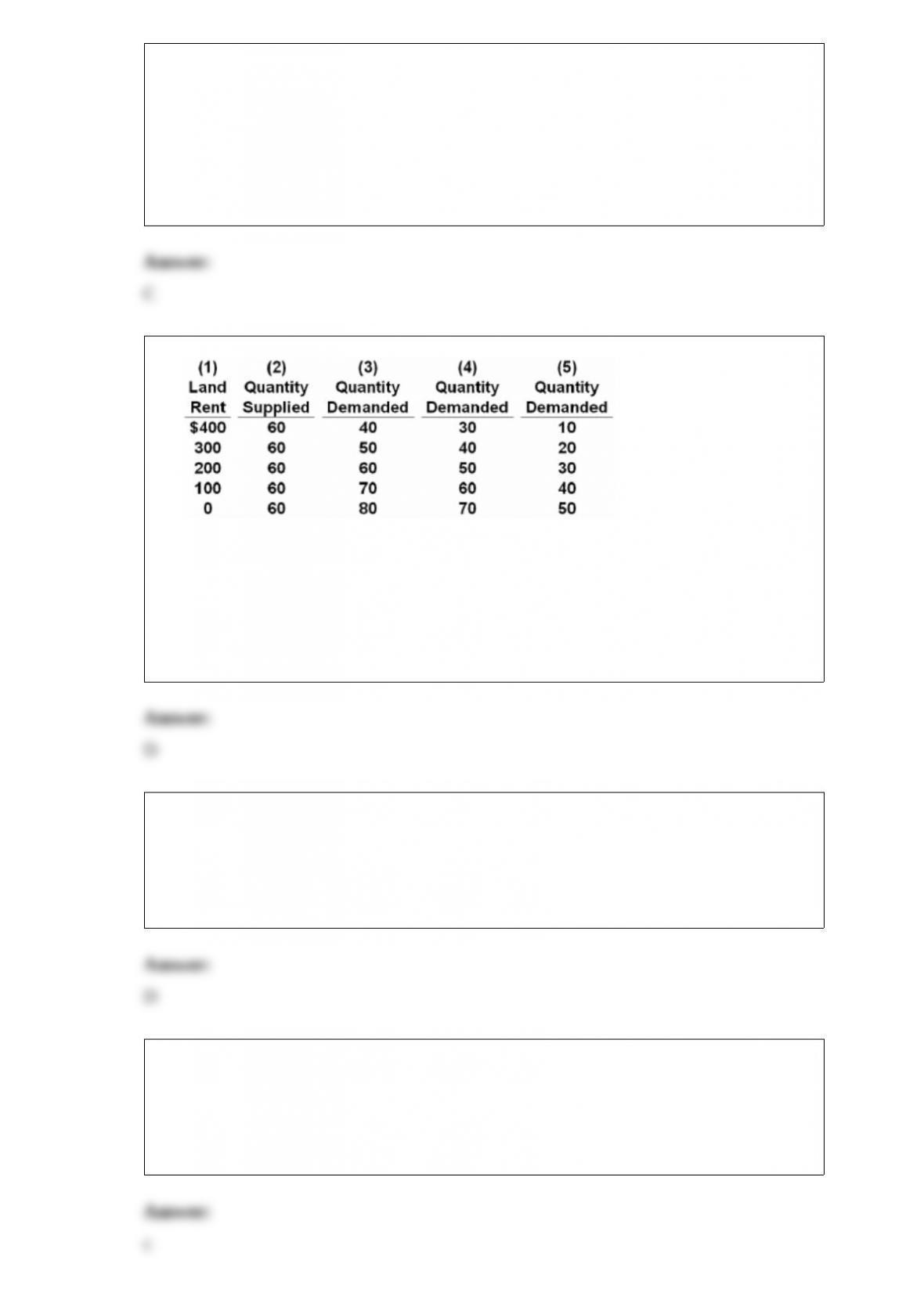
2)
Refer to the above table, in which the values for columns (2) through (5) are in acres.
Positive land rent will occur if the relevant columns are:
A.(1), (2), and (3) only.
B.(1), (2), and (3) and (1), (2), and (5).
C.(1), (2), and (4) and (1), (2), and (5).
D.(1), (2), and (3) and (1), (2), and (4).
3) Nonrivalry and nonexcludability are the main characteristics of:
A.consumption goods.
B.capital goods.
C.private goods.
D.public goods.
4) refer to the above diagram. which line(s) show(s) a positive vertical intercept?
a.a and d only.
b.b and c only.
c.a, d, and e
d.a, d, and b

5) The “future value” of a sum of money refers to:
A.the estimated value of that money invested in a stock portfolio at some future date.
B.the purchasing power of a given amount of money adjusted for price changes.
C.today’s value of a sum of money to be received in the future.
D.the amount to which some current sum of money will grow over time.
6) Contractionary fiscal policy is so named because it:
A.involves a contraction of the nation’s money supply.
B.necessarily reduces the size of government.
C.is aimed at reducing aggregate demand and thus achieving price stability.
D.is expressly designed to contract real GDP.
7) In the inverted-U theory of R&D, which of the following industry concentration
ratios would be most conducive to R&D (as a percentage of firm sales)?
A.1 percent
B.10 percent
C.50 percent
D.70 percent
8) The foreign purchases effect suggests that a decrease in the U.S. price level relative
to other countries will:
A.shift the aggregate demand curve leftward.
B.shift the aggregate supply curve leftward.
C.decrease U.S. exports and increase U.S. imports.
D.increase U.S. exports and decrease U.S. imports.
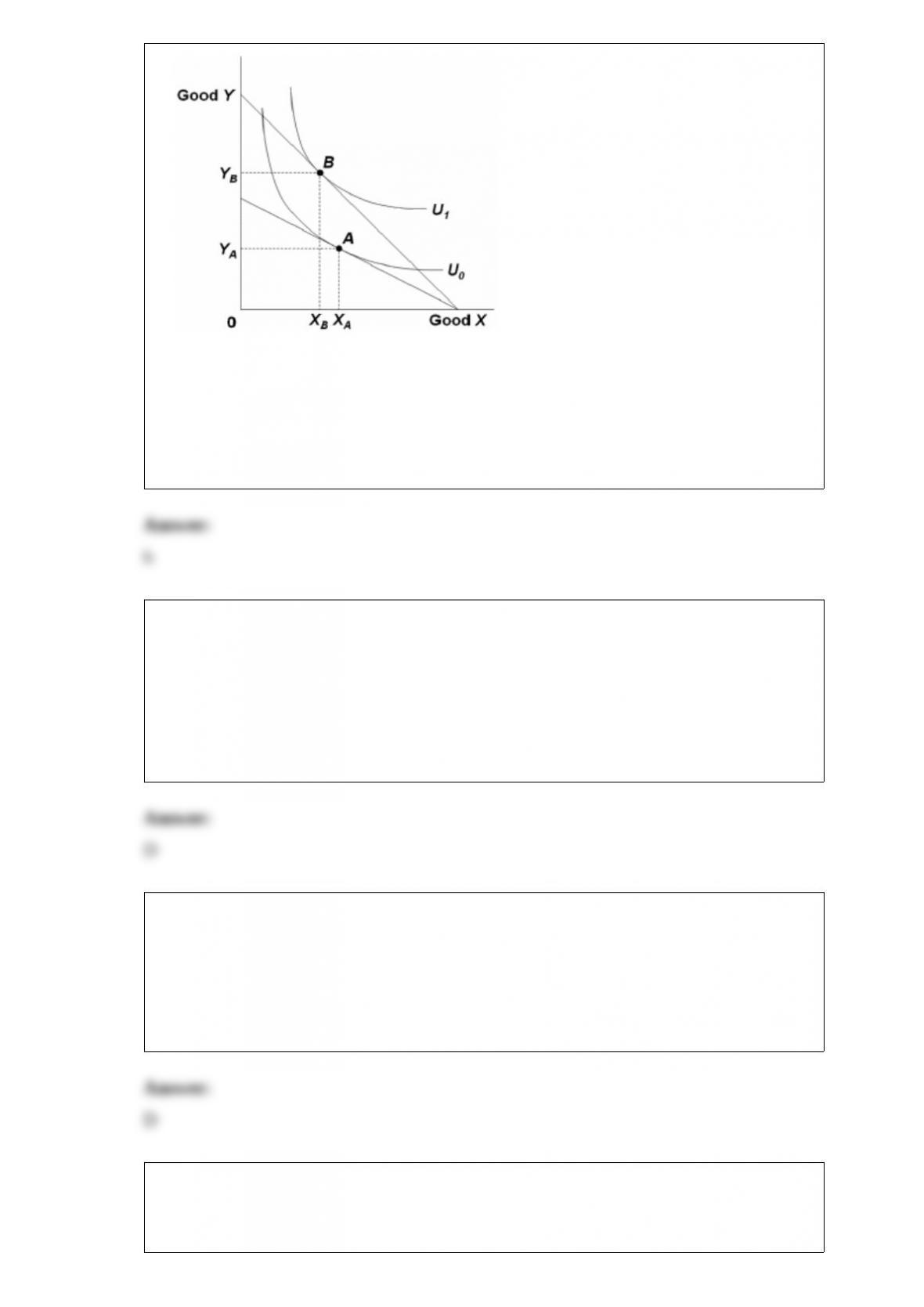
9)
refer to the above diagram. the budget line shift that moves the consumer’s equilibrium
from point a to point b suggests:
a.an increase in the demand for product x.
b.a decrease in the demand for product x.
c.no change in the demand for product x.
d.that x is an inferior good.
10) In the taste-for-discrimination model:
A.a decline in discrimination will reduce the actual African-American-white wage ratio.
B.an increase in collective discrimination coefficients of employers will reduce the
demand for African-American workers, decrease the African-American wage, and
increase African-American employment.
C.firms that discriminate will have lower costs than firms that do not discriminate.
D.competitive forces will tend to reduce discrimination in the very long run.
11) Resource pricing is important because:
A.resource prices are a major determinant of money incomes.
B.resource prices allocate scarce resources among alternative uses.
C.resource prices, along with resource productivity, are important to firms in
minimizing their costs.
D.of all of these reasons.
12) Famines in sub-Saharan Africa:
A.are solely the result of unalterable weather conditions.
B.have become less common in recent decades.

C.are the result of drought, civil strife, overpopulation, and inappropriate public
policies.
D.are solely the result of government policies that overprice agricultural products.
13) If personal taxes were decreased and resource productivity increased
simultaneously, the equilibrium:
A.output would rise.
B.output would fall.
C.price level would necessarily fall.
D.price level would necessarily rise.