
Even countries that depend primarily on market forces to resolve the basic economic
questions will usually rely on the collective decision-making process to
a. determine the prices of goods and resources.
b. allocate goods that are essential to life.
c. determine the distribution of income among citizens.
d. define and enforce private-property rights and designate the acceptable forms of
competitive economic behavior.
Economists generally criticize high barriers to market entry because
a. the ability of consumers to discipline producers is weakened.
b. unregulated monopolists and oligopolists can often gain by increasing output and
raising price.
c. legal barriers to entry will encourage firms to “invest” resources in developing highly
desired products that consumers are willing to pay more for.
d. entry barriers are popular with consumers but not businesses.
When the expenditure approach is used to measure GDP, the major components of GDP
are
a. consumption, investment, indirect business taxes, and depreciation.
b. employee compensation, rents, interest, self-employment income, and corporate
profits.

c. employee compensation, corporate profits, depreciation, and indirect business taxes.
d. consumption, investment, government consumption and gross investment, and net
exports.
Under the rational expectations hypothesis, which of the following is the most likely
long-run effect of a move to a more expansionary monetary policy?
a. higher prices and no change in real output
b. higher prices and expansion in real output
c. no change in prices but an expansion in real output
d. no change in either prices or real output
Assume that the demand for paper products increases. Then, we expect that the
a. demand for trees will also increase.
b. demand for trees will stay the same.
c. demand for trees will decrease.
d. effect on the demand for trees is uncertain; it depends on the elasticity of the demand
for paper.

If an advance in computer technology reduces the need for businesses to hire
accountants, students majoring in accounting should expect
a. a lower rate of return on their human capital investment.
b. an increase in their employment prospects.
c. a higher wage rate than they were expecting when they selected their major.
d. an increase in the demand for accountants.
If the marginal physical product (MPP) of labor is 60 and the price of labor per period
is $20, the MPP of machinery is 75 and the price of the machinery per period is $25, in
order to achieve optimal input proportions the firm should use
a. more labor and less machinery.
b. more machinery and less labor.
c. more labor with the same amount of machinery.
d. the current combination.

A competitive market economy with low barriers to entry affords an entrepreneur with
a. an environment that shields each currently successful producer from changing market
conditions.
b. the opportunity to bring new and different products and services to the market.
c. little opportunity for wealth creation.
d. a static business environment.
At an interest rate of 6 percent, if an investment project was expected to yield $1,000
per year (to be received at year end) for each of the next three years, profit-maximizing
decision makers would undertake the project only as long as the cost remained less than
a. $1,000.
b. $2,577.
c. $2,673.
d. $3,000.
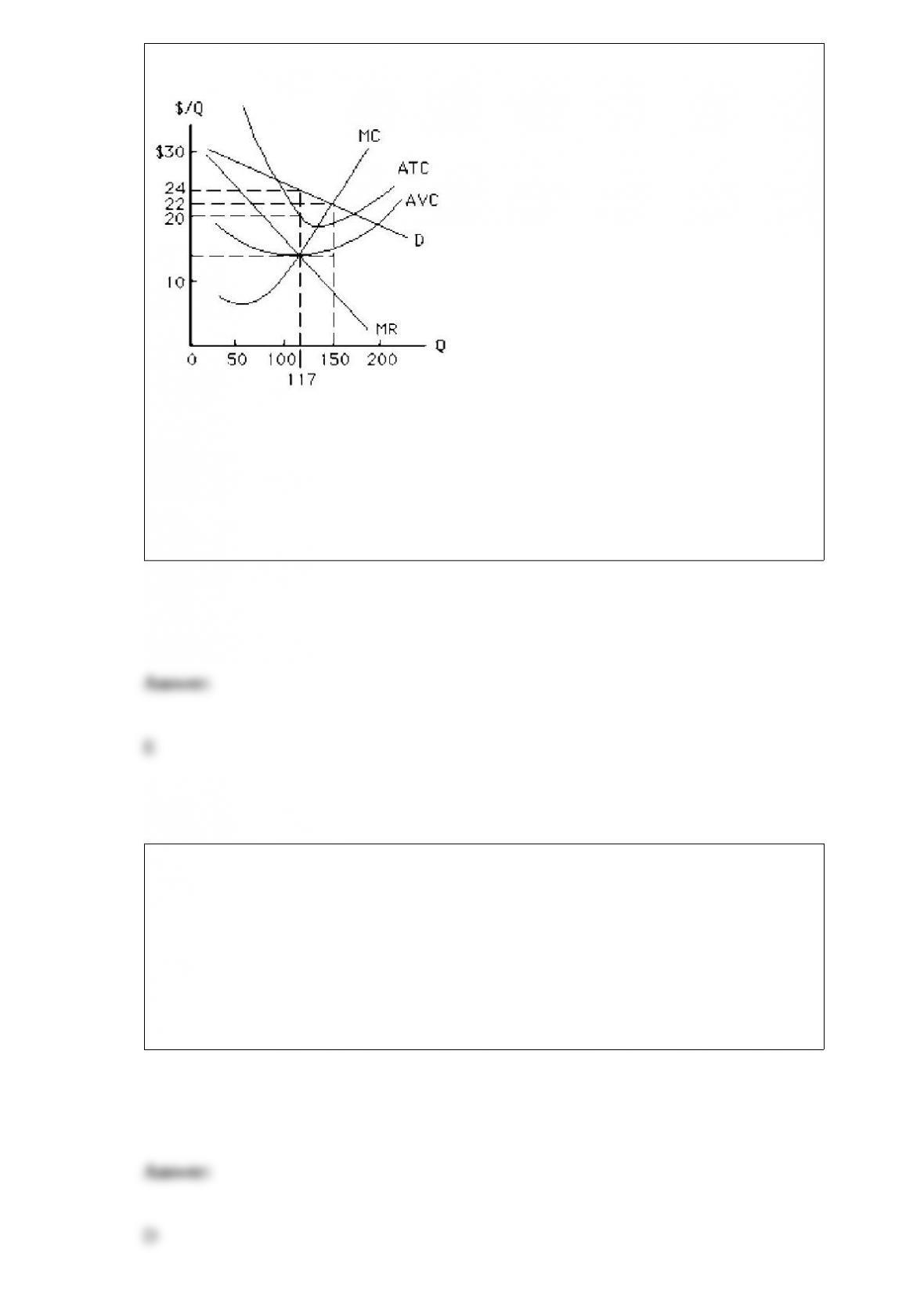
Figure 11-18
The profit-maximizing output and price for the firm in Figure 11-18, which charges the
same price to all customers, are
a. 117 and $14
b. 150 and $22
c. 150 and $14
d. 117 and $22
e. 117 and $24
The phenomenon that describes how transfer programs, which significantly reduce the
adversities of poverty, also reduce the opportunity cost of choices that often lead to
poverty is known as
a. the implicit marginal tax rate.
b. Gibson’s paradox.
c. the Phillips curve
d. the Samaritan’s dilemma.
Which of the following will cause a decrease in the demand for peanut butter?
a. an increase in the supply of peanut butter
b. an increase in the price of peanut butter
c. a doubling of the price of bread
d. a drought in Georgia that destroyed 30 percent of the peanut crop
e. an increase in consumer income
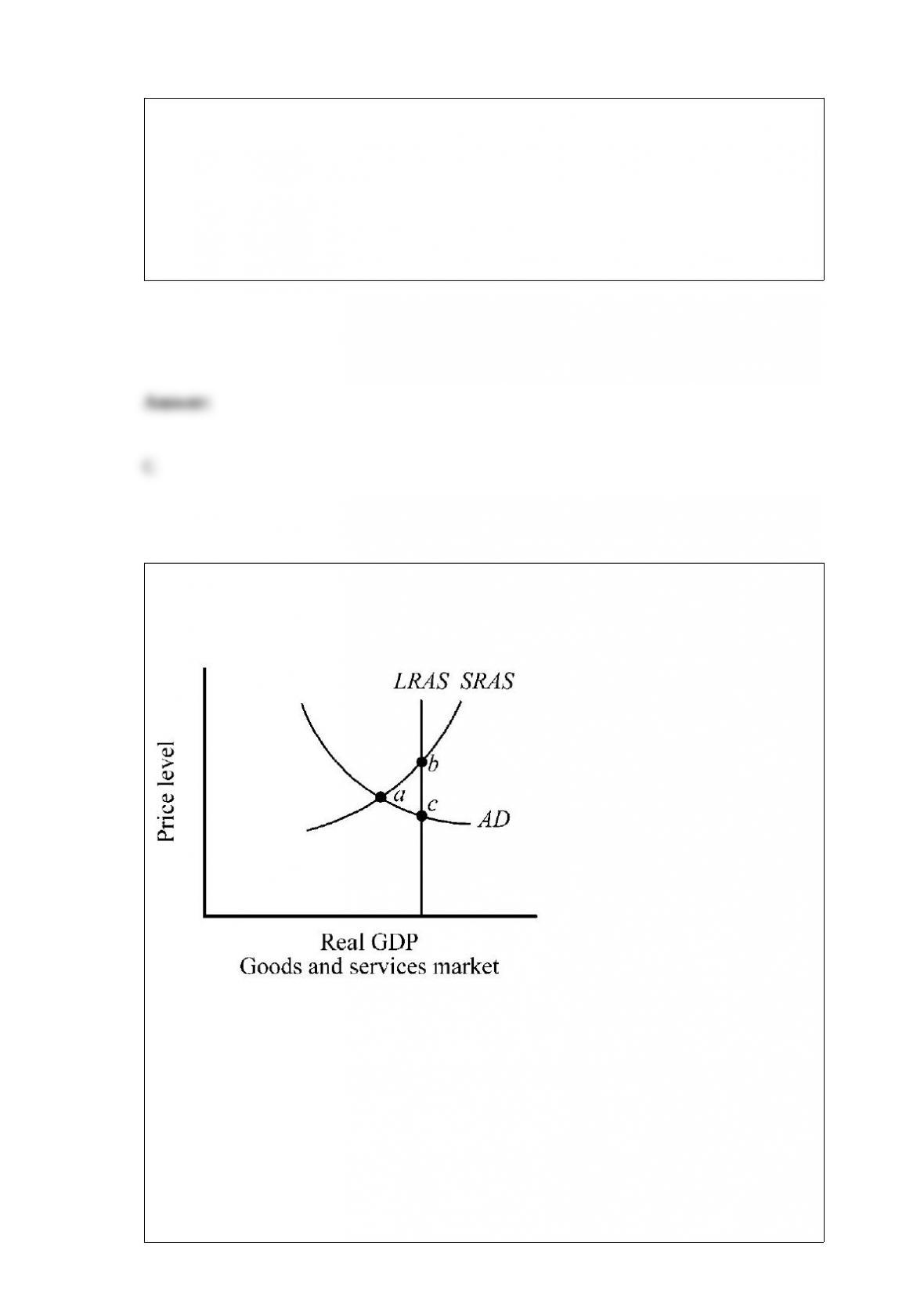
Use the figure below to answer the following question(s).
Figure 12-2
Refer to Figure 12-2. Which of the following will most likely be favored by a
Keynesian economist if the economy is operating at point a?
a. a balanced budget
b. restrictive fiscal policy
c. expansionary fiscal policy
d. continuation of the current tax and expenditure policies (dependence on the

economy’s self-correcting mechanism to restore full employment)
Comparisons of GDP between developed and underdeveloped countries are often
misleading because underdeveloped countries produce
a. a greater share of their total production in the household sector, which understates
their GDP relative to developed countries.
b. a smaller share of their total production in the household sector, which understates
their GDP relative to developed countries.
c. a greater share of their total production in the household sector, which overstates their
GDP relative to developed countries.
d. a smaller share of their total production in the household sector, which overstates
their GDP relative to developed countries.
A large grain crop resulting from favorable weather conditions would shift which of the
following curves?
a. only aggregate demand
b. aggregate demand and short-run aggregate supply
c. only short-run aggregate supply
d. only long-run aggregate supply

Within the framework of the AD/AS model, when the current price level in the goods
and services market is above the level anticipated at the time decision makers agreed to
long-term resource contracts,
a. producer profits will fall, leading to a reduction in output.
b. the natural rate of unemployment will rise.
c. the actual rate of unemployment will fall below the natural rate of unemployment.
d. output will be temporarily below the economy’s long-run sustainable output.
Economic theory indicates that the growth of subsidies to healthcare consumers and
accompanying expansion in third-party payments will
a. lead to higher healthcare prices.
b. lead to lower healthcare prices.
c. reduce the incentive of consumers to economize.
d. increase the incentive of healthcare providers to provide their services at a low cost.
e. do both a and c above.
The index of leading indicators was developed to provide more reliable information on
a. the expected future direction of the economy.
b. the future profitability of the leading companies in various industries.
c. where the economy has been in the recent past.
d. the extent to which the economy’s existing plant and equipment capacity is being
used.
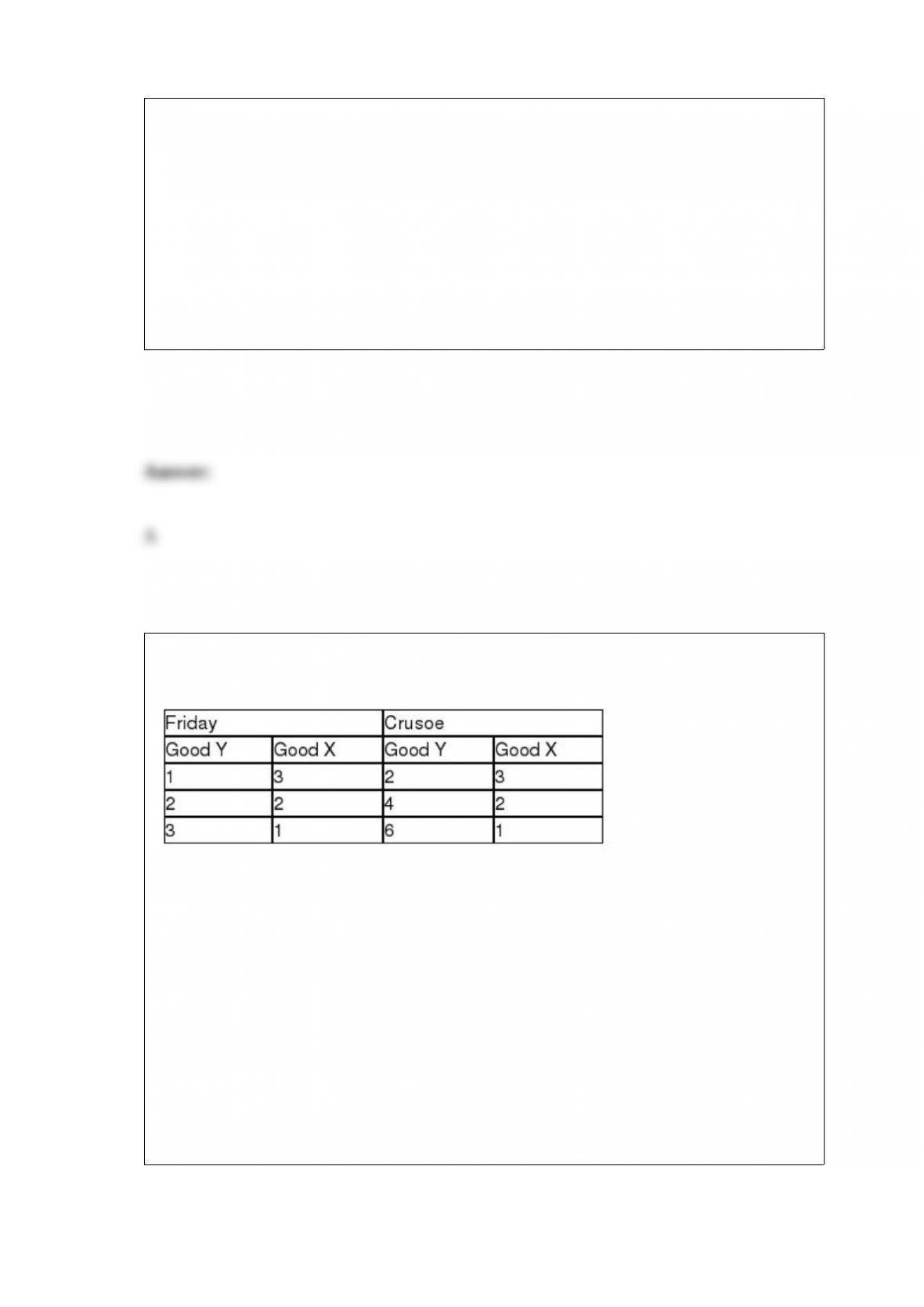
Use the table below to choose the correct answer. The table outlines the production
possibilities of Robinson Crusoe and Joe Friday.
If Crusoe and Friday want to maximize their consumption possibilities,
a. Crusoe should specialize in producing good X and Friday in producing good Y, but
no trade should be allowed.
b. Crusoe should specialize in producing good X and Friday in producing good Y; trade
should occur to maximize joint consumption.
c. Crusoe should specialize in producing good Y and Friday in producing good X; trade
should occur to maximize joint consumption.
d. Not enough information is provided to conclusively answer this question.

If the Fed wanted to expand the money supply as part of an antirecession strategy, it
could
a. increase the reserve requirements imposed on commercial banks.
b. decrease the interest rate paid on excess reserves encouraging banks to extend more
loans.
c. sell U.S. government securities and other financial assets that it is currently holding.
d. raise the interest rate on loans extended to banks and other financial institutions.
The “rule of 70” is a simple rule
a. (70 divided by the growth rate) that approximates the number of years it will take for
income to double at various growth rates.
b. (70 multiplied by the growth rate) that approximates the number of years it will take
for income to double at various growth rates.
c. (70 divided by the percentage of population over age 70) that can be used to
approximate a nation’s growth of real GDP.
d. (70 multiplied by the percentage of population over age 70) that can be used to
approximate a nation’s growth of real GDP.

When the government is heavily involved in the regulation of business activity,
entrepreneurs will be encourage to spend more time and resources on
a. research and the development of better products.
b. keeping their production costs low.
c. rent seeking.
d. productive activities and less on political lobbying.
If a firm refuses to hire any females due to a personal prejudice, its profits will
a. increase markedly.
b. decrease.
c. not be affected.
d. increase slightly.
The supply curve of a human resource will be more elastic the
a. easier it is to obtain the skill and knowledge necessary to provide the resource.
b. more elastic the demand for the product.
c. more inelastic the demand for the product.
d. higher the skill level necessary to perform the job.
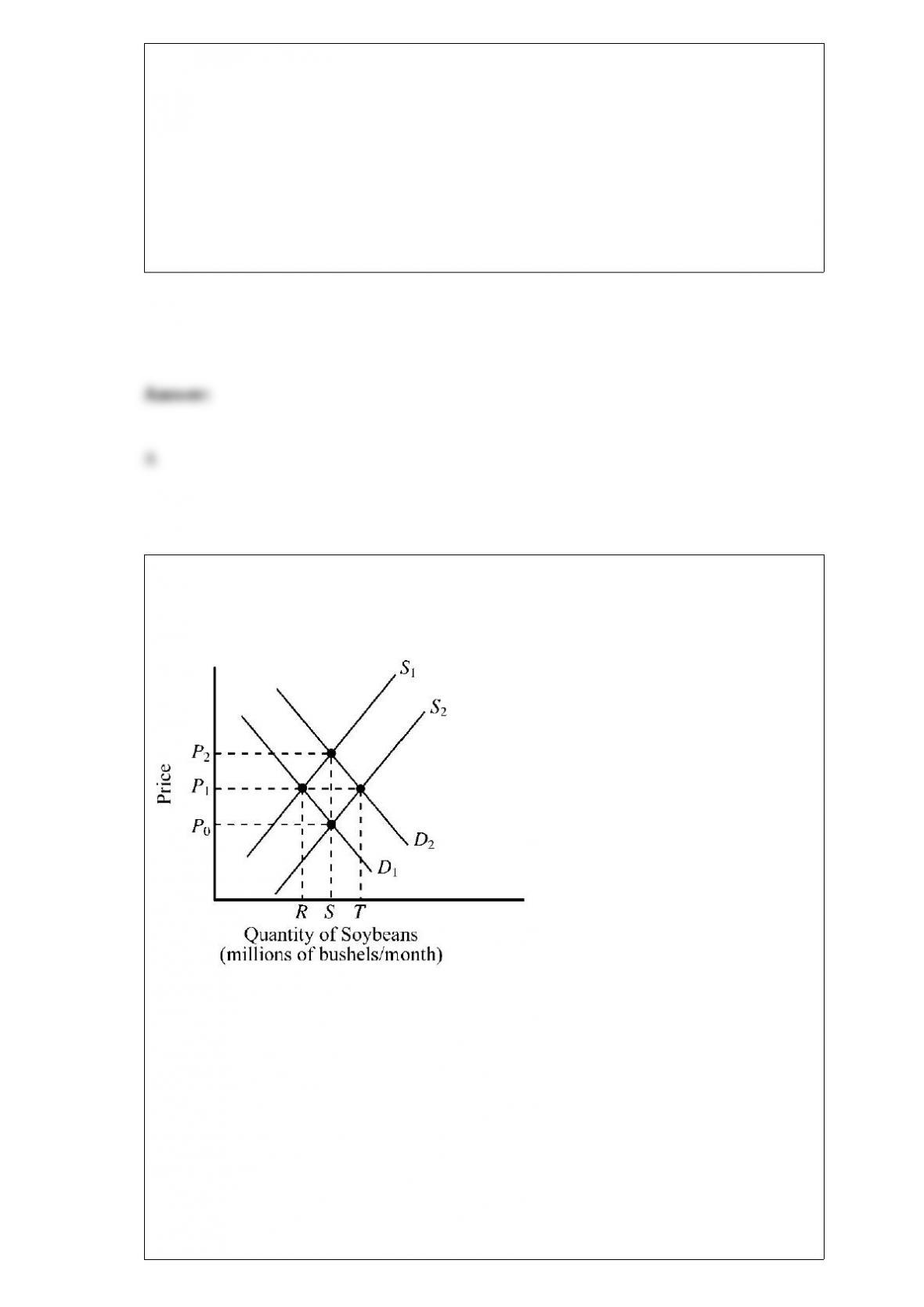
Use the figure below to answer the following question(s).
Figure 3-8
In Figure 3-8, if the initial demand and supply for soybeans were D1 and S1, how would
a decrease in the cost of producing soybeans affect the market for soybeans?
a. Demand would increase to D2, price would increase to P2, and the quantity would
increase to S.
b. Supply would increase to S2, price would decrease to P0, and the quantity would
increase to S.
c. Both demand and supply would increase so the price would remain at P1, but the
quantity would increase to T.
d. None of the above would occur.
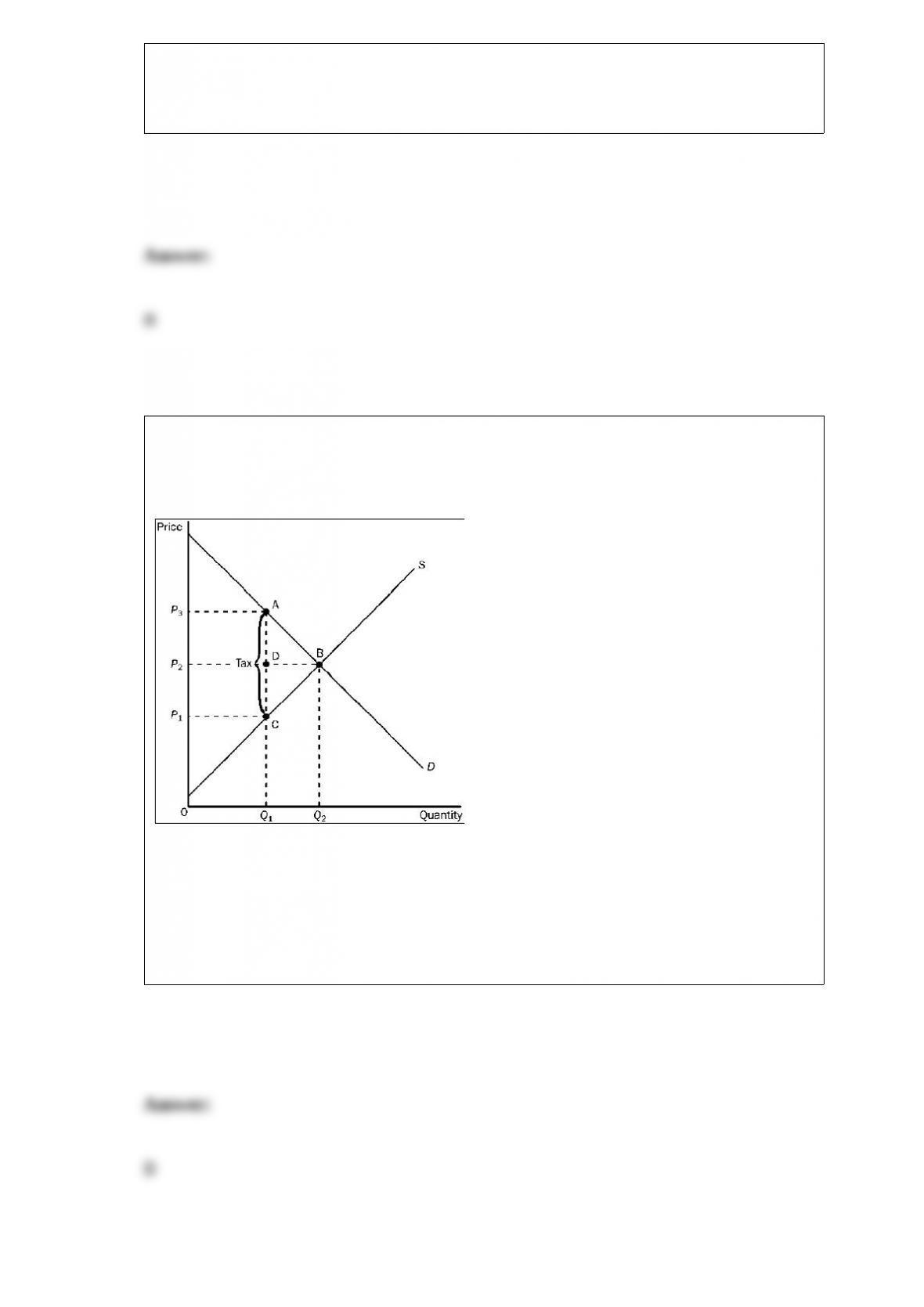
Figure 4-24
Refer to Figure 4-24. The per unit burden of the tax on buyers is
a. P3 P1.
b. P3 P2.
c. P2 P1.
d. Q2 Q1.

Rational choice requires that opportunity cost be
a. ignored in making a decision.
b. considered for individual choices, but not for societal choices.
c. computed, but not actually used in making a decision.
d. considered as part of making a decision.
e. used as the sole decision criterion.
Which of the following are NOT scarce?
a. time for leisure activities
b. computers
c. compact discs
d. the air we breathe
If the marginal revenue product of the fifth worker hired by a firm is $15 and the price
of a unit of output is $5 regardless of how much is sold, then the marginal product of
the fifth worker is
a. 15 units of output.

b. 5 units of output.
c. 3 units of output.
d. 45 units of output.
e. 75 units of output.
If Congress suddenly passes legislation that required all U.S. workers to receive the
same annual pay, we would expect
a. less human capital investment.
b. a shortage of workers to fill the least desirable jobs.
c. a surplus of workers to fill the easy, desirable jobs.
d. all of the above.
Which of the following is the most efficient method to reduce pollution emissions?
a. government pollution charges or taxes
b. non-tradable emission standards that cap allowable pollution
c. common law enforcement of property rights, when those rights are well-defined and

transaction costs are low
d. legislated regulations limiting the quantity of emissions allowed by each firm
Which of the following is the major difference between the chained consumer price
index and the regular consumer price index?
a. The chained index assumes that households purchase the same bundle of goods over
a lengthy time period; the regular price index makes allowance for shifts away from
goods that have become more expensive.
b. The chained index makes allowance each month for shifts away from goods that have
become more expensive; the regular consumer price index fails to adjust for these
shifts.
c. The chained consumer price index reflects changes in the prices of all final goods and
services produced during a period, whereas the regular consumer price index reflects
only changes in the prices of goods purchased by households.
d. The chained consumer price index will generally result in a higher measured rate of
inflation than the regular consumer price index.
If monetary and fiscal policy are going to promote economic stability, they must
_________ during a recession, and _________ during an economic boom. (Fill in the
blank)
a. add stimulus; apply restraint
b. apply restraint; add stimulus

c. add stimulus; add stimulus
d. apply restraint; apply restraint
When the Fed increases the money supply by buying Treasury securities, it will
a. decrease short-term interest rates to a greater degree than long-term interest rates.
b. decrease long-term interest rates to a greater degree than short-term interest rates.
c. increase short-term interest rates to a greater degree than long-term interest rates.
d. increase long-term interest rates to a greater degree than short-term interest rates.
The administrative, enforcement, and compliance costs of collecting taxes in the United
States sum to
a. between 1 and 2 percent of the revenues collected.
b. between 5 and 6 percent of the revenues collected.
c. between 12 and 15 percent of the revenues collected.
d. more than half of the revenues collected.