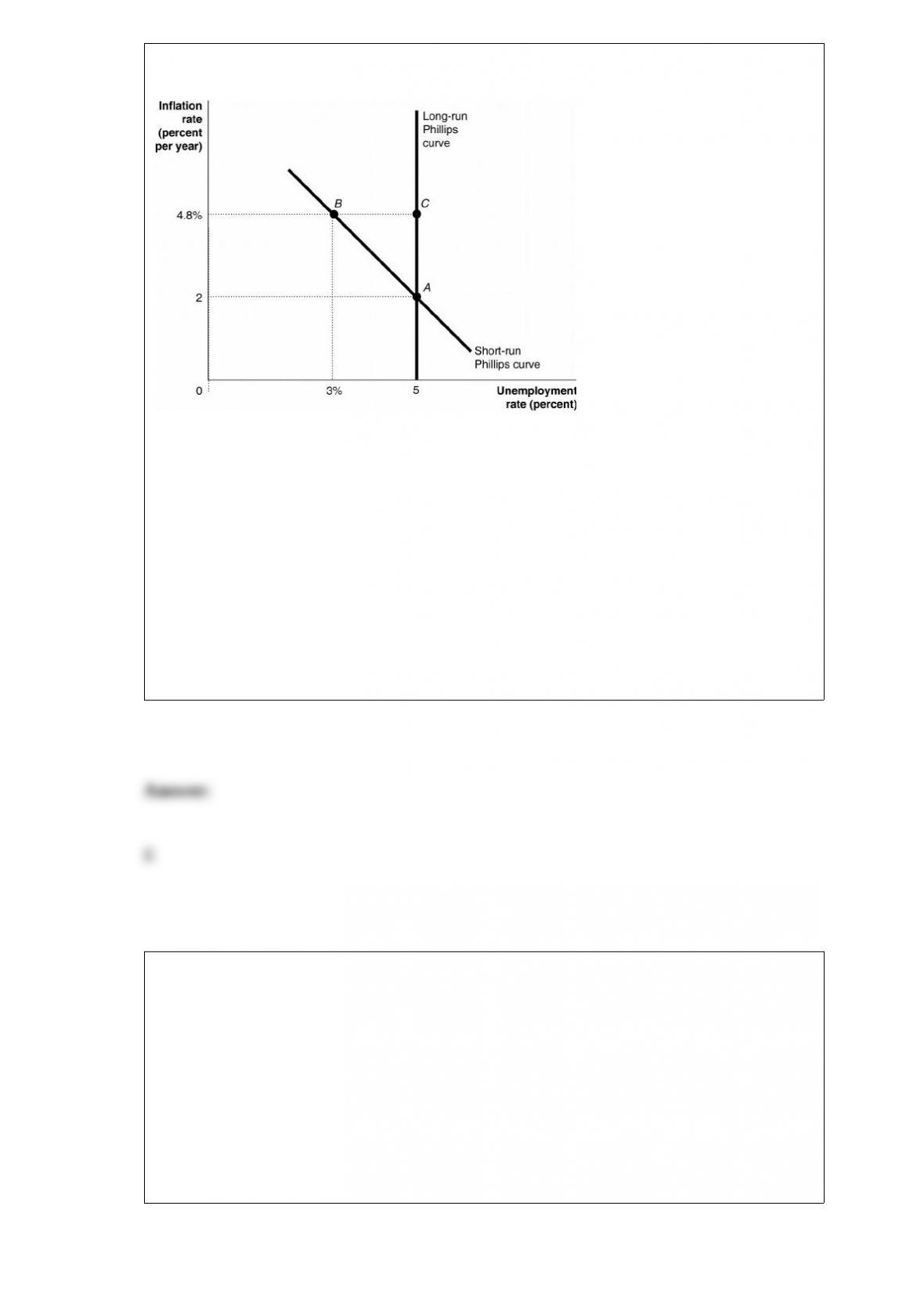
Figure 17-6
Refer to Figure 17-6. If firms and workers have rational expectations, an expansionary
monetary policy will cause the short-run equilibrium to move from
A) point B to point C.
B) point C to point A.
C) point A to point B.
D) point B to point A.
E) point A to point C.
The key idea of the aggregate expenditure model is that in any particular year, the level
of ________ is determined mainly by the level of aggregate expenditure.
A) frictional unemployment
B) export spending
C) government spending
D) GDP

If workers and firms expect that inflation will be 3 percent next year, and real wages are
not changing over time, by how much will nominal wages increase?
A) 3 percent
B) more than 3 percent
C) less than 3 percent
D) depends on actual inflation for next year
In 2013, Caterpillar laid off employees. The employees who were laid off due to the
business cycle would be considered
A) structurally unemployed.
B) frictionally unemployed.
C) seasonally unemployed.
D) cyclically unemployed.

How will the exchange rate (foreign currency per dollar) respond to a decrease in the
relative rate of productivity growth in the United States in the long run?
A) Exchange rates will rise.
B) Exchange rates will fall.
C) Exchange rates will be unaffected by changes in the relative rate of productivity
growth in the United States, both in the short run and in the long run.
D) The exchange rate will be affected in the short run, but not in the long run.
Imagine that you borrow $1,000 for one year and at the end of the year you repay the
$1,000 plus $100 of interest. If the inflation rate was 7%, what was the real interest rate
you paid?
A) 17 percent
B) 10 percent
C) 7 percent
D) 3 percent
Table 8-18
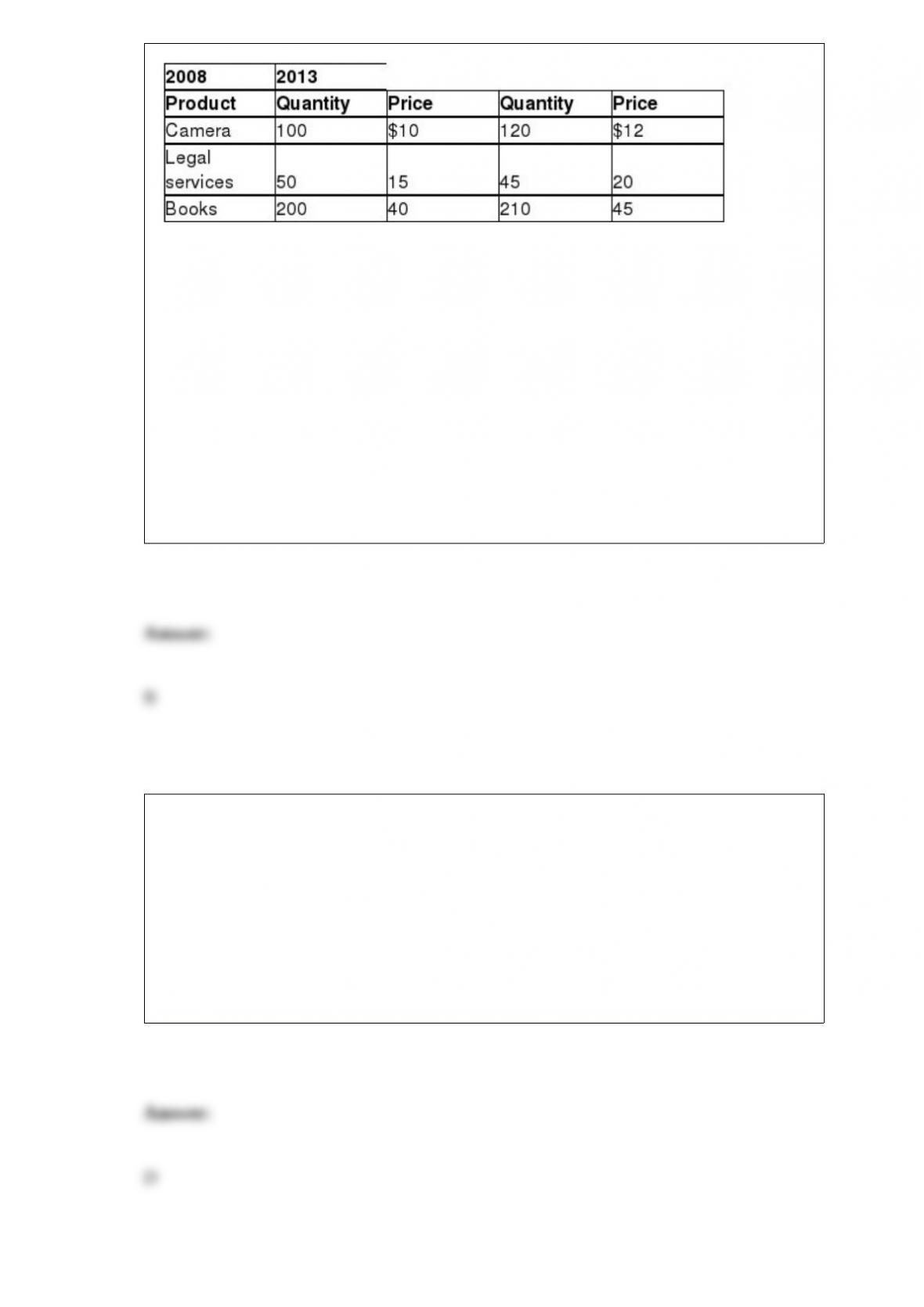
A very simple economy produces three goods: cameras, legal services, and books. The
quantities produced and their corresponding prices for 2008 and 2013 are shown in the
table above.
Refer to Table 8-18. What is nominal GDP in 2013 when 2008 is the base year?
A) $28,885
B) $11,790
C) $11,200
D) $10,275
The federal government debt equals
A) tax revenues minus government spending.
B) government spending minus tax revenues.
C) the accumulation of past budget deficits.
D) the total value of U.S. Treasury bonds outstanding.

With which of the following statements would a “real business cycle” theorist most
closely agree?
A) “Monetary policies have the greatest impact on real GDP when they are anticipated.”
B) “Expansionary monetary policy allows the central bank to control inflation and
unemployment simultaneously.”
C) “Wages adjust rapidly to changes in inflation as long as expectations are formed
rationally.”
D) “Technological shocks to the economy affect only aggregate demand in the short
run.”
Increases in the price level
A) increase the opportunity cost of holding money.
B) decrease the opportunity cost of holding money.
C) increase the quantity of money needed for buying and selling.
D) decrease the quantity of money needed for buying and selling.
Firms
A) have no influence on the circular flow in a market economy.
B) purchase resources in the product market.
C) sell goods in the product market.
D) sell resources in the factor market.
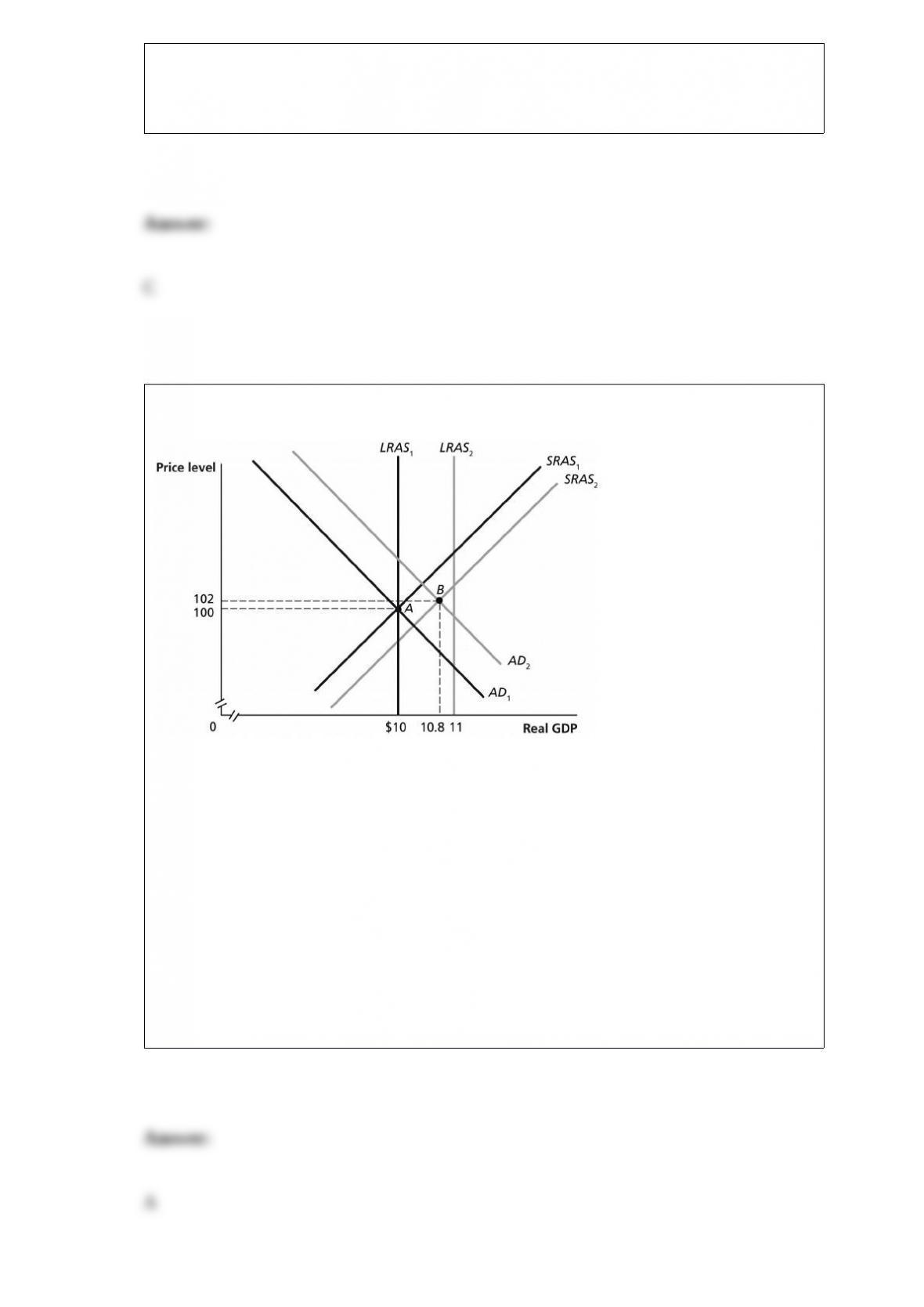
Figure 16-5
Refer to Figure 16-5. In the dynamic model of AD–AS in the figure above, if the
economy is at point A in year 1 and is expected to go to point B in year 2, Congress and
the president would most likely pursue
A) expansionary fiscal policy.
B) contractionary fiscal policy.
C) expansionary monetary policy.
D) contractionary monetary policy.
E) contractionary automatic stabilizers.

If the CPI is currently 202, what does this tell you about inflation between last year and
this year?
A) There was deflation in the economy between this year and last year.
B) Inflation in the economy between this year and last year was 2%.
C) Inflation in the economy between this year and last year was 102%.
D) The CPI measures only the level of prices in a given year, not the percentage change
in prices from one year to the next.
All of the following policies are ways for a country to promote long-run economic
growth except
A) increasing vaccinations against infectious diseases.
B) undergoing political reform to decrease corruption.
C) enacting stronger laws to protect property rights.
D) imposing stricter regulations to limit foreign direct investment.
The level of real GDP in the long run is
A) potential GDP.
B) affected by changes in the price level.
C) determined solely by aggregate demand.
D) the same as the level of nominal GDP in the long run.
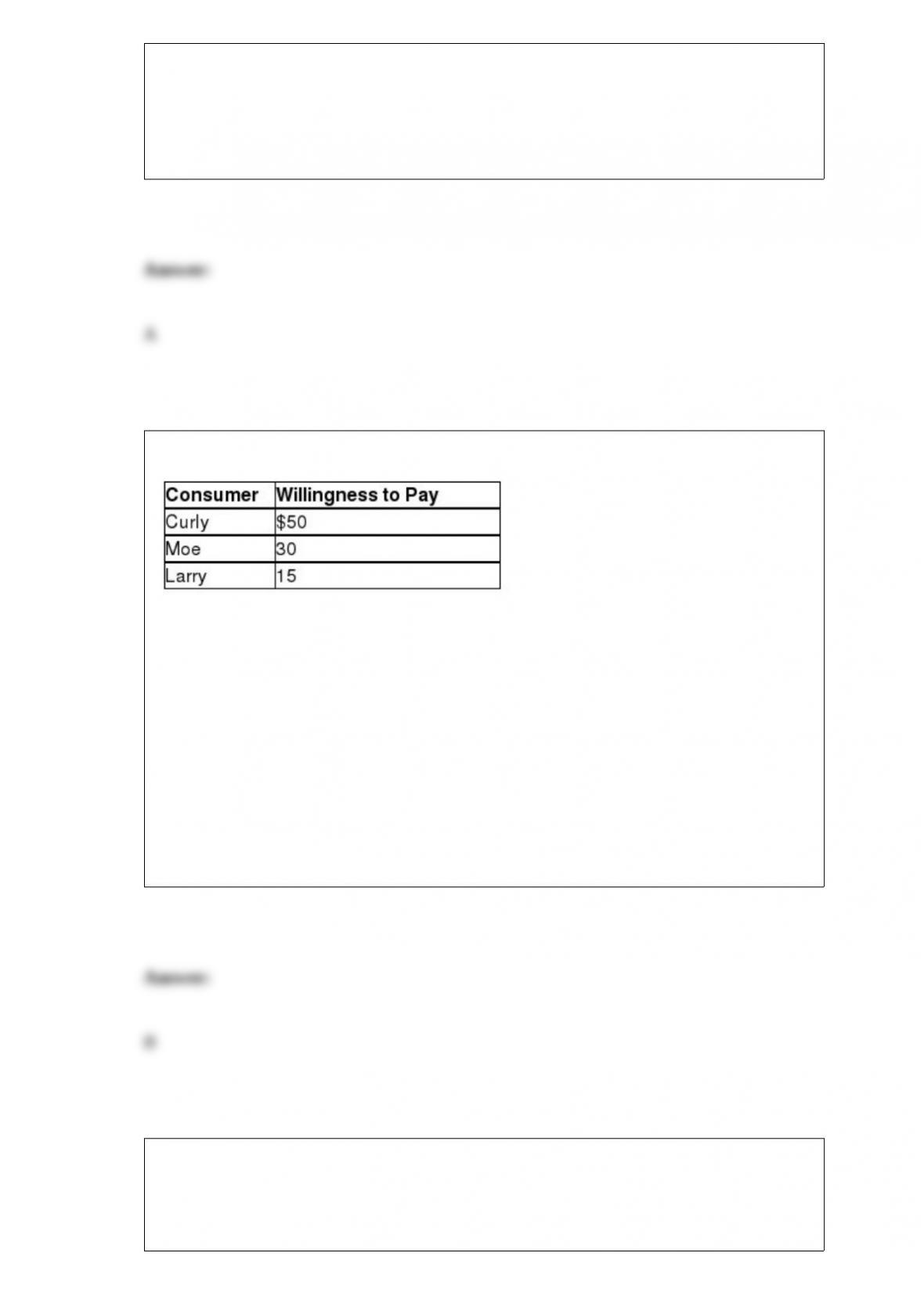
Table 4-1
Refer to Table 4-1. The table above lists the highest prices three consumers, Curly,
Moe, and Larry, are willing to pay for a bottle of champagne. If the price of one of the
bottles is $24 dollars
A) Curly will buy two bottles, Moe will buy one bottle and Larry will buy no bottles.
B) Curly will receive $26 of consumer surplus from buying one bottle.
C) Curly and Moe receive a total of $80 of consumer surplus from buying one bottle
each. Larry will buy no bottles.
D) Larry will receive $15 of consumer surplus since he will buy no bottles.
Suppose the economy is at full employment and firms become more optimistic about
the future profitability of new investment. Which of the following will happen in the
short run?

A) Output will decline.
B) Prices will decline.
C) Unemployment will decline.
D) The aggregate demand curve will shift to the left.
When people became less concerned with the underlying value of their houses and
instead focused on the expectations of the prices of their houses increasing, ________
occurred.
A) stagflation
B) an automatic destabilizer
C) a housing bubble
D) a supply shock
Knowledge capital is ________ in production and ________. As a result, firms
________ free ride.
A) nonrival; nonexcludable; can
B) nonrival; excludable; can
C) rival; nonexcludable; cannot
D) nonrival; nonexcludable; cannot