
According to the classical dichotomy, which of the following is not influenced by
monetary factors?
a. the price level
b. real GDP
c. nominal interest rates
d. All of the above are correct.
If the dollar appreciates, perhaps because of speculation or government policy, then
U.S. net exports
a. increase which shifts aggregate demand right.
b. increase which shifts aggregate demand left.
c. decrease which shifts aggregate demand right.
d. decrease which shifts aggregate demand left.
The basket of goods in the consumer price index changes
a. occasionally, as does the group of goods used to compute the GDP deflator.
b. automatically, as does the group of goods used to compute the GDP deflator.
c. occasionally, whereas the group of goods used to compute the GDP deflator changes
automatically.
d. automatically, whereas the group of goods used to compute the GDP deflator changes
occasionally.
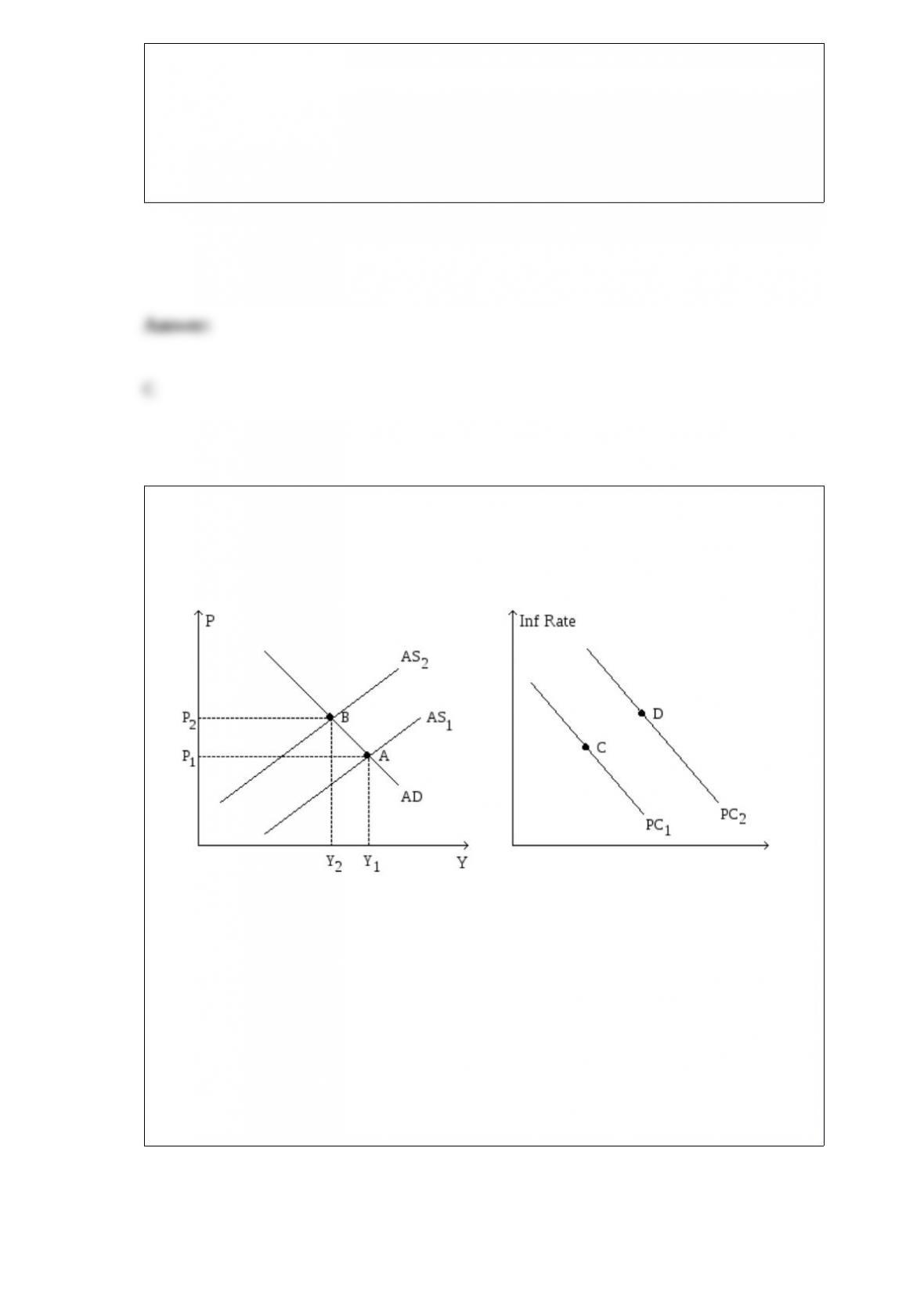
Figure 22-8. The left-hand graph shows a short-run aggregate-supply (SRAS) curve
and two aggregate-demand (AD) curves. On the right-hand diagram, “Inf Rate” means
“Inflation Rate.”
Refer to Figure 22-8. Subsequent to the shift of the Phillips curve from PC1 to PC2, the
curve will soon shift back to PC1 if people perceive the
a. increase in the inflation rate as a temporary aberration.
b. economic boom as a temporary aberration.
c. increase in the inflation rate as a sign of a new era of higher inflation.
d. economic boom as a sign of a new era of higher economic growth.

If a country has a trade surplus, then its
a. saving is greater than domestic investment and Y > C + I + G.
b. saving is greater than domestic investment and Y < C + I + G.
c. saving is less than domestic investment and Y > C +I + G.
d. saving is less than domestic investment and Y < C + I + G.
Which of the following is included in the aggregate demand for goods and services?
a. consumption demand
b. investment demand
c. net exports
d. All of the above are correct.

Which of the following is likely to have the most price inelastic demand?
a. chocolate
b. Godiva chocolate
c. Hershey’s chocolate
d. All three would have the same elasticity of demand because they are all related.
England can benefit from trade
a. only with nations that can produce goods England cannot produce.
b. only with less developed nations.
c. only with nations outside of Europe.
d. with any nation.
After much consideration, you have chosen Ireland over Spain for your Study Abroad
program next year. However, the deadline for your final decision is still months away
and you may reverse this decision. Which of the following events would prompt you to
reverse this decision?
a. The marginal benefit of going to Spain increases.

b. The marginal cost of going to Spain increases.
c. The marginal benefit of going to Ireland increases.
d. The marginal cost of going to Ireland decreases.
Pierre says that he will spend exactly 75 cents a day on candy bars, regardless of the
price of candy bars. Pierre’s demand for candy bars is
a. perfectly elastic.
b. unit elastic.
c. perfectly inelastic.
d. None of the above answers is correct.
Zelzar has decided to end its policy of not trading with the rest of the world. When it
ends its trade restrictions, it discovers that it is importing incense, exporting steel, and
neither importing nor exporting rugs. Which groups in Zelzar are better off as a result of
the new free-trade policy?
a. producers of incense and consumers of steel
b. consumers of all three goods
c. consumers of incense and producers of rugs

d. producers of steel and consumers of incense
Consider the following rule for monetary policy: r = 2 percent + + 1/2(y – y*)/y* +
1/2(- *), where r is the nominal interest rate, y is real GDP, y* is an estimate of the
natural rate of output, is the inflation rate, and * is the inflation target. Which of the
following statements is not correct?
a. If aggregate demand shifts right from long-run equilibrium, this rule unambiguously
implies that the Fed increases the nominal interest rate.
b. If aggregate supply shifts right from long-run equilibrium at the inflation target, we
cannot tell without more information whether the Fed should increase or decrease the
nominal interest rate.
c. If output is at its natural level, but inflation is above its target, the Fed must increase
the nominal interest rate.
d. If inflation is at its targeted level, but output is above its natural rate, the Fed must
decrease the federal funds rate.
Which of the following could be the price elasticity of demand for a good for which an
increase in price would increase revenue?
a. 0.2
b. 1

c. 1.5
d. All of the above could be correct.
Suppose over some period of time the money supply tripled, velocity fell by half, and
real GDP doubled. According to the quantity equation the price level is now
a. 6 times its old value.
b. 3 times its old value.
c. 1.5 times its old value.
d. 0.75 times its old value.
Inflation reduction has the lowest cost when the efforts are
a. credible so that the sacrifice ratio is low.
b. credible so that the sacrifice ratio is high.
c. unexpected so that the sacrifice ratio is high.
d. unexpected so that the sacrifice ratio is low.

An economist working for the Central Bank of Fredonia estimates a Phillips curve for
Fredonia and reports the following points on the estimated curve.
actual inflation rate unemployment rate
5% 4%
4% 4.5%
3% 5%
2% 5.5%
Which of the following statements is correct?
a. These points are consistent with the theoretical long-run Phillips curve, but not with
the short-run Phillips curve.
b. These points are consistent with the theoretical short-run Phillips curve, but not with
the long-run Phillips curve.
c. These points are consistent with both the theoretical short-run and long-run Phillips
curves.
d. These points are not consistent with either the theoretical short-run or long-run
Phillips curves.
If the demand for loanable funds shifts right, then
a. the real interest rate and the equilibrium quantity of loanable funds both fall.

b. the real interest rate falls and the equilibrium quantity of loanable funds rises.
c. the real interest rate and the equilibrium quantity of loanable funds both rise.
d. the real interest rate rises and the equilibrium quantify of loanable funds falls.
Suppose a country abandons a no-trade policy in favor of a free-trade policy. If, as a
result, the domestic price of beans increases to equal the world price of beans, then
a. that country becomes an exporter of beans.
b. that country has a comparative advantage in producing beans.
c. at the world price, the quantity of beans supplied in that country exceeds the quantity
of beans demanded in that country.
d. All of the above are correct.
Figure 3-6
Maxine’s Production Possibilities Frontier Daisy’s Production Possibilities
Frontier
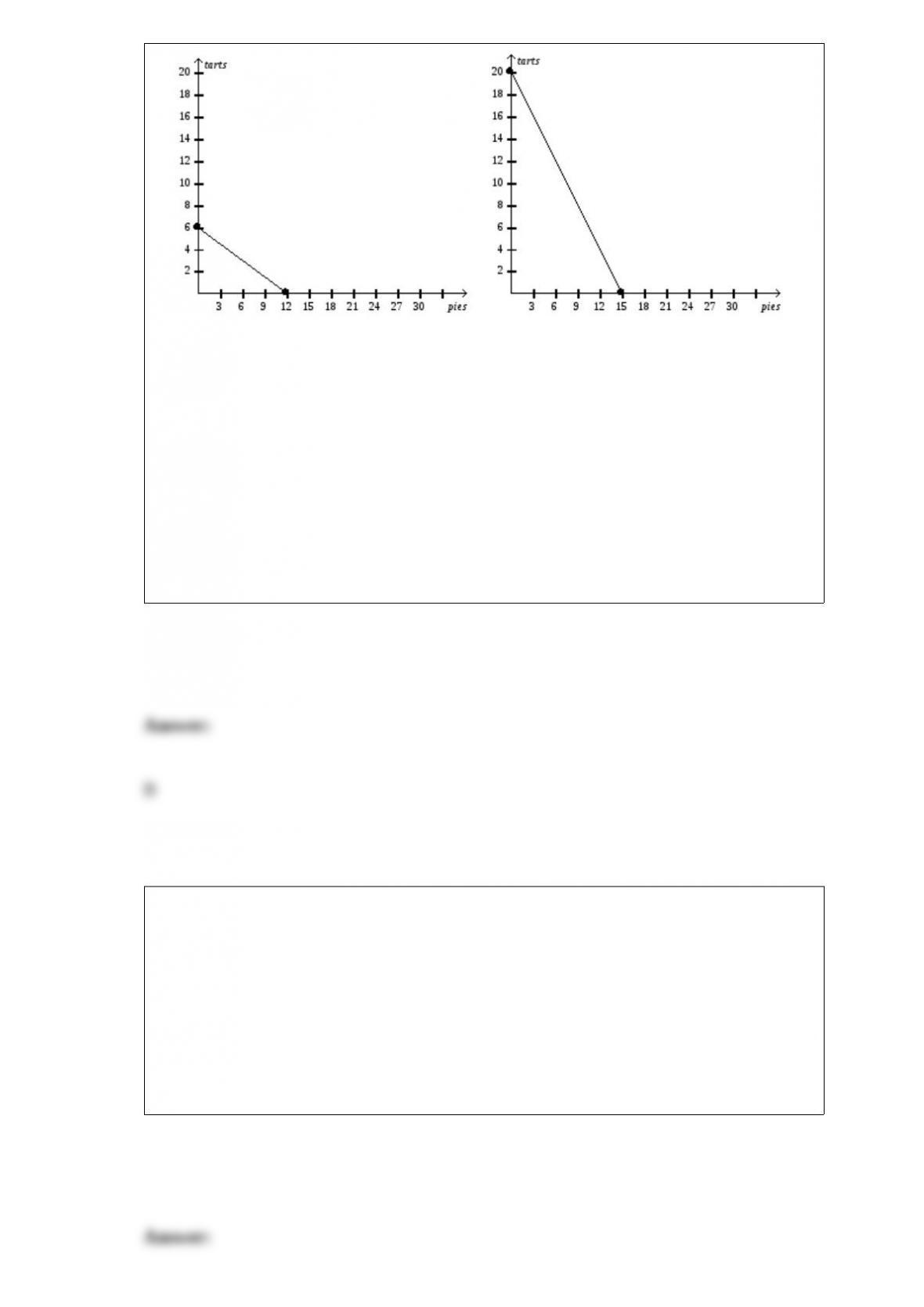
Refer to Figure 3-6. If the production possibilities frontiers shown are each for one day
of work, then which of the following combinations of pies and tarts could Maxine and
Daisy together not make in a given day?
a. 2 pies and 25 tarts
b. 10 pies and 22 tarts
c. 12 pies and 15 tarts
d. 15 pies and 16 tarts
If the reserve ratio is 5 percent, then the money multiplier is
a. 25.
b. 20.
c. 2.5.
d. 1.25.

Which of the following is included in the consumption component of GDP?
a. household purchases of appliances.
b. household purchases of medical care.
c. household purchases of food.
d. All of the above are included in the consumption component of GDP.
Nathan owns a bakery that bakes only cakes. All of his bakers work 8 hours per day. In
2009, he employed 5 bakers who produced a total of 200 cakes each day. In 2010, he
employed 6 bakers who produced a total of 249 cakes each day. The bakery’s
productivity
a. decreased by 2.33%.
b. increased by 2.33%.
c. increased by 3.75%.
d. increased by 24.50%.
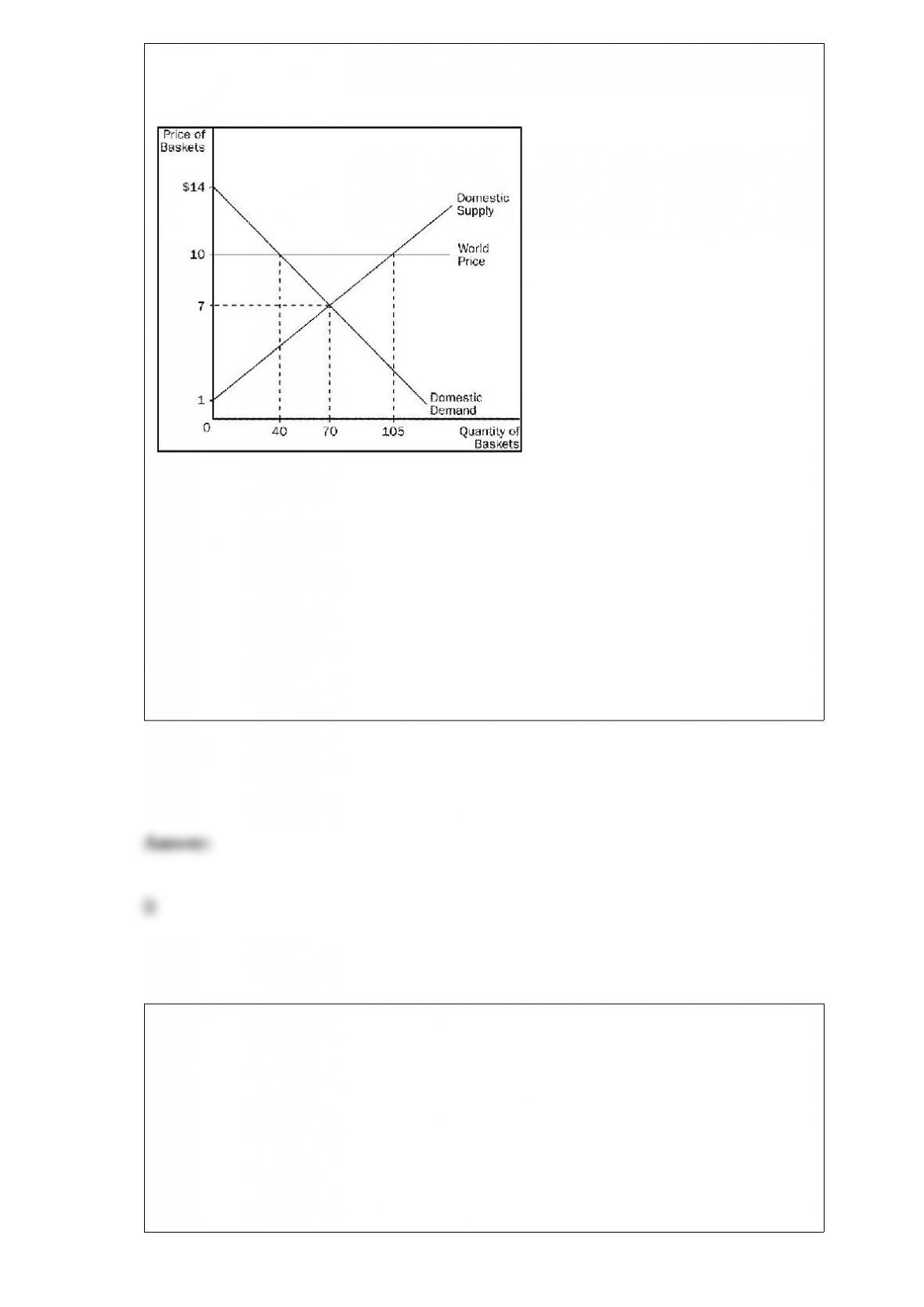
Figure 9-2
Refer to Figure 9-2. At the world price and with free trade,
a. the domestic quantity of baskets demanded is greater than the domestic quantity of
baskets supplied.
b. the basket market is in equilibrium.
c. the domestic demand for baskets is perfectly inelastic.
d. both domestic producers of baskets and domestic consumers of baskets are better off
than they were without free trade.
College-age athletes who drop out of college to play professional sports
a. are not rational decision makers.
b. are well aware that their opportunity cost of attending college is very high.
c. are concerned more about present circumstances than their future.
d. underestimate the value of a college education.

According to the theory of purchasing-power parity, the nominal exchange rate between
two countries must reflect the differing
a. price levels in those countries.
b. resource endowments in those countries.
c. income levels in those countries.
d. standards of living between those countries.
Figure 8-2
The vertical distance between points A and B represents a tax in the market.
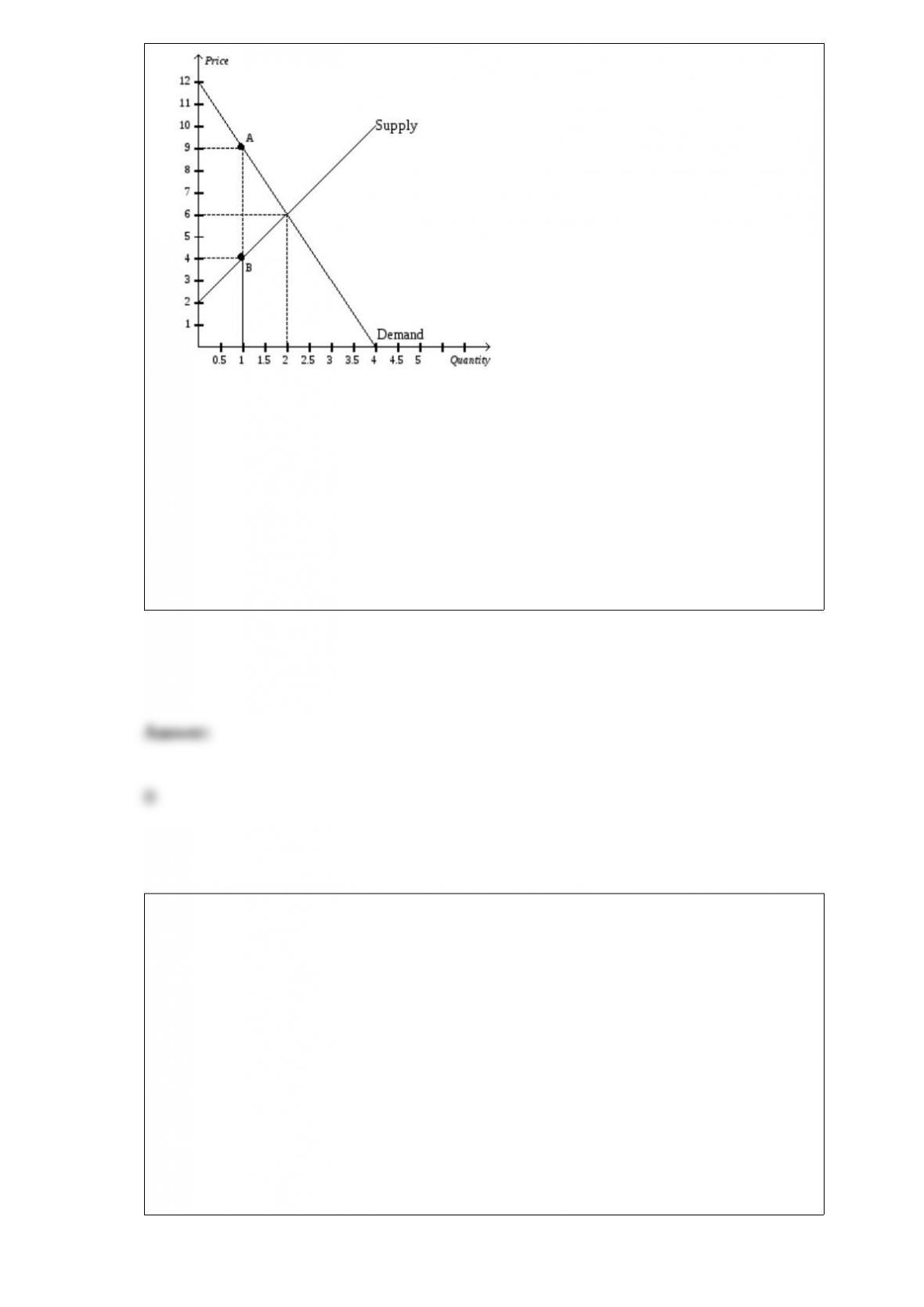
Refer to Figure 8-2. The per-unit burden of the tax on buyers is
a. $2.
b. $3.
c. $4.
d. $5.
The price index was 150 in the first year, 160 in the second year, and 165 in the third
year. Which of the following statements is correct?
a. The price level was higher in the second year than in the first year, and it was higher
in the third year than in the second year.
b. The inflation rate was positive between the first and second years, and it was positive
between the second and third years.
c. The inflation rate was lower between the second and third years than it was between
the first and second years.
d. All of the above are correct.
The ordered pair that represents the origin on a graph is
a. (1, 1).
b. (0, 0).
c. (-1, -1).
d. ( ).
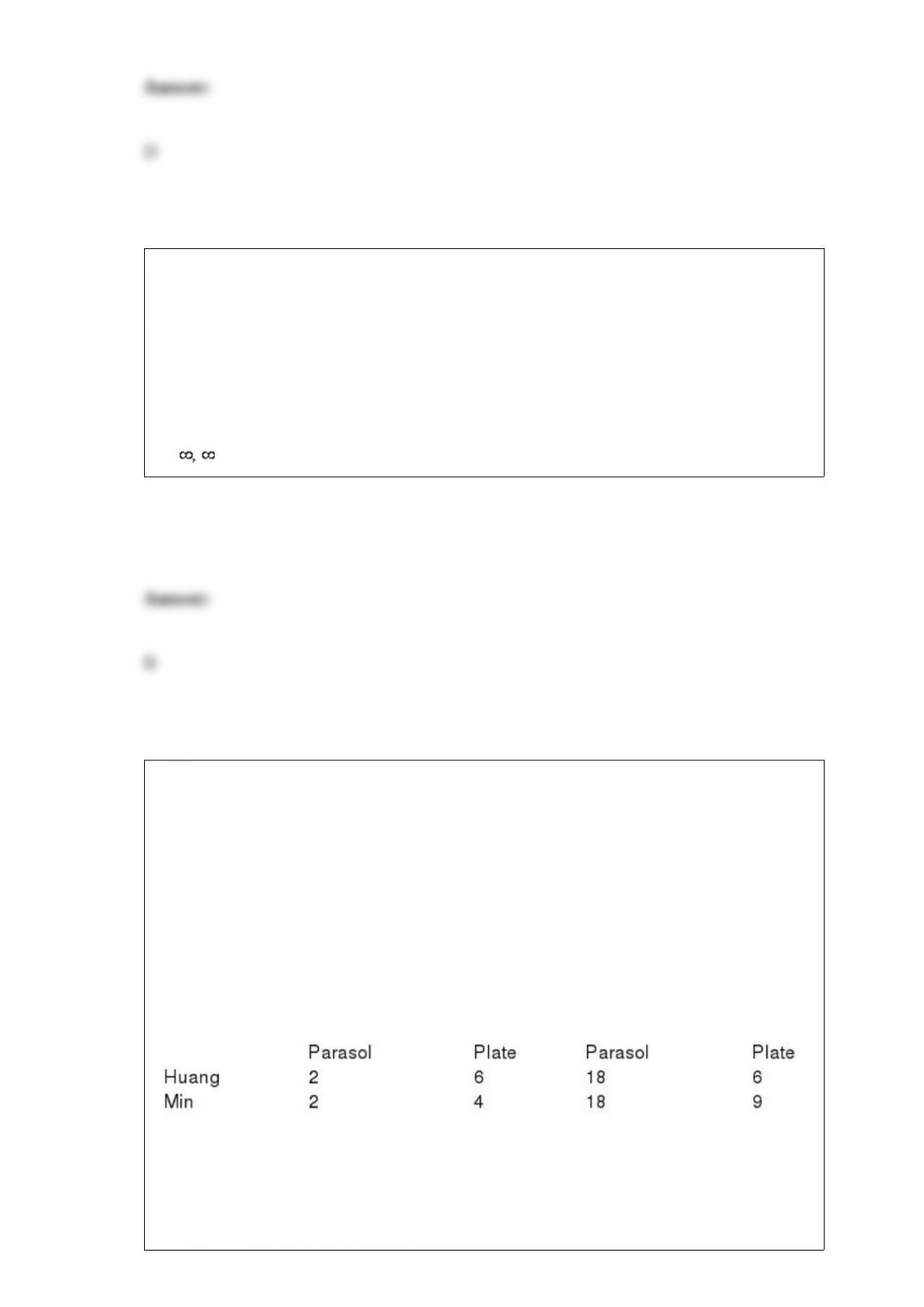
Table 3-8
Assume that Huang and Min can switch between producing parasols and producing
porcelain plates at a constant rate.
Labor Hours Needed
to Make 1 Quantity Produced
in 36 Hours
Refer to Table 3-8. Min has an absolute advantage in the production of
a. plates and a comparative advantage in the production of plates.
b. parasols and a comparative advantage in the production of plates.

c. neither good and a comparative advantage in the production of parasols.
d. neither good and a comparative advantage in the production of plates.
According to purchasing-power parity, if prices in the United States increase by a
smaller percentage than prices in Poland, then
a. the real exchange defined as Polish goods per unit of U.S. goods rises.
b. the real exchange defined as Polish goods per unit of U.S. goods falls.
c. the nominal exchange rate defined as Polish currency per dollar rises.
d. the nominal exchange rate defined as Polish currency per dollar falls.
Which of the following is likely to have the most price inelastic demand?
a. strawberry-banana milk shakes
b. gasoline in the short run
c. diamond earrings
d. box seats at a major league baseball game