
In a small Asian country, it is estimated that changing the level of capital from $8
million to $12 million will increase real GDP from $5 million to $6 million. If the
number of hours worked in the labor force does not change, what does this information
tell you about the slope of the per-worker production function in this range?
A) The slope is -4.
B) The slope is 1/4.
C) The slope is 4.
D) The slope is 8.
A patent grants an inventor exclusive rights to a product for how long?
A) 14 years
B) 17 years
C) 20 years
D) the lifetime of the product
Figure 13-2
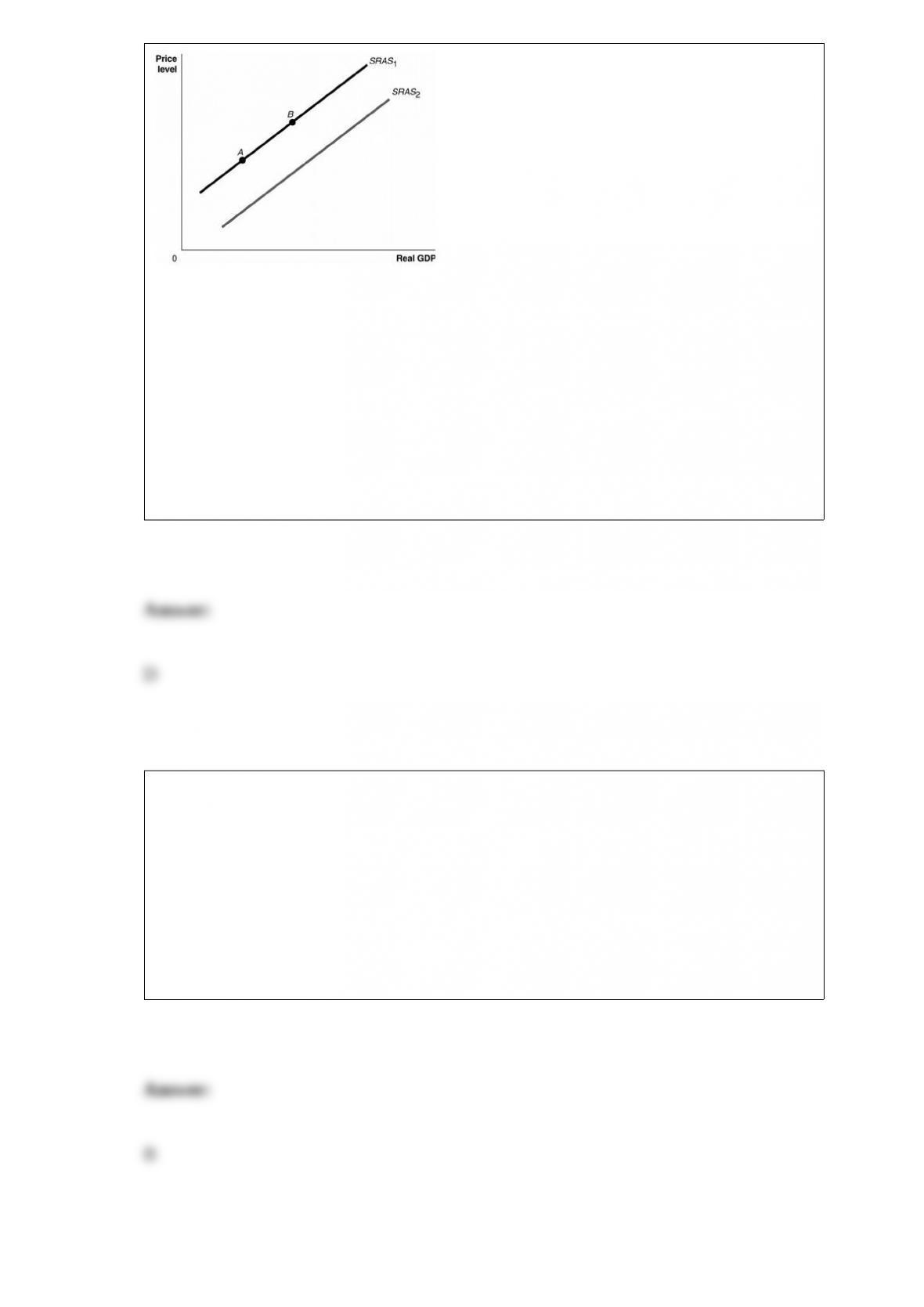
Refer to Figure 13-2. Ceteris paribus, a decrease in the price level would be
represented by a movement from
A) SRAS1 to SRAS2.
B) SRAS2 to SRAS1.
C) point A to point B.
D) point B to point A.
Which of the following functions of money would be violated if inflation were high?
A) unit of account
B) store of value
C) certificate of gold
D) medium of exchange

Which of the following is likely to increase measured GDP?
A) A greater number of women decide to stay at home and provide day care for their
children under age 5.
B) Marijuana becomes legal to grow and sell.
C) Tax rates increase and more people attempt to underreport their income for tax
purposes.
D) More people decide to do their own lawn maintenance and give up using a
professional service.
Horatio can produce either a combination of 15 bird houses and 25 wind chimes or a
combination of 30 bird houses and 15 wind chimes. If he now produces 30 bird houses
and 15 wind chimes, what is the opportunity cost of producing an additional 10 wind
chimes?
A) 2 bird houses
B) 15 bird houses
C) 30 bird houses
D) 45 bird houses
The United States is called a debtor nation because
A) it has a large current account deficit and is simultaneously funded by foreign
investment.

B) it has a large financial account deficit that is used to fund the current account deficit.
C) it has a large balance of payments deficit that is used to fund the current account
deficit.
D) U.S. capital outflows are much greater than U.S. capital inflows.
Long-run economic growth requires all of the following except
A) technological change.
B) increases in capital per hour worked.
C) government provision of secure property rights.
D) political instability.
Banks can make additional loans when required reserves are
A) greater than total reserves.
B) less than total reserves.
C) less than total deposits.
D) less than total loans.

How does contractionary monetary policy affect net exports in the short run?
A) Contractionary monetary policy increases exports and reduces imports.
B) Contractionary monetary policy reduces exports and increases imports.
C) Contractionary monetary policy increases exports and increases imports.
D) Contractionary monetary policy reduces exports and reduces imports.
The consumer price index implicitly assumes that the demand curve for each good and
service in the representative market basket is
A) positively sloped.
B) negatively sloped.
C) vertical.
D) horizontal.
In response to already low interest rates doing little to stimulate the economy, the Fed

announced a new program in September 2011 under which it would purchase long-term
Treasury securities while selling an equal amount of shorter-term Treasury securities.
This policy was known as
A) inflation targeting.
B) Operation Twist.
C) securities-bubble deflating.
D) quantitative easing.
Assume that Honduras has a comparative advantage in producing bananas and exports
bananas to Brazil. We can conclude that
A) Honduras also has an absolute advantage in producing bananas relative to Brazil.
B) Honduras has a lower opportunity cost of producing bananas relative to Brazil.
C) Brazil has an absolute disadvantage in producing bananas relative to Honduras.
D) Labor costs are higher for banana producers in Brazil than in Honduras.
The output of Mexican citizens who work in Texas would be included in the
A) gross domestic product of Mexico.
B) gross national product of Mexico.
C) gross national product of the United States.

D) net national product of the United States.
In a small economy in 2013, aggregate expenditure was $850 million while GDP that
year was $800 million. Which of the following can explain the difference between
aggregate expenditure and GDP that year?
A) Aggregate expenditure is always less than GDP in developed countries.
B) Firm investment in inventories was less than anticipated in 2013.
C) Firm investment in inventories was greater than anticipated in 2013.
D) Aggregate expenditure is always less than GDP in developing countries.
Figure 3-7
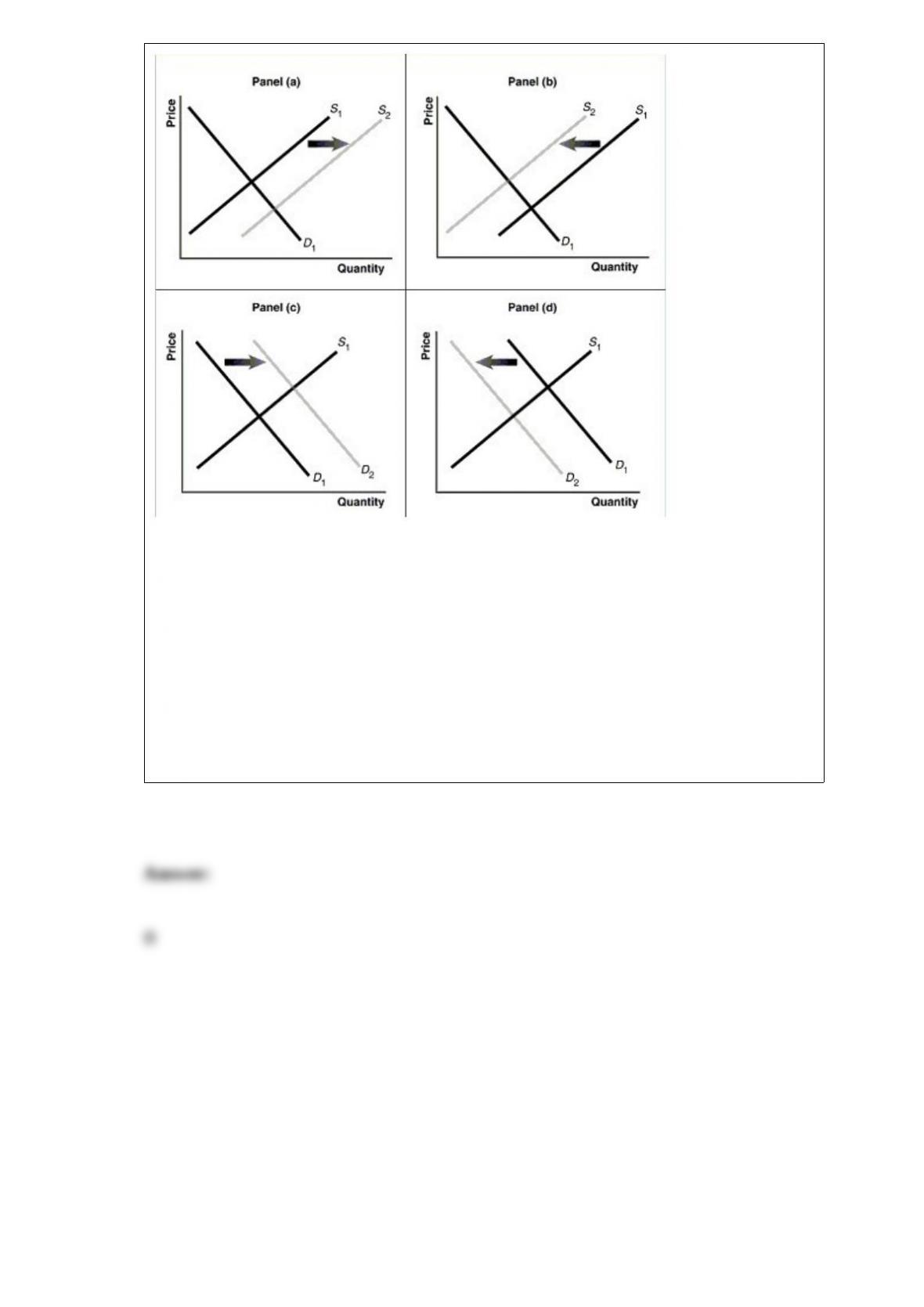
Refer to Figure 3-7. Assume that the graphs in this figure represent the demand and
supply curves for tuna. Which panel best describes what happens in this market when
there is a decrease in the productivity of commercial fishermen?
A) Panel (a)
B) Panel (b)
C) Panel (c)
D) Panel (d)