In general, the supply curve for a natural resource
A) is vertical.
B) is horizontal.
C) slopes downward to reflect decreasing available quantities over time.
D) slopes upward.
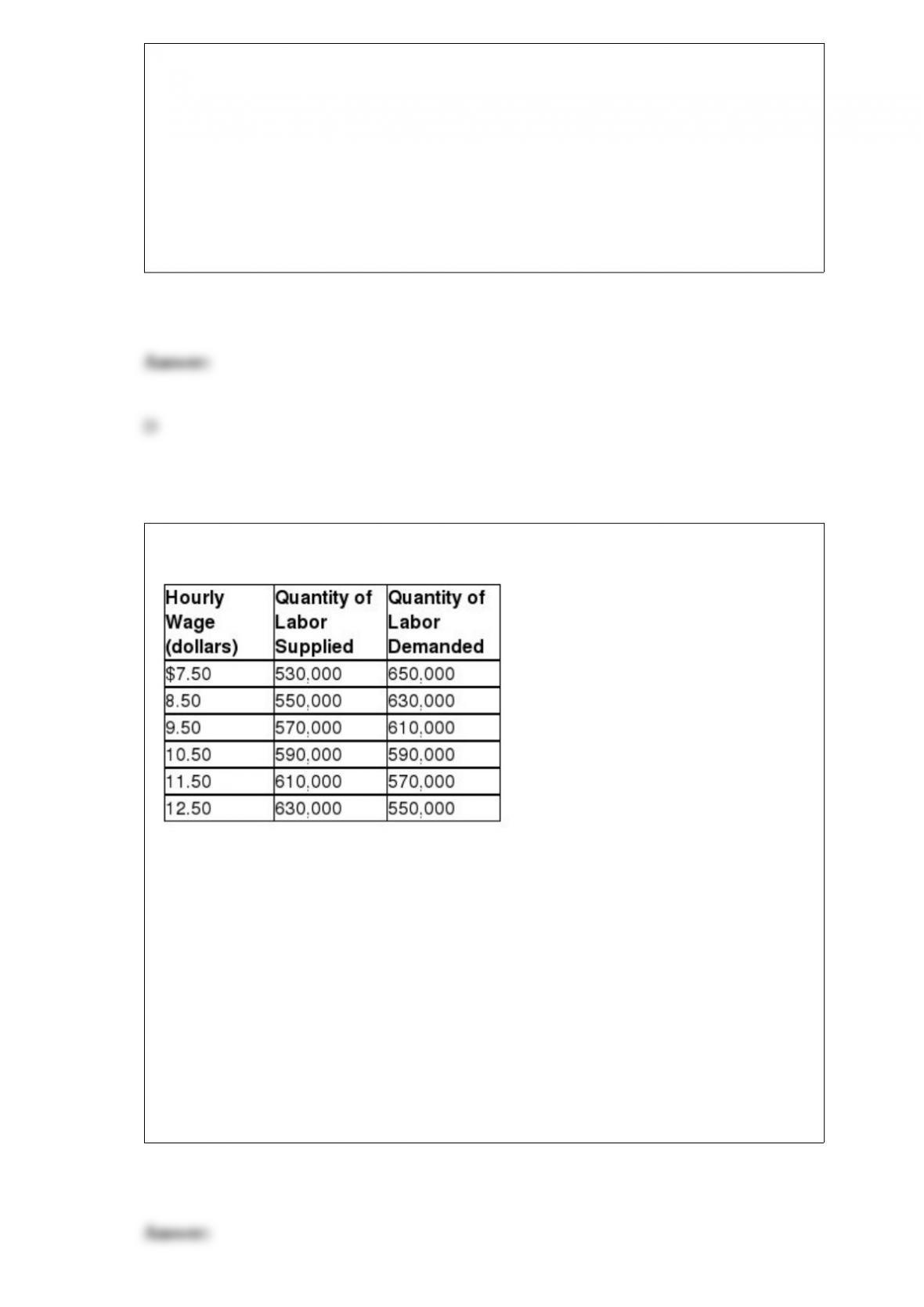
Table 4-7
Table 4-7 shows the demand and supply schedules for labor market in the city of Pixley.
Suppose that the quantity of labor supplied increases by 40,000 at each wage level.
What are the new free market equilibrium hourly wage and the new equilibrium
quantity of labor?
A) W = $8.50; Q = 550,000
B) W = $12.50; Q = 630,000
C) W = $9.50; Q = 610,000
D) W = $11.50; Q = 610,000
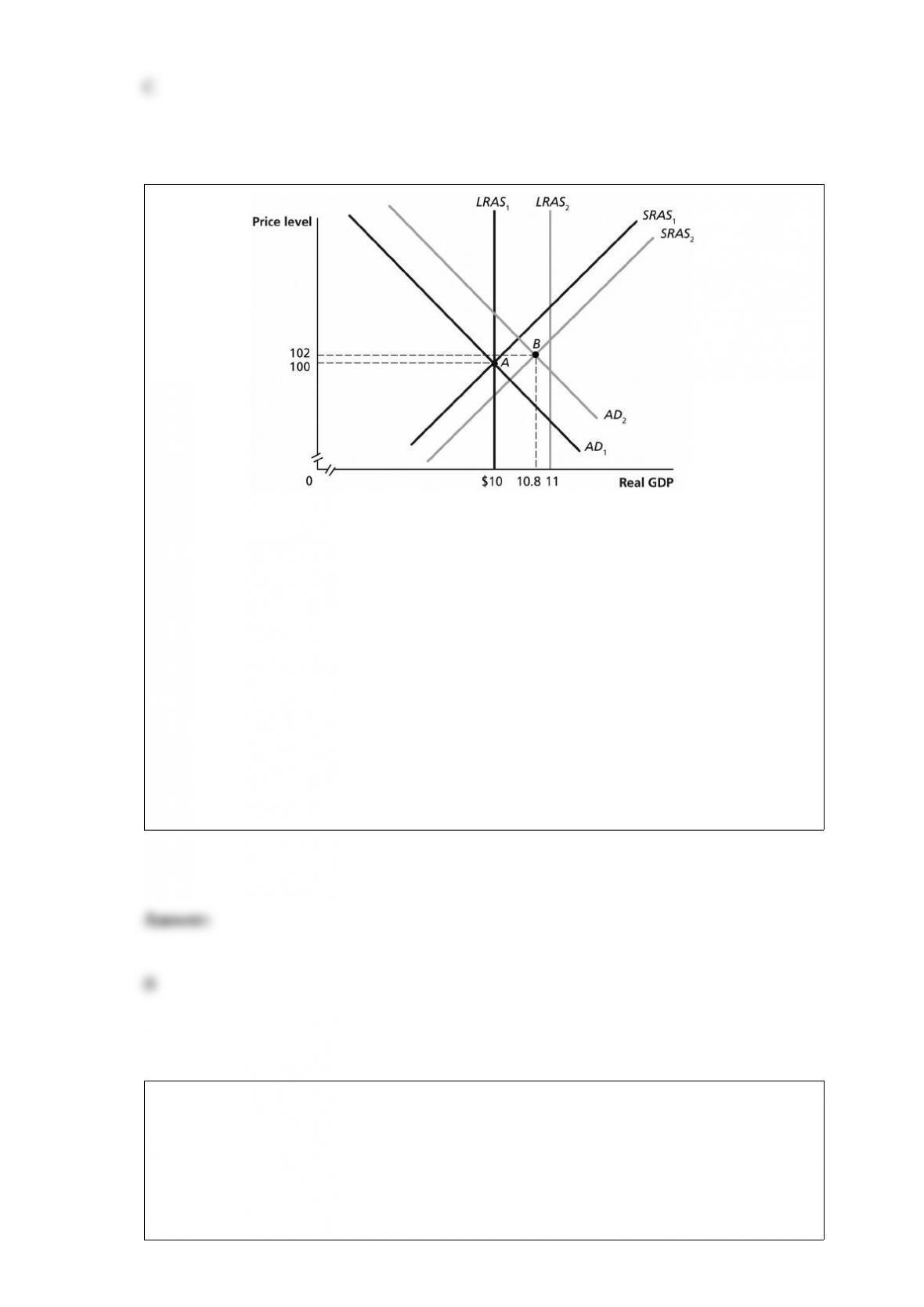
Figure 27-5
In the dynamic model of AD–AS in the figure above, if the economy is at point A in year
1 and is expected to go to point B in year 2, and no fiscal or monetary policy is pursued,
then at point B
A) the unemployment rate is very low.
B) firms are operating below capacity.
C) the economy is above full employment.
D) income and profits are rising.
E) there is pressure on wages and prices to rise.
A possible advantage of a horizontal merger for the economy is that
A) the merging firms could avoid losses.
B) the merged firm might reap economies of scale which could translate into lower
prices.
C) the degree of competition in the industry will be intensified.
D) the government stands to collect more corporate income tax revenue.
An advantage of the personal consumption expenditures price index (PCE) over the
Consumer Price Index (CPI) as a measure of inflation is that the PCE
A) includes the prices of more consumer goods and services.
B) includes the prices of consumer goods, but not consumer services.
C) includes the prices of consumer services, but not consumer goods.
D) is a fixed market-basket price index that does not allow the mix of products to
change each year.
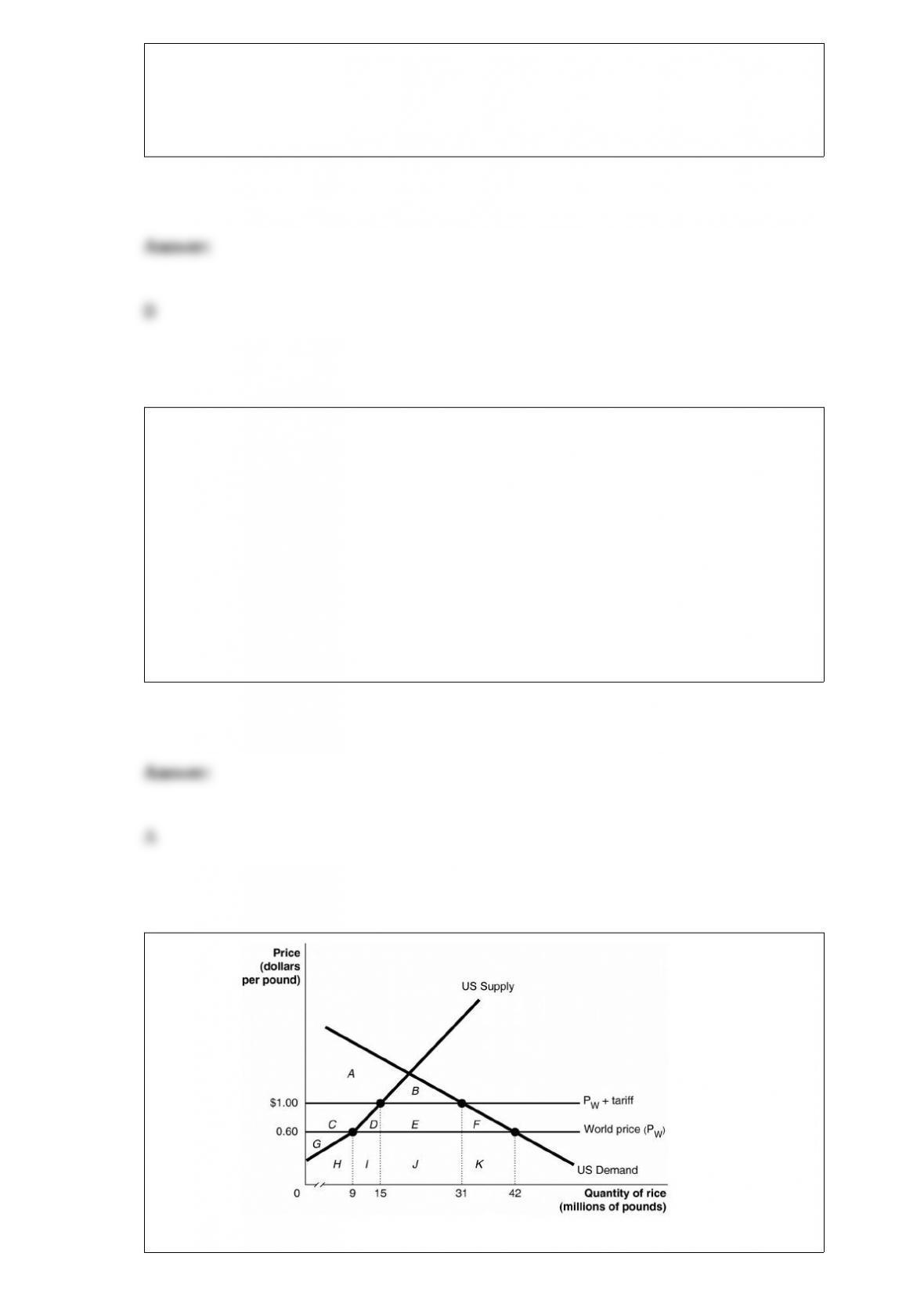
Figure 9-2 Suppose the U.S.
government imposes a $0.40 per pound tariff on rice imports. Figure 9-2 shows the

impact of this tariff. The tariff causes domestic consumption of rice
A) to fall by 27 million pounds.
B) to fall by 11 million pounds.
C) to rise by 6 million pounds.
D) to rise by 16 million pounds.
A bank holds its reserves as ________ and ________.
A) securities; loans
B) securities; deposits at the Federal Reserve
C) vault cash; deposits at the Federal Reserve
D) vault cash; loans
According to the text, economists consider full employment to occur when
A) everyone who wants a job has a job.
B) frictional unemployment equals zero.
C) the sum of frictional unemployment and structural unemployment equals zero.
D) the unemployment rate consists of only frictional and structural unemployment.
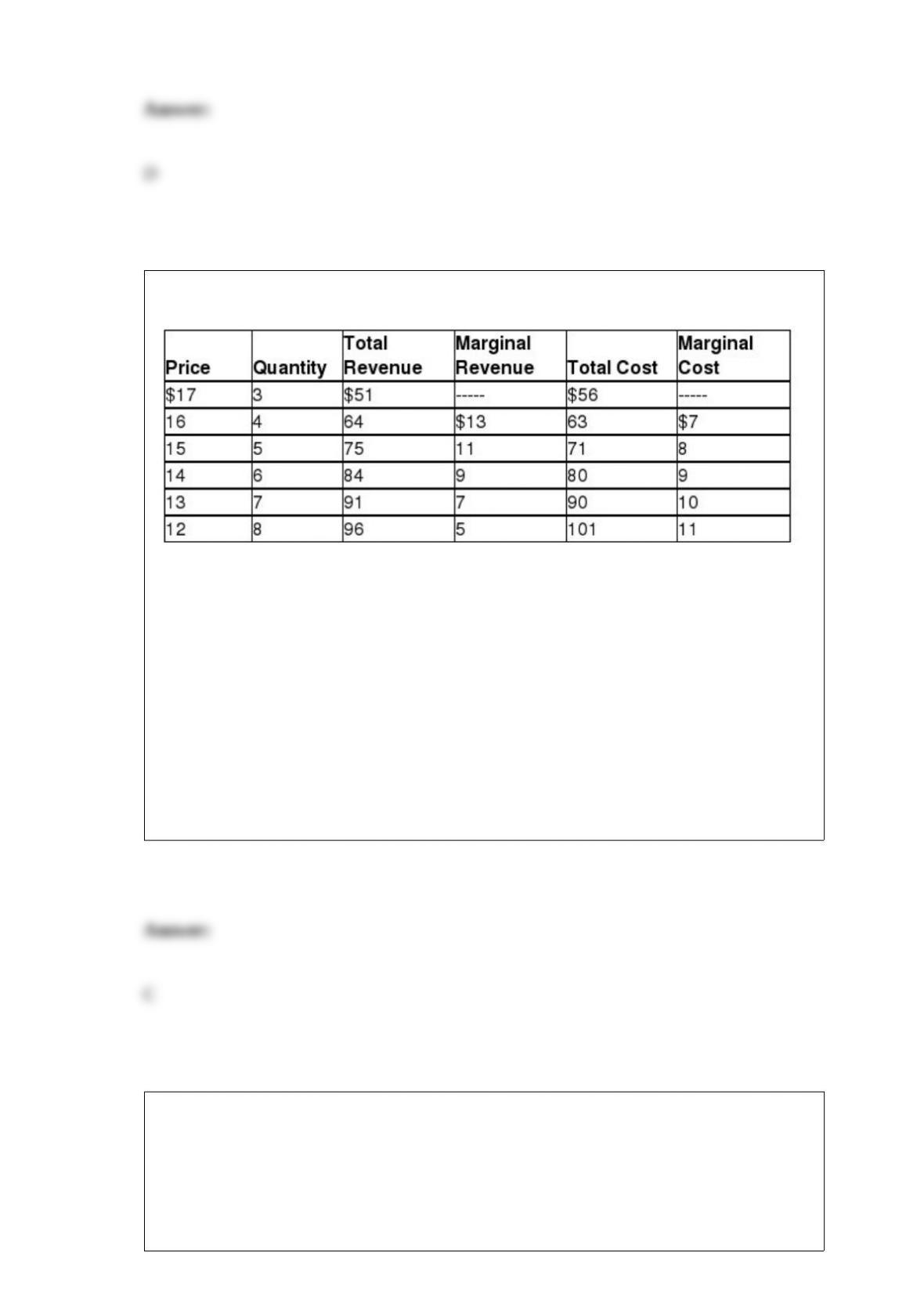
Table 15-3
Assume Table 15-3 gives the monthly demand and costs for subscriptions to basic cable
for Comcast, a cable television monopoly in Philadelphia.
If Comcast maximizes its profits, how much profit will it earn?
A) $84
B) $40
C) $4
D) Comcast will break even.
Which of the following is not a characteristic of long-run equilibrium in a
monopolistically competitive market?
A) Selling price equals average total cost.
B) Production is at minimum average total cost.

C) Marginal revenue equals marginal cost.
D) Selling price is greater than marginal cost.
Molly Sharp is producing a documentary about the plight of the six-toed ferrets of Sri
Lanka. Molly has spent $125,000 of her own money on this project and the
documentary is now complete. Molly just found out that no studio is willing to release
her documentary and she must now shop it to cable television networks, where she
knows she will not be able to recoup her investment. Which of the following statements
regarding Molly Sharp’s documentary is true?
A) She should not try to have her documentary aired on television because she cannot
recoup her $125,000 investment.
B) Since the $125,000 is a sunk cost, she should still try to have her documentary aired
on television even though she will not see a profit.
C) The $125,000 is a variable cost, so will not be incurred if she chooses not to have her
documentary aired.
D) The $125,000 investment is an economic cost, and she will still make an accounting
profit even if the television network willing to air her documentary pays her less than
$125,000.
In response to already low interest rates doing little to stimulate the economy, the Fed
began buying 10-year Treasury notes and certain mortgage-backed securities to keep
interest rates low. This policy is known as
A) inflation targeting.

B) contractionary monetary policy.
C) securities-bubble deflating.
D) quantitative easing.
People who lost their jobs as hand-drawn animators because of the popularity of
computer-generated 3D animation are examples of persons who are suffering
A) frictional unemployment.
B) structural unemployment.
C) cyclical unemployment.
D) seasonal unemployment.
E) unnatural unemployment.