Which of the following was not given as a reason for income differences in the
textbook?
a. luck
b. low minimum wage
c. wage discrimination
d. risk taking
A government agricultural policy in which a guaranteed price is set and no surplus is
created is the
a. marketing quota system.
b. acreage allotment program.
c. price support program.
d. target price system.
Exhibit 2-2
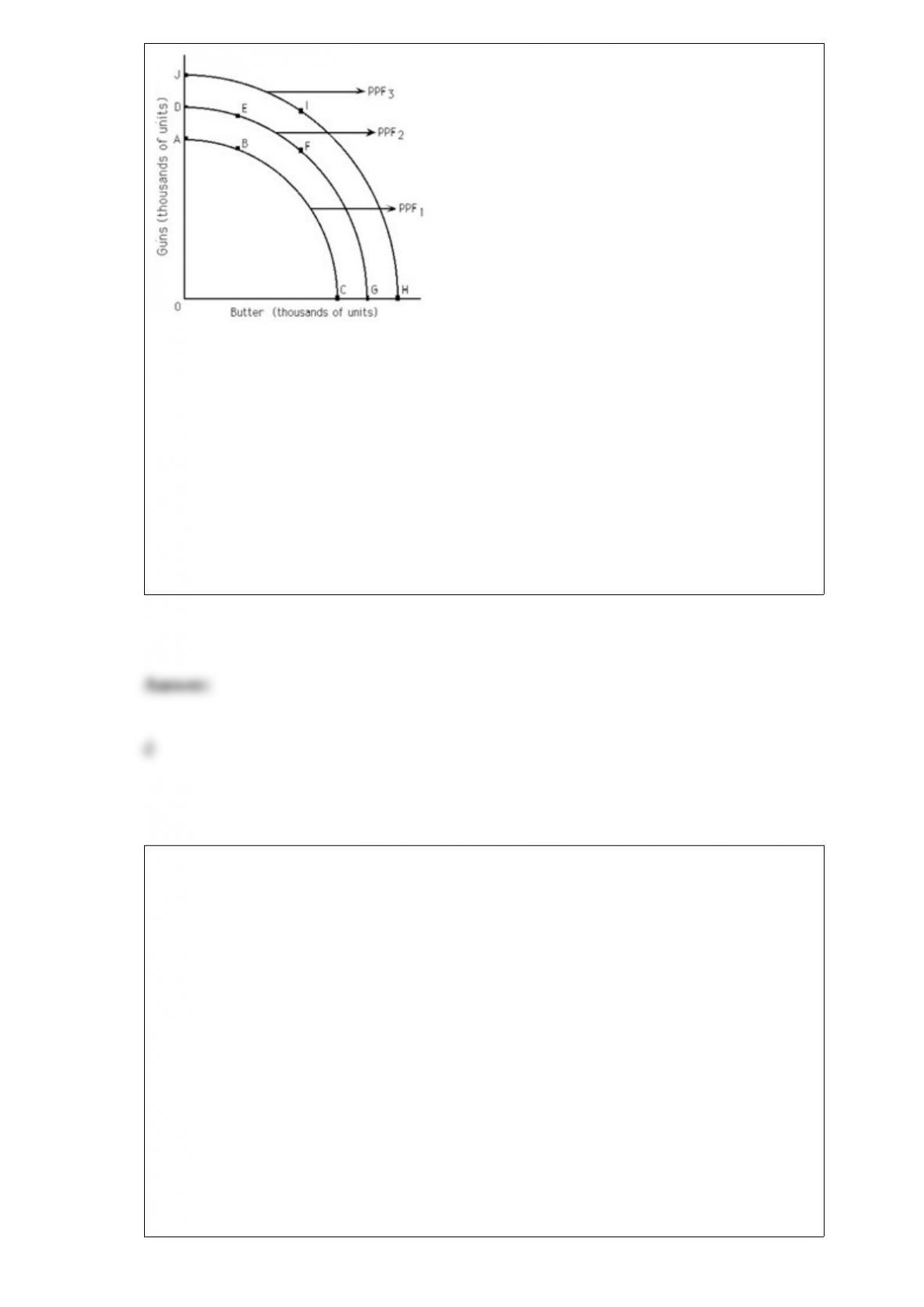
If PPF2 is the relevant production possibilities frontier, then point __________ is
unattainable.
a. A
b. G
c. D
d. J
Which of the following statements is false?
a. Government can remove individuals from a prisoner’s dilemma setting and make
them better off.
b. In a prisoner’s dilemma setting, it is impossible for the government to define and
enforce property rights that the individuals involved in the setting want to have defined
and enforced.
c. As long as government charges each individual in a prisoner’s dilemma setting a tax
that is less than the gain received by being removed from the setting, then government
has made the individuals better off.
d. Depending upon the amount of the tax charged to each individual in a prisoner’s
dilemma setting, the government can make both persons better off, both persons worse
off, or one person better off and the other person worse off.
Which of the following increases the quantity supplied of agricultural goods?
a. acreage allotments
b. assigning market quotas
c. agricultural price supports
d. a, b, and c
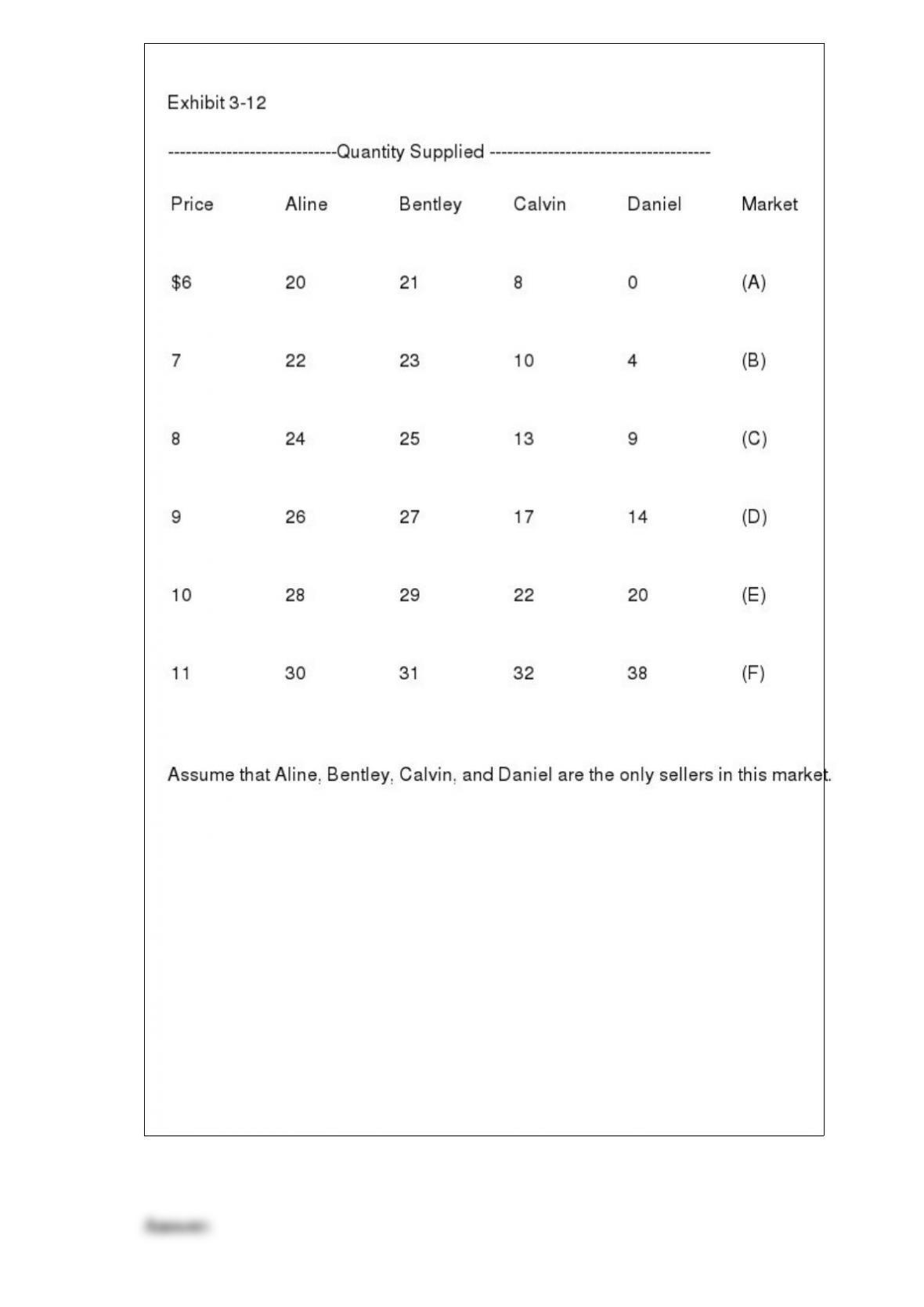
Fill in blanks (C) and (D) respectively with the market quantity supplied at each given
price.
a. 17.75; 21.00
b. 47; 52
c. 50; 55
d. 71; 84
e. none of the above
Situation 4-1
During the winter of 1973-74, a general system of wage and price controls (including a
price ceiling on gasoline) was in force in the United States. At the beginning of 1974,
some oil-producing countries imposed an oil embargo (a legal prohibition on
commerce) on the West. In the spring of 1974, price controls were] abolished.
An economist would have most likely predicted that once price controls were abolished
in the spring of 1974,
a. the price of gasoline would decline sharply.
b. the surplus of gasoline would go away.
c. the shortage of gasoline would go away.
d. the demand for gasoline would decrease.
e. both c and d
Exhibit 25-9
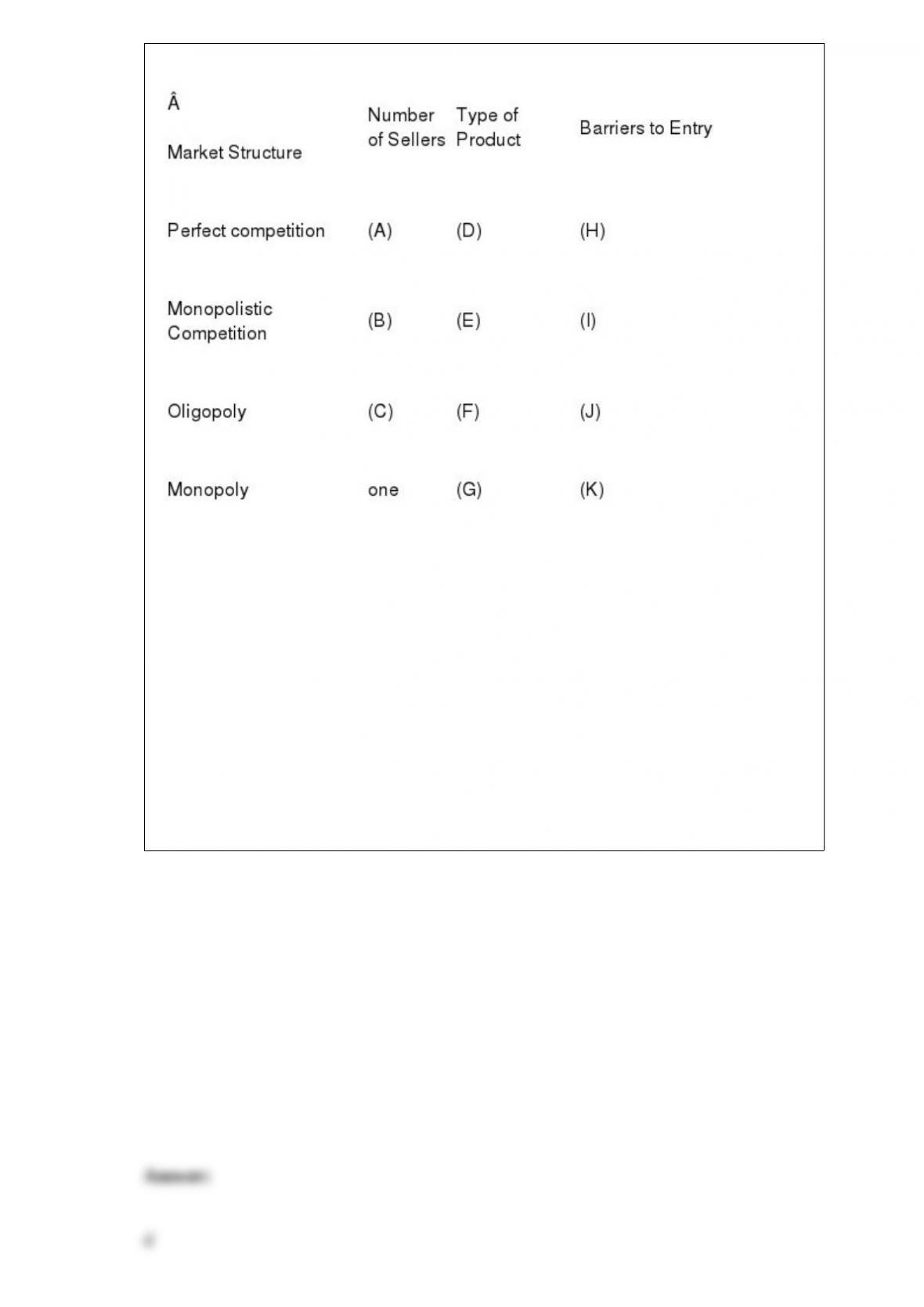
The type of product sold in a perfectly competitive market is ___________ [blank
(D)].The type of product sold in a monopolistic competitive market is ____________
[blank (E)].The type of product sold in an oligopoly is _________ [blank (F)]. The type
of product sold in a monopoly is ___________ [blank (G)].
a. unique; homogeneous or differentiated; differentiated; homogeneous
b. differentiated; homogeneous; homogeneous or differentiated; unique
c. homogeneous; homogeneous; differentiated; unique
d. homogeneous; differentiated; homogeneous or differentiated; unique
The headline in the newspaper reads “County Supervisors Debate Building New
Schools.” The headline relates closest to which economic concept?
a. goods and bads
b. utility
c. choice
d. efficiency
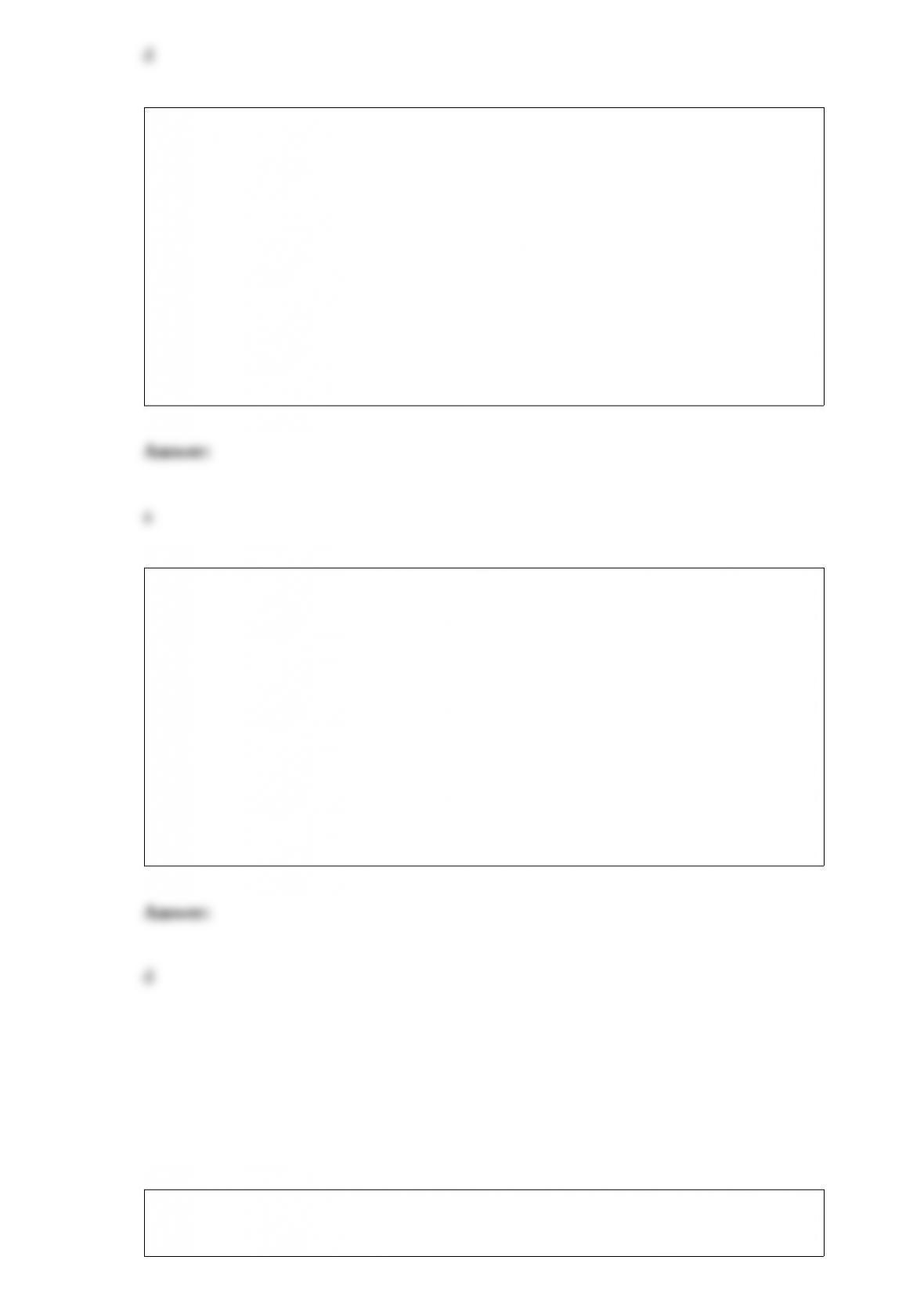
Exhibit 23-8
What is the total variable cost of firm A at the profit-maximizing (or loss-minimizing)
level of production?
a. $300
b. $700
c. $1,000
d. $400
The lower the price of medical care in general, the higher the
____________________________ medical care and the ______________________
specific items that make up medical care (such as x-rays).The result will be a
_______________ price for the specific items that make up medical care.
a. quantity demanded of; higher the demand for; higher
b. demand for; higher the demand for; higher
c. quantity demanded of; lower the demand for; lower
d. demand for; higher the quantity demanded of; higher
For a factor price taker, the factor supply curve is __________, whereas the market
factor supply curve is __________.
a. horizontal; vertical
b. vertical; horizontal
c. upward sloping; horizontal
d. horizontal; upward sloping
e. upward sloping; upward sloping
The price of a given good is likely to be less variable with speculators than it would be
without speculators.
a. True
b. False
For a monopoly firm, price is __________ marginal revenue, and for a monopolistic
competitive firm, price is __________ marginal revenue.
a. less than; equal to
b. greater than; equal to
c. greater than; less than
d. greater than; greater than
e. equal to; less than
Exhibit 34-1
Considering the data, which of the following terms of trade would both countries agree
to?
a. 1 unit of X for 2 units of Y
b. 1 unit of X for 3 units of Y
c. 1 unit of X for 1 unit of Y
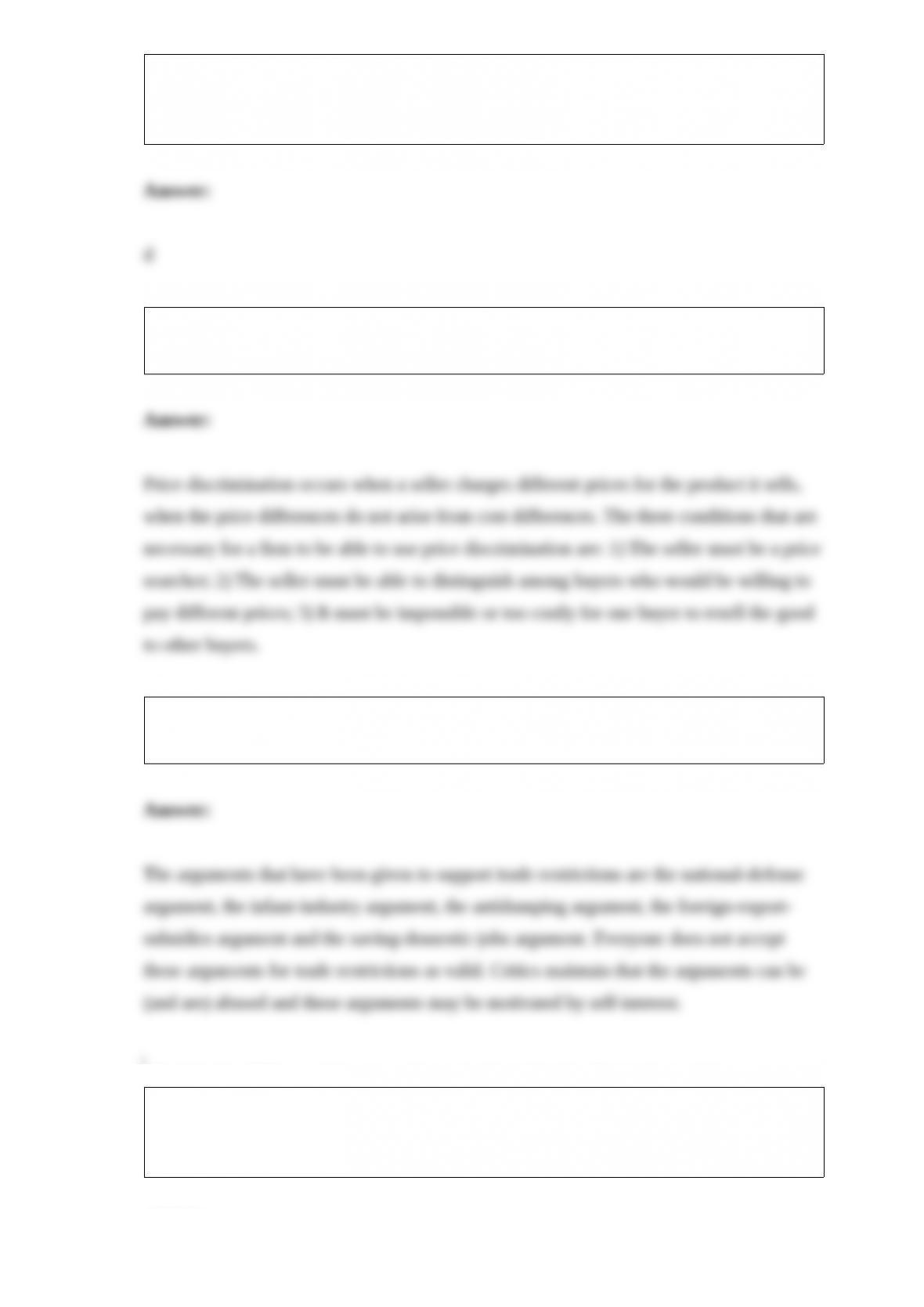
d. 1 unit of X for 1.50 units of Y
e. all of the above
Define price discrimination. What three conditions must exist before a firm can use it
successfully?
List and describe three arguments that help to explain why nations sometimes restrict
trade. Does everyone agree with these arguments?
Explain the difference between a change in demand and a change in quantity
demanded.Be sure to specify what causes each to change and how they differ when
graphed.
In the short run, if price (P) is less than average total cost (ATC) will a perfectly
competitive firm necessarily shut down?Explain why or why not using a hypothetical
numerical example.
Explain what an economist means when he says, €You don€t find any $10 bills on the
sidewalk.€
Why is profit maximized at the level of output where marginal revenue equals marginal
cost?
Describe the two major ways that entrepreneurs increase trade.Give your own unique
example of each to help support your answer.