
Which of the following would increase gross private domestic investment in an
economy?
A) an increase in the shares of Apple stock households own
B) an increase in the number of workers Apple hires
C) an increase in the level of Apple’s inventory
D) an increase in the number of highway construction projects the government is
funding
Consider the following economic agents:
a. the government
b. consumers
c. producers Who, in a centrally planned economy, decides what goods and services
will be produced with the scarce resources available in that economy?
A) the government
B) producers
C) consumers
D) consumers and producers
E) the government, consumers and producers

The consumption function describes the relationship between
A) consumption spending and national income.
B) consumption spending and aggregate income.
C) consumption spending and disposable income.
D) consumption spending and personal income.
Examples of assets that are included in household wealth would be
A) stocks, bonds, and savings accounts.
B) stocks, loans owed, and savings accounts.
C) stocks, bonds, and mortgages.
D) stocks, credit cards, and savings accounts.
Some firms require consumers to pay an initial fee for the right to buy their product and
an additional fee for each unit of the product they purchase. This practice is referred to
as
A) odd pricing.
B) dual pricing.
C) a two-part tariff.
D) intertemporal pricing.
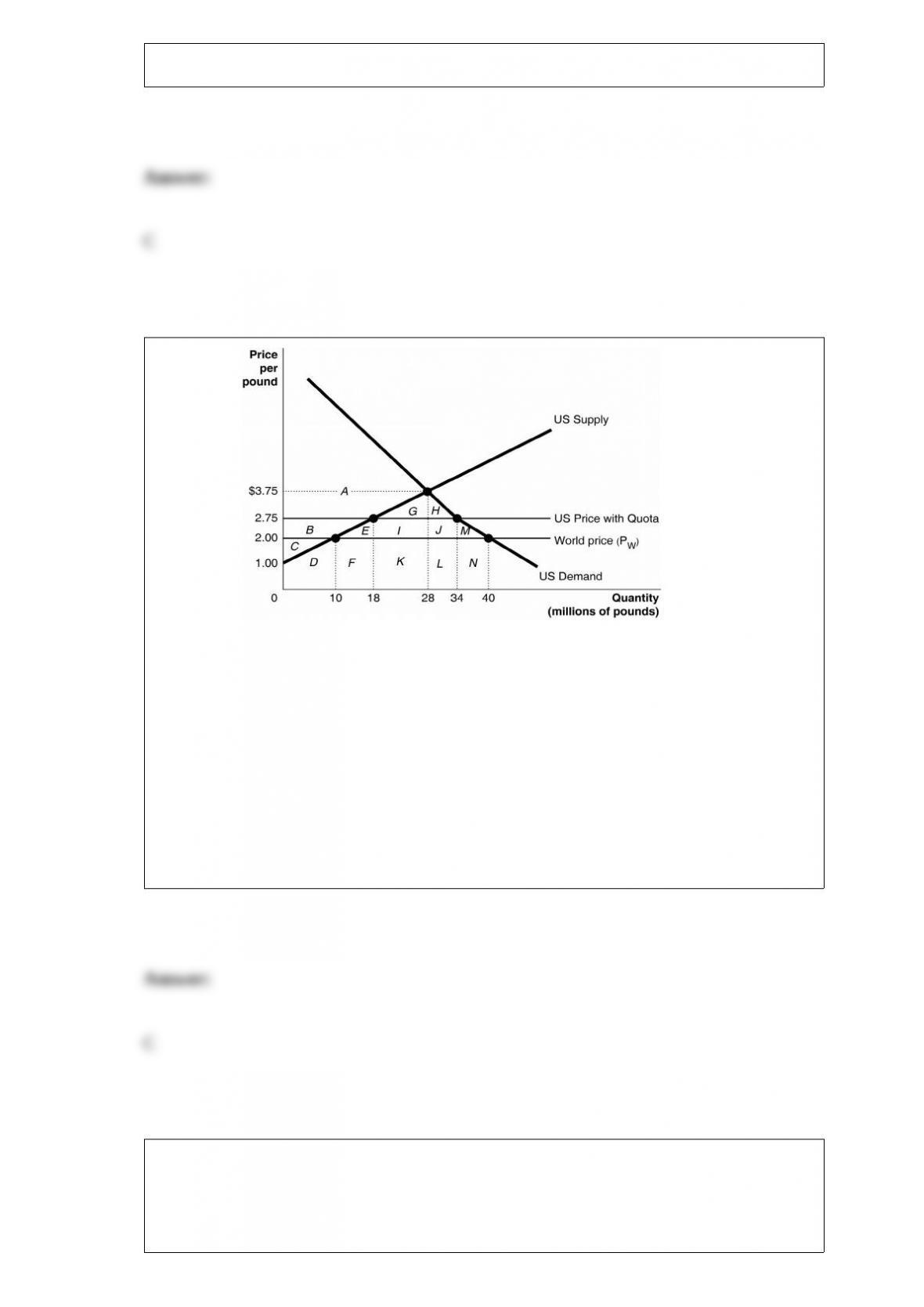
Figure 9-3 Since 1953 the
United States has imposed a quota to limit the imports of peanuts. Figure 9-3 illustrates
the impact of the quota. With a quota in place, what is the quantity consumed in the
domestic market?
A) 10 million pounds
B) 28 million pounds
C) 34 million pounds
D) 40 million pounds
The social cost of cutting trees for firewood in a government forest is
A) the increased likelihood of flooding as more trees are cut.

B) the increased likelihood of flooding as more trees are cut plus the private cost of
cutting the trees.
C) opportunity cost to the individual of cutting the wood.
D) the marginal costs of cutting the last tree.
In a perfectly competitive industry, in the long-run equilibrium
A) the typical firm is producing at the output where its long-run average total cost is not
minimized.
B) the typical firm is earning an accounting profit greater than its implicit costs.
C) the typical firm earns zero profit.
D) the typical firm is maximizing its revenue.
Table 18-1
Suppose $1 billion is available in the budget and Congress is considering allocating the
funds to one of the following three alternatives: 1) Subsidies for education, 2) Research
on Alzheimer’s or 3) Increased border security. Table 18-1 shows three voters’ rankings

of the alternatives.
Suppose a series of votes are taken in which each pair of alternatives is considered in
turn. If the vote is between allocating funds to education subsidies and increased border
security
A) Ivy and Jasmine vote for education subsidies, Rose votes for increased border
security, and education subsidies wins.
B) Ivy and Rose vote for increased border security, Jasmine votes for education
subsidies, and increased border security wins.
C) Jasmine and Rose vote for education subsidies, Rose votes for increased border
security, and education subsidies wins.
D) Jasmine and Ivy vote for increased border security, Rose votes for education
subsidies, and increased border security wins.
________ is an experiment that tests the significance of fairness in consumer decision
making.
A) The fairness challenge
B) The consumer choice paradigm
C) The ultimatum game
D) The Giffen paradox
All of the following explain why purchasing power parity does not completely explain

long-run fluctuations in exchange rates except
A) not all goods and services produced in any country are traded internationally.
B) consumer preferences for goods and services differ across countries.
C) some countries impose barriers to trade.
D) most countries have free markets with little, if any, government regulation.
If firms and workers have rational expectations, including knowledge of the policy
being used by the Federal Reserve
A) expansionary monetary policy is especially effective.
B) expansionary monetary policy is ineffective.
C) expansionary monetary policy is effective in the short run, but not the long run.
D) expansionary monetary policy is effective in the short run and the long run.
Technological improvements are more likely to occur if
A) the economy is centrally planned.
B) entrepreneurs are compensated with higher profits for taking risks.

C) economic decisions are made by politicians rather than entrepreneurs.
D) companies face little competition in their markets.
Countries that engage in trade will tend to specialize in the production of goods and
services in which they have ________ and will ________ these goods and services.
A) a comparative advantage; import
B) an absolute advantage; export
C) a comparative advantage; export
D) an absolute advantage; import
Domestically produced goods and services sold to other countries are referred to as
A) exports.
B) imports.
C) transfer payments.
D) capital outflow.

Suppose the cross-price elasticity of demand between DVDs at Amazon.com and DVDs
at Buy.com is 3.5. Based on this information, predict what happens when Amazon.com
lowers its DVD prices by 10 percent.
A) The quantity of DVDs demanded on Amazon.com will increase by 35 percent.
B) The quantity of DVDs demanded on Buy.com will increase by 35 percent.
C) The quantity of DVDs demanded on Amazon.com will decrease by 35 percent.
D) The quantity of DVDs demanded on Buy.com will decrease by 35 percent.
Which one of the following is not a possible barrier to entry high enough to keep
competing firms out of a monopoly industry?
A) The monopoly firm has control of a key resource necessary to produce a good.
B) There are important network externalities in supplying a good or service.
C) large economies of scale that result in a natural monopoly
D) a high concentration ratio
For productive efficiency to hold,

A) price must equal the marginal cost of the last unit produced.
B) price must equal marginal revenue of the last unit sold.
C) average variable cost is minimized in production.
D) average total cost is minimized in production.