
Refer to the figure below. The economy pictured in the figure has a(n) ______ gap with
a short-run equilibrium indicated by point ___.
A. recessionary; A
B. recessionary; B
C. recessionary; C
D. expansionary; A
The percentage change in quantity demanded that results from a 1 percent change in
price is known as the:
A. price elasticity of supply.
B. price elasticity of demand.
C. income elasticity of demand.
D. cross-price elasticity of demand.
In an open economy, if domestic citizens decide to save more, then the domestic real
interest rate will ______ and the level of capital investment in the country will _____,
holding other factors constant.
A. increase; increase

B. increase; decrease
C. decrease; decrease
D. decrease; increase
Refer to the figure below. Based on the diagram, if potential output equals 8,000 and
the real interest rate is 6%, then there is ______ gap and the Fed must ______ the real
interest rate so that output will equal potential output.
A. a recessionary; raise
B. a recessionary; reduce
C. no output; not change
D. an expansionary; raise
Suppose the price P on a given demand curve results in a price elasticity of demand
equal to 1. Any price higher than P will lie on the ______ part of the demand curve, and
any price lower than P will lie on the ______ part of the demand curve.
A. elastic; inelastic
B. unit elastic; inelastic
C. inelastic; elastic
D. elastic; unit elastic
The demand curve illustrates the fact that consumers:
A. tend to purchase more of a good as its price rises.
B. purchase name brand products more frequently than generic products.
C. tend to purchase more of a good as its price falls.
D. purchase more of a good as their incomes rise.
Two companies, Dirty Inc. and Filthy Inc., each of which has access to 5 different
production processes, each of which has a different cost and produces a different
amount of pollution. The daily costs of the processes and the number of tons of smoke
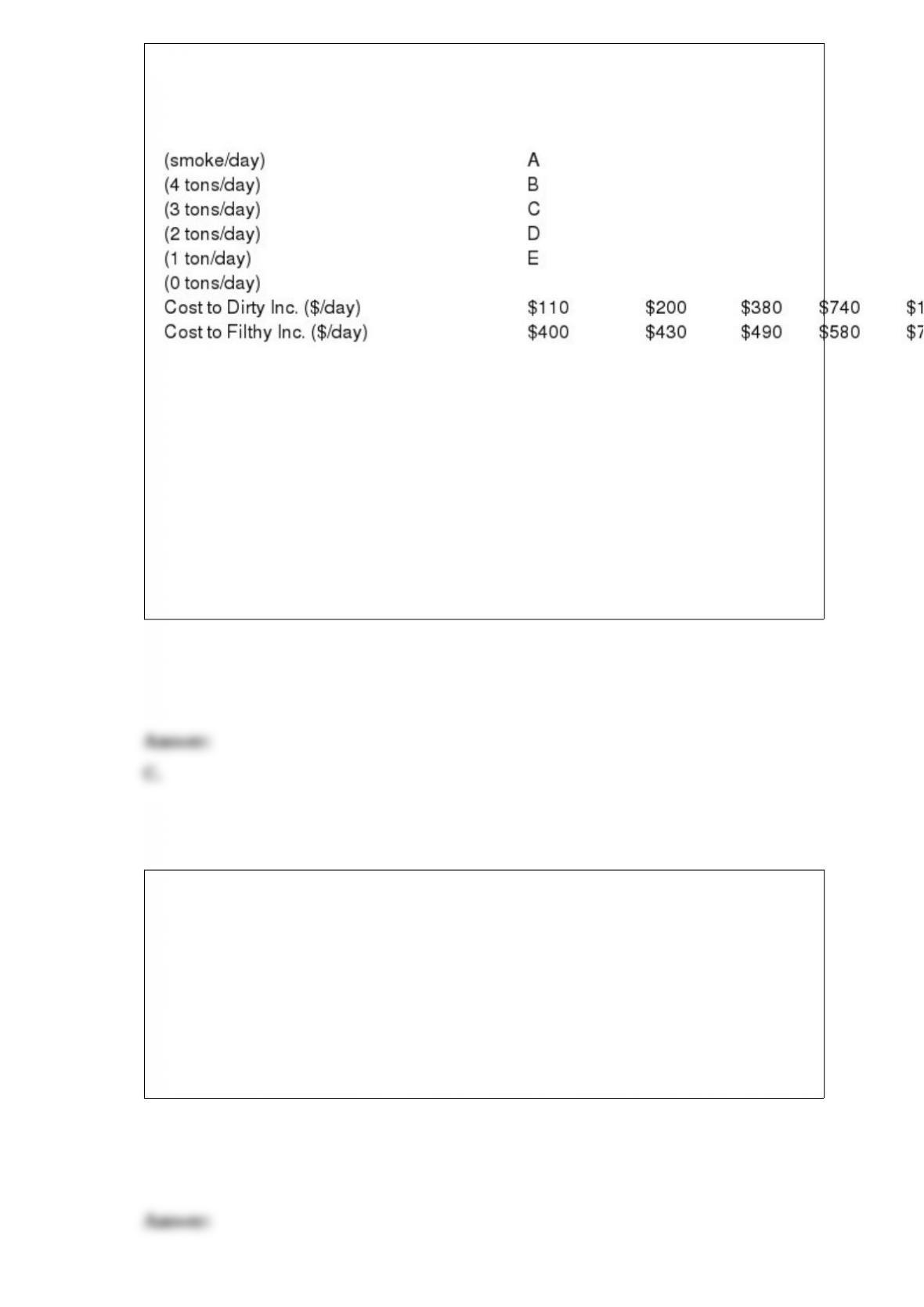
emitted are shown in the table below.
process
Suppose pollution is initially unregulated. If the City Council imposes a tax of $91 per
day on each ton of smoke emitted, then total emissions will fall to ______ tons of
smoke per day.
A. 1
B. 2
C. 4
D. 8
Suppose that the technology used to manufacture laptops has improved. The likely
result would be:
A. an increase in supply of laptops.
B. an increase in quantity supplied of laptops.
C. a decrease in supply of laptops.
D. a decrease in quantity supplied of laptops.

To prospective employers, a honors degree from a highly selective college is ______.
A. a credible signal about whether a job applicant is intelligent and hard working
B. a credible signal about whether a job applicant had a job before
C. not a credible signal about whether a job applicant is intelligent and hard working
D. only a credible signal about a whether job applicant is intelligent and hard working if
the job requires a college degree
Refer to the figure below. The marginal utility of the 6th pizza is:
A. 95
B. 100
C. 5
D. 17.5

Purchasing goods such that the ratio of marginal utility to price is equal across all goods
results in the:
A. greatest total utility.
B. lowest expenditure.
C. greatest marginal utility.
D. same expenditure on all goods.
In the short-run Keynesian model where the marginal propensity to consume is 0.75, to
offset a recessionary gap resulting from a $1 billion decrease in autonomous
consumption, transfers must be:
A. increased by $1 billion.
B. decreased by $1 billion.
C. increased by $1.33 billion.
D. decreased by $1.33 billion.

Economics is the study of:
A. the financial concerns of businesses and individuals.
B. the role of government in limiting the choices people make.
C. choice in the face of limited resources.
D. whether we will have enough resources in the future.
The demand curve for a perfectly competitive firm is ______, while the demand curve
for a monopolist is ______.
A. perfectly elastic; downward-sloping
B. vertical; downward-sloping
C. perfectly elastic; perfectly inelastic
D. perfectly inelastic; perfectly elastic

Suppose that in most car collisions between cars of unequal size, the smaller car
sustains the most damage and its occupants suffer the most injury. In answering the
following question, assume that, on average, smaller cars generate less air pollution
than larger cars and that every person in the economy drives at least one car. Suppose
the size of all cars increased by 25%. Collisions between two cars would cause ______
and air pollution would ______.
A. less injury; increase
B. greater injury; increase
C. neither greater nor less injury; remain the same
D. neither greater nor less injury; increase
Before it became illegal, cigarette manufacturers once relied heavily on TV advertising.
According to the textbook, when the government banned TV advertising, the cigarette
manufacturers:
A. supported the ban due to their concern over health effects of smoking.
B. thought their First Amendment rights were being violated.
C. were made worse off because the ban significantly reduced cigarette sales.
D. benefited because the decision about whether to advertise on TV was a prisoner’s
dilemma.

A higher real interest rate ______ saving and ______ consumption spending.
A. increases; increases
B. increases; decreases
C. does not change; does not change
D. decreases; increases
If an economy maintains a small rate of growth for a long period of time, then the size
of the economy:
A. can only increase by a small amount.
B. can increase by a large amount.
C. can never double.
D. will stay nearly constant.
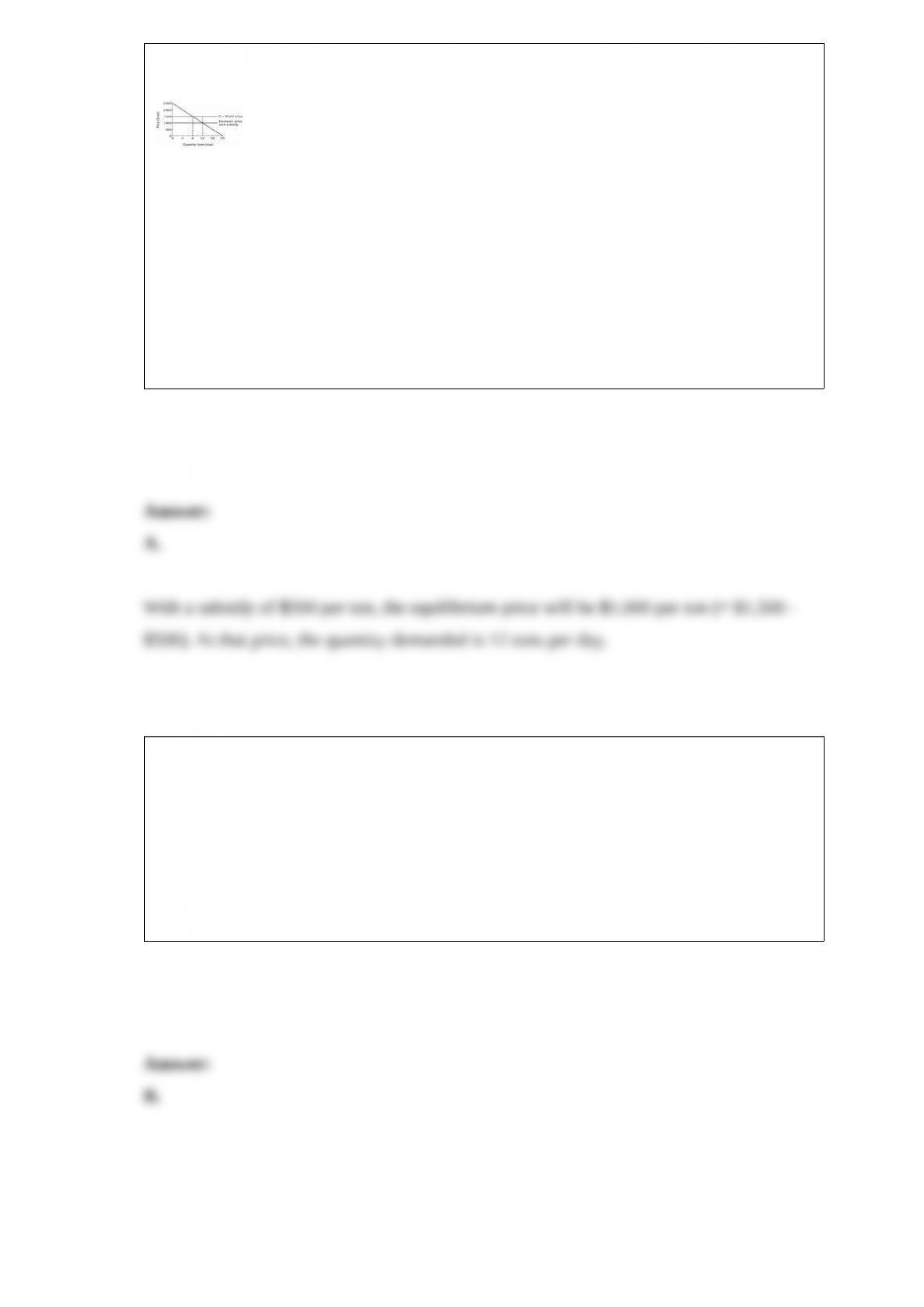
Suppose a small island nation imports sugar for its population at the world price of
$1,500 per ton. The domestic market for sugar is shown below.
If the government provides a subsidy of $500 per ton, the equilibrium price of sugar
will be ______ per ton, and the equilibrium quantity will be ______ tons per day.
A. $1000; 12
B. $1000; 8
C. $1500; 12
D. $1500; 8
The “true” costs of inflation to an economy include all of the following except:
A. shoe-leather costs.
B. higher relative prices.
C. noise in the price system.
D. unexpected redistribution of wealth.

The primary objective of most private firms is to:
A. maximize revenue.
B. maximize profit.
C. minimize cost.
D. maximize output.
Suppose Chris is offered the following gamble: with probability 0.1 he will win $90,
with probability 0.4 he will win $50, and with probability 0.5 he will lose $60. The
expected value of this gamble is found by solving:
A. 0.1 × ($90 – $60) + 0.4 × ($50 – $60)
B. 0.1 × $90 + 0.4 × $50
C. 0.1 × $90 + 0.4 × $50 – 0.5 × $60
D. ($90 + $50 – $60)/3
Smith and Jones comprise a two-person economy. Their hourly rates of production are
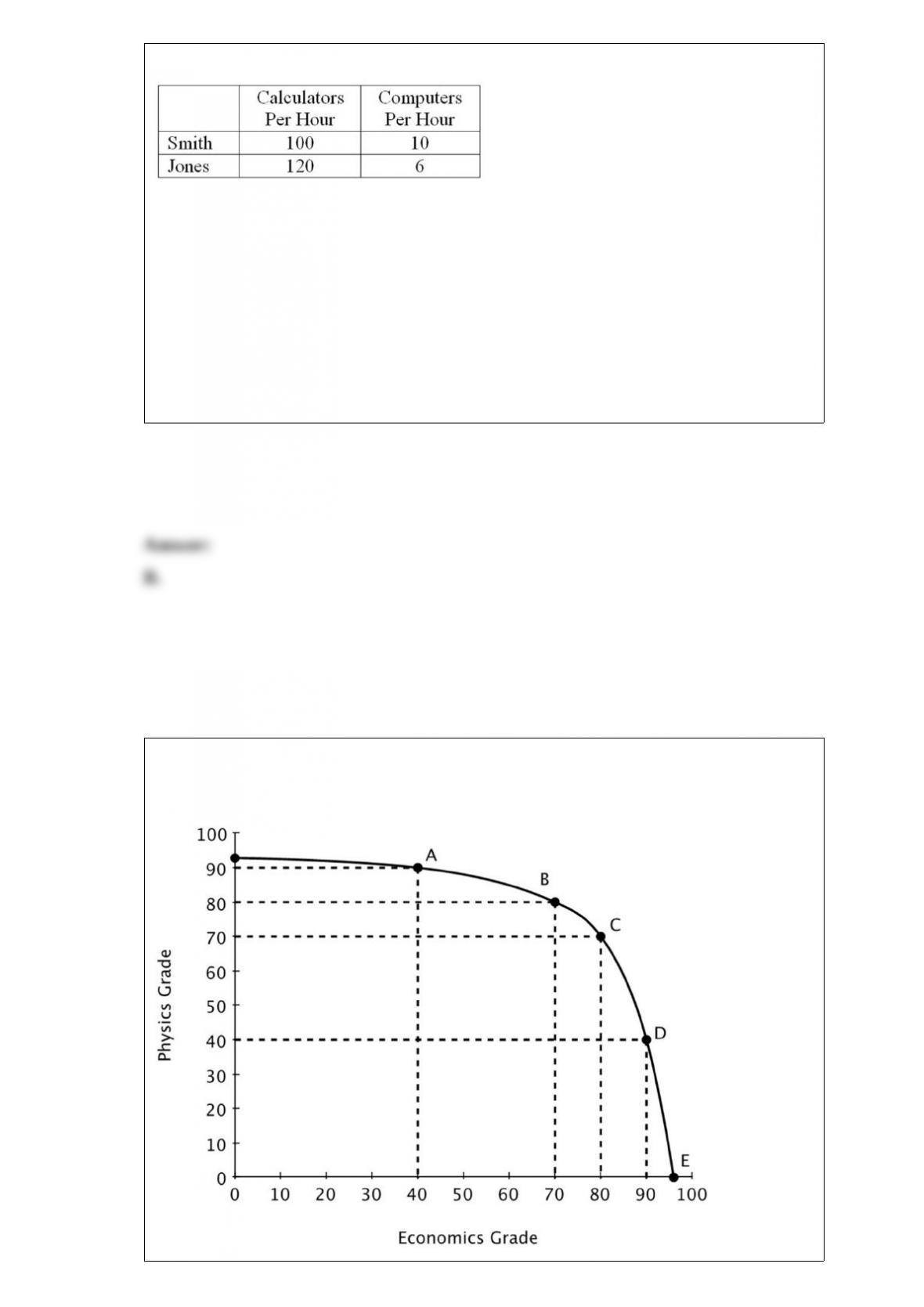
shown below.
If Smith and Jones are dividing their time efficiently and producing more than 10
computers and fewer than 120 calculators per hour, then Smith will ______ and Jones
will ______.
A. produce only computers; produce only calculators
B. produce only computers; split his time between computers and calculators
C. split his time between computers and calculators; produce only computers
D. produce only calculators; produce only computers
Moe divides his time between studying Physics and studying Economics. His
production possibilities curve for his final grade in each class is shown below.

Both of Moe’s professors require at least a 65 to pass and a 90 to earn an A. Which of
the following is true?
A. Moe can pass both classes.
B. Moe can pass economics, but only if he fails physics.
C. Moe can pass physics, but only if he fails economics.
D. Moe could earn an A in economics and still pass physics.
Assume that all firms in this industry have identical cost curves, and that the market is
perfectly competitive.
In the long run, there will be ______ firms in this market.
A. 10
B. 15
C. 25
D. 50

The money demand curve will shift to the left if:
A. the nominal interest rate increases.
B. the nominal interest rate decreases.
C. ATM machines are introduced.
D. the price level increases.
Saving $100 will:
A. increase wealth by $100.
B. increase wealth by $100 only if the $100 is used to purchase an asset.
C. increase wealth by $100 only if the $100 is used to repay a debt.
D. decrease wealth by $100.
The following table shows the relationship between the speed of a computer’s CPU and
its benefits and costs. Assume that all other features of the computer are the same (that
is, CPU speed is the only source of variation), and only the CPU speeds listed below are
available for purchase.
The total benefit of a 3.0GHz computer is:
A. $300.
B. $900.
C. $1,700.
D. $1,650.
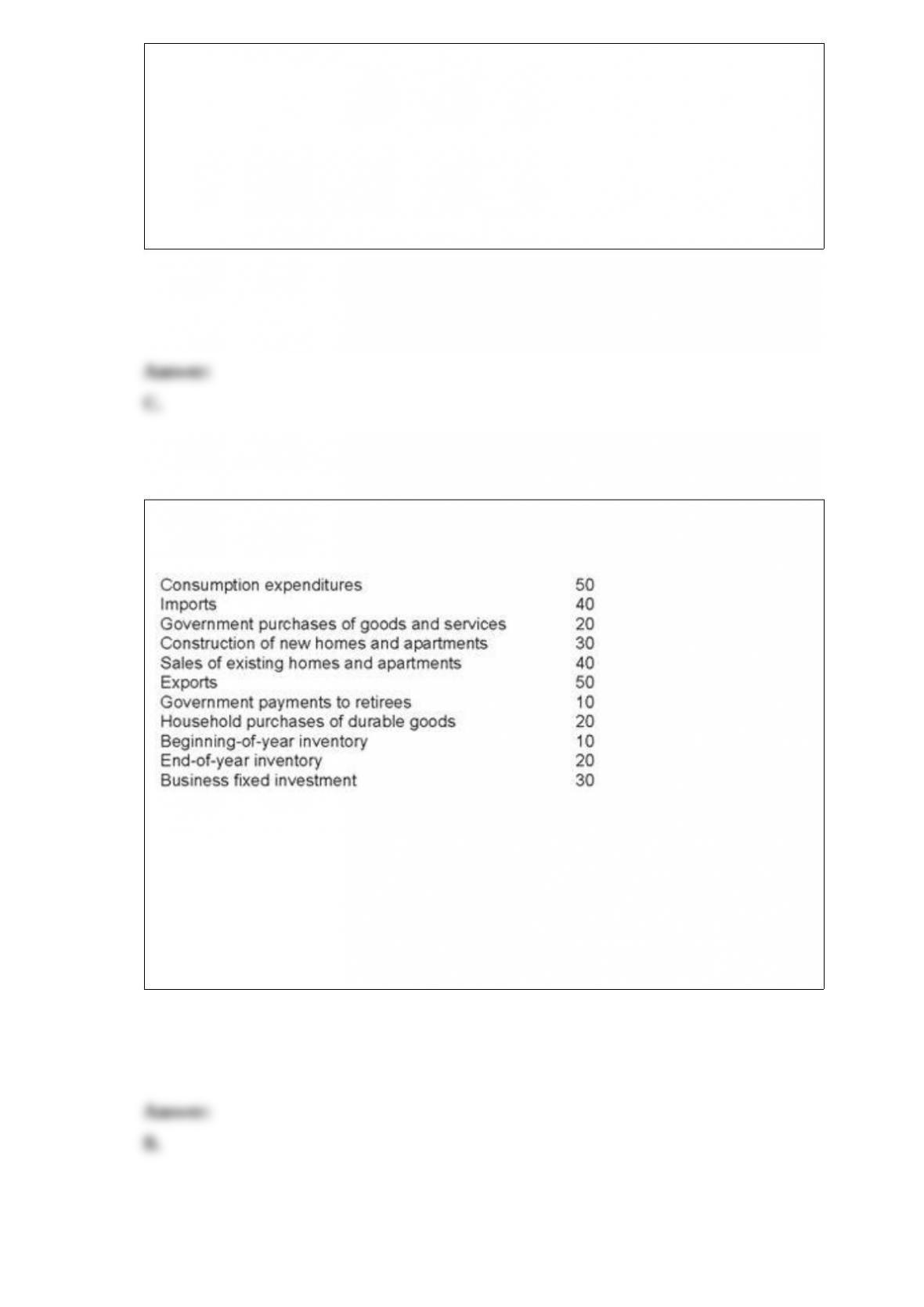
The following table provides data for an economy in a certain year. __
Given the data in the table, compute the government purchases component of GDP.
A. 10
B. 20
C. 30
D. 40

If you use $1,000 to purchase silver bullion, which you plan to keep in a safe, you are
using money as:
A. bank reserves.
B. a medium of exchange.
C. a unit of account.
D. a store of value.
Joe is the owner of the 7-11 Mini Mart, Sam is the owner of the SuperAmerica Mini
Mart, and together they are the only two gas stations in town. Currently, they both
charge $3 per gallon, and each earns a profit of $1,000. If Joe cuts his price to $2.90 and
Sam continues to charge $3, then Joe’s profit will be $1,350, and Sam’s profit will be
$500. Similarly, if Sam cuts his price to $2.90 and Joe continues to charge $3, then
Sam’s profit will be $1,350, and Joe’s profit will be $500. If Sam and Joe both cut their
price to $2.90, then they will each earn a profit of $900. You may find it easier to
answer the following questions if you fill in the payoff matrix below.
If both players choose their dominated strategy they will each earn ______, and if both
players choose their dominant strategy they will each earn ______.
A. $500; $1350
B. $900; $1350
C. $900; $1000
D. $1000; $900

Technological advances that increase the marginal product of labor will lead to
A. a decrease in the demand for labor because the firm won”t need as many workers.
B. an increase in the demand for labor because workers will be more productive.
C. no change in demand for labor because the demand for labor depends on the wage.
D. a decrease in the supply of labor because fewer workers can get the job done.