
1) Financial innovation has caused
A) banks to suffer declines in their cost advantages in acquiring funds, although it has
not caused a decline in income advantages
B) banks to suffer a simultaneous decline of cost and income advantages
C) banks to suffer declines in their income advantages in acquiring funds, although it
has not caused a decline in cost advantages
D) banks to achieve competitive advantages in both costs and income
2) Total reserves are the sum of ________ and ________.
A) excess reserves; borrowed reserves
B) required reserves; currency in circulation
C) vault cash; excess reserves
D) excess reserves; required reserves
3) In which of the following situations would you prefer to be the lender?
A) The interest rate is 9 percent and the expected inflation rate is 7 percent
B) The interest rate is 4 percent and the expected inflation rate is 1 percent
C) The interest rate is 13 percent and the expected inflation rate is 15 percent
D) The interest rate is 25 percent and the expected inflation rate is 50 percent
4) Bank’s make their profits primarily by issuing
A) equity
B) negotiable CDs
C) loans
D) NOW accounts
5) The concept of adverse selection helps to explain
A) why collateral is not a common feature of many debt contracts
B) why large, well-established corporations find it so difficult to borrow funds in
securities markets
C) why financial markets are among the most heavily regulated sectors of the economy

D) why stocks are the most important source of external financing for businesses
6) Bonds with relatively low risk of default are called ________ securities and have a
rating of Baa (or BBB) and above; bonds with ratings below Baa (or BBB) have a
higher default risk and are called ________.
A) investment grade; lower grade
B) investment grade; junk bonds
C) high quality; lower grade
D) high quality; junk bonds
7) The portfolio theories of money demand state that when income (and therefore,
wealth) is higher, the demand for the money asset will ________ and the demand for
real money balances will be ________.
A) rise; higher
B) rise; lower
C) fall; higher
D) fall; lower
8) If a bank has excess reserves greater than the amount of a deposit outflow, the
outflow will result in equal reductions in
A) deposits and reserves
B) deposits and loans
C) capital and reserves
D) capital and loans
9) If prices in the bond market become more volatile, everything else held constant, the
demand curve for bonds shifts ________ and interest rates ________.
A) left; rise
B) left; fall
C) right; rise
D) right; fall
10) The Bretton Woods system broke down in the early 1970s for all but one of the
following reasons:
A) deficit countries losing international reserves were not willing to devalue their
currencies
B) surplus countries were not willing to revalue their currencies upwards
C) surplus countries were not willing to pursue more expansionary policies
D) the United States had been pursuing an inflationary monetary policy to reduce
domestic unemployment
11) The Baumol-Tobin analysis suggests that a decrease in the brokerage fee for buying
and selling bonds will cause the demand for money to ________ and the demand for
bonds to ________.
A) increase; increase
B) increase; decrease
C) decrease; decrease
D) decrease; increase
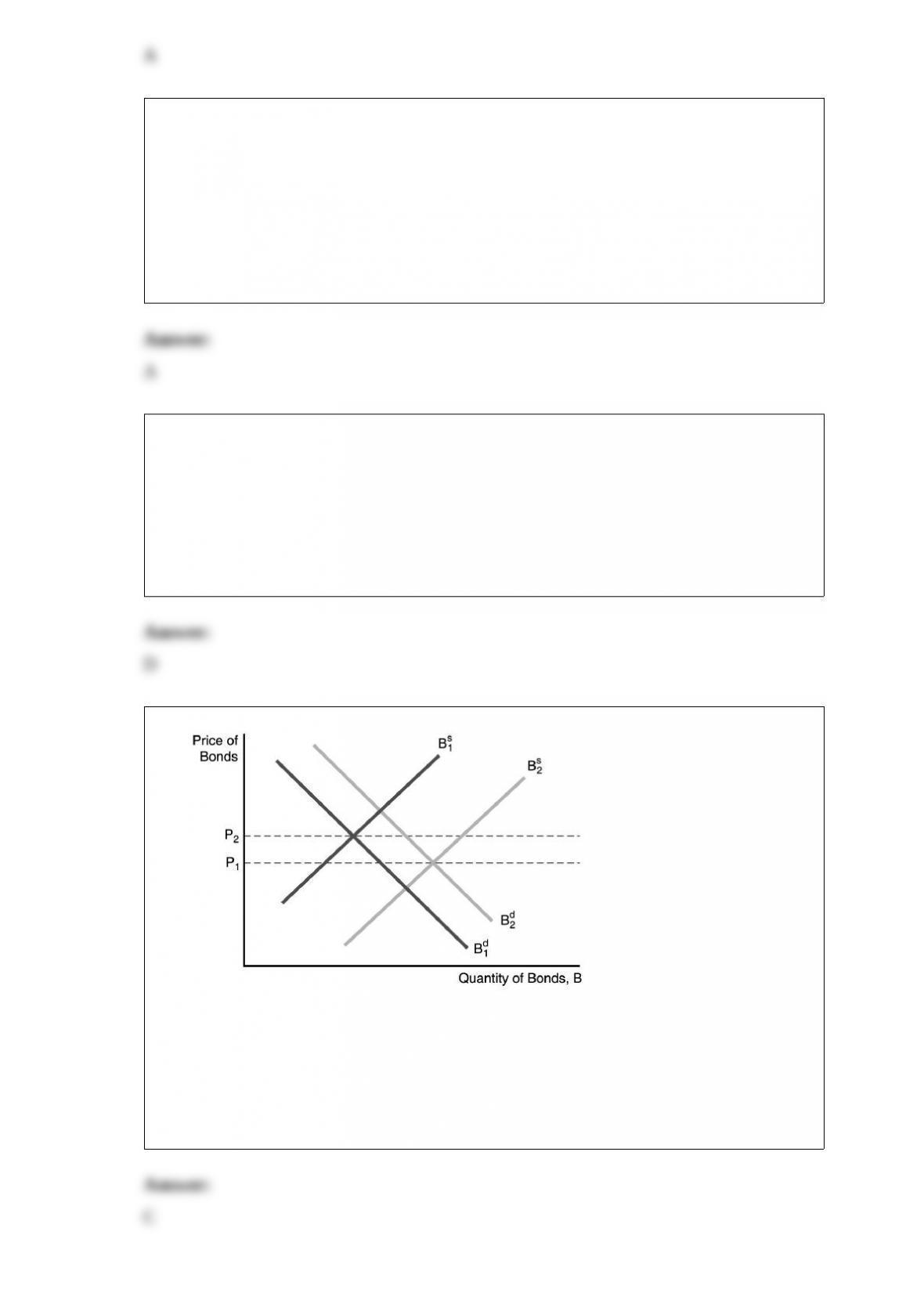
12)
In the figure above, a factor that could cause the demand for bonds to shift to the right
is:
A) an increase in the riskiness of bonds relative to other assets
B) an increase in the expected rate of inflation
C) expectations of lower interest rates in the future
D) a decrease in wealth

13) Using Taylor’s rule, when the equilibrium real federal funds rate is 3 percent, the
positive output gap is 2 percent, the target inflation rate is 1 percent, and the actual
inflation rate is 2 percent, the nominal federal funds rate target should be
A) 5 percent
B) 5.5 percent
C) 6 percent
D) 6.5 percent
14) A financial contract that obligates one party to exchange a set of payments it owns
for another set of payments owned by another party is called a
A) hedge
B) call option
C) put option
D) swap
15) Capital ________ are American purchases of foreign assets, and capital ________
are foreign purchases of American assets.
A) inflows; outflows
B) inflows; inflows
C) outflows; outflows
D) outflows; inflows
16) If the expected path of 1-year interest rates over the next five years is 2 percent, 4
percent, 1 percent, 4 percent, and 3 percent, the expectations theory predicts that the
bond with the lowest interest rate today is the one with a maturity of
A) one year
B) two years
C) three years
D) four years
17) Sometimes one observes that the price of a company’s stock falls after the
announcement of favorable earnings. This phenomenon is
A) clearly inconsistent with the efficient markets hypothesis

B) consistent with the efficient markets hypothesis if the earnings were not as high as
anticipated
C) consistent with the efficient markets hypothesis if the earnings were not as low as
anticipated
D) consistent with the efficient markets hypothesis if the favorable earnings were
expected
18) Recent research indicates that inflation performance (low inflation) has been found
to be best in countries with
A) the most independent central banks
B) political control of monetary policy
C) money financing of budget deficits
D) a policy of always keeping interest rates low
19) Suppose the economy is producing at the natural rate of output and the government
passes legislation that severely restricts a company’s ability to reduce production costs
via outsourcing. Everything else held constant, this policy action will cause ________
in the unemployment rate in the short run and ________ in inflation in the short run.
A) an increase; an increase
B) a decrease; a decrease
C) a decrease; an increase
D) no change; no change
20) Financial intermediaries develop ________ in things such as computer technology
which allows them to lower transactions costs.
A) expertise
B) diversification
C) regulations
D) equity
21) According to aggregate demand and supply analysis, the rising oil prices coupled
with the global financial crisis in 2007-2008 caused the unemployment rate to
________ and the level of real aggregate output to ________.

A) increase; increase
B) increase; decrease
C) decrease; increase
D) decrease; decrease
22) The theory of PPP suggests that if one country’s price level rises relative to
another’s, its currency should
A) depreciate
B) appreciate
C) float
D) do none of the above
23) Which of the following are reported as liabilities on a bank’s balance sheet?
A) Reserves
B) Checkable deposits
C) Loans
D) Deposits with other banks
24) Argentina’s financial crisis was due to
A) poor supervision of the banking system
B) a lending boom prior to the crisis
C) fiscal imbalances
D) lack of expertise in screening and monitoring borrowers at banking institutions
25) The advantage of forward contracts over future contracts is that they
A) are standardized
B) have lower default risk
C) are more liquid
D) are more flexible

26) Which of the following statements about central bank structure and independence
are true?
A) In recent years, with the exception of the Bank of England and the Bank of Japan,
most countries have reduced the independence of their central banks, subjecting them to
greater democratic control
B) Before the Bank of England was granted greater independence, the Federal Reserve
was the most independent of the world’s central banks
C) Both theory and experience suggest that more independent central banks produce
better monetary policy
D) While the European Central Bank is independent, it is not as independent as the
Federal Reserve
27) Which of the following is true?
A) Special drawing rights are loans to countries made by the IMF
B) Changes in the quantity of special drawing rights are tied to changes in the quantity
of gold
C) Special drawing rights are a paper substitute for gold
D) Special drawing rights are not held as international reserves
28) When the domestic currency is initially overvalued in a fixed exchange rate regime,
the central bank must intervene in the foreign exchange market to ________ the
domestic currency, thereby allowing the money supply to ________.
A) purchase; decline
B) sell; decline
C) purchase; increase
D) sell; increase
29) ________ are the only depository institutions that are tax-exempt.
A) Commercial banks
B) Savings and loans
C) Mutual savings banks
D) Credit unions

30) Everything else held constant, in the market for reserves, when the supply for
federal funds intersects the reserve demand curve along the horizontal section of the
demand curve, lowering the interest rate paid on excess reserves
A) increases the federal funds rate
B) lowers the federal funds rate
C) has no effect on the federal funds rate
D) has an indeterminate effect of the federal funds rate
31) By taking the short position on a futures contract of $100,000 at a price of 115 you
are agreeing to ________ a ________ face value security for ________.
A) sell; $100,000; $115,000
B) sell; $115,000; $100,000
C) buy; $100,000; $115,000
D) buy; $115,000; $100,000
32) One advantage of using swaps to eliminate interest-rate risk is that swaps
A) are less costly than futures
B) are less costly than rearranging balance sheets
C) are more liquid than futures
D) have better accounting treatment than options
33) According to Tobin’s q theory, when q is ________, firms will not purchase new
investment goods because the market value of firms is ________ relative to the cost of
capital.
A) low; low
B) low; high
C) high; low
D) high; high
34) The price specified on an option at which the holder can buy or sell the underlying
asset is called the
A) premium
B) call

C) strike price
D) put
35) Advice on taxes, accounting or management information systems, and business
strategies are commonly referred to as ________ services.
A) accounting audit
B) management advisory
C) seller
D) managing underwriter
36) The bond supply and demand framework is easier to use when analyzing the effects
of changes in ________, while the liquidity preference framework provides a simpler
analysis of the effects from changes in income, the price level, and the supply of
________.
A) expected inflation; bonds
B) expected inflation; money
C) government budget deficits; bonds
D) government budget deficits; money
37) Assuming initially that rr = 10%, c = 40%, and e = 0, a decrease in rr to 5% causes
the M1 money multiplier to ________, everything else held constant.
A) increase from 2.8 to 3.11
B) decrease from 3.11 to 2.8
C) increase from 2 to 2.22
D) decrease from 2.22 to 2
38) All but the most primitive societies use money as a medium of exchange, implying
that
A) the use of money is economically efficient
B) barter exchange is economically efficient
C) barter exchange cannot work outside the family
D) inflation is not a concern