
1) Forestry companies with secure property rights have a greater incentive to harvest
and replant in a sustainable manner.
2) a progressive tax takes relatively more from the rich than it does from the poor.
3) economic theory suggests that immigration should be allowed into a country until the
marginal benefit of the last immigrant is zero.
4) disposable income measures the before-tax income received by resource suppliers.
5) if the demand for wheat is highly price inelastic, an extraordinarily large crop may
reduce farm incomes.
6) U.S. exports increase and U.S. imports decrease the supplies of foreign monies
owned by U.S. banks.
7) Assuming that interest rates are positive, the present value of an $80 barrel of oil in 2
years is less than an $80 barrel today.

8) Alan Greenspan is the current chair of the Board of Governors.
9) Other things equal, an increase in productivity will shift the short-run aggregate
supply curve rightward.
10) each point on a single indifference curve reflects the same level of total utility for a
consumer.
11) If the demand for agricultural products is inelastic, a relatively small increase in
supply will cause farm prices and incomes to decline.
12) Horizontal mergers may be anticompetitive because nonmerged firms are
foreclosed from selling their products to the buying firm.
13) Agriculture is overcrowded because of absolute and relative increases in the size of
farm employment.
14) the personal distribution of income refers to the:
a.division of income between personal taxes, consumption expenditures, and saving.
b.division of income on the basis of industry sources, for example, agriculture,
transportation, and mining.
c.distribution of income to basic resource classes, that is, wages, rents, interest, and
profits.
d.way income is distributed among specific households or spending units.
15) Suppose the multiplier is 4 and lump-sum taxes are increased by $16 in a closed
economy. We can predict that:
A.GDP will increase by $64.
B.GDP will decrease by $64.
C.the aggregate expenditures schedule will shift downward by $12.
D.inflation will occur.
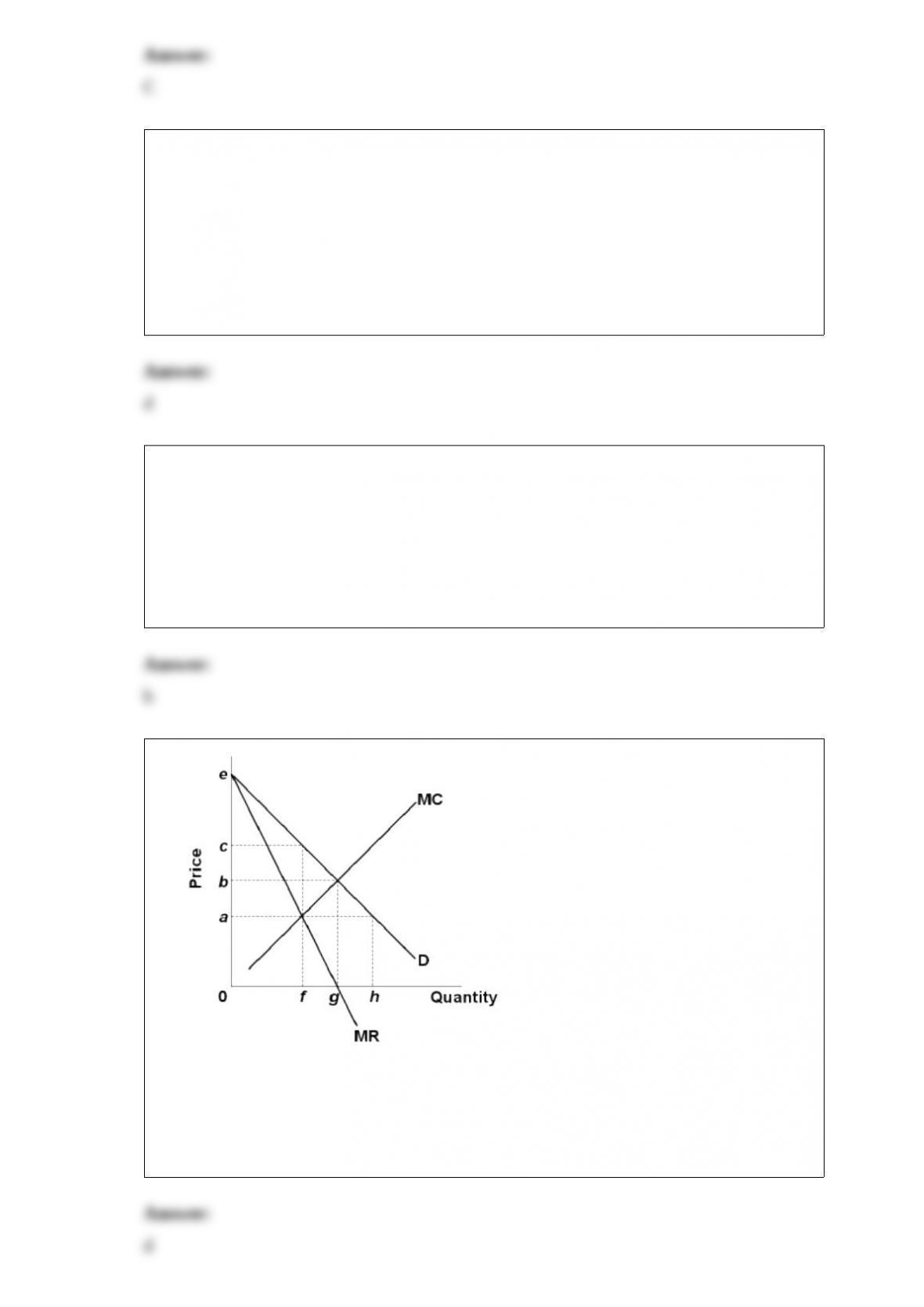
16)
in the figure above are two linear production possibilities curves for countries alpha and
beta. we can conclude that:
a.different value systems make it impossible to compare opportunity costs in the two
countries.
b.the opportunity cost of shelter is greater in beta than it is in alpha.
c.the opportunity cost of food is greater in alpha than it is in beta.
d.the opportunity cost of shelter is greater in alpha than it is in beta.
17) The supply-side anecdote about the 10 breakfast diners illustrates that:
A.people who pay the highest taxes get the least benefit from a tax reduction.
B.tax cuts are distributed evenly across the population.
C.unintended consequences may result from redistributing tax reductions at the expense
of those paying the highest taxes.
D.a tax cut would stimulate economic growth.
18) determine, other things equal, the effects of a given change in a determinant of
demand or supply for product x upon (1) the demand (d) for, or supply (s) of, x, (2) the
equilibrium price (p) of x and (3) the equilibrium quantity (q) of x.
refer to the above. if x is an inferior good, a decrease in income will:
a.decrease d, decrease p, and decrease q.
b.decrease d, decrease p, and increase q.
c.increase s, decrease p, and increase q.
d.increase d, increase p, and increase q.
19) health savings accounts (hsas) implemented by the 2003 medicare law:
a.are only available to those enrolled in medicare.
b.allow workers to accumulate untaxed dollars for payment of qualified medical
expenses.
c.are criticized because they require workers to “use it or lose it” each year; workers are
not allowed to accumulate balances over time.
d.can only be used to pay for prescription drugs.
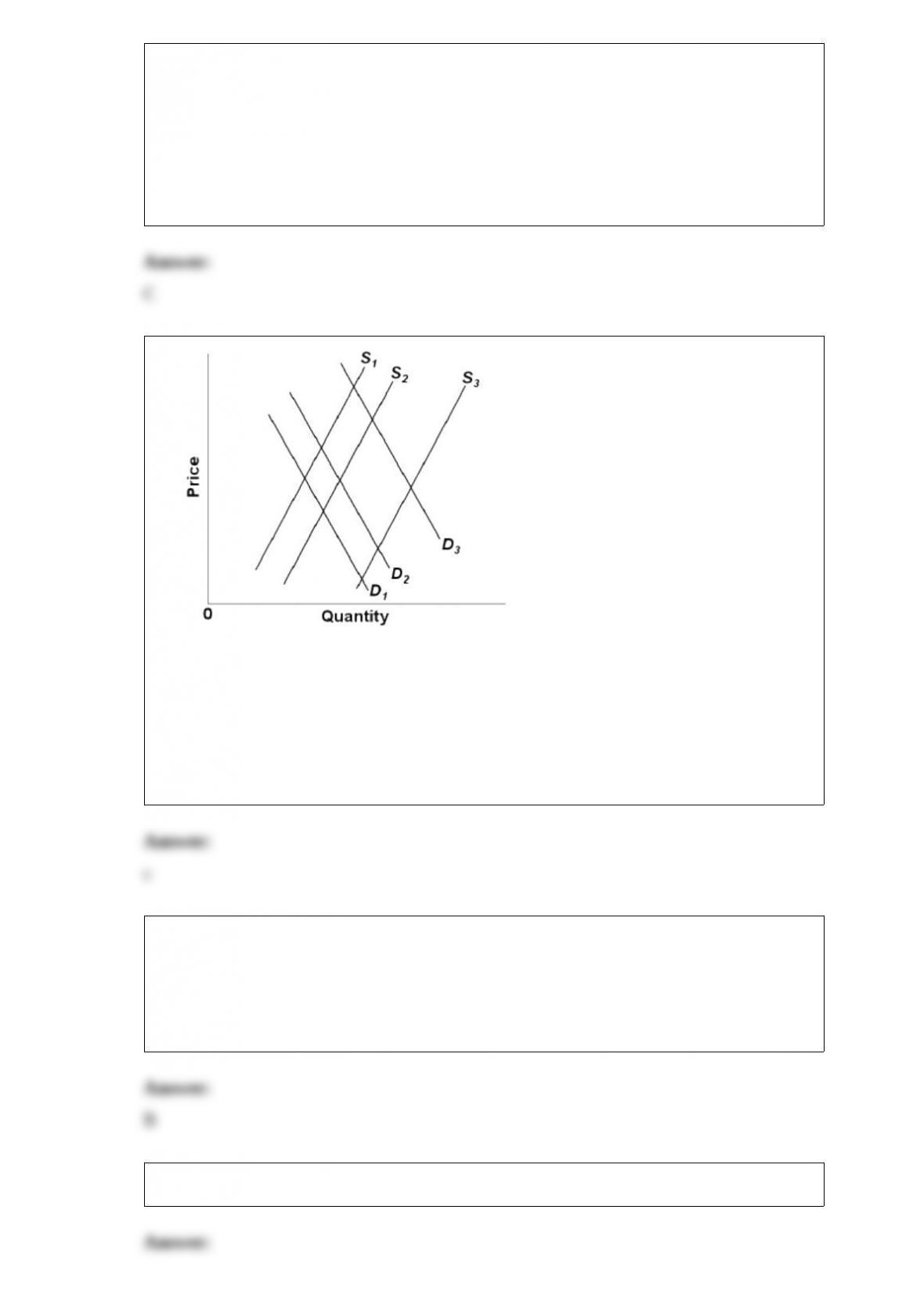
20)
refer to the above diagram for a pure monopolist. monopoly output will be:
a.between f and g
b.h
c.g
d.f
21) A major difference between social insurance and welfare is that social insurance:
A.exclusively involves older Americans whereas welfare is confined mainly to mothers
with young children.
B.forces recipients to demonstrate need while welfare does not.
C.is normally financed by earmarked payroll taxes while welfare is financed out of
general tax revenues.
D.provides cash transfers while welfare does not.
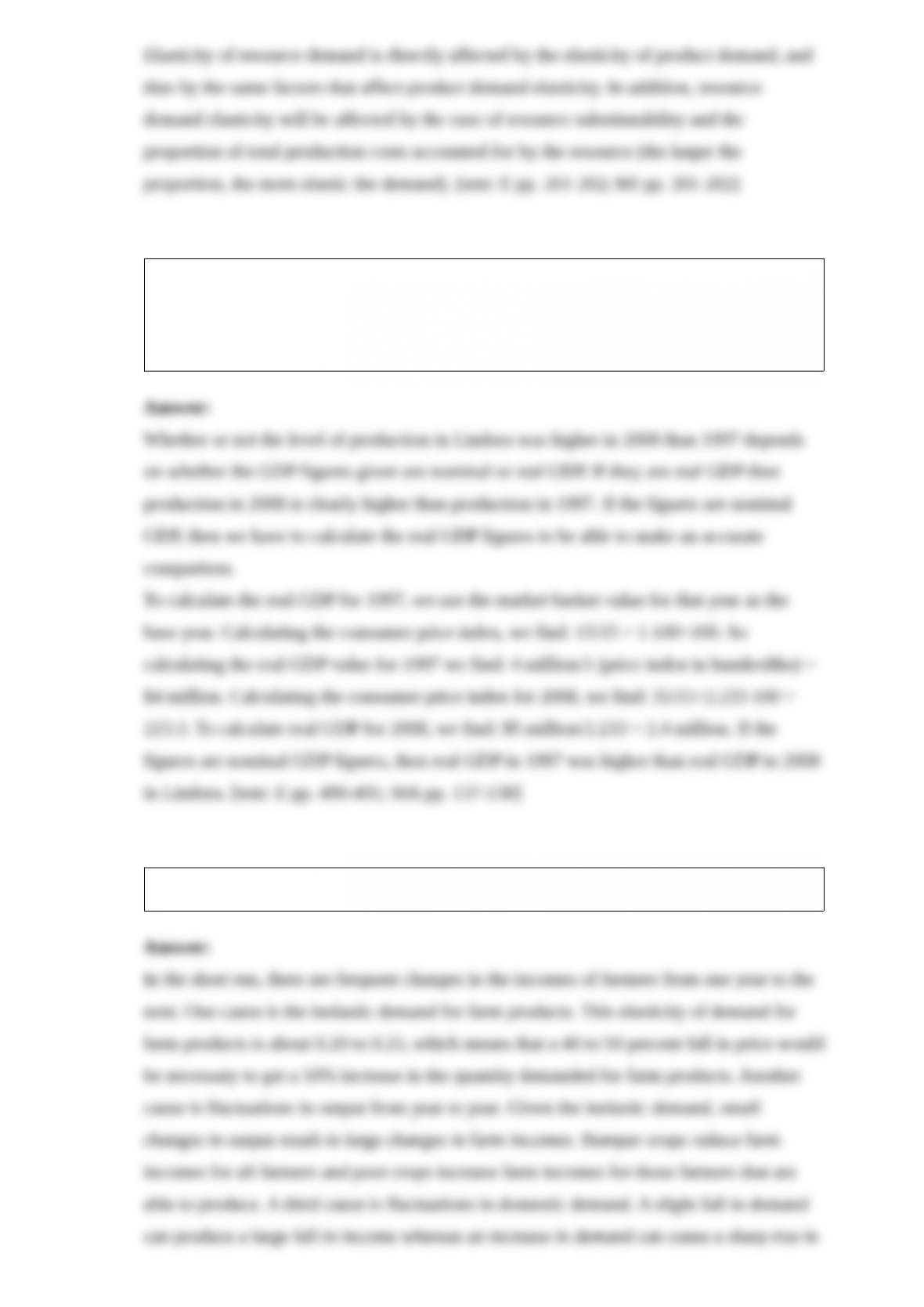
22)
refer to the above figure that shows the market for u.s. health care. the problem of
rapidly rising medical care costs is best illustrated by the shifts of the demand and
supply curves from d1 to:
a.d2 and s1 to s2.
b.d2 and s1 to s3.
c.d3 and s1 to s2.
d.d3 and s1 to s3.
23) The purpose of the Freedom to Farm Act of 1996 was to:
A.immediately end U.S. farm subsidies.
B.end 60 years of U.S. price supports for American grain crops.
C.eliminate U.S. tariffs and quotas on imported farm goods.
D.stabilize short-run crop prices.
24) Compare the factors that explain the elasticity of resource and product demand.
25) In 1997, GDP in the tiny country of Lindora was $4 million and the price of a
market basket of goods was $15. In 2008, GDP in Lindora was $5 million and the price
of a market basket of goods was $ Given this information, it is clear that Lindora GDP
had a higher level of production in 2008 than 1997. Evaluate this statement.
26) Describe the short-run situation in U.S. agriculture. What are its causes?

27) Why are payroll taxes regressive?
28) How large is the actual multiplier?
29) What is the official reserves account and how is it used in the balance of payments?
30) There is no such thing as risk-free return. Evaluate.
31) Why is the ownership of the public debt an important issue?