
1) the social security program in the united states faces a long-term funding crisis
because:
a.the social security trust fund was exhausted in 2006
b.the number of retirees receiving benefits is rising more rapidly than the number of
workers paying payroll taxes.
c.recent tax cuts have reduced payroll tax revenues.
d.the war on terrorism has drained funds away from social security.
2) (consider this) the rapid rise in the number of women in the paid u.s. workforce over
the past several decades has:
a.shifted the u.s. production possibilities curve inward (to the left).
b.moved the u.s. economy from a point inside its production possibilities curve to a
point on the curve.
c.reduced income inequality in the united states.
d.shifted the u.s. production possibilities curve outward (to the right) and expanded real
gdp.
3) Suppose a loan customer is considering two alternative $22,000 loans. Loan 1
requires payment of $1,100 of interest each year and Loan 2 has a 6 percent annual
interest rate. Other things equal, the loan customer will:
A.be indifferent between the two loans because they both have the same annual
percentage rate.
B.reject both loans because they each carry too high an interest rate.
C.choose Loan 1 because it has a lower annual interest rate than Loan 2.
D.choose Loan 2 because it has a lower annual interest rate than Loan 1.
4) If prices and wages are inflexible downward, a decrease in aggregate demand will:
A.reduce the price level but not real output.
B.increase short-run aggregate supply.
C.decrease short-run aggregate supply.
D.reduce real output but not the price level.
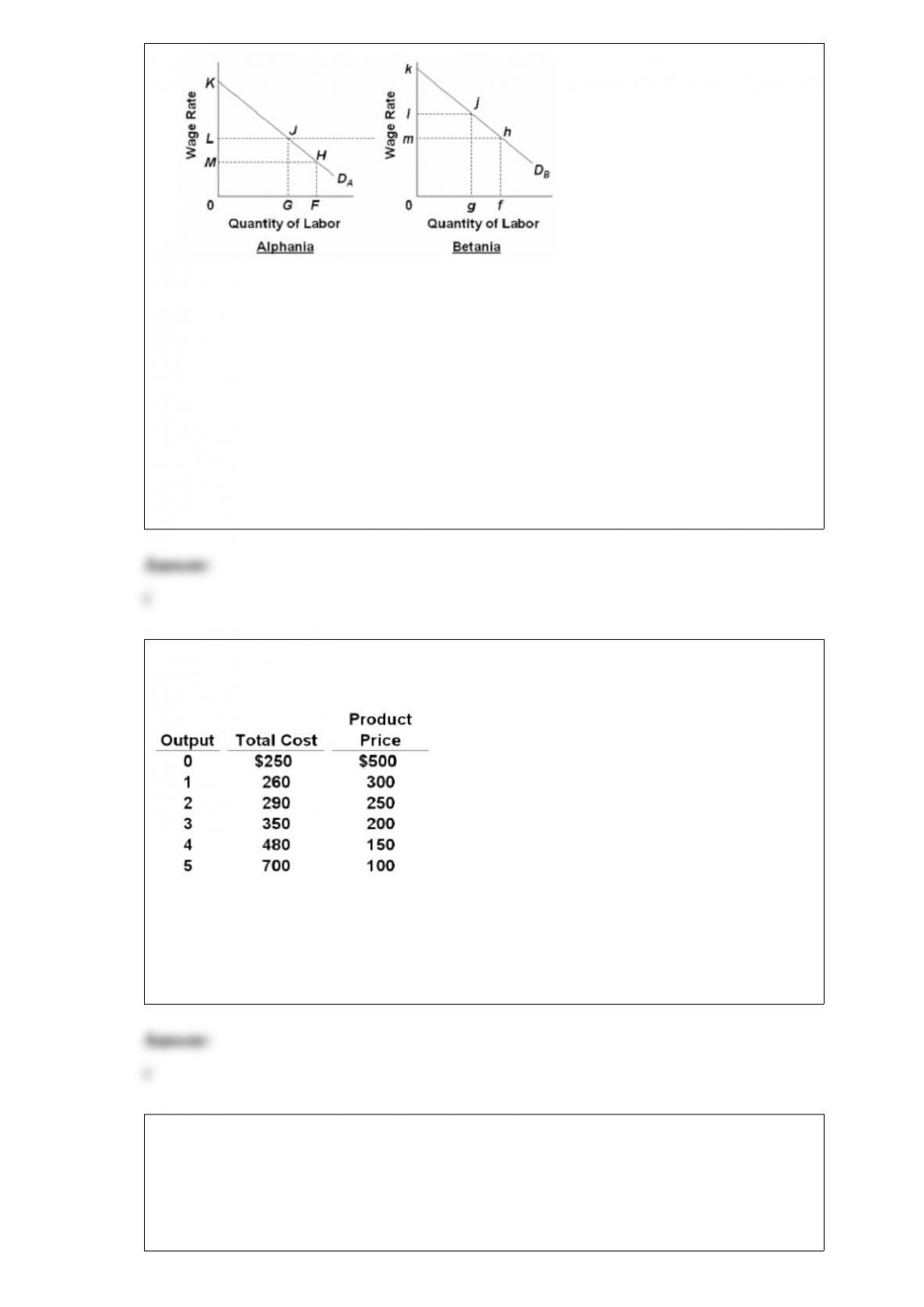
5)
assumptions: (1) the demand for labor in alphania and betania are as shown by da and
db, respectively; (2) alphania’s native labor force is f and that of betania is g; (3) wage l
in alphania is equal to wage m in betania; and (4) full employment exists in both
countries.
refer to the above diagram and assumptions. we would expect a flow of remittances
from migrants to:
a.decrease in national income loss in betania.
b.increase the national income gain in betania.
c.decrease the national income loss in alphania.
d.decrease the national income gains in both countries.
6) the following information for a pure monopolist:
the above nondiscriminating monopolist should set its price at:
a.$300.
b.$250.
c.$200.
d.$150.
7) Since 2000, U.S. official reserves have:
A.maintained a constant value of about $30 billion.
B.been steadily accumulated.
C.been seriously depleted.
D.rising and falling, with deposits and withdrawals roughly balancing over time.

8) a monopolistic firm has a sales schedule such that it can sell 10 prefabricated garages
per week at $10,000 each, but if it restricts its output to 9 per week it can sell these at
$11,000 each. the marginal revenue of the tenth unit of sales per week is:
a.-$1,000.
b.$9,000.
c.$10,000.
d.$1,000.
9) when a firm is on the inelastic segment of its demand curve, it can:
a.increase total revenue by reducing price.
b.decrease total costs by decreasing price.
c.increase profits by increasing price.
d.increase total revenue by more than the increase in total cost by increasing price.
10) The aggregate demand curve:
A.is upsloping because a higher price level is necessary to make production profitable
as production costs rise.
B.is downsloping because production costs decline as real output increases.
C.shows the amount of expenditures required to induce the production of each possible
level of real output.
D.shows the amount of real output that will be purchased at each possible price level.
11)
Suppose that a firm’s legal staff concludes that a new product that the firm is developing
is patentable. Graphically, this new information would shift the firm’s expected rate of
return curve on R&D to the:
A.right and reduce its optimal amount of R&D.
B.right and increase its optimal amount of R&D.
C.left and increase its optimal amount of R&D.
D.left and reduce its optimal amount of R&D