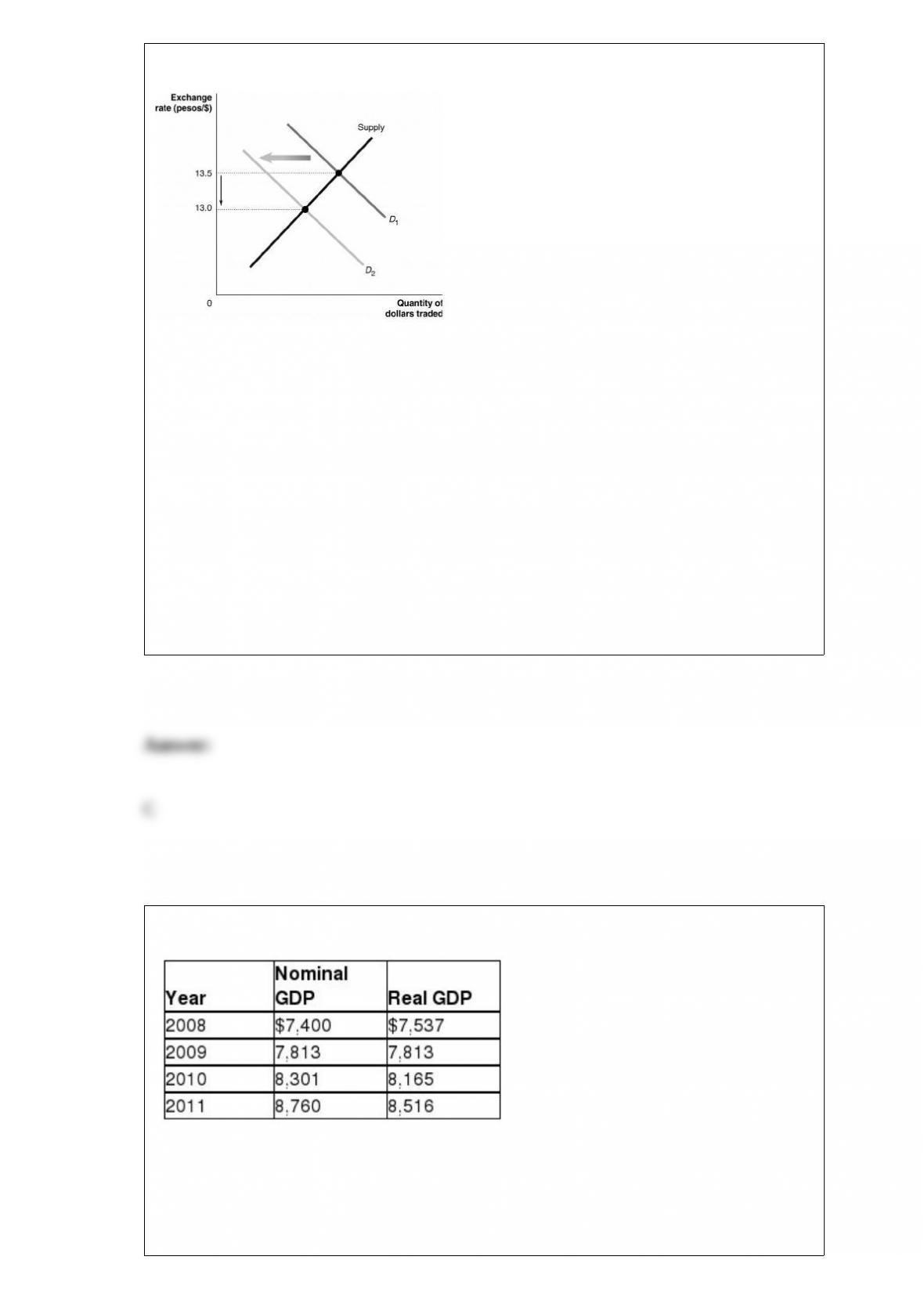
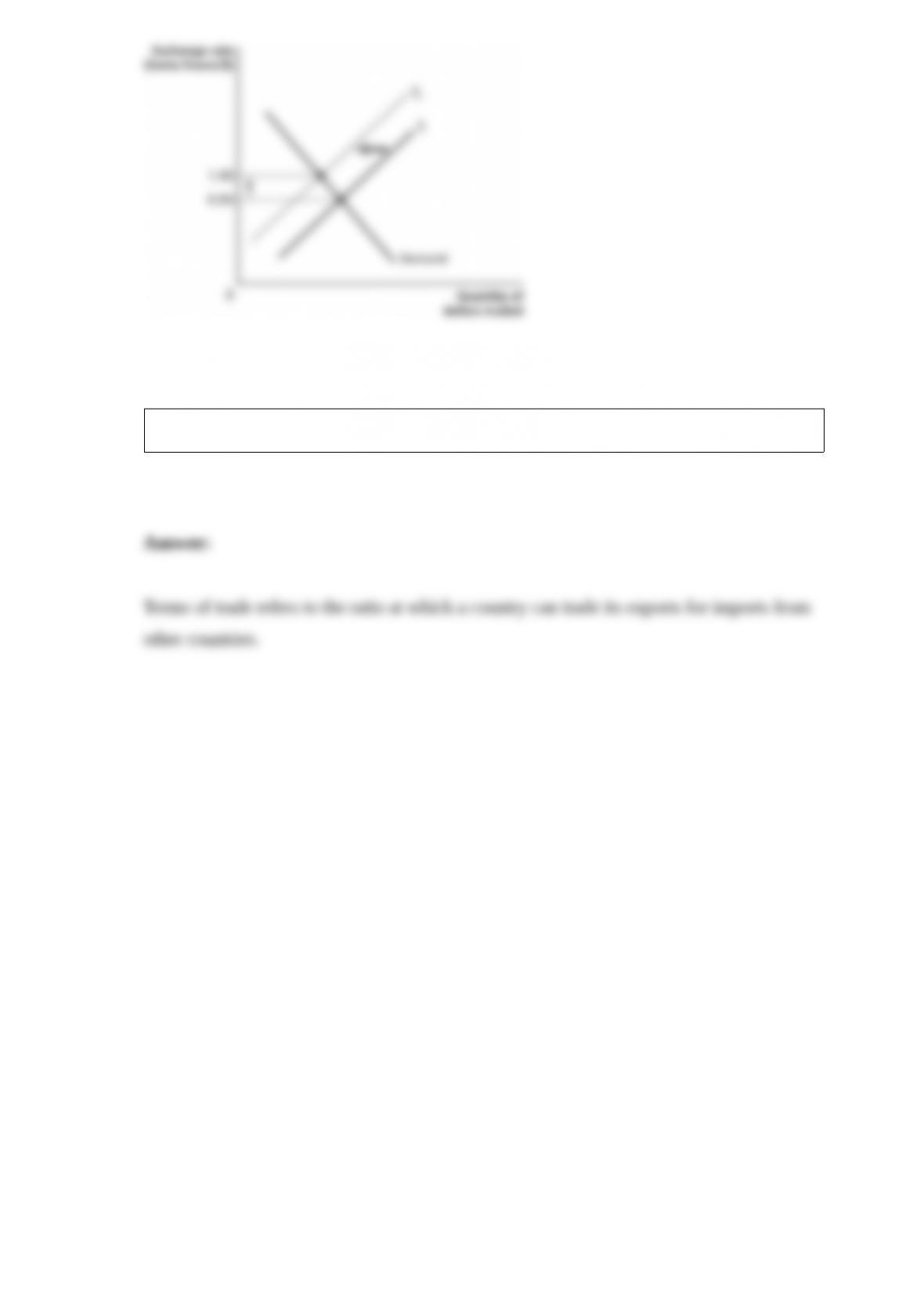
Figure 19-6
Refer to Figure 19-6. Which of the following would cause the change depicted in the
figure above?
A) Lack of investment in infrastructure causes Mexican productivity to fall relative to
American productivity.
B) A possibility of diseased poultry in Mexico causes U.S. consumers to decrease their
preferences for Mexican-raised chickens relative to U.S.-raised chickens.
C) A new trade agreement with Mexico results in the United States removing all tariffs
on sugar imported from Mexico.
D) An expansionary monetary policy in Mexico causes an increase in the price level of
Mexican goods relative to U.S. goods.
Table 8-12
Refer to Table 8-12. Consider the following data on nominal GDP and real GDP (values
are in billions of dollars): The base year used in calculating real GDP is
A) 2008.

B) 2009.
C) 2010.
D) 2011.
The following equations represent the demand and supply for kumquats.
QD = 60 – 3P
QS = -20 + 5P
What is the equilibrium price (P) and quantity (Q – in thousands) of kumquats?
A) P = $5; Q = 20 thousand
B) P = $30; Q = 5 thousand
C) P = $20; Q = 10 thousand
D) P = $10; Q = 30 thousand
From an initial long-run macroeconomic equilibrium, if the Federal Reserve anticipated
that next year aggregate demand would grow significantly faster than long-run
aggregate supply, then the Federal Reserve would most likely
A) increase income tax rates.
B) decrease income tax rates.
C) increase interest rates.

D) decrease interest rates.
China began pegging its currency, the yuan, to the dollar in 1994. Because the yuan has
been ________ at the pegged exchange rate, the Chinese government ________ its
reserves of dollars as the government purchased more ________ to maintain the pegged
exchange rate.
A) undervalued; increased; dollars
B) undervalued; decreased; yuan
C) overvalued; decreased; yuan
D) overvalued; increased; yuan
________ dictates the lowest wage that firms may pay for labor.
A) A maximum wage requirement
B) A minimum wage law
C) The black market wage
D) A price ceiling wage

Part of the spending on the Caldecott Tunnel project in northern California came from
the American Reinvestment and Recovery Act, which is an example of discretionary
fiscal policy aimed at increasing
A) real GDP and employment.
B) tax revenues and the federal budget surplus.
C) disposable income and interest rates.
D) the money supply and money demand.
Although the Federal Reserve had traditionally made discount loans only to ________,
in response to the financial crisis in 2008 the Fed made primary dealers eligible for
discount loans as well.
A) commercial banks
B) government agencies
C) investment banks
D) mortgage lenders

Figure 16-2
Refer to Figure 16-2. In the graph above, if the economy is at point A, an appropriate
fiscal policy by the Congress and the president would be to
A) decrease the required reserve ratio.
B) sell government securities.
C) increase government expenditures.
D) decrease transfer payments.
Which of the following accurately describes the impact of the rule of law on a country’s
economic growth rate?
A) Countries with a strong rule of law have faster economic growth.
B) Countries with a weak rule of law have faster economic growth.
C) Countries that enforce property rights through lawsuits have slower economic
growth.
D) Countries where favoritism and bribery are common have stronger rates of growth.

Suppose that in 2013, the national income in the United States was $200 billion,
depreciation was $15 billion, personal taxes were $20 billion, and transfer payments
were $10 billion. Gross domestic product in 2013 is
A) $185 billion.
B) $215 billion.
C) $220 billion.
D) $245 billion.
In the short run, the Federal Reserve can affect which of the following?
A) the inflation rate
B) the unemployment rate
C) the growth rate of real GDP in the economy
D) all of the above
Describe briefly how the final value of an iPhone must be equal to the sum of incomes
generated by the production of the iPhone.
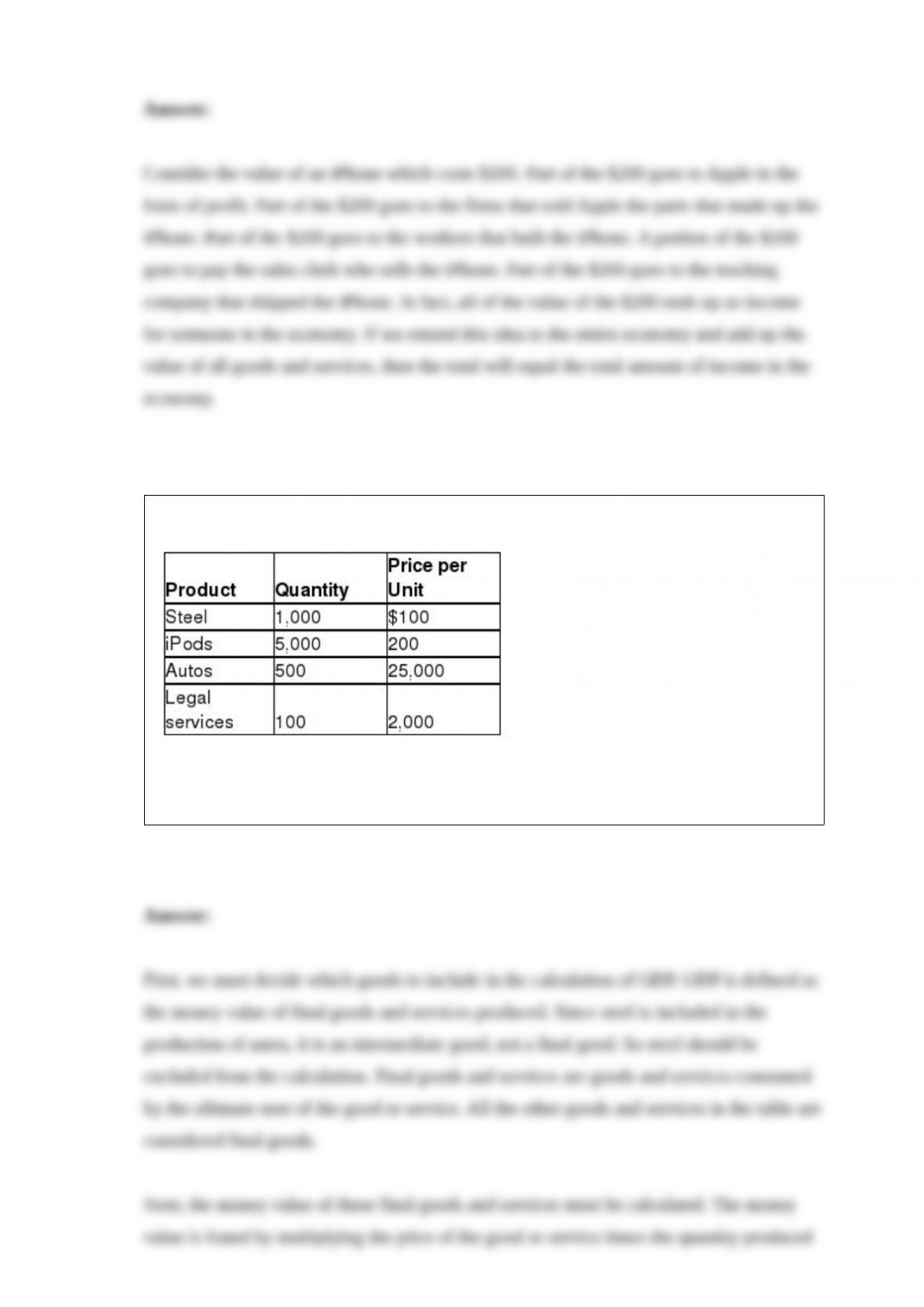
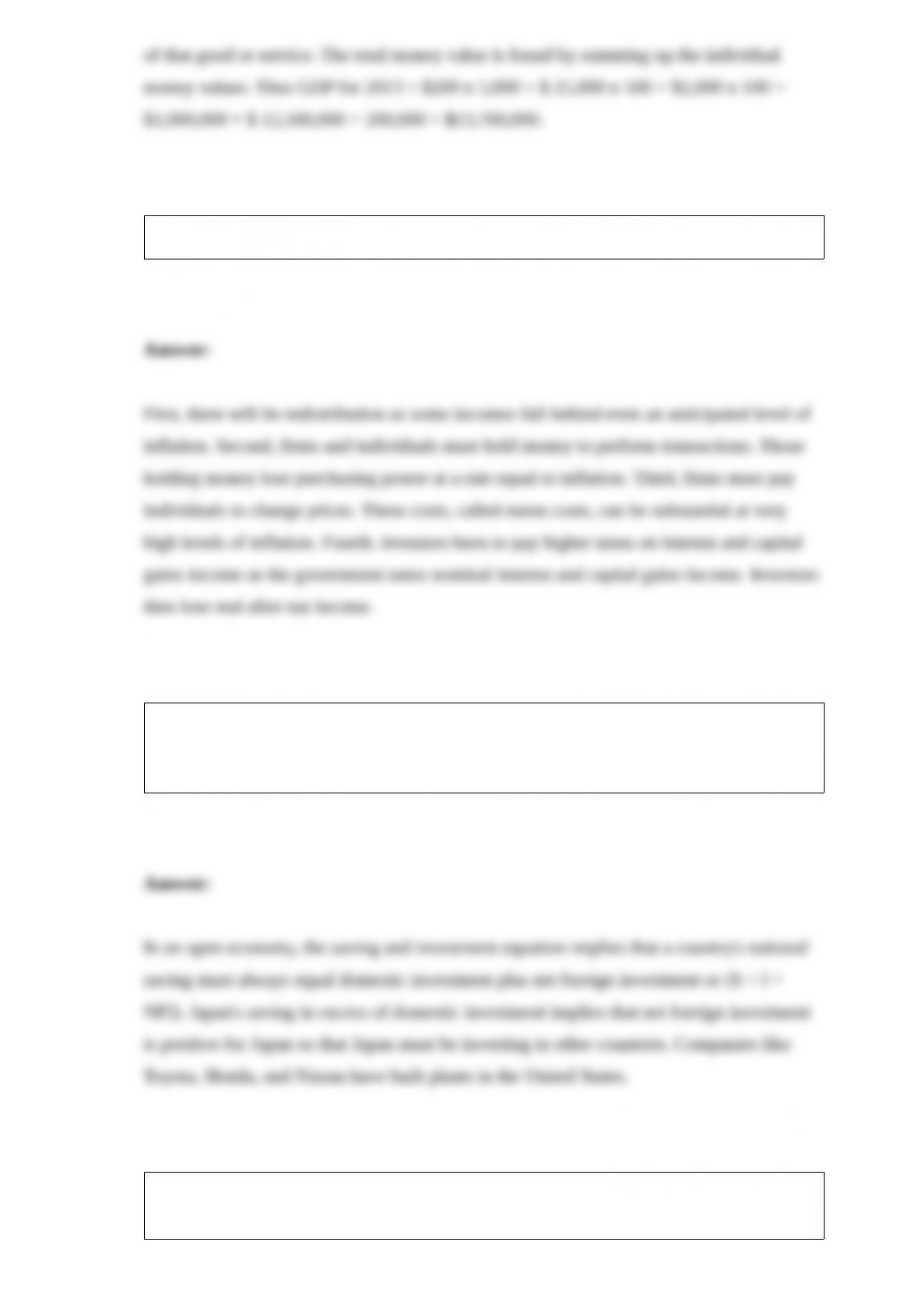
Table 8-9
Refer to Table 8-9. Suppose that the above table represents the goods and services
produced in a very simple economy in 2013. Assume that steel is used as an input in the
production of autos. Using that information, calculate GDP for the year 2013.
Describe how inflation can be costly even if it is anticipated.
Japan has a fairly high saving rate and the level of saving in Japan is above domestic
investment. Use the saving and investment equation to explain what Japan is doing with
this excess of saving above domestic investment.
If firms and workers have adaptive expectations, what impact will contractionary
monetary policy have on inflation, unemployment, and the Phillips curve?
The “Big Mac Theory of Exchange Rates” tests the accuracy of purchasing power
parity theory. In July 2013, The Economist reported that the average price of a Big Mac
in the United States was $4.56. In Switzerland, the average price of a Big Mac at that
time was 6.50 Swiss francs. If the exchange rate between the dollar and the Swiss franc
was 0.93 Swiss francs per dollar, how would purchasing power parity predict the
exchange rate will change in the long run? Support your answer graphically.
What are terms of trade?