
Consider two labor markets, C and D. Wages in labor market D fall. This could be due
to
a. the marginal revenue curve in the product market (that employees in labor market D
supply with goods) shifts to the left.
b. an increase in the marginal physical product of the employees in labor market D.
c. an increase in the price and marginal revenue of the product that employees in labor
market D produce.
d. b and c
e. a, b, and c
The effects of tariffs and quotas are: a(n) __________ in the prices of imported goods
to domestic consumers, and a(n) __________ in imports.
a. increase; increase
b. increase; decrease
c. decrease; increase
d. decrease; decrease
Bond prices and bond yields have a(n) ______________ relationship.
a. direct

b. inverse
c. independent
d. positive
If a labor union successfully practices collective bargaining against a monopsonist, then
a. product price will decrease.
b. both wages and employment may rise.
c. both wages and employment may fall.
d. workers will probably receive a wage further away from their marginal revenue
products.
e. b and d
Which of the following statements is false?
a. The monopolistic competitor is a price searcher.
b. The monopolistic competitor produces a product that differs slightly from the
products of the other firms in the industry.
c. The monopolistic competitor faces a horizontal demand curve.
d. The monopolistic competitor produces an output at which price is greater than
marginal cost.
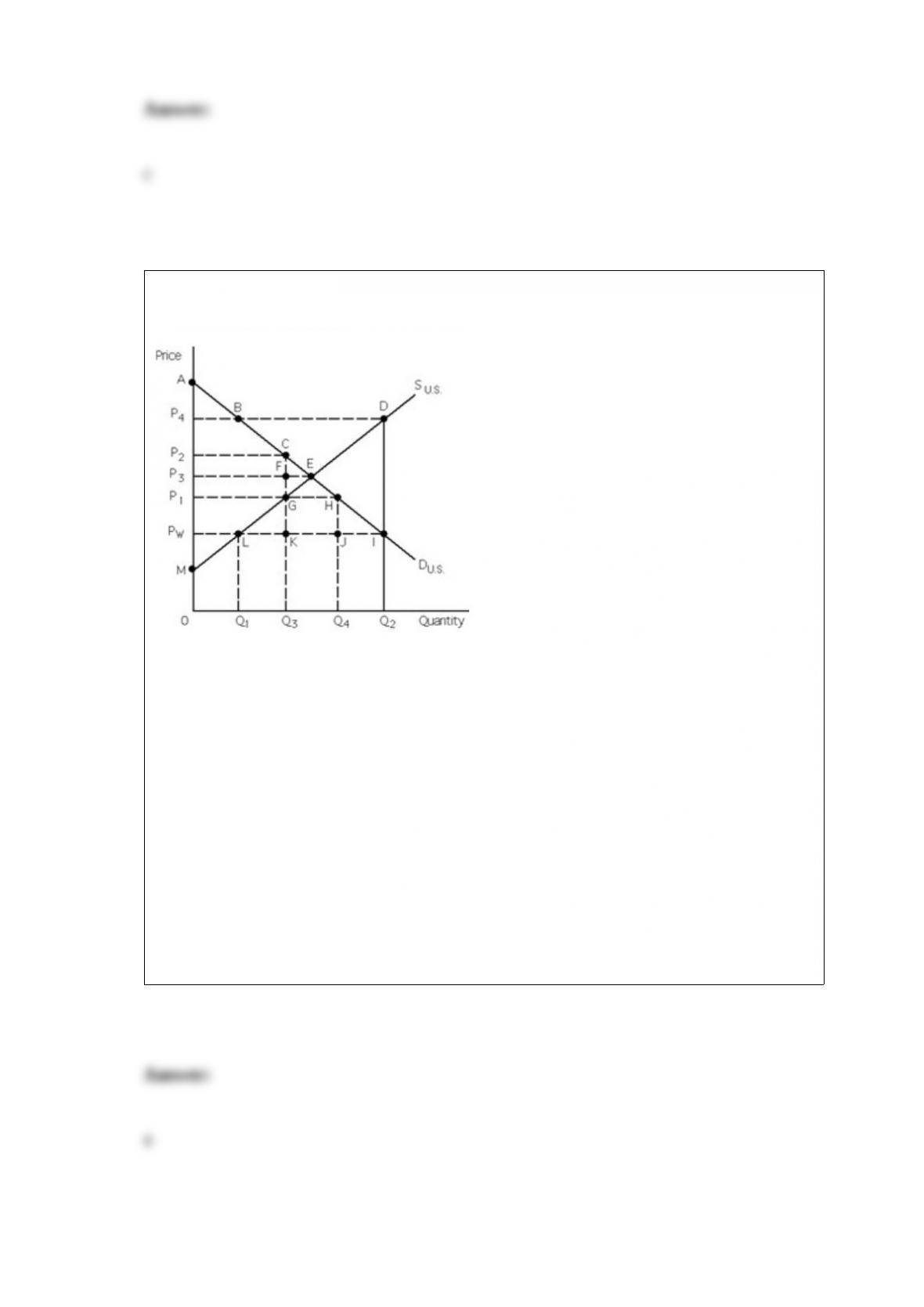
Exhibit 34-12
PW is the price that exists in a free world market. If the U.S. imposes a quota to reduce
imports to Q4 – Q3, price will rise to
a. P1.
b. P2.
c. P3.
d. P4.
e. There is not enough information to answer the question.

Fixed costs
a. are equal to explicit costs plus implicit costs.
b. do not vary as output varies.
c. are the same as total costs for any level of output greater than zero.
d. are another name for sunk costs.
Research presented in the text shows that people are more likely to spend a larger
percentage of money received from the government when it is called a €tax bonus€ than
they would if it were called a €tax rebate.€
a. True
b. False
Exhibit 23-10

Is it possible for this firm to produce €too much€ output?
a. Yes, any quantity above 2 units is too much output.
b. Yes, any quantity above 4 units is too much output.
c. Yes, any quantity above 6 units is too much output.
d. No, it is not possible for this firm to produce too much output.
If Luke can bake bread at a lower opportunity cost than Jason, and Jason can produce
paintings at a lower opportunity cost than Luke, it follows that
a. Lukehas a comparative advantage in paintings and Jason has a comparative
advantage in baking bread.
b. BothLuke and Jason have a comparative advantage in baking bread.
c. BothLuke and Jason have a comparative disadvantage in producing paintings.
d. Lukehas a comparative advantage in baking bread and Jason has a comparative
advantage in producing paintings.
e. There is not enough information to answer the question.
If total revenue falls as a result of a decrease in the price of a given good, it follows that
demand is
a. perfectly elastic.
b. inelastic.
c. unit elastic.
d. perfectly inelastic.
e. b or d
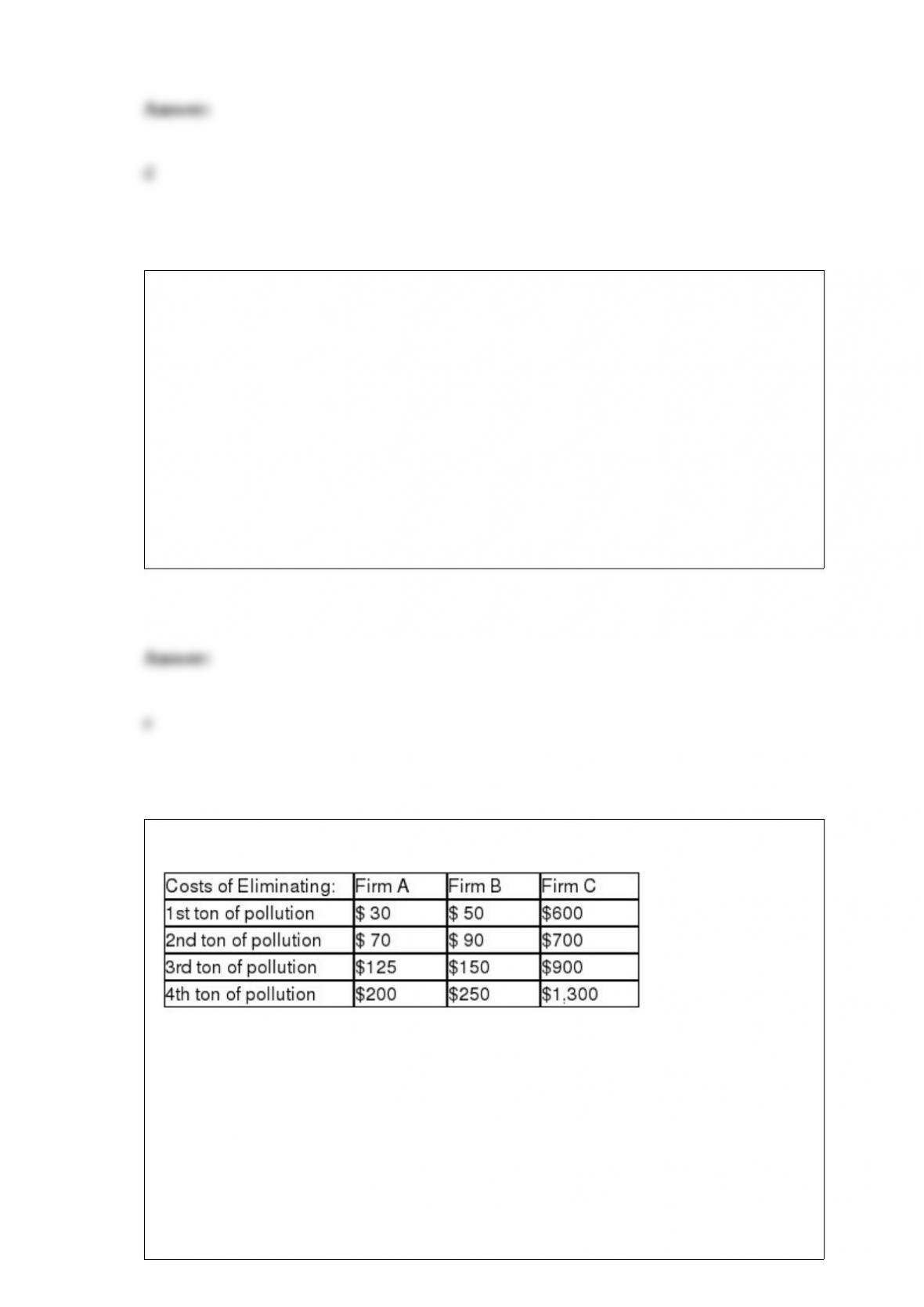
Exhibit 31-3
What is the cost to Firm B of eliminating 2 tons of pollution?
a. $350
b. $250
c. $300
d. $140

e. $540
Prior to attending college, Marvin is offered a lucrative four-year contract as an actor in
a daytime soap opera. Assuming that acting and attending college are Marvin’s
preferred alternatives and that he must choose between the two, his opportunity cost of
attending college after receiving the offer ________________, making him
____________ likely to attend college than before he received the offer.
a. increases; less
b. decreases; more
c. stays the same; equally likely
d. increases; more
e. decreases; less
Given two goods, X and Y, and their prices, PX and PY a consumer will maximize total
utility by allocating expenditures such that
a. MUX/PY = MUY/PX.
b. PY/MUX = PX/MUY.

c. MUX/PX = MUY /PY.
d. MUX = PX = MUY = PY = MU$.
e. MUX = MUY = PX = PY = MU$.