
In order for an individual to achieve consumer equilibrium through the consumption of
two goods, A and B, that individual must fulfill the condition
a. TUA = TUB.
b. TUA/PA = TUB/PB.
c. MUA = MUB.
d. MUA/PA = MUB/PB.
e. MUB/PA = MUA/PB.
In an oligopoly market, unlike in other market structures, firms
a. can act interdependently.
b. can produce a homogeneous product or a differentiated product.
c. use advertising.
d. face low barriers to entry and exit.
e. a and b
In economics, capital is defined as a financial asset such as stocks and bonds.

a. True
b. False
The demand curve for good X is a straight downward-sloping line. It follows that the
demand for good X is ________ elastic at __________ prices than at __________
prices.
a. less; lower; higher
b. more; lower; higher
c. more; higher; lower
d. less; higher; lower
e. a and c
Exhibit 22-14
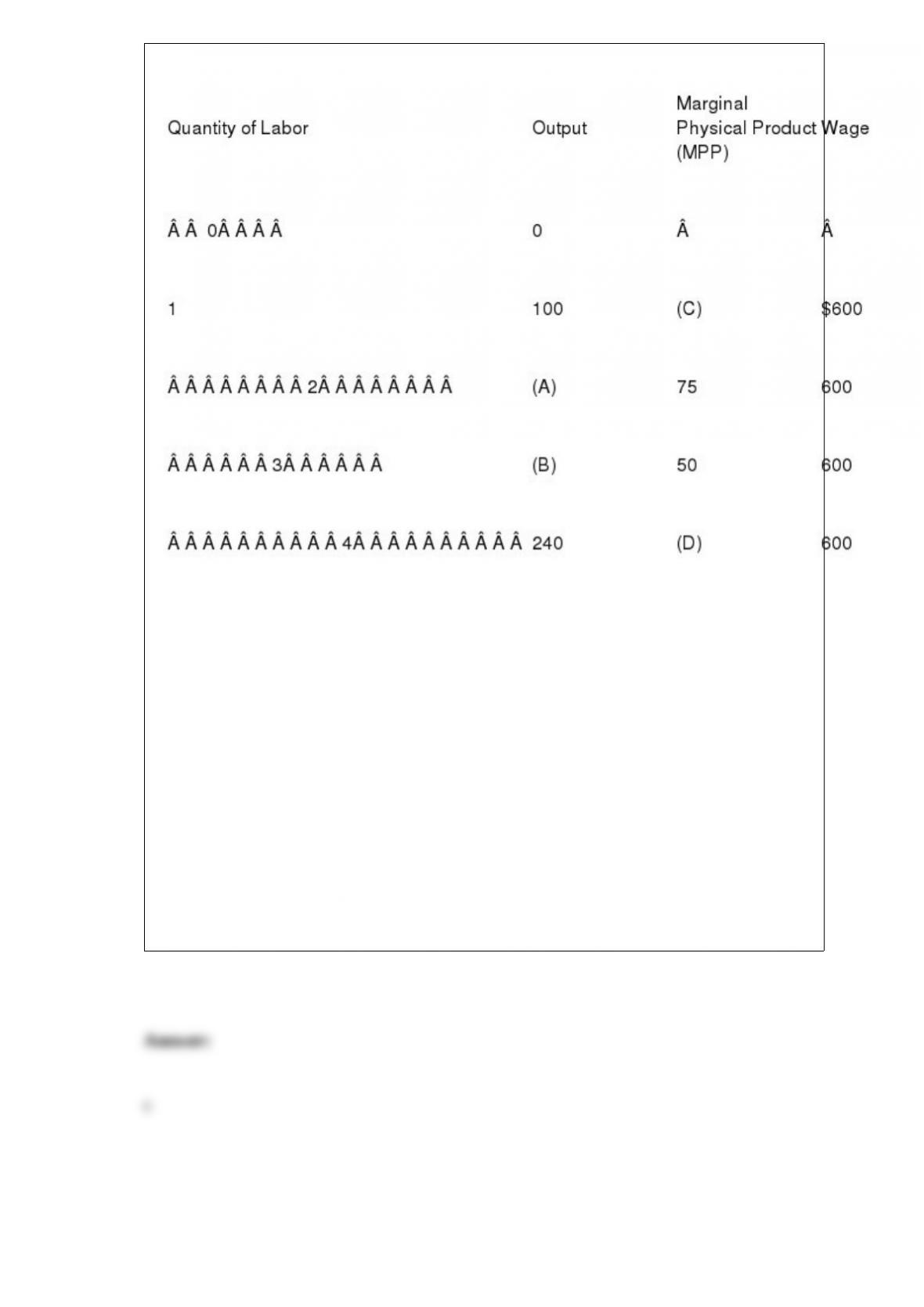
Assume that labor is the only variable input and that each additional laborer is paid
$600.
What is the marginal cost of producing this good with 3 and 4 laborers working [blanks
(G) and (H)], respectively?
a. $200; $150
b. $60; $30
c. $12; $40
d. $6; $8
e. none of the above

The least-cost rule requires that, for every factor, the ratio of the
a. marginal physical product to factor price must be equal.
b. marginal revenue product to factor price must be equal.
c. marginal revenue product to output must be equal.
d. marginal cost to factor price must be equal.
e. b and c
With a price elasticity of demand of 0.45, when the price of soybeans falls by 10
percent, the quantity demanded of soybeans rises by approximately _____________
percent.
a. 4.50
b. 45.0
c. 0.45
d. 0.56

If there is an increase in the amount of good B foregone as every additional unit of good
A is produced, the PPF between goods A and B would
a. be a straight line.
b. be a bowed-outward curve.
c. be a bowed-inward curve.
d. not exist.
“To understand the decisions of regulatory bodies, you must first understand how the
decisions affect the regulators themselves.” The person who made this statement
probably believes in the __________ theory of regulation.
a. capture
b. public interest
c. social interest
d. public choice
e. none of the above

A price floor is a government-mandated
a. minimum price below which legal trades cannot be made.
b. maximum price above which legal trades cannot be made.
c. minimum price at which all units of the good must be legally sold.
d. minimum price below which legal trades can be made.
The __________ the opportunity cost of doing something, the __________ likely a
person will do that something.
a. lower; less
b. lower; more
c. higher; more
d. higher; less
e. b and d
An IOU that promises to pay a certain amount at maturity, and also to pay periodic
fixed amounts until that date, is called a(n)
a. stock.
b. equity.

c. bond.
d. futures contract.
In all cases, normative economics deals with
a. what is.
b. what should be.
c. relatively small units in the economy.
d. the entire economy.
Describe the law of diminishing marginal returns. How does it relate to the shape of the
marginal cost (MC) curve?
What is the typical shape of the AFC curve?Explain why it is shaped this way.
Describe the condition under which a profit-maximizing monopolist will be resource
allocative efficient.
Describe the three theories of where profit comes from.
Explain the difference between the law of diminishing marginal returns and
diseconomies of scale.
What is a cartel?Describe some of the problems inherent in forming and maintaining a
cartel.
Why do many prospective voters choose to watch sports on television rather than
watching the news or political roundtables?In your answer, be sure to mention the role
played by rational ignorance.
Compare and contrast the following market structures: monopolistic competition and
monopoly.
Explain how nonrecourse loans operate and how they help to support crop prices.
Explain the difference between a change in supply and a change in quantity supplied.
Be sure to state what causes each to change and how they differ when graphed.