If a bank receives a $20 million discount loan from the Federal Reserve, then the bank’s
reserves will
A) not change.
B) increase by $20 million.
C) increase by less than $20 million.
D) increase by more than $20 million.
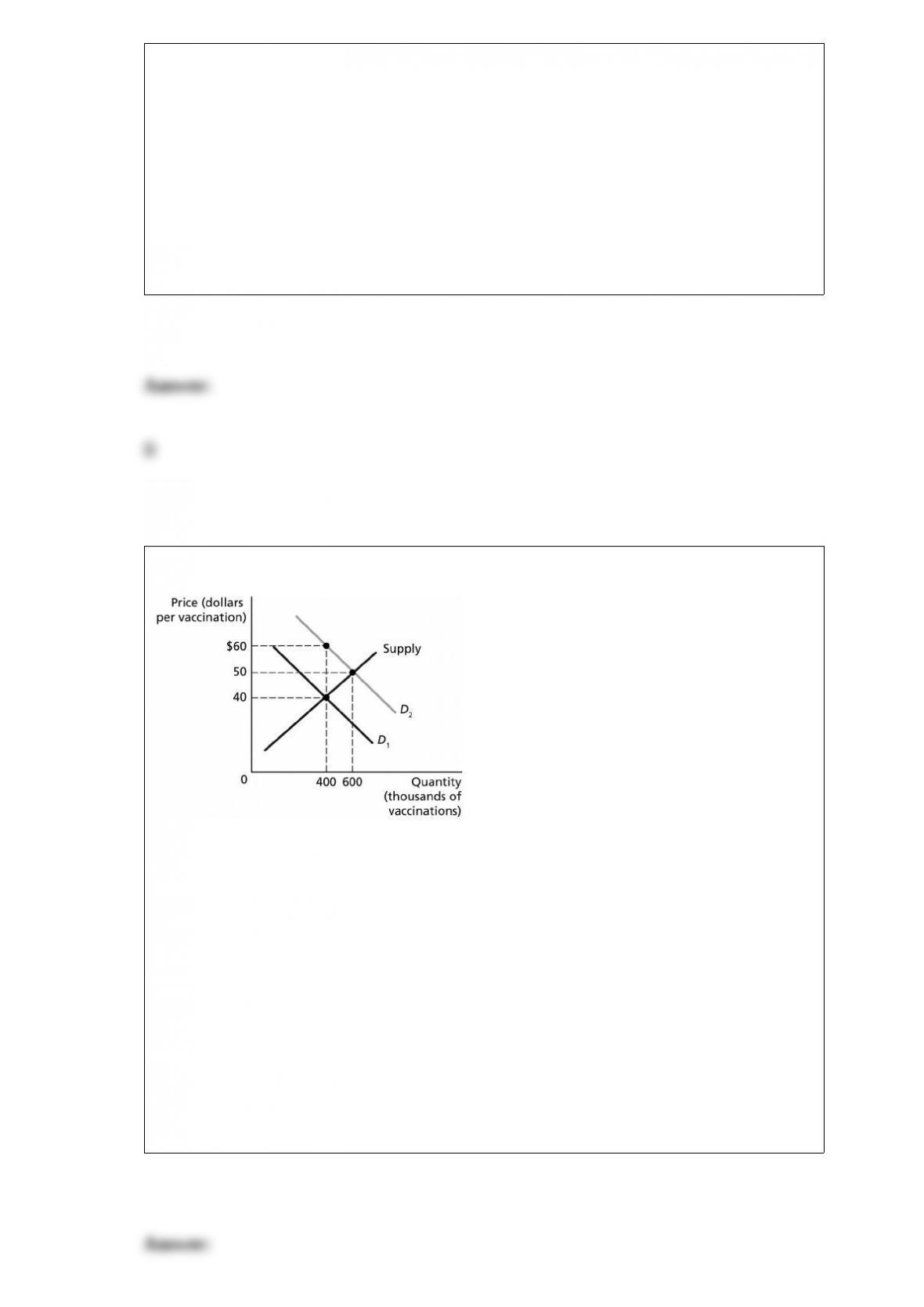
Figure 5-1
Figure 5-1 represents the market for vaccinations. Vaccinations are considered a benefit
to society, and the figure shows both the marginal private benefit and the marginal
social benefit from vaccinations.
Refer to Figure 5-1. The market equilibrium quantity is ________ thousand
vaccinations.
A) 200
B) 400
C) 600
D) >600

Contractionary monetary policy to prevent real GDP from rising above potential real
GDP would cause the inflation rate to be ________ and real GDP to be ________.
A) higher; higher
B) higher; lower
C) lower; higher
D) lower; lower
The Fed
A) always engages in countercyclical policy.
B) always intends to engage in procyclical policy.
C) can engage in procyclical policy if it mistimes its policy response.
D) never intends to engage in countercyclical policy.
Expansionary monetary policy will result in
A) lower interest rates.

B) decreased rates of inflation.
C) a decrease in aggregate demand.
D) All of the above are correct.
Which of the following would most likely induce the Federal Reserve to conduct
expansionary monetary policy? A significant decrease in
A) oil prices.
B) business taxes.
C) income tax rates.
D) investment spending.
Replacing employment-based health care with a government-run system could reduce
employers payments for their workers insurance, but the amount that they would have
to pay in overall compensation
A) would remain essentially unchanged.
B) would dramatically increase.
C) would fall to zero.
D) would dramatically decrease.

You have a bond that pays $60 per year in coupon payments. Which of the following
would result in an increase in the price of your bond?
A) Coupon payments on newly-issued bonds rise to $80 per year.
B) The likelihood that the firm issuing your bond will default on debt increases.
C) The price of a share of stock in the company falls.
D) Coupon payments on newly-issued bonds fall to $50 per year.
Under the monetary growth rule proposed by the monetarists, the money supply would
grow each year at a constant rate equal to the long-run rate of growth of
A) inflation.
B) real GDP.
C) interest rates.
D) employment.

If the average productivity of American firms is rising more quickly than the average
productivity of Indian firms, which of the following would you expect to see? (India’s
currency is the rupee.)
A) an increase in the value of the rupee relative to the dollar
B) a decrease in the prices of Indian products
C) a decrease in the quantity demanded of Indian products relative to American
products
D) an increase in the quantity demanded of Indian products relative to American
products
Lionel’s Lawn Care is a company that maintains residential yards. Lionel’s cost for his
standard package of mowing, edging, and trimming is $15, and he charges $25 for this
service. For a total price of $40, Lionel will also trim shrubs, a service that adds an
additional $10 to the total cost of the standard package. What is Lionel’s marginal cost
of adding the shrub-trimming service to the standard package?
A) $10
B) $15
C) $25
D) $40

All other factors held constant, increased growth in aggregate demand will
A) increase inflation.
B) reduce unemployment.
C) move the economy to a higher point on the short-run Phillips curve.
D) All of the above are correct.
Based on the following information, what is the balance on the financial account?
Exports of goods and services = $5 billion
Imports of goods and services = $3 billion
Net income on investments = -$2 billion
Net transfers = -$2 billion
Increase in foreign holdings of assets in the United States = $4 billion
Increase in U.S. holdings of assets in foreign countries = -$1 billion
A) $3 billion
B) $2 billion
C) $1 billion
D) -$1 billion

For how long does a patent give a firm the exclusive legal right to a product?
A) 10 years
B) 17 years
C) 20 years
D) 50 years
Total dividend payments plus retained earnings divided by outstanding stock shares
equals
A) the price-earnings ratio.
B) earnings per share.
C) the dividend yield.
D) the year-to-date percentage change.
Figure 7-2
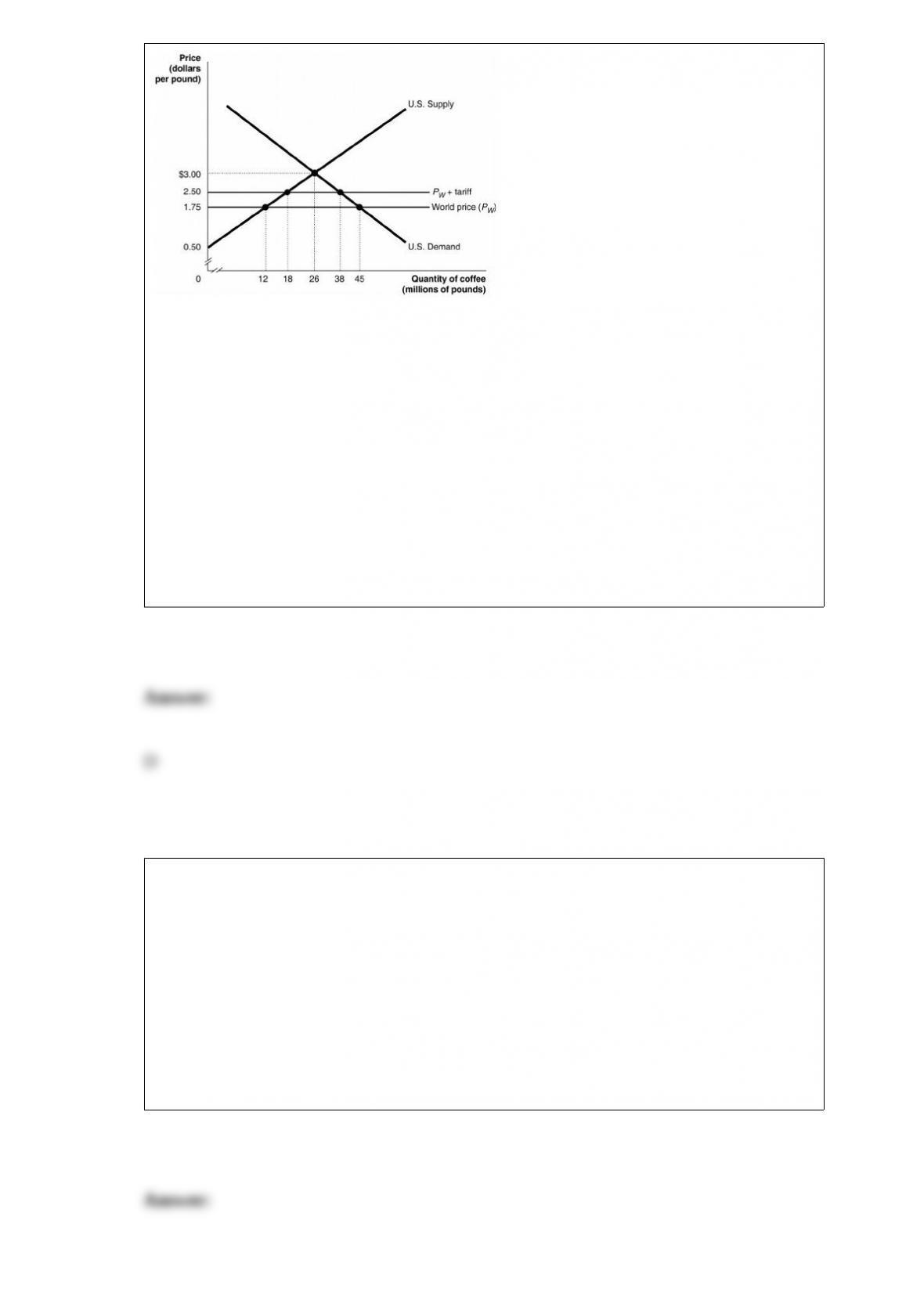
Suppose the U.S. government imposes a $0.75 per pound tariff on coffee imports.
Figure 7-2 shows the impact of this tariff.
Refer to Figure 7-2. The loss in domestic consumer surplus as a result of the tariff is
equal to
A) $5 million.
B) $19.875 million.
C) $24.875 million.
D) $31.125 million.
When the price level in the United States rises relative to the price level of other
countries, ________ will rise, ________ will fall, and ________ will fall.
A) imports; exports; net exports
B) exports; imports; net exports
C) net exports; exports; imports
D) net exports; imports; exports

If the Fed pursues expansionary monetary policy,
A) aggregate demand will rise, and the price level will rise.
B) aggregate demand will fall, and the price level will fall.
C) aggregate demand will rise, and the price level will fall.
D) aggregate demand will fall, and the price level will rise.
The maximum price that a buyer is willing to pay for a good measures his
A) consumer surplus.
B) marginal benefit.
C) willingness to pay.
D) producer surplus.
Hyperinflation is caused by
A) a constant increase in the money supply.
B) a high rate of growth in the money supply.

C) Real GDP growing more rapidly than the money supply.
D) the money supply growing more slowly than GDP.