
International firms tend to support reasonable labor and environmental laws to expand
future local markets for their businesses.
Due to adverse selection,very few lemons will be sold in the market for used cars.
Research shows that pollution-intensive U.S. companies tend to invest in nations with
lenient environmental standards.
A decrease in population shifts the production possibility frontier outwards over time.

A firm that engages in price discrimination must be able to identify the preferences of
every
customer it serves.
Shortage means the same thing as scarcity.
Average total cost is equal to average variable cost minus average fixed cost.

In a free market there are significant restrictions on how a good or service can be
produced or sold.
To successfully price discriminate, a firm must ensure that there are no opportunities for
arbitrage.
Suppose a monopoly is producing its profit-maximizing output level. Now suppose the
government imposes a lump-sum tax on the monopoly, independent of its output. As a
result the monopolist will increase the price of its product to cover its higher cost.
Results of the ultimatum game indicate that most people value fairness enough that they
will refuse to participate in a transaction they consider unfair, even if they are worse off
financially as a result.

If a country produces only two goods, then it is not possible to have an absolute
advantage in the production of both those goods.
One reason a country does not specialize completely in production is that not all goods
and services are traded internationally.
Black markets only exist in developing nations.

If a monopolistically competitive firm breaks even, the firm is earning as much in this
industry as it could in any other comparable industry.
A modern example of the tragedy of the commons is the forests in many poor countries.
If the Gini coefficient for Cartland is 1, it means that income distribution is perfectly
equal in this society.
In the short run, a firm that incurs losses might choose to produce rather than shut down
if the amount of its revenue is less than its fixed cost.

A profit-maximizing monopolistically competitive firm produces and sells an
allocatively efficient quantity of output.
For a perfectly competitive firm, at the profit-maximizing output average revenue
equals marginal cost.
A tax is efficient if it imposes a small excess burden relative to the tax revenue it raises.

Small businesses will be completely immune to events in the international business
environment.
The equilibrium in the prisoner’s dilemma is a dominant strategy Nash equilibrium.
The incidence of a tax depends on whether the government collects the tax from buyers
or sellers.
Free trade refers to trade between countries without government restrictions.

Suppose the absolute value of the price elasticity of demand for basketball game tickets
on your campus is greater than 1. Increasing ticket prices will increase the total revenue
from ticket sales.
A product’s price approaches its marginal cost as market concentration increases.
In the short-run, even if a monopoly’s total revenue does not cover its variable costs, it
should continue to produce because ultimately in the long run, the monopoly will start
earning profits.

If consumers believe the price of iPads will decrease in the future, this will cause the
demand for iPads to decrease now.
In the market for factors of production, firms earn income by selling goods and services
to households.
The absolute value of the price elasticity of demand for telescopes is 1.5. Therefore,
telescopes can be classified as a luxury.
The only type of business that faces unlimited liability is a sole proprietorship.

A monopolistically competitive industry that earns economic profits in the short run
will face a more elastic demand curve in the long run.
Direct finance includes the sale by a corporation of stocks or bonds, but does not
include borrowing money from a bank.
Rapid economic growth tends to increase the degree of income mobility.

The price elasticity of supply is calculated as the change in supply divided by the
change in price.
Which of the following would be considered an implicit cost of operating a business?
A) advertising expenses
B) wages paid to workers
C) a normal rate of return for investors
D) any explicit cost
Which of the following demonstrates the endowment effect?
A) Whelan inherits a cottage in Cape Cod from his grandfather and is unwilling to sell
it for sentimental reasons.
B) Robert Pattinson commands a premium in the movie industry because he is endowed
with dashing looks.
C) Isabella was not willing to part with her “Robert Pattinson” poster although she was
offered $100 for it, a sum greater than what it costs to purchase another such poster.
D) If you received a good as a gift, you are less likely to attach a monetary value to the
good.

Most companies today operate in an environment of increased transparency and
scrutiny regarding their business activities. This is due to ________.
A) the rise of the social media
B) the prosperity of developing nations
C) the heterogeneity in markets
D) labor market flexibility in developing nations
Dividing the current market price of a stock by the firm’s earnings per share gives the
firm’s
A) price-earnings ratio.
B) year-to-date percentage change.
C) dividend yield.
D) stock coupon maturity yield.

Which of the following does not explain why consumers buy products that many other
consumers are already buying?
A) technology
B) the satisfaction people derive by being viewed as “fashionable”
C) cost-effective way to gather information about a product
D) differences in tastes and preferences
The long-run supply curve for a perfectly competitive, constant-cost industry
A) is upward-sloping.
B) is horizontal.
C) is downward-sloping.
D) is found by adding up the marginal cost curves for all firms in the industry.
The following equations represent the demand and supply for silver pendants.

QD = 50 – 2P
QS = -10 + 2P
What is the equilibrium price (P) and quantity (Q – in thousands) of pendants?
A) P = $15; Q = 20 thousand
B) P = $50; Q = 10 thousand
C) P = $20; Q = 15 thousand
D) P = $10; Q = 30 thousand
A curve that shows combinations of consumption bundles that give a consumer the
same utility is called
A) a utility curve.
B) an indifference curve.
C) a preference curve.
D) a demand curve.
According to an article the Wall Street Journal, “The big car makers are pushing a wide

array of new technology into production, responding to relentless competitive pressure,
rising energy prices and consumer demand for better safety.
Source: Joseph B. White, “Ford, GM Eye Shift in Buying Habits,” Wall Street Journal,
May 22, 2006.
Which of Porter’s competitive forces does this statement allude to?
A) the threat of competition from new entrants
B) competition from foreign auto manufacturers
C) competition from existing firms within the industry
D) competition from substitute products from outside the industry
Average total cost is equal to
A) average fixed cost minus average variable cost.
B) total cost divided by the level of output.
C) marginal cost plus variable cost.
D) total cost divided by the number of workers.
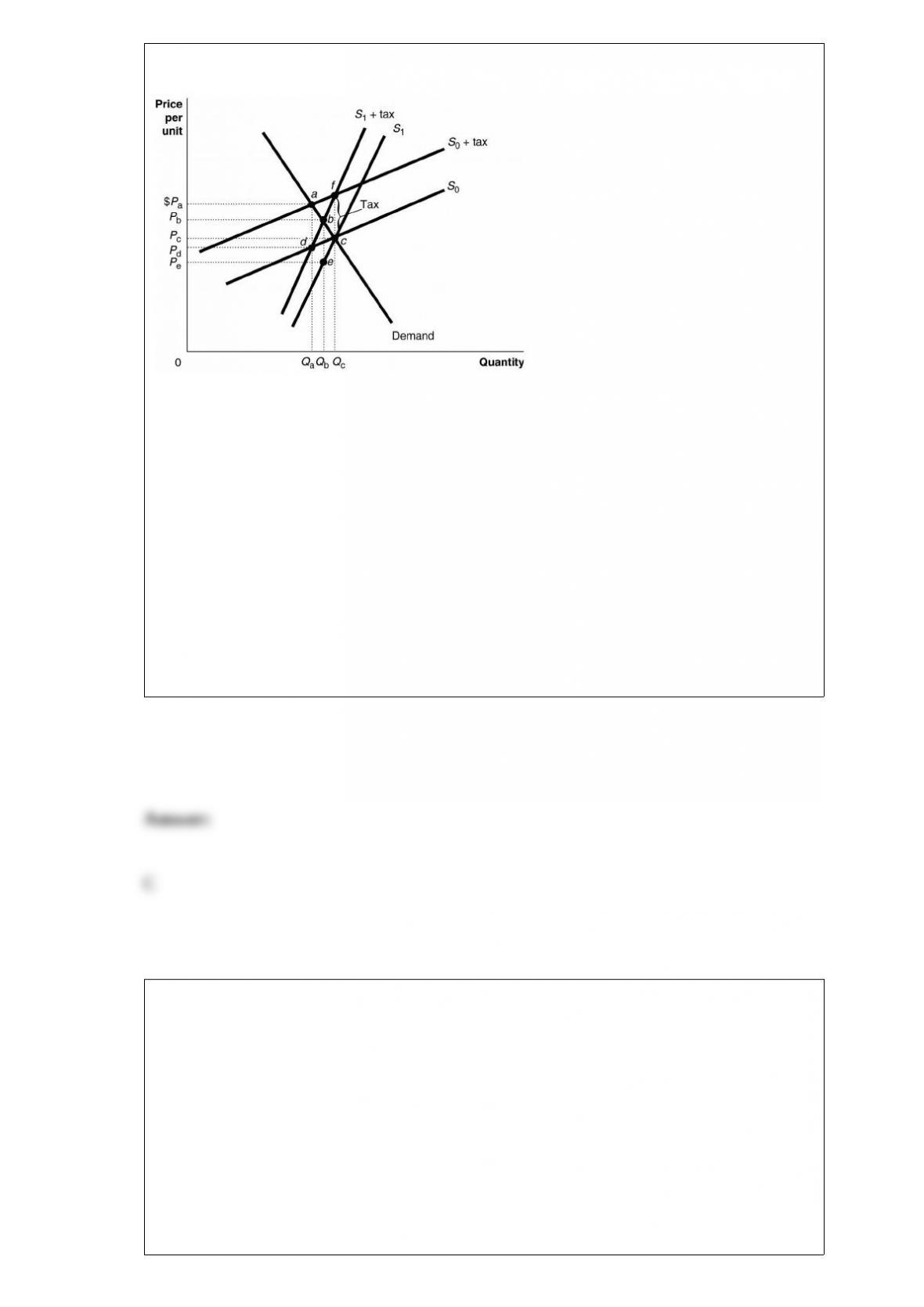
Figure 18-2
Figure 18-2 shows a demand curve and two sets of supply curves, one set more elastic
than the other.
Refer to Figure 18-2. If the government imposes an excise tax of $1.00 on every unit
sold,
A) the deadweight loss is identical under either supply curve.
B) the deadweight loss is greater under the supply curve S1.
C) the deadweight loss is greater under the supply curve S0.
D) there is no deadweight loss since revenue raised is used to fund government projects.
The Athenian Theatre sells play tickets for the same play at different prices: a lower
price to those who opt for the seats at the back of the theatre and a higher price for those
who purchase seats in the front, around the stage. Which of the following statements is
true?
A) This is an example of product differentiation but not price discrimination.
B) The theatre practices first-degree price discrimination by setting prices based on
willingness to pay.
C) Since the cost of producing the play does not change with the seating configuration,

this is evidence of price discrimination based on market segmentation.
D) Charging two different prices is an effective way to avoid an excess demand for play
tickets; the higher price lowers quantity demanded to some extent.
Suppose electronic cigarette manufacturer NJOY is successful in establishing a
profitable market for e-cigarettes in what is a monopolistically competitive industry. In
the long run, NJOY will most likely find it ________ to remain profitable as they face
________ competition in the e-cigarette market.
A) harder; more
B) harder; less
C) easier; more
D) easier; less
What does the marginal rate of substitution measure?
A) It measures the rate at which a consumer must give up one good to purchase another
good.
B) It measures the rate at which a consumer will substitute one good for another when
the price of one good changes.
C) It measures the change in utility from consuming one additional unit of a good.

D) It measures the rate at which a consumer is willing to trade off one product for
another while keeping utility constant.
Mel’s House of Cars is an automobile dealership that sells both new and used cars. Two
other dealerships located nearer Mel’s pay their salespeople a straight salary – they
receive no commission for each car they sell. Mel has decided to pay all of his
salespeople a commission on all car sales. Which of the following is most likely to
occur as a result of Mel’s decision?
A) Mel will have difficulty finding salespeople. Research by labor economists has
found that most employees prefer the security of a salary to the uncertainty of being
paid based on how much revenue they generate for their employers.
B) Mel will experience a principal-agent problem. Some of his salespeople will tend to
shirk because they will not be paid if they sell no cars, regardless of how hard they
work.
C) Mel will be able to hire some of the most productive salespeople who work for the
other two dealerships.
D) Mel risks violation of federal law that regulates firms’ compensation policies.
Consider a used car market in which half the cars are good and half are bad (lemons). A
rational buyer in this market should
A) offer to pay a price equal to the most she would pay for a good car.

B) offer to pay a price equal to the most she would pay for a lemon.
C) offer to pay a price somewhere between the price she would pay for a good car and
the price she would pay for a lemon.
D) save up and buy a new car.
For a perfectly competitive firm, which of the following is not true at profit
maximization?
A) Market price is greater than marginal cost.
B) Marginal revenue equals marginal cost.
C) Total revenue minus total cost is maximized.
D) Price equals marginal cost.
Assume a hypothetical case where an industry begins as perfectly competitive and then
becomes a monopoly. Which of the following statements comparing the conditions in
the industry under both market structures is true?
A) A monopoly will produce more and charge a higher price than would a perfectly
competitive industry producing the same good.
B) A monopoly will produce more and advertise more than would a perfectly

competitive industry producing the same good.
C) A monopoly will produce less and charge a higher price than would a perfectly
competitive industry producing the same good.
D) A monopoly will produce less and charge a lower price than would a perfectly
competitive industry producing the same good.
Arnold Kim began blogging about Apple products during his fourth year of medical
school. Kim’s website, MacRumors.com, became so successful that he decided to give
up his medical career and work full time on his website, despite the nearly $200,000 he
had invested in his education. In making his decision, the $200,000 he spent on his
education
A) should be ignored since it represents a sunk cost.
B) should be considered since it is money he has spent and needs to recoup.
C) should be ignored only if Kim can earn more than $200,000 by running his website.
D) should be considered since it is money he could have used to invest in his website.
The value of all goods and services produced by a country’s domestic and international
activities over a one-year period is the country’s ________.
A) gross domestic product (GDP)
B) gross world product (GWP)
C) gross national product (GNP)
D) gross state product (GSP)
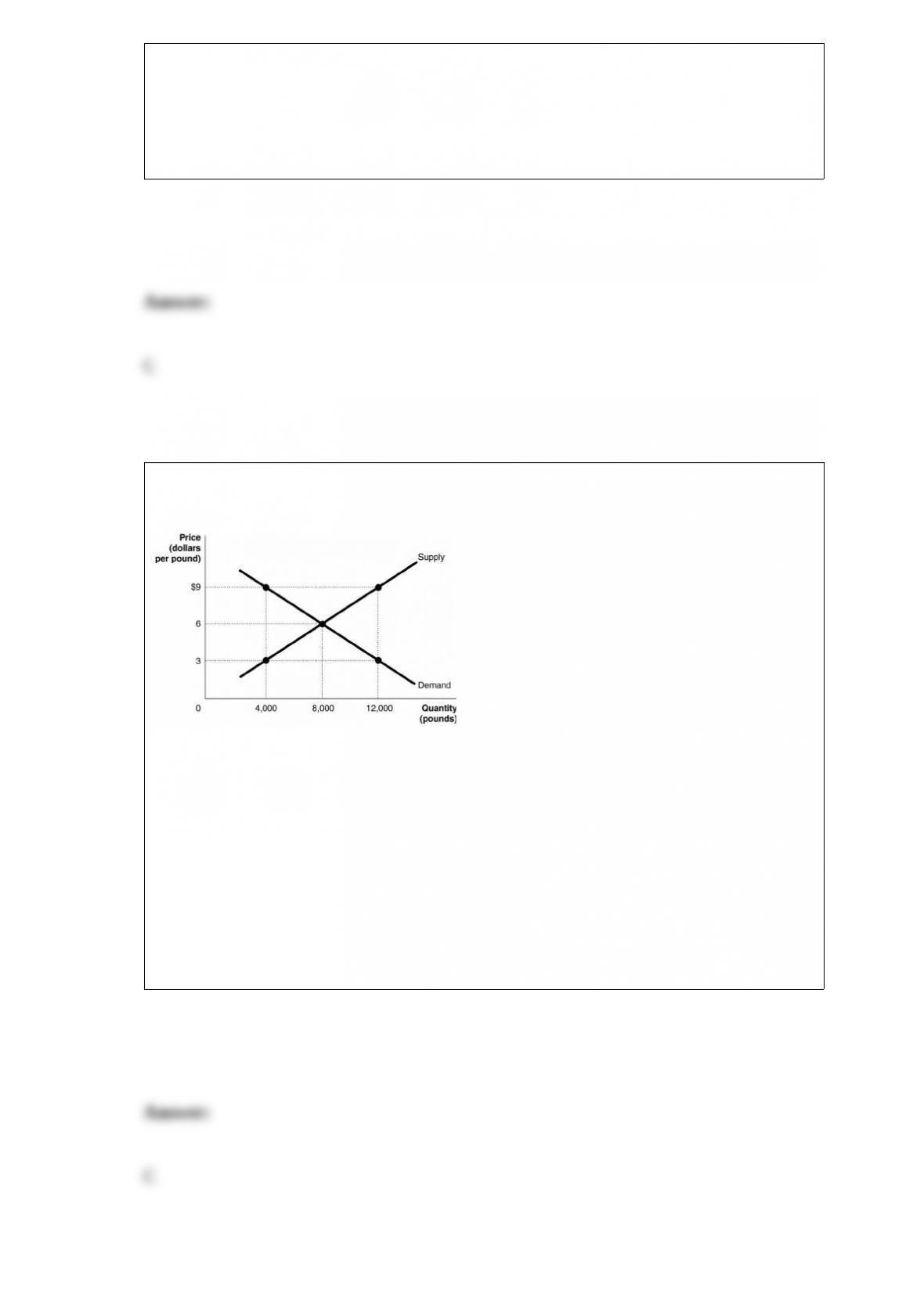
Figure 4-4
Refer to Figure 4-4. The figure above represents the market for pecans. Assume that
this is a competitive market. If the price of pecans is $9
A) economic surplus is maximized.
B) too many consumers want to buy pecans.
C) the quantity supplied is greater than the economically efficient quantity.
D) the quantity demanded is economically efficient but the quantity supplied is
economically inefficient.

The efficient output level of a public good occurs where the
A) greatest number of free riders occurs.
B) marginal cost of producing the last unit is equal to the marginal benefit realized by
consumers.
C) total cost of production is affordable.
D) marginal cost of production is at its lowest.
In February, market analysts predict that the price of titanium will rise in March. What
happens in the titanium market in February, holding everything else constant?
A) The supply curve shifts to the right.
B) The supply curve shifts to the left.
C) The quantity demanded and the quantity supplied of titanium increase.
D) The demand curve shifts to the left.
A demand curve shows
A) the willingness of consumers to buy a product at different prices.
B) the willingness of consumers to substitute one product for another product.
C) the relationship between the price of a product and the demand for the product.
D) the relationship between the price of a product and the total benefit consumers
receive from the product.
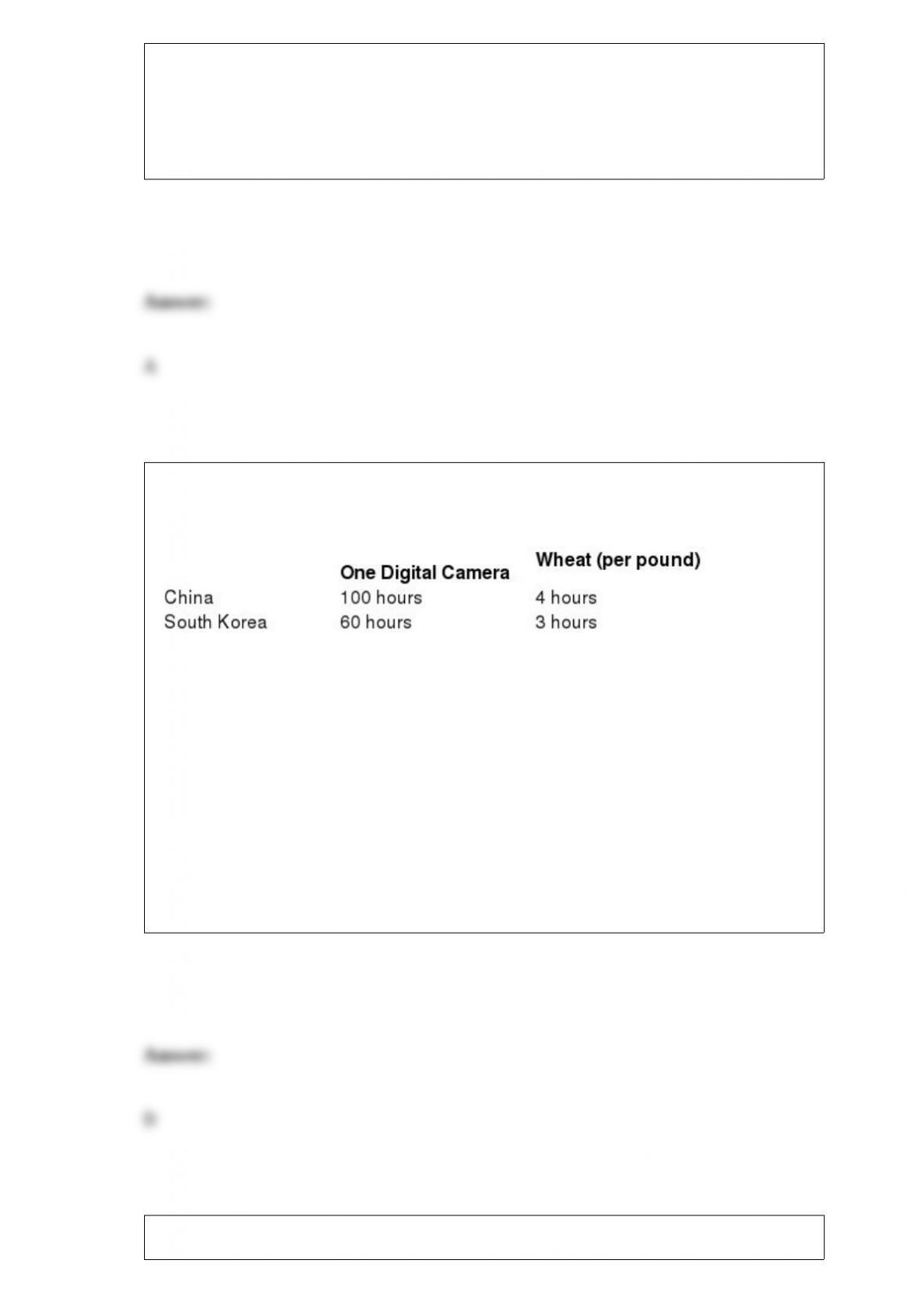
Table 2-8
Table 2-8 shows the number of labor hours required to produce a digital camera and a
pound of wheat in China and South Korea.
Refer to Table 2-8. South Korea has a comparative advantage in the production of
A) wheat.
B) digital cameras.
C) both products.
D) neither product.
Monopolistically competitive firms have downward-sloping demand curves. In the long
run, monopolistically competitive firms earn zero economic profits. These two
characteristics imply that in the long run
A) monopolistically competitive markets achieve productive efficiency.
B) monopolistically competitive markets achieve allocative efficiency.
C) monopolistically competitive firms earn economic profits.
D) monopolistically competitive firms have excess capacity.
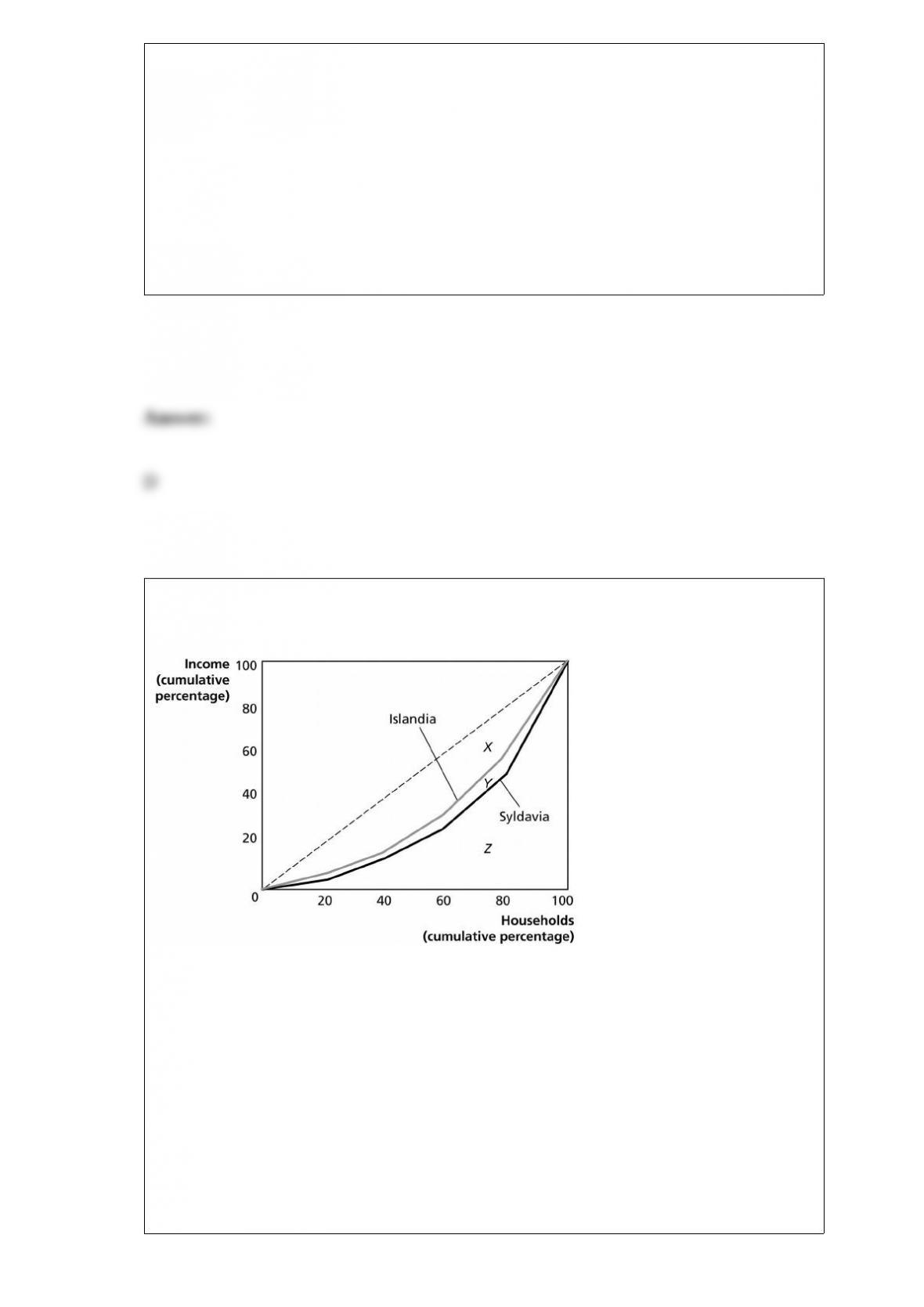
Figure 18-6
Figure 18-6 shows the Lorenz curves for Islandia and Syldavia.
Refer to Figure 18-6. If area X = 2,060, area Y = 240, and area Z= 2,700, calculate the
Gini coefficient for Syldavia.
A) 0.05
B) 0.12
C) 0.46
D) 0.85
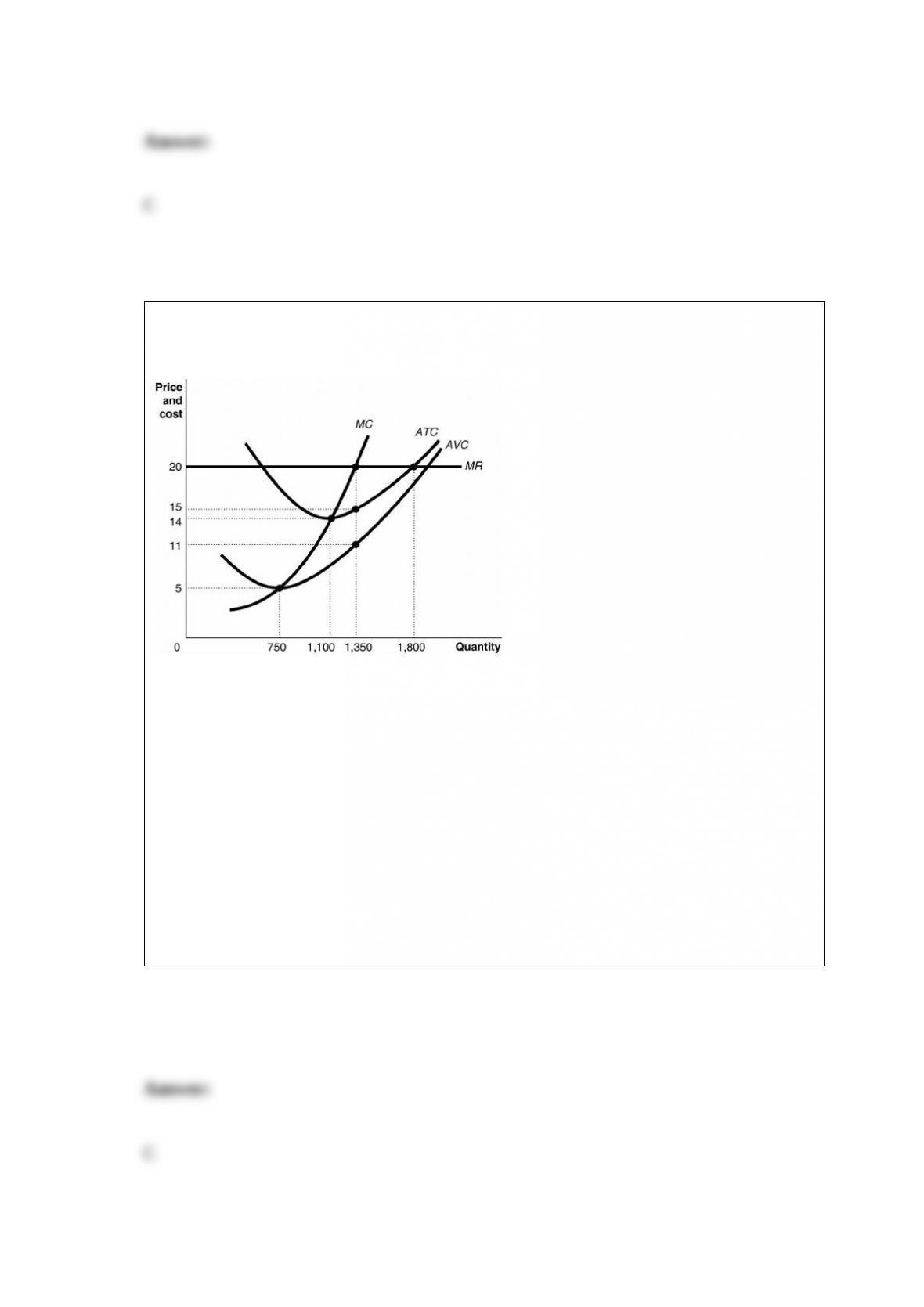
Figure 12-5
Figure 12-5 shows cost and demand curves facing a typical firm in a constant-cost,
perfectly competitive industry.
Refer to Figure 12-5. If the market price is $20, what is the firm’s profit-maximizing
output?
A) 750 units
B) 1,100 units
C) 1,350 units
D) 1,800 units

Economists estimated that the price elasticity of beer is -0.30 and the income elasticity
of beer is 0.09. This means that
A) an increase in the price of beer will increase the quantity demanded of beer and beer
is a normal good.
B) an increase in the price of beer will lead to an increase in revenue for beer sellers
and beer is a normal good.
C) a decrease in the price of beer will lead to an increase in revenue for beer sellers and
beer is an inferior good.
D) an increase in the price of beer will lead to a decrease in the quantity demanded of
beer and beer is a necessity.
Ethan Nicholas, who developed the iShoot application for the iPhone 3G, found that to
maintain sales in a profitable competitive market, the price of a product
A) will usually rise.
B) will usually fall.
C) will usually remain stable.
D) will eventually fall to zero.
The difference between the ________ and the ________ from the sale of a product is

called producer surplus.
A) lowest price a firm would have been willing to accept; price it actually receives
B) highest price a firm wold have been willing to accept; lowest price it was willing to
accept
C) cost to produce a product; price a firm actually receives
D) cost to produce a product; profit received
The machines workers have to work with are considered
A) human capital.
B) physical capital.
C) entrepreneurship.
D) financial capital.
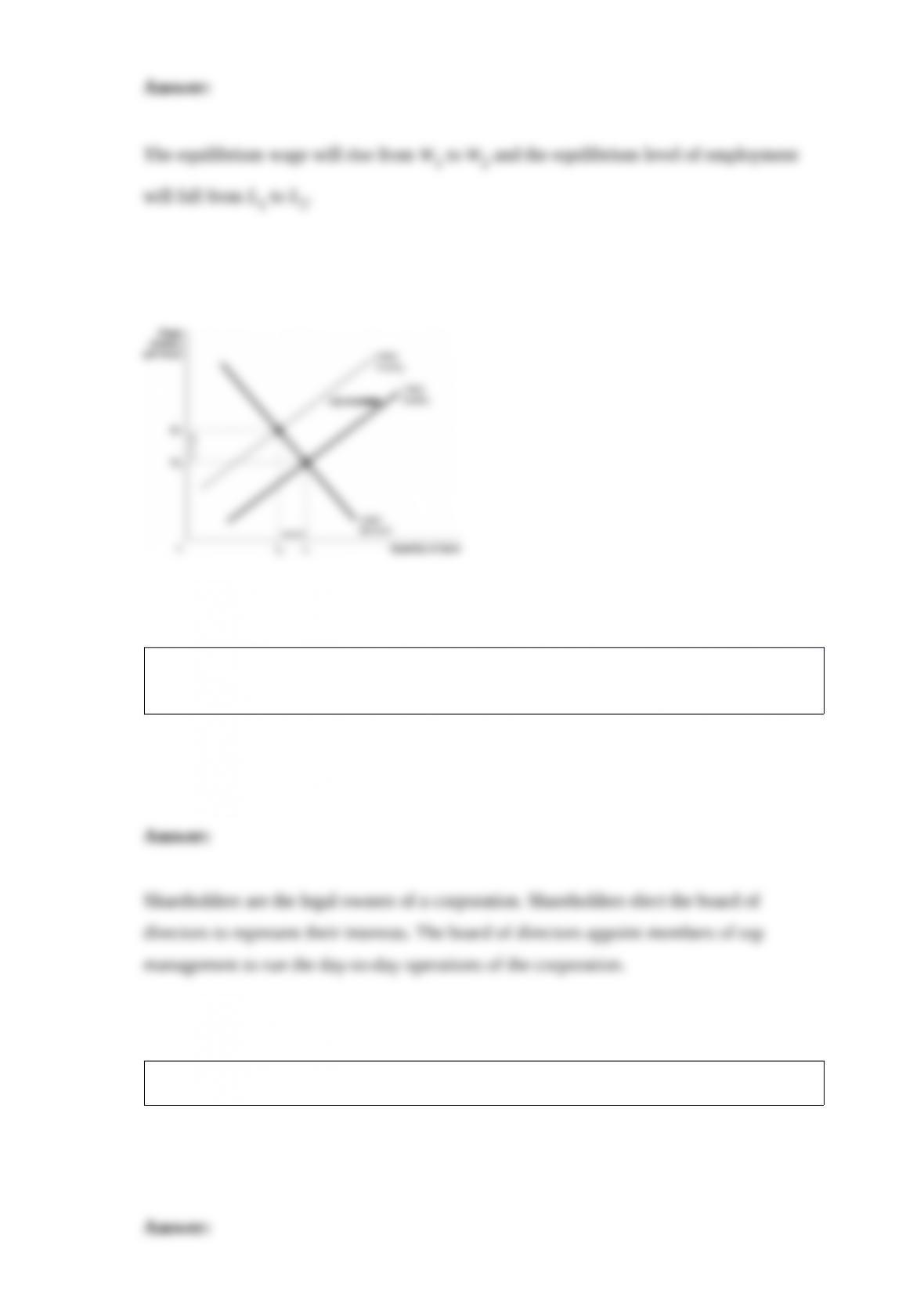
If the labor supply curve shifts to the left and the labor demand curve remains
unchanged, what will happen to the equilibrium wage and the equilibrium level of
employment? Illustrate your answer with a graph.
Explain the relationships between a corporation’s shareholders, its board of directors,
and its top managers.
Who is the seller in a primary market and who is the seller in a secondary market?
Explain why OPEC is caught in a prisoner’s dilemma?
What is a circular flow diagram and what does it demonstrate?
What are the five variables that will shift the demand curve?
Firms engage in odd pricing when they charge prices that appear to be less than they
really are; for example, charging a price of $4.95 instead of $5.00 and $.99 instead of
$1.00. How have researchers tried to determine whether odd pricing is successful in
convincing consumers that odd prices are less than they really are?
The Equal Pay Act of 1963 requires that men and women be given equal pay for equal
work in the same establishment. Most people agree that gender discrimination in the
workplace is unfair, but many economists have criticized advocates of comparable
worth. Is paying the same wages for jobs that have comparable worth mandated by the
Equal Pay Act? Why don’t most economists support proposals to force employers to pay
their male and female employees based on comparable worth rules?
What is a centrally planned economy?
How does a public good differ from a quasi-public good? In your answer give an
example of each type of good.
What is the difference between an invention and an innovation?
What gives rise to a natural monopoly? How do consumers benefit from a natural
monopoly?
What is odd pricing? Why do some merchants use odd pricing?
If you pay $14,000 in taxes on an income of $125,000, and $17,400 in taxes on an
income of $144,000, what is your marginal tax rate? Show your work.
Former Alabama Governor George Wallace ran for president several times, once as a
third-party candidate in 1968. Wallace claimed there was “not a dime’s worth of
difference” between the Democratic and Republican parties during one of his
campaigns. How does Wallace’s comment relate to the median voter theorem?
Suppose a doctor can earn an additional $25,000 in revenue per year by keeping her
office open on Sundays. At what additional cost would keeping the office open on
Sundays not be considered economically rational?