A monopolistically competitive firm should lower its price if its marginal revenue
exceeds its marginal cost.
If the demand for a product decreases and the supply of the product does not change,
equilibrium price and equilibrium quantity will both increase.
By 2013, spending on federal health care programs such as Medicare and Medicaid had
grown to 6 percent of GDP.
A positive technological change will cause the quantity supplied of a good to increase.
One of the monetary policy goals of the Federal Reserve is price stability.
Goodyear’s sales are now greater outside the United States than inside the United
States.
When Jack’s income increases by $1,000, he spends an additional $850 dollars. This
implies that his marginal propensity to save is 0.85.
Macroeconomic equilibrium can occur at any point on the 45-degree line.

The slope of an isocost line determines the marginal rate of substitution.
The labor force participation rates of men have gradually increased since 1948.
Suppose at a price of $50, Yoshi’s Jazz Bar sells 20 tickets to its nightly jazz
performance and
at a price of $40, it sells 25 tickets. Based on this information, the demand for Yoshi’s
jazz performance is elastic.
The income effect explains why there is an inverse relationship between the price of a
product and the quantity of the product demanded.

Contractionary monetary policy refers to the Fed’s decreasing the money supply and
decreasing interest rates to decrease real GDP.
Dumping refers to countries exporting unwanted and inferior products to other
countries.
The Difference between consumer surplus and producer surplus in a market is equal to
the deadweight loss.
According to a study of the U.S. demand for alcoholic beverages, the price elasticity of
demand for beer is -0.30. Which of the following could explain why the price elasticity
of demand for beer is low?
A) Beer is an inferior alcoholic beverage.
B) More and more people are switching to wine and cocktails rather than beer.

C) The price of beer is relatively low and for many people it is a habit forming product.
D) There are only a few major suppliers of beer.
Frictional unemployment is the result of
A) a persistent mismatch between the skills and characteristics of workers and the
requirements of the jobs.
B) the search process of matching workers with jobs.
C) the ups and downs in inflation.
D) a slowdown in the economy.
In a production possibilities frontier model, a point ________ the frontier is
productively inefficient.
A) along
B) inside
C) outside
D) at either intercept of

Which of the following statements about perfect price discrimination is false?
A) There is no consumer surplus if a firm engages in perfect price discrimination.
B) Perfect price discrimination occurs when the seller charges the highest price each
consumer would be willing to pay for the product.
C) A condition for perfect price discrimination is that it must be costlier to service some
customers than others.
D) For the price-discriminating firm, its marginal revenue curve coincides with its
demand curve.
Suppose a decrease in the supply of wheat results in an increase in revenue. This
indicates that
A) the decrease in quantity sold is proportionately larger than the resulting change in
price.
B) the resulting increase in price is proportionately greater than decrease in quantity
sold.
C) the demand curve for wheat must be vertical.
D) the supply curve for wheat must be vertical.
The “Discount Department Stores” industry is highly concentrated. What does this
mean?
A) There are many large stores, such as Wal-Mart, Target, and Kohl’s, in this industry.
B) A few large stores account for a significant portion of industry sales.
C) There is cut-throat competition in this industry because there are no entry barriers.
D) The sales volume in this industry is consistently high.
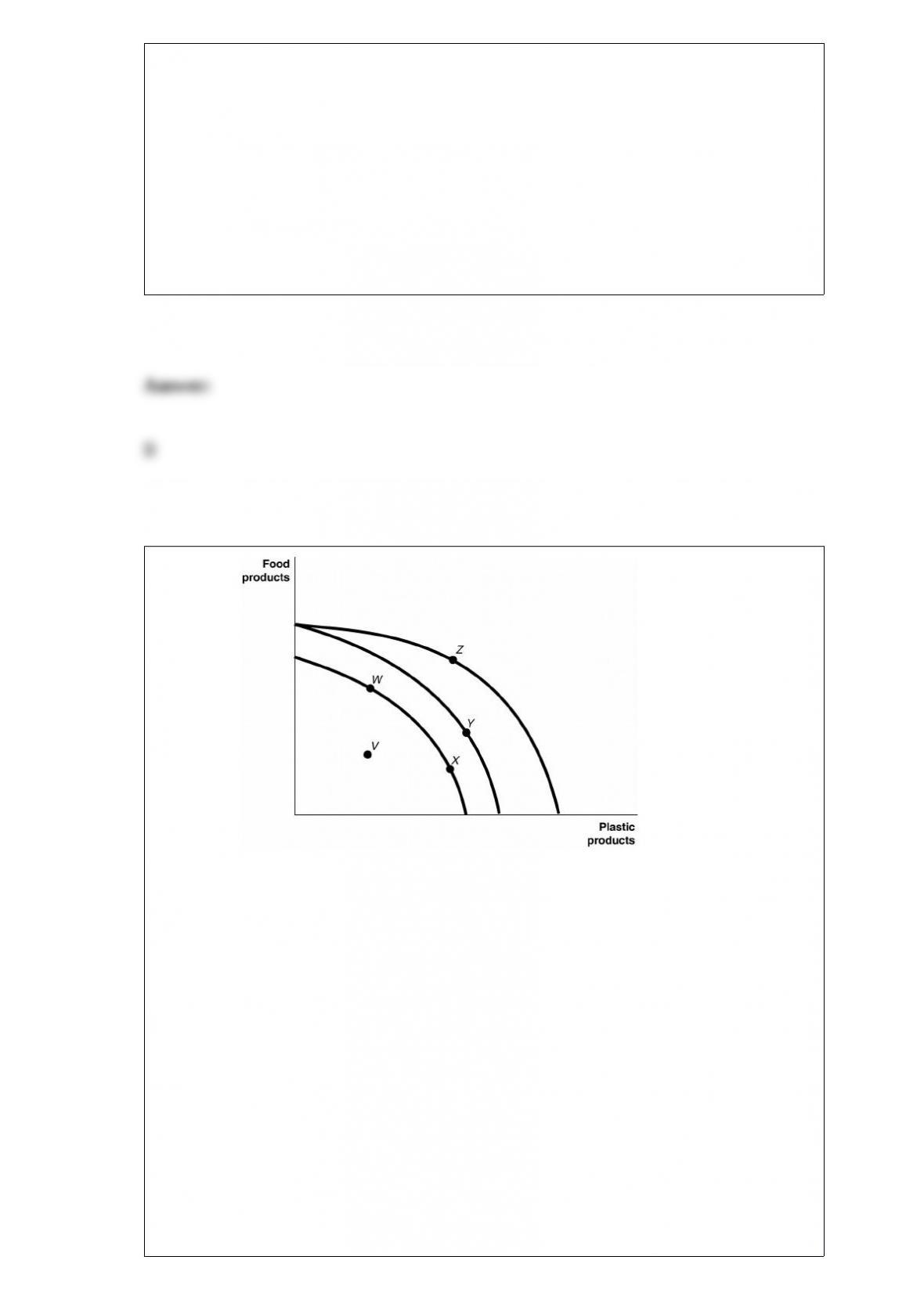
Figure 2-4
Figure 2-4 shows various points on three Different production possibilities frontiers for
a nation.
Consider the following events:
a. an increase in the unemployment rate
b. general technological advancement
c. a decrease in consumer wealth Which of the events listed above could cause a
movement from X to V?
A) a only
B) a and b only

C) b and c only
D) a, b, and c
Under current tax law individuals do not pay taxes on health insurance benefits they
receive from their employers. As a result
A) the federal government spends more than it receives in tax revenue.
B) individuals are encouraged to want generous health coverage that reduces their
incentives to cut costs.
C) the quality of health care provided is less than it would be if benefits were taxed.
D) politicians are encouraged to raise income and payroll taxes.
When the coupon rate on newly issued bonds increases relative to older, outstanding
bonds, what happens?
A) The market price of the older bond falls in the secondary market.
B) The market price of the older bond rises in the secondary market.
C) Older bonds can still be sold at their face value.
D) Older bonds will sell for less than their face value.
Which of the following would cause a decrease in the supply of peanut butter?
A) a decrease in the price of jelly (assuming that peanut butter and jelly are
complements)
B) a decrease in the price of peanut butter
C) an increase the price of peanuts
D) an increase in the technology used to produce peanut butter
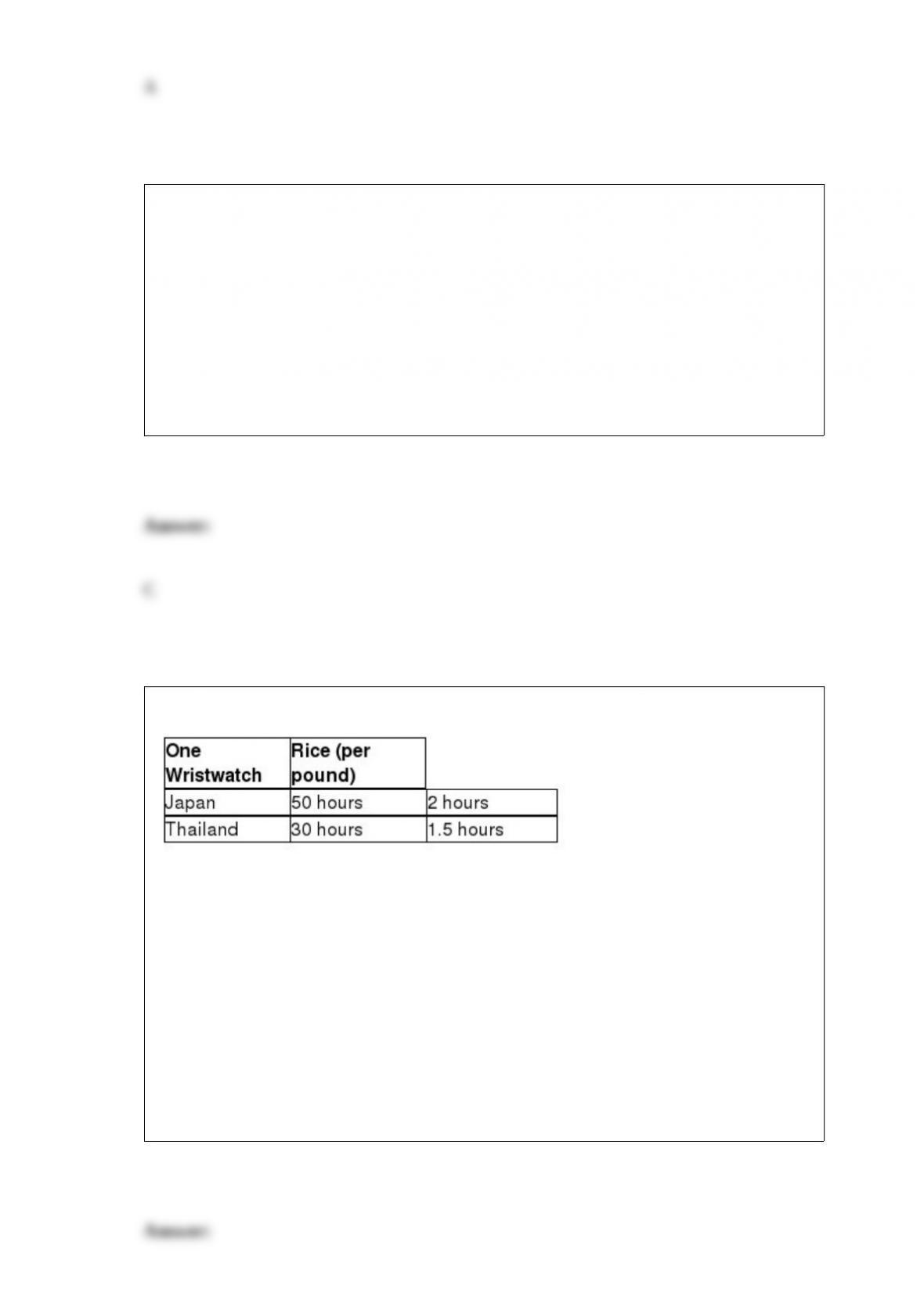
Table 2-20
Table 2-20 shows the number of labor hours required to produce a wristwatch and a
pound of rice in Japan and Thailand.
What is Thailand’s opportunity cost of producing one wristwatch?
A) 0.05 pounds of rice
B) 20 pounds of rice
C) 25 pounds of rice
D) 60 pounds of rice

The currencies of Poland and Iceland (the zloty and the krona, respectively) declined in
value relative to the euro following the financial crisis of 2008. This means that the
A) zloty and krona appreciated in value against the euro.
B) euro depreciated in value against the zloty and the krona.
C) zloty and krona depreciated in value against the euro.
D) zloty depreciated in value against the krona.
E) Both A and B are correct.
Governments sometimes erect barriers to trade other than tariffs and quotas. Which of
the following is not an example of this type of trade barrier?
A) a requirement that the employees of domestic firms that engage in foreign trade pay
income taxes
B) a requirement that imports meet health and safety requirements
C) restrictions on imports for national security reasons
D) a requirement that the U.S. government buy military uniforms only from U.S.
manufacturers

The balance of trade includes trade in
A) goods only.
B) services only.
C) both goods and services.
D) neither goods nor services.
If, in response to an increase in the price of pineapples, the quantity demanded of
pineapples decreases, economists would describe this as
A) a decrease in demand.
B) a decrease in quantity demanded.
C) a change in consumer income.
D) a decrease in consumers’ taste for coffee.
If the Federal Reserve targets the interest rate and the money demand curve shifts to the
left, then the Fed
A) cannot maintain the interest rate target.
B) can maintain the interest rate target, but at a lower quantity of the money supply.
C) can maintain the interest rate target, but at a higher quantity of the money supply.
D) can maintain the interest rate target with no change in the money supply.
Explain the Law of Demand.
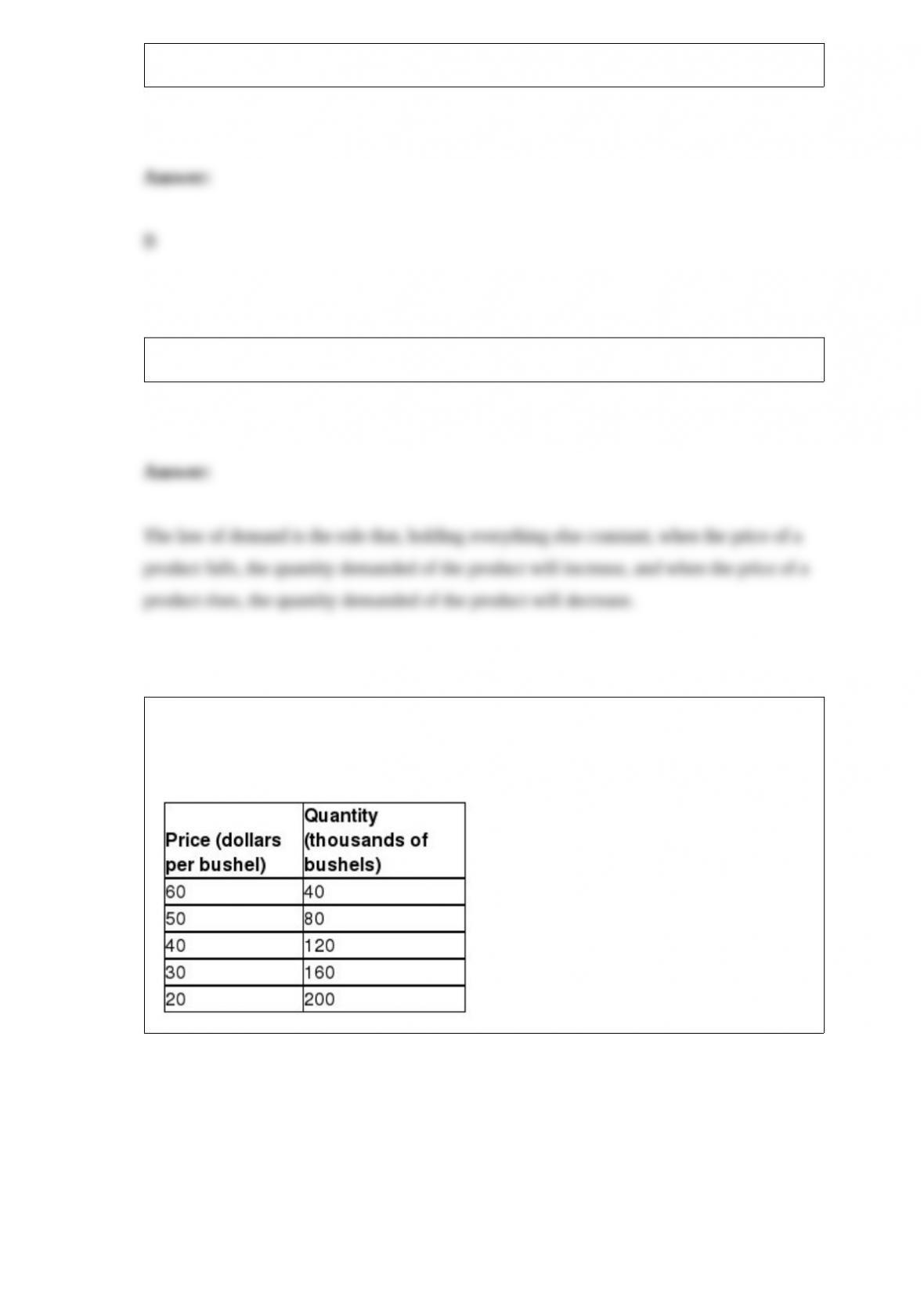
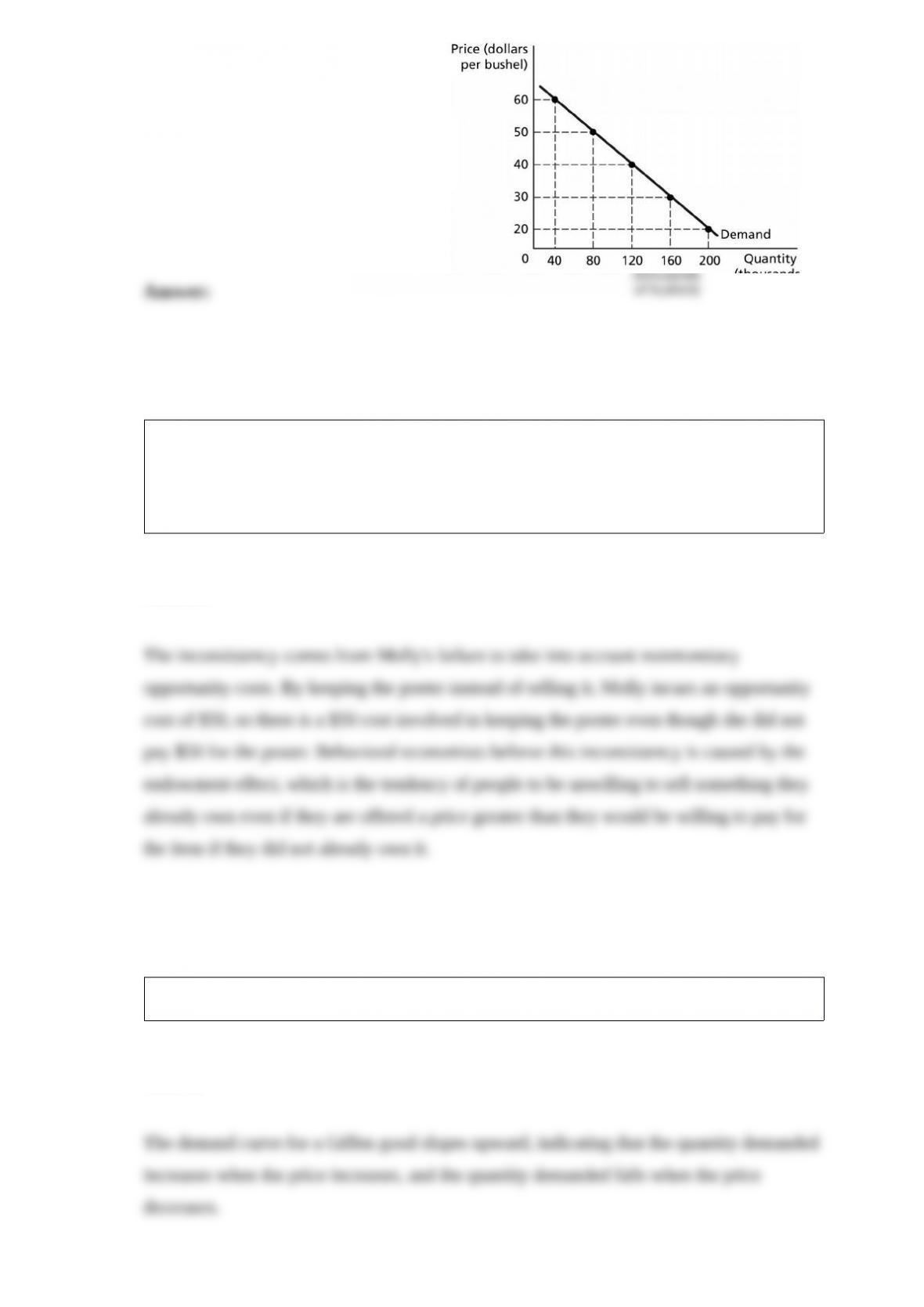
Use the following demand schedule for cherries to draw a graph of the demand curve.
Be sure to label the demand curve and each axis, and show each point on the demand
curve.
Molly received an autographed poster of David Hasselhoff for her 21st birthday. Her
friend Helga offered her $50 for the poster, but Molly refused to sell the poster even
though she knows she would never pay that much to replace it if it was ever damaged or
destroyed. Explain this inconsistency in Molly’s behavior.
Describe the demand curve for a Giffen good.
Is it possible for technological change to be negative? If so, give an example.
Why might a country raise interest rates in the face of an exchange rate crisis?