1) Assuming that interest rates are positive, the present value of an $80 barrel of oil in 2
years is less than an $80 barrel today.
2) The principle that private negotiation can resolve potential externalities without
resort to government intervention is known as the Coase theorem.
3) Other things equal, the shorter the loan period and the larger the loan size, the higher
is the interest rate charged by the lender.
4) There is no tradeoff between unemployment and inflation in the long run.
5) A contractionary fiscal policy shifts the aggregate demand curve leftward.
6) Federal deposit insurance discourages but does not prevent bank runs.
7) the european union (eu) is a free trade zone comprising all the nations of eastern and
western europe.
8) The monopsonist in a nonunionized labor market pays a wage rate below the MRP of
labor.
9) “tax freedom day” in the united occurs in mid-july.
10) The idea of coordination failures suggests the possibility of less-than-desirable
price-level and real-output equilibriums in the economy.
11) successful price discrimination requires that buyers charged the different prices be
physically separated.
12) nafta refers to the:
a.national association of free trade agencies.
b.national alliance for foreign trade and assistance.
c.north american free trade agreement.
d.northern alliance for tariff adjustment.
13) a nation’s infrastructure refers to:
a.its ability to realize economies of scale.
b.its stock of technological knowledge.
c.public capital goods such as highways and sanitation systems.
d.the productivity of its labor force.
14) answer the next question(s) on the basis of the following national income data. all
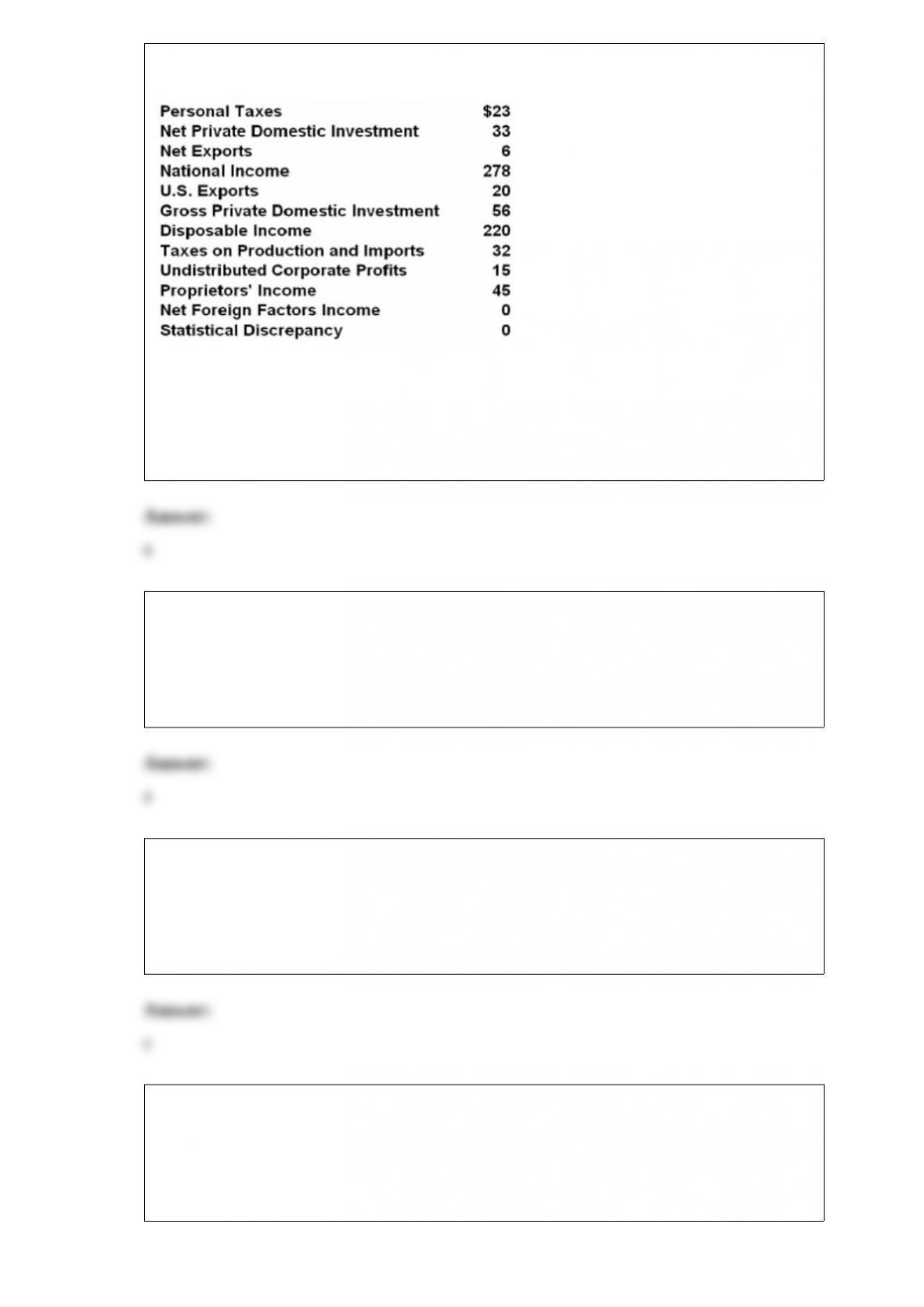
figures are in billions of dollars.
refer to the above data. consumption of fixed capital (private sector) is:
a.$23.
b.$14.
c.$32.
d.$26.
15) utility refers to the:
a.satisfaction that a consumer derives from a good or service.
b.rate of decline in a product demand curve.
c.relative scarcity of a product.
d.usefulness of a product.
16) marginal product:
a.diminishes at all levels of production.
b.may initially increase, then diminish, but never become negative.
c.may initially increase, then diminish, and ultimately become negative.
d.is always less than average product.
17) MMDA stands for:
A.money maturity deposit asset.
B.money market deposit account.
C.mutual money deposit asset.
D.mature money deposit account.
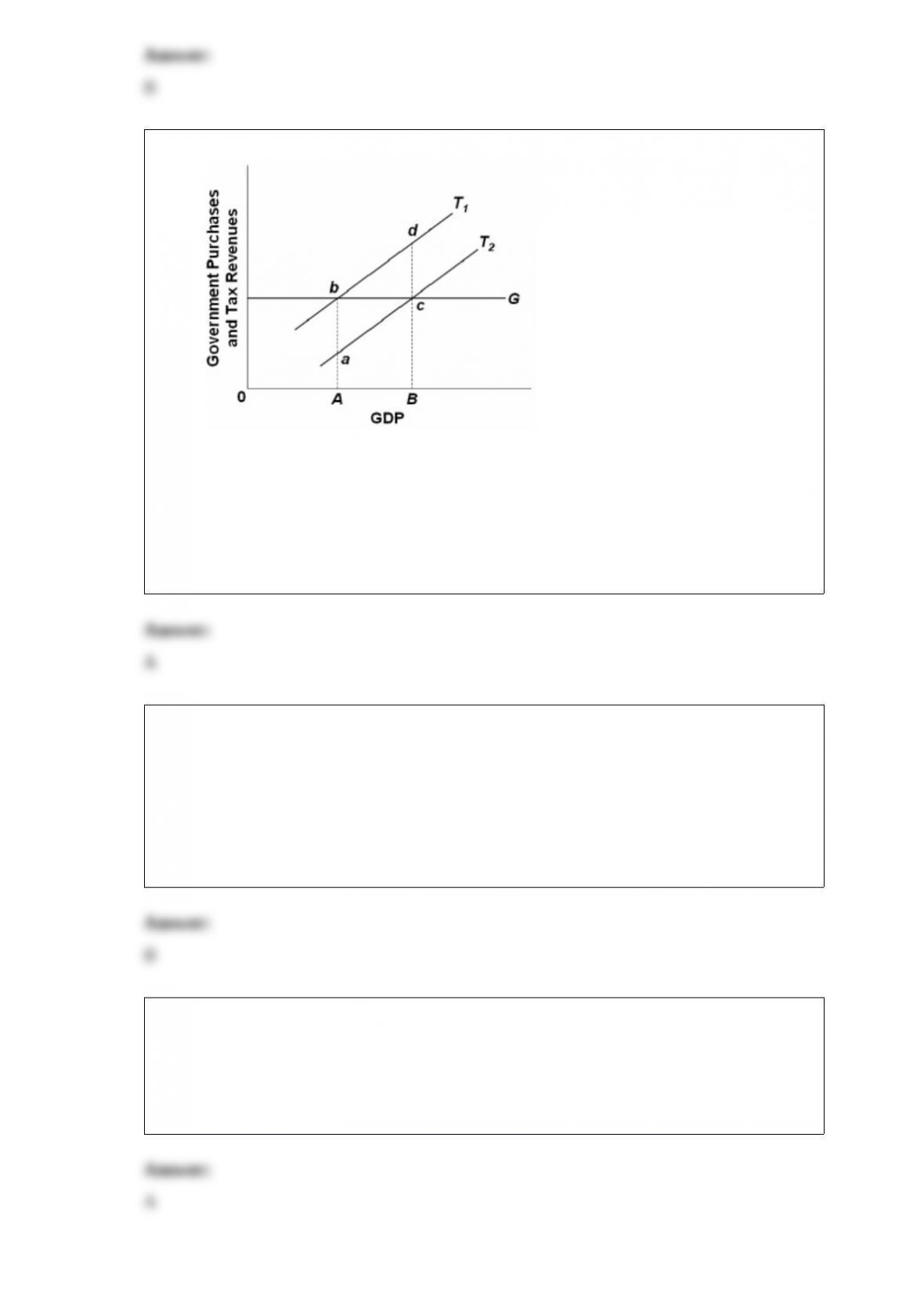
18)
Refer to the above diagram. Discretionary fiscal policy designed to expand GDP is
illustrated by:
A.the shift of curve T1 to T2.
B.the shift of curve T2 to T1.
C.a movement from a to c along curve T2.
D.a movement from d to b along curve T1.
19) Featherbedding refers to:
A.a situation in which a union forces an employer to hire union workers in preference
to nonunion workers.
B.the requirement that unneeded workers be retained on a job.
C.the refusal by one union to handle or transport goods produced by workers in another
union.
D.disputes among two or more unions as to which will perform certain jobs.
20) In recent years U.S. foreign aid has been:
A.less than 1 percent of its output.
B.about 2 percent of its output.
C.about 3 percent of its output.
D.about 5 percent of its output.
21) the rate of inflation can be found by subtracting:
a.the real income from the nominal income.
b.last year’s price index from this year’s price index.
c.this year’s price index from last year’s price index and dividing the difference by this
year’s price index.
d.last year’s price index from this year’s price index and dividing the difference by last
year’s price index.
22) the market system:
a.produces considerable inefficiency in the use of scarce resources.
b.effectively harnesses the incentives of workers and entrepreneurs.
c.is inconsistent with freedom of choice in the long run.
d.has slowly lost ground to emerging command systems.
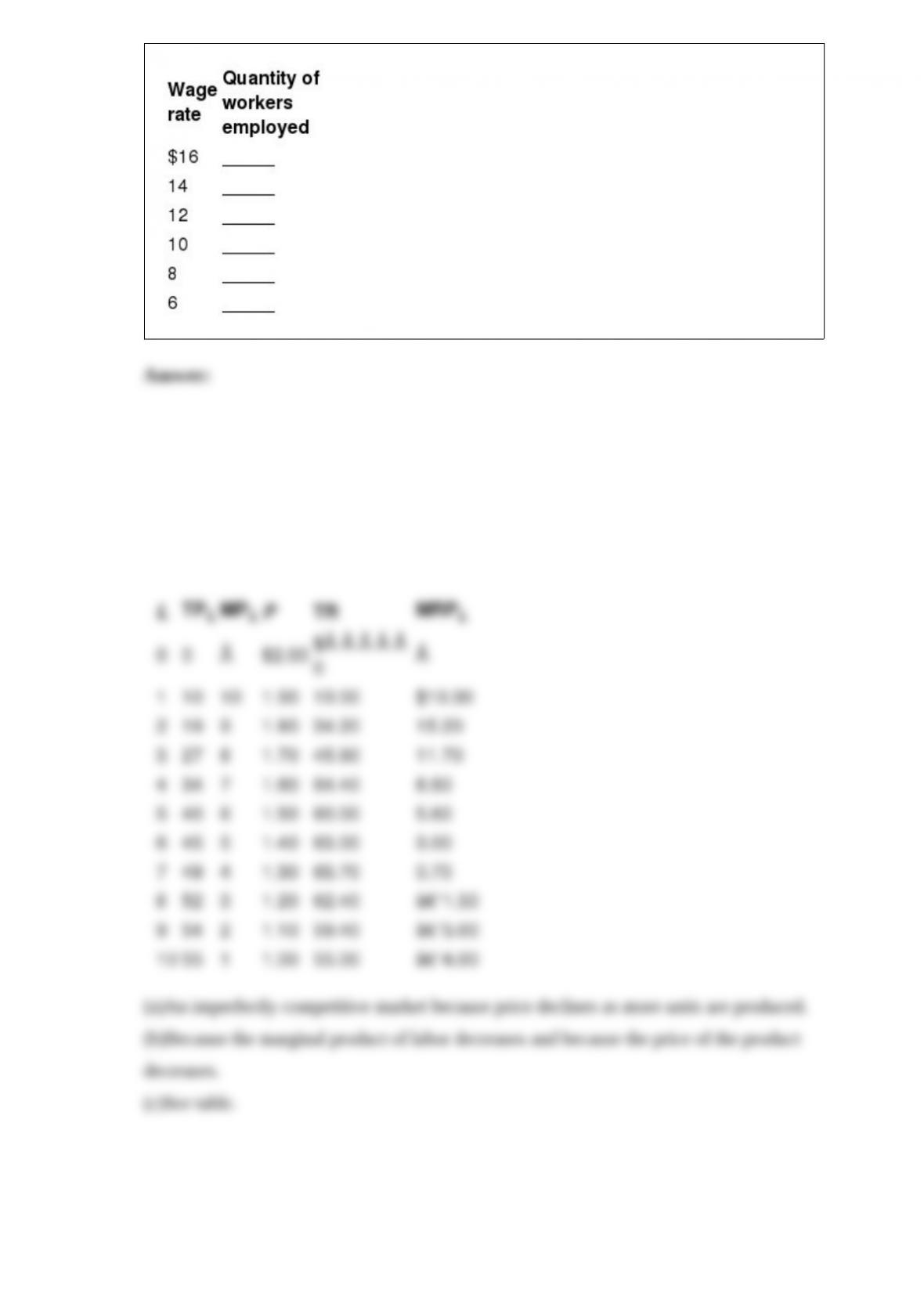
23) Complete the following table, where L is the units of labor, TPL is the total product
of labor, MPL is the marginal product of labor, P is product price, TR is total revenue,
and MRPL is the marginal revenue product of labor.
(a)In what type of market is the firm selling its product? How do you know?
(b)Why does the MRP schedule decrease as labor increases?
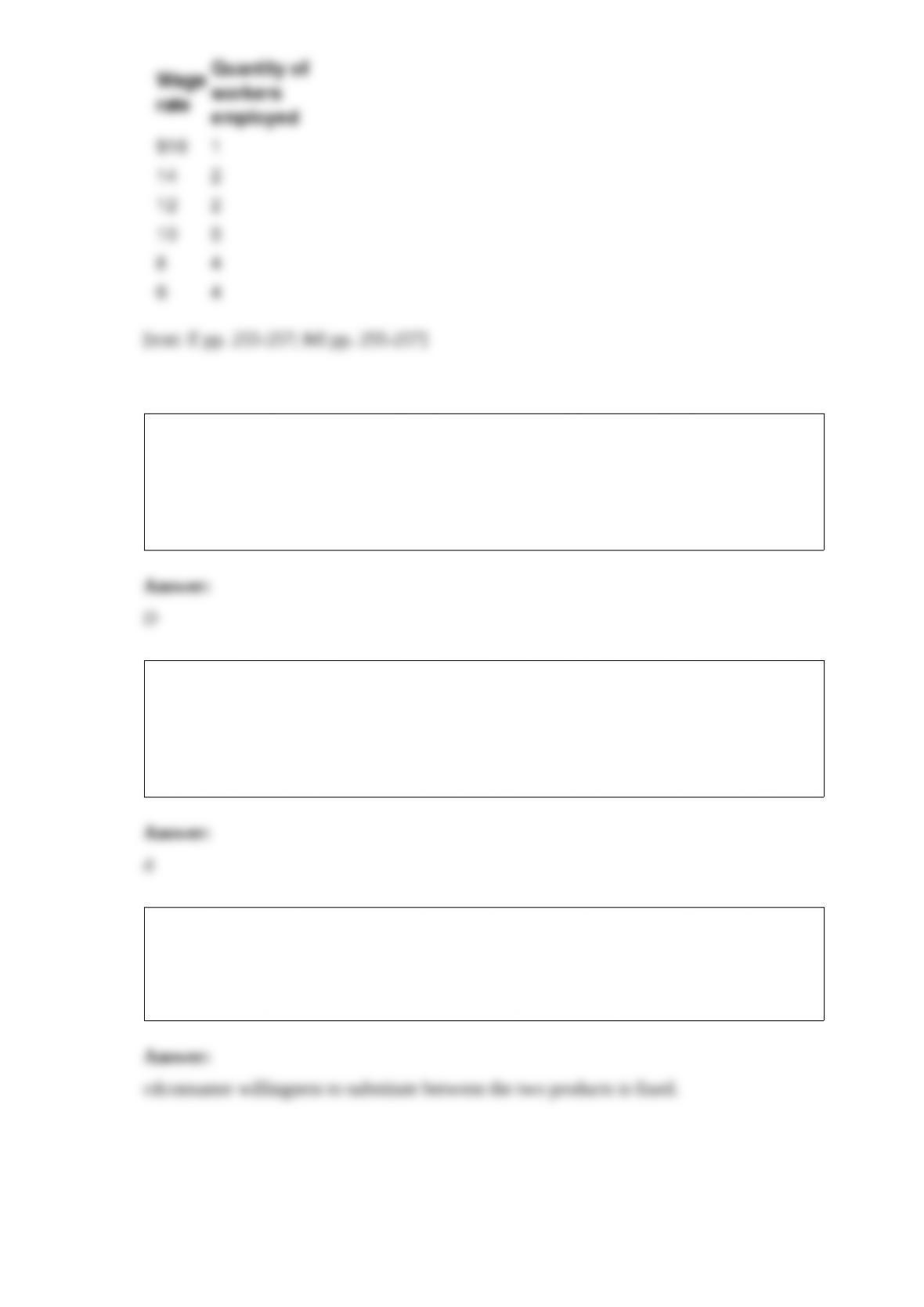
(c)Complete the following table.
24) The Laffer Curve is a central concept in:
A.monetarism.
B.Keynesianism.
C.welfare economics.
D.supply-side economics.
25) in order to apply the concept of diminishing returns to study time:
a.the amount of study time available must be held constant.
b.study time must be considered a long-run production process.
c.all inputs to the learning process must be allowed to vary.
d.all inputs to the learning process except for study time must be assumed to be fixed.
26) in drawing a budget line it is assumed that:
a.consumer preferences are fixed.
b.the prices of the two products are variable.
c.money income is fixed.
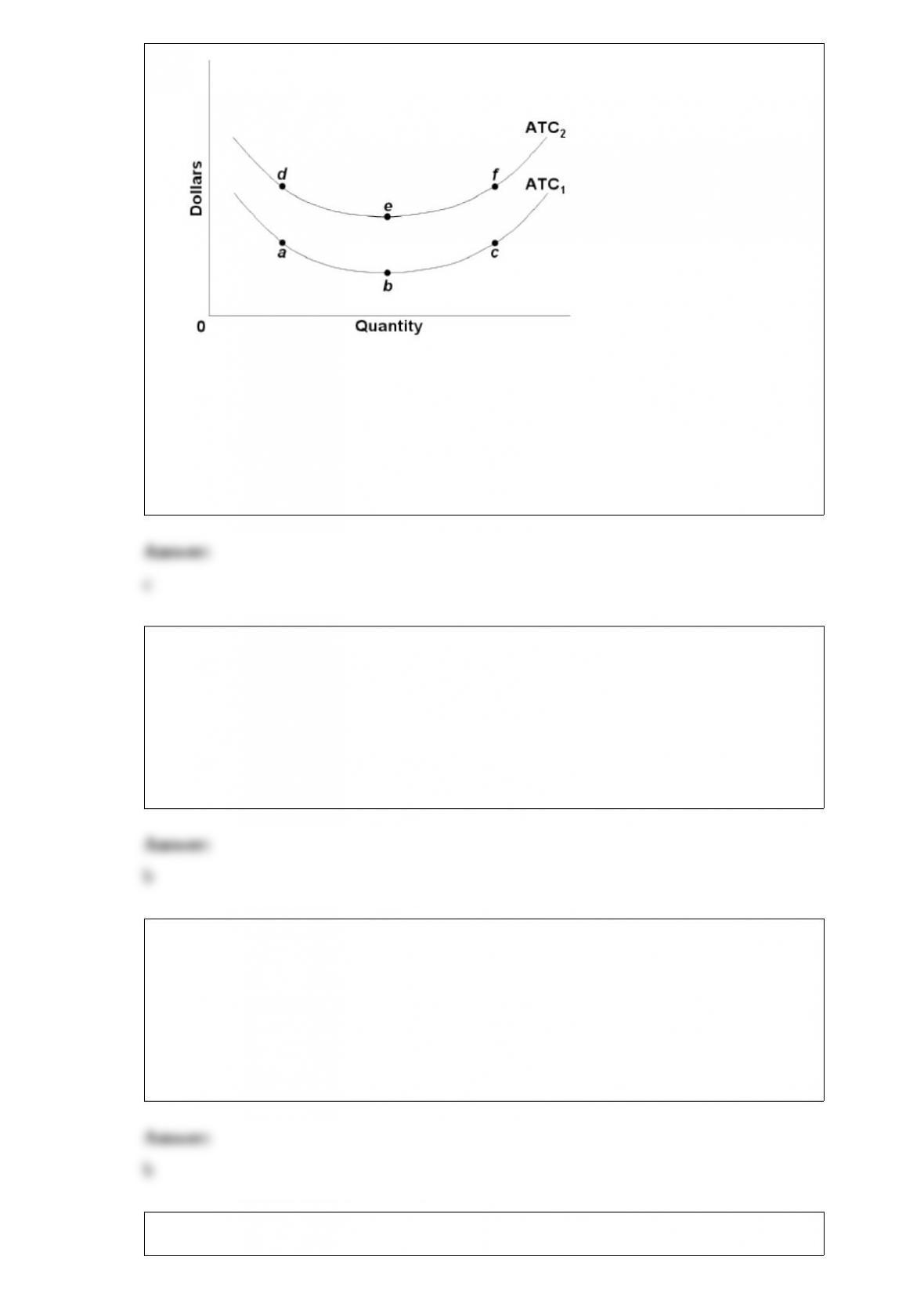
27)
refer to the above graph. which one of the following would cause a move from point e
on short-run average total cost curve atc2 to point b on short-run average cost curve
atc1?
a.diminishing marginal returns
b.an increase in the wage rate
c.a decrease in the wage rate
d.increasing marginal returns
28) assume the natural rate of unemployment in the u.s. economy is 5 percent and the
actual rate of unemployment is 9 percent. according to okun’s law, the negative gdp gap
as a percent of potential gdp is:
a.4 percent.
b.8 percent.
c.10 percent.
d.2 percent.
29) total utility may be determined by:
a.multiplying the marginal utility of the last unit consumed by the number of units
consumed.
b.summing the marginal utilities of each unit consumed.
c.multiplying the marginal utility of the last unit consumed by product price.
d.multiplying the marginal utility of the first unit consumed by the number of units
consumed.
30) the average u.s. tariff rate on imported goods is about:
a.5 percent.
b.12 percent.
c.25 percent.
d.50 percent.
31) Which types of industries are hit hardest by a recession? Explain.
32) What is the relationship between rent-seeking expenditures and monopoly?
33) Why is it difficult for most investors to take advantage of arbitrage opportunities?
34) Do you agree or disagree with the statement that: A monopolist always charges the
highest possible price. Explain.
35) Describe the difference between real GDP and nominal GDP. Which concept is
more useful for measuring change in the economy over time? Why?
36) Describe cost-push inflation in the extended aggregate demand and aggregate
supply model. Explain the policy dilemma for government policy if they take no action
or use monetary and fiscal policy to counter the cost-push inflation.