
1) Which of the following is not a feature of the Food, Conservation, and Energy Act of
2008?
A.direct payments (direct subsidies) based on crops previously grown
B.countercyclical payments
C.marketing loans
D.acreage allotments (restrictions on the number of acres that can be planted)
2) Graphically, the full-employment, low-inflation, rapid-growth economy of the last
half of the 1990s is depicted by a:
A.rightward shift of the aggregate demand curve along a fixed aggregate supply curve.
B.rightward shift of the aggregate supply curve along a fixed aggregate demand curve.
C.rightward shift of the aggregate demand curve and a rightward shift of the aggregate
supply curve.
D.leftward shift of the aggregate demand curve and a leftward shift of the aggregate
supply curve.
3) digital cameras and memory cards are:
a.substitute goods.
b.complementary goods.
c.independent goods.
d.inferior goods.
4) In the United States, the rate of unionization is:
A.higher for sales workers than for transportation workers.
B.lower for managers than for teachers.
C.lower for production workers than for sales workers.
D.higher for social workers than for protective service workers.
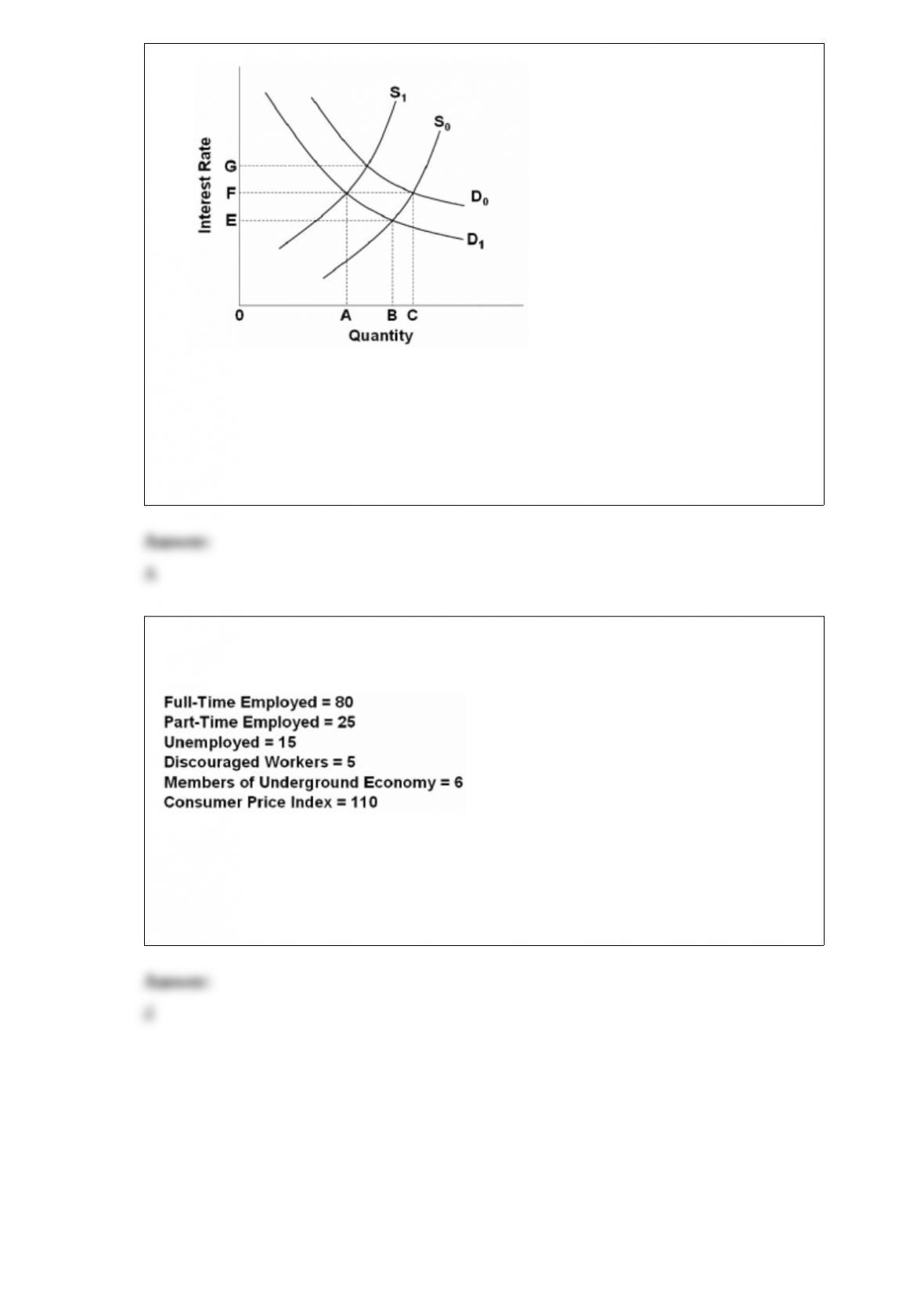
5)
Refer to the above diagram. The demand for loanable funds curve D1 slopes downward
because:
A.business will borrow more funds at lower interest rates than at higher ones.
B.at lower interest rates households will make more funds available for lending.
C.at lower interest rates, households will consume more and save less.
D.business will borrow more funds at higher interest rates than at lower ones.
6) answer the next question(s) on the basis of the following information about a
hypothetical economy:
refer to the above information. the rate of inflation:
a.is 110 percent.
b.is 10 percent.
c.is 0 percent.
d.cannot be determined from the data.
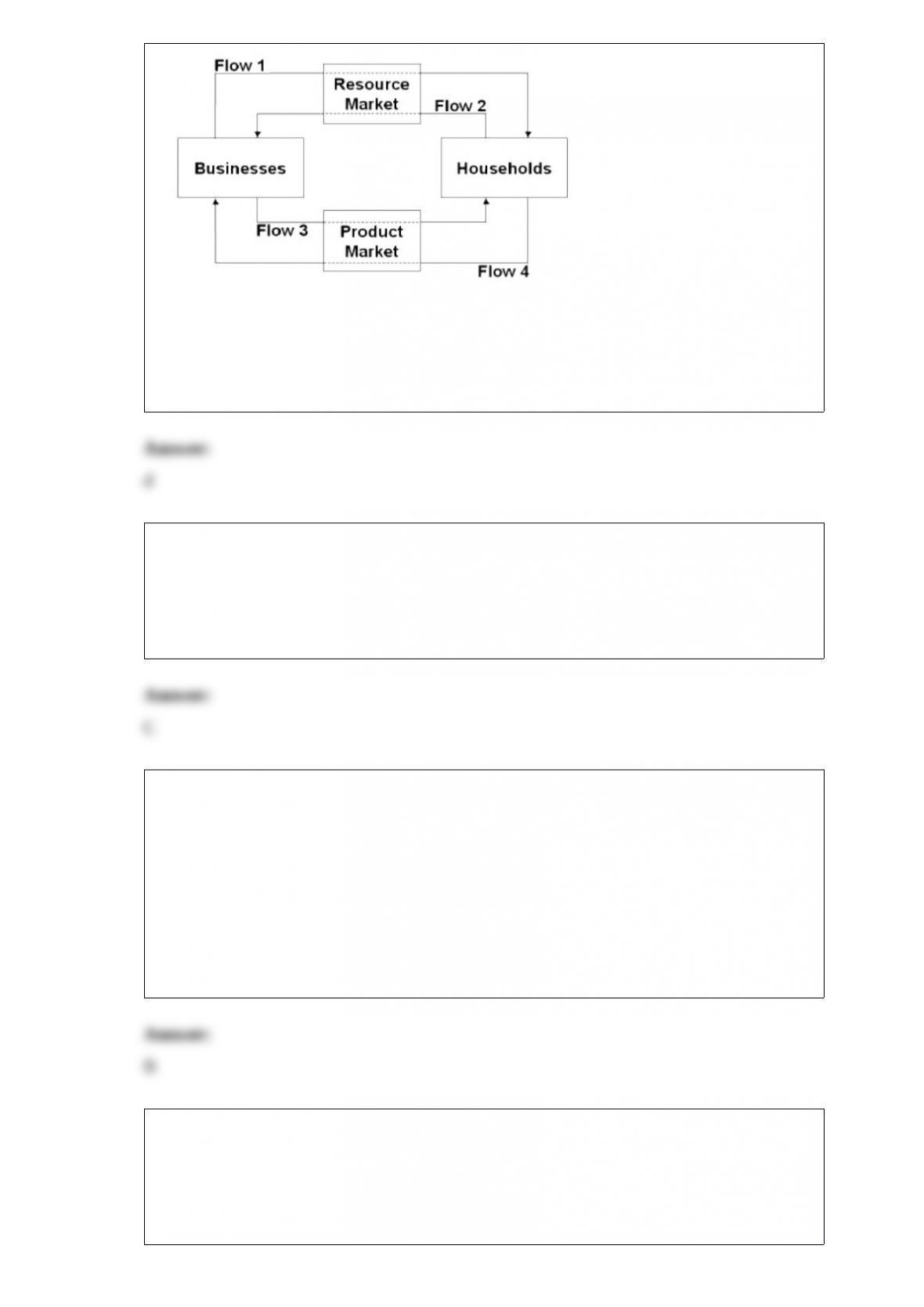
7)
refer to the above diagram. flow (4) represents:
a.wage, rent, interest, and profit income.
b.land, labor, capital, and entrepreneurial ability.
c.goods and services.
d.consumer expenditures.
8) Other things equal, an improvement in productivity will:
A.increase the equilibrium price level.
B.shift the aggregate supply curve to the left.
C.shift the aggregate supply curve to the right.
D.shift the aggregate demand curve to the left.
9) Kara and Kyle are competing Sockeye Salmon fishers. Both have been allocated
ITQs that limit their catch to 2,000 tons of Sockeye Salmon each. Kara’s cost per ton is
$8; Kyle’s cost per ton is $12.
Refer to the information above. If the market price of Sockeye Salmon is $15 per ton,
what is the maximum amount Kara would be willing to pay per ton for Kyle’s ITQs?
A.$3.
B.$7.
C.$8.
D.$15.
10) marginal product:
a.diminishes at all levels of production.
b.may initially increase, then diminish, but never become negative.
c.may initially increase, then diminish, and ultimately become negative.
d.is always less than average product.

11) If the economy has a standardized budget surplus, this means that:
A.the public sector is exerting an expansionary impact on the economy.
B.tax revenues would exceed government expenditures if full employment were
achieved.
C.the actual budget is necessarily also in surplus.
D.the economy is actually operating at full employment.
12) the unemployment rate is the:
a.ratio of unemployed to employed workers.
b.number of employed workers minus the number of workers who are not in the labor
force.
c.percentage of the labor force that is unemployed.
d. percentage of the total population that is unemployed.
13) market failure occurs when:
a.not every consumer can buy as much of a good as they want at the price they want it.
b.the competitive market system produces too much or too little of a good.
c.competitive market forces produce incomes that are unequal.
d.government interferes with competitive market forces.
14) The following information about a banking system: new currency deposited in the
system = $40 billion; legal reserve ratio = 0.20; excess reserves prior to the currency
deposit = $0.
Refer to the above information. The banking system will be able to expand the money
supply through loans by:
A.$160 billion.
B.$200 billion.
C.$40 billion.
D.$128 billion.
15) Which of the following is least likely to violate the Sherman Act or the Clayton
Act?
A.Competitive firms A, B, and C meet and agree to charge a common price.
B.Competitive firms D and E, each with 35 percent market shares, merge into a single
firm.
C.Competitive firms F and G independently charge lower prices to frequent customers
than to occasional customers.
D.Large dominant firm H forces buyers to purchase its product X in order to buy its
popular product Y.
16) Currently farm employment is about:
A.15.8 percent of total employment.
B.9.4 percent of total employment.
C.1.3 percent of total employment.
D.5.0 percent of total employment.
17) In 2007 the United States’ balance on goods was about:
A.-$435 billion.
B.+ $107 billion.
C.-$816 billion.
D.-$739 billion.
18)
Refer to the above data. If a lump-sum tax (the same tax amount at each level of GDP)
of $40 is imposed in this economy, we can conclude that the tax:
A.enhances the economy’s built-in stability.
B.reduces the economy’s built-in stability.
C.neither increases nor decreases built-in stability.
D.increases the MPC and therefore increases the size of the multiplier.