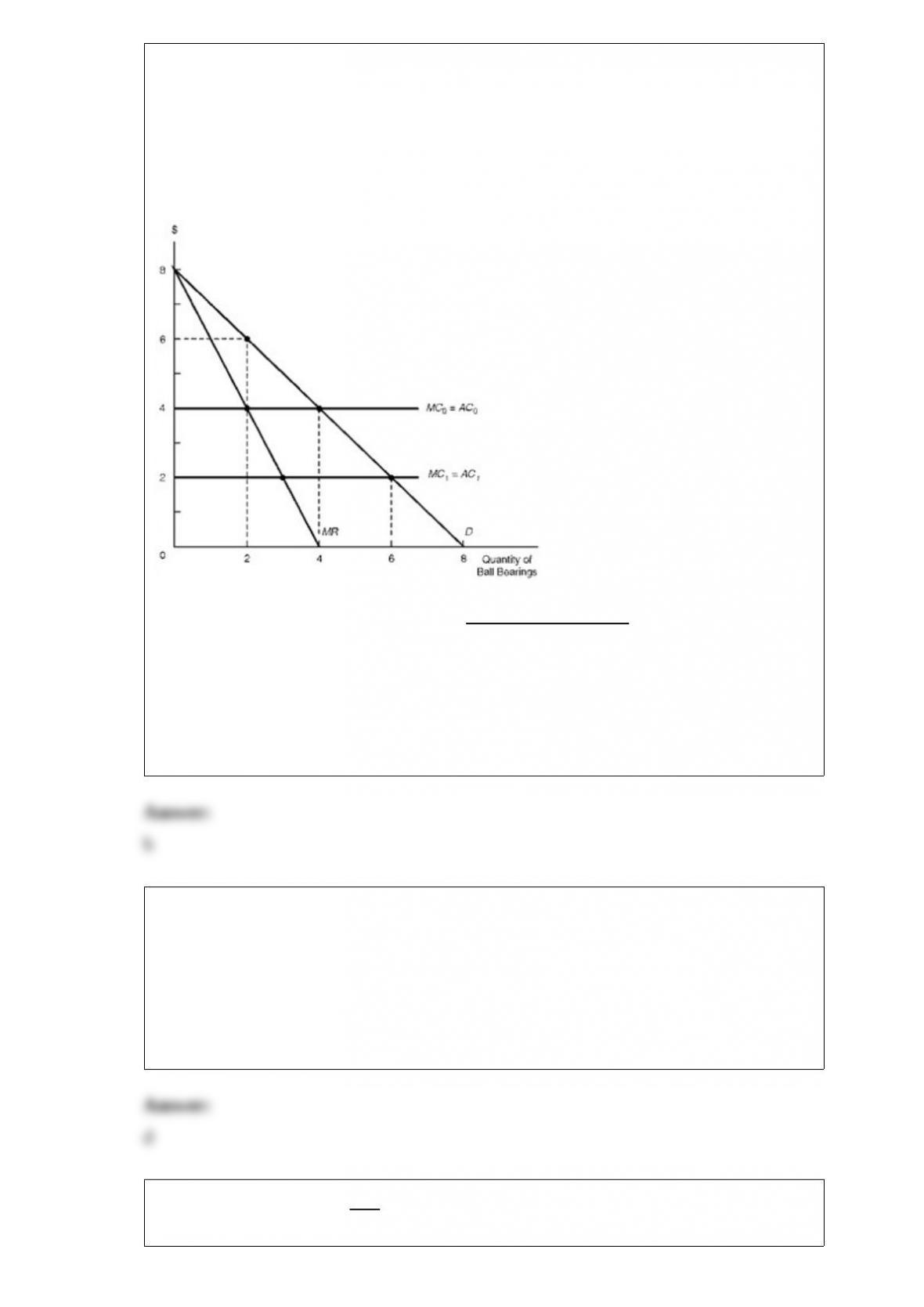
1) figure 9.1 illustrates the market conditions facing sony company and american
company initially operating as competitors in the domestic ball bearing market. each
firm realizes constant long-run costs, mc0=ac0.
figure 9.1. international joint venture
consider figure 9.1. assume venture company’s formation yields new cost reductions,
indicated by mc1=ac1, which result from changes in work rules by venture company
employees that led to higher worker productivity. the net effect of venture company’s
formation on the welfare of the domestic economy is:
a.no change
b.gain of $2
c.gain of $4
d.loss of $2
2) suppose the government grants a subsidy to domestic producers of an
import-competing good. the subsidy tends to result in deadweight losses for the
domestic economy in the form of the:
a.consumption effect
b.redistribution effect
c.revenue effect
d.protective effect
3) which of the following best applies to the theory of overlapping demands?
a.manufactured goods

b.services
c.primary products
d.none of the above
4) j. m. keynes suggested that a trade deficit nation
a.would experience a fall in income
b.would experience a decline in imports
c.would require active intervention by the government
d.both a and b
5) the absorption approach to currency devaluation deals with the income effects of
devaluation while the elasticity approach to devaluation deals with the price effects of
devaluation.
a.true
b.false
6) the absorption approach to currency depreciation is represented by one of the
following equations:
a.b = y – a
b.y = c + i + g + (x-m)
c.i + x = s + m
d.s – i = x – m
7) most economists belief that in the 1980s, a massive outflow of capital caused a
current account deficit for the united states.
a.true
b.false
8) “country risk” analysis is concerned with all of the following except:
a.depreciation of the borrowing country’s currency
b.political instability in the borrowing country
c.economic growth in the borrowing country
d.external debt of the borrowing country
9) the leontief paradox:
a.was applied to the product life cycle theory
b.suggested that the u.s. exports labor-intensive goods
c.found that national income differences underlie world trade patterns
d.implied that diseconomies of scale occur at low output levels
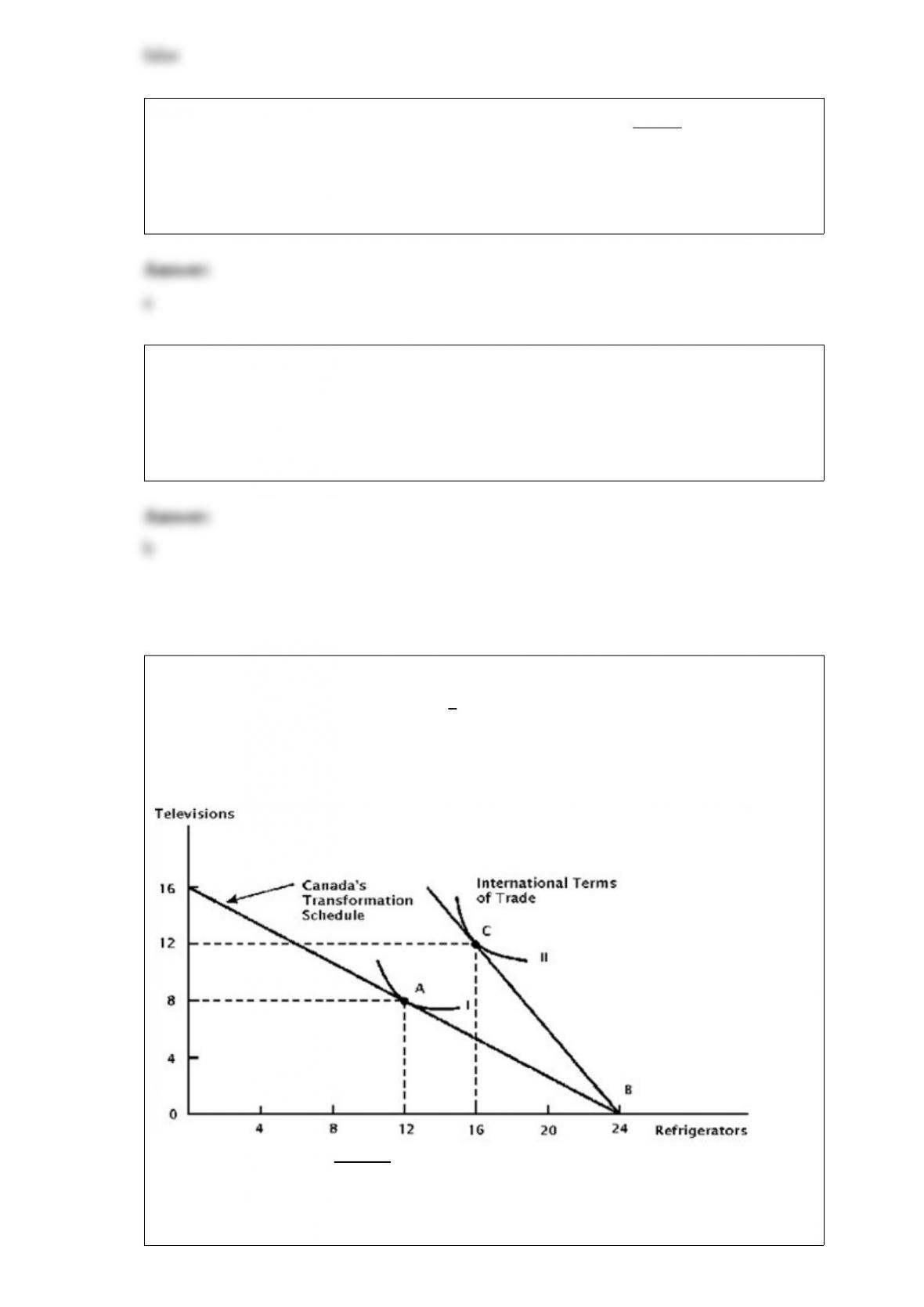
10) figure 2.2 illustrates trade data for canada. the figure assumes that canada attains
international trade equilibrium at point c.
figure 2.2. canadian trade possibilities
according to figure 2.2, imports for canada total:
a.6 televisions
b.8 televisions
c.12 televisions
d.16 televisions
11) under floating exchange rates and high capital mobility, an expansionary monetary
policy would help a country resolve a recession and a current account deficit.
a.true
b.false
12) which balance-of-payments item does not directly enter into the calculation of the
u.s. gross domestic product?
a.merchandise imports
b.shipping and transportation receipts
c.direct foreign investment
d.service exports
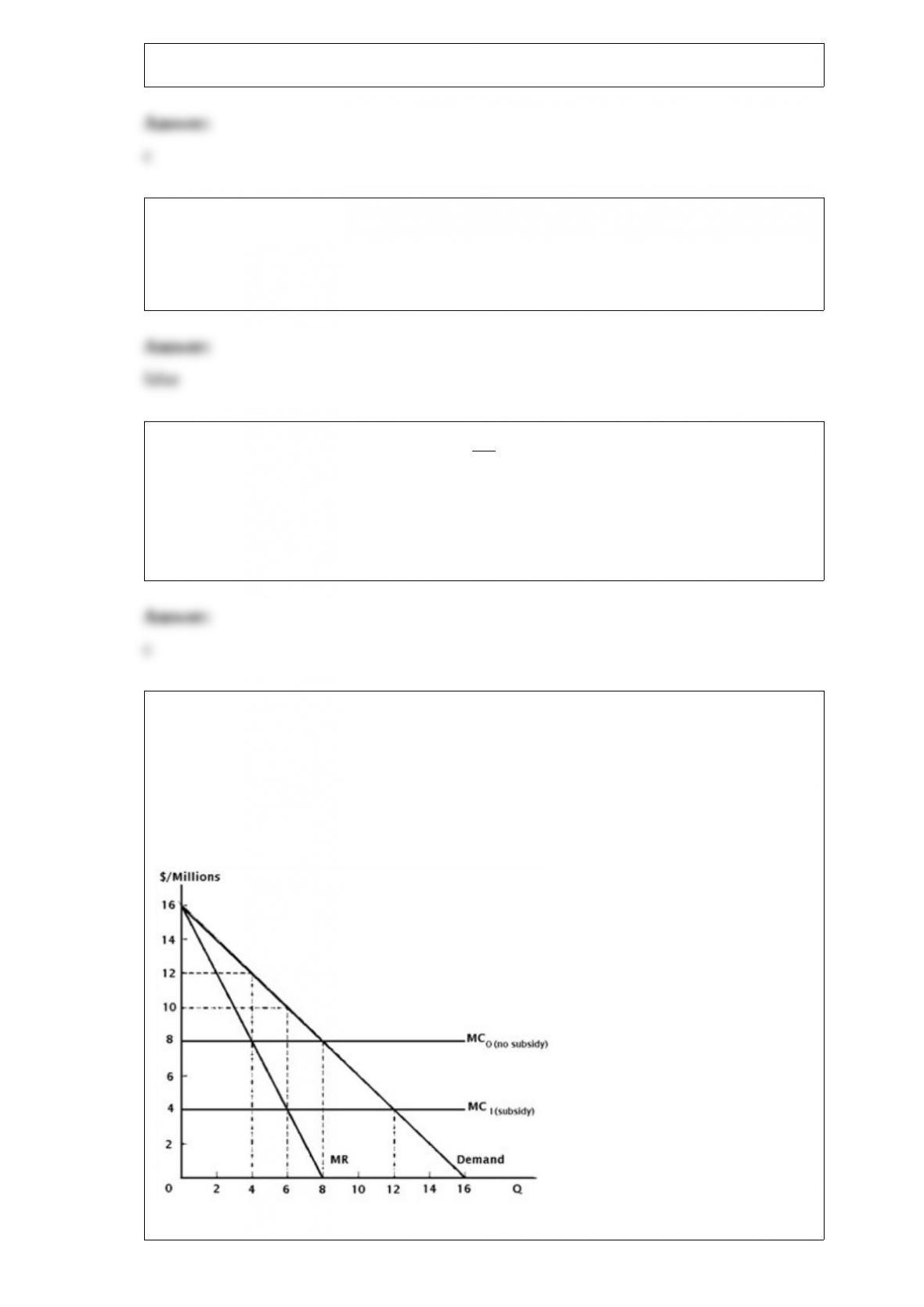
13) assume boeing inc. (of the united states) and airbus industrie (of europe) rival for
monopoly profits in the canadian aircraft market. suppose the two firms face identical
cost and demand conditions, as seen in figure 6.1.
figure 6.1. strategic trade policy: boeing versus airbus
consider figure 6.1. suppose the european government provides airbus a subsidy of $4

million on each aircraft manufactured, and that the subsidy convinces boeing to exit the
canadian market. as the monopoly seller, airbus maximizes profit by selling ____
aircraft at a price of $____, and realizes profits totaling $____.
a.6, $10 million, $36 million
b.6, $12 million, $24 million
c.12, $10 million, $36 million
d.12, $12 million, $24 million