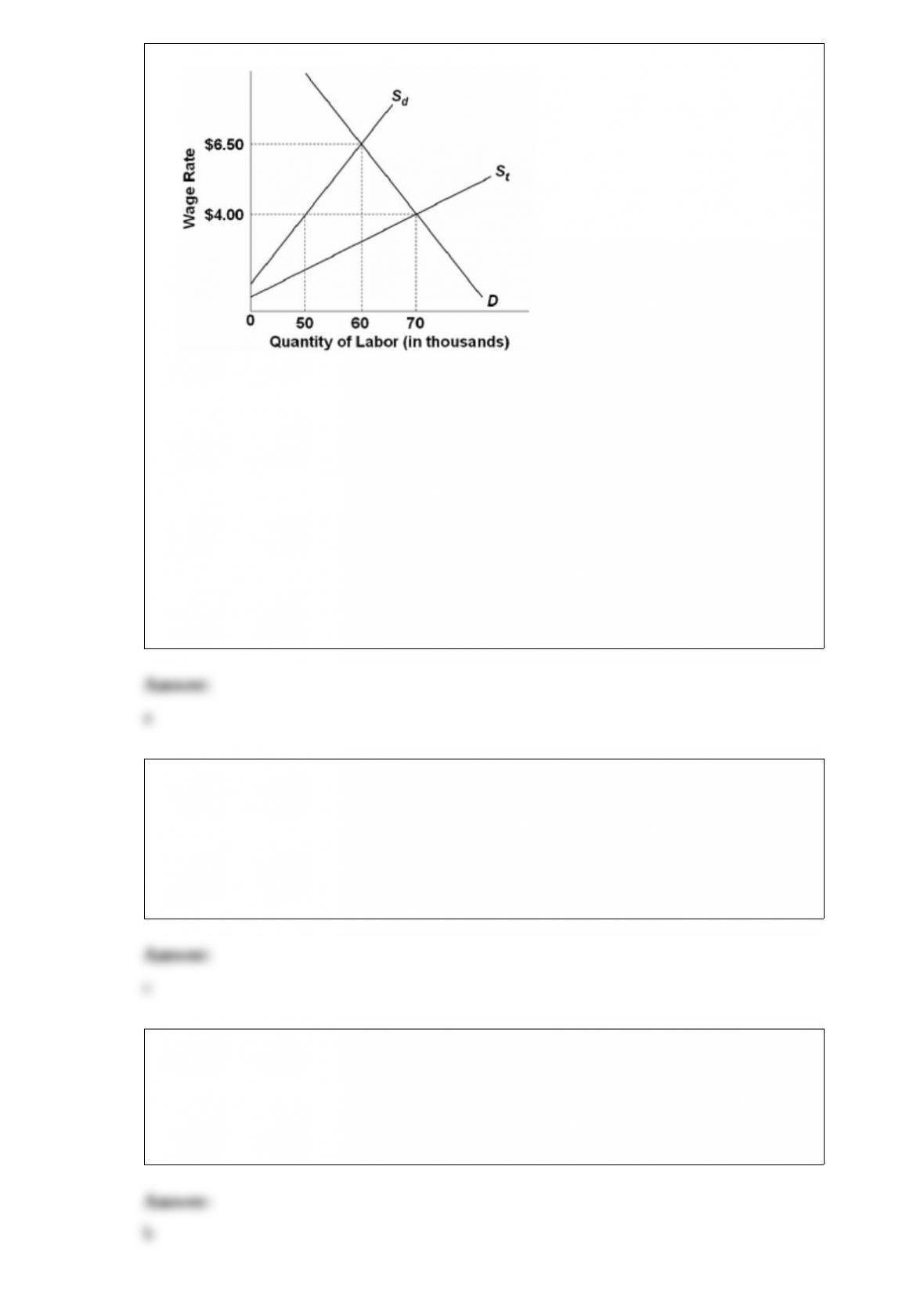
1)
assumptions: 1) employers in this market are willing and able to ignore minimum wage
laws; 2) sd represents the supply of domestically-born (and legal immigrant) workers;
3) st represents the total supply of workers in this labor market (sd plus illegal
immigrants); and 4) unless otherwise stated, illegal immigration is not effectively
blocked by the government.
refer to the above figure. how many illegal immigrant workers will be hired at
equilibrium?
a.20,000
b.50,000
c.60,000
d.70,000
2) in which of the following industries are economies of scale exhausted at relatively
low levels of output?
a.aircraft production
b.automobile manufacturing
c.concrete mixing
d.newspaper printing
3) households in the aggregate use the largest share of their total income to:
a.pay taxes.
b.consume.
c.save.
d.buy capital goods.

4) economic profits are calculated by subtracting:
a.explicit costs from total revenue.
b.implicit costs from total revenue.
c.implicit costs from normal profits.
d.explicit and implicit costs from total revenue.
5) in a purely competitive industry:
a.there will be no economic profits in either the short run or the long run.
b.economic profits may persist in the long run if consumer demand is strong and stable.
c.there may be economic profits in the short run, but not in the long run.
d.there may be economic profits in the long run, but not in the short run.
6) if you operated a small bakery, which of the following would be a variable cost in the
short run?
a.baking ovens
b.interest on business loans
c.annual lease payment for use of the building
d.baking supplies (flour, salt, etc.)
7) which of the following would most likely occur during the expansionary phase of the
business cycle?
a.demand-pull inflation
b.cost-push inflation
c.structural inflation
d.frictional inflation
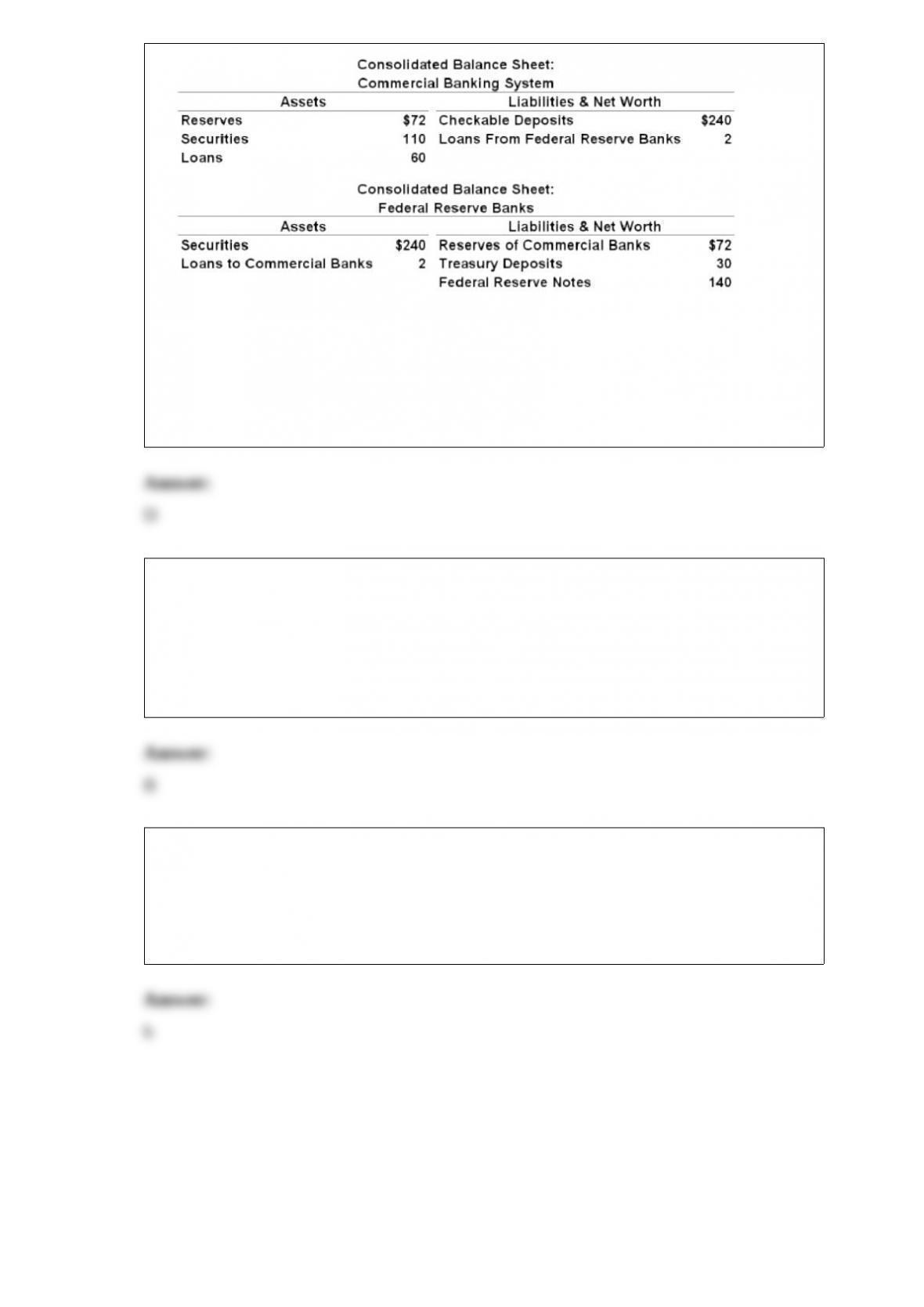
8)
Assuming no currency drains, when the Federal Reserve Banks purchase government
securities the reserves of commercial banks are:
A.decreased by a multiple of the amount of the purchase.
B.decreased by the amount of the purchase.
C.increased by a multiple of the amount of the purchase.
D.increased by the amount of the purchase.
9) (Consider This) Changing World Technologies receives a $42 per barrel federal
biofuel subsidy. The purpose of such a subsidy would be to:
A.increase the supply of both biofuel and conventional oil.
B.increase the supply of biofuel and reduce the demand for conventional oil.
C.increase the demand for biofuel and reduce the supply of conventional oil.
D.increase the demand for biofuel and increase the supply of conventional oil.
10) price elasticity of supply is:
a.positive in the short run but negative in the long run.
b.greater in the long run than in the short run.
c.greater in the short run than in the long run.
d.independent of time.