1) households and businesses are:
a.both buyers in the resource market.
b.both sellers in the product market.
c.sellers in the resource and product markets respectively.
d.sellers in the product and resource markets respectively.
2) In exchange for a share of ZYX’s profits if it succeeds, Firm ABC provides
development funds to newly formed ZYX which is developing an innovative product.
ABC funds are called ____________ while ZYX is known as a ____________.
A.venture capital; startup
B.retained earnings; entrepreneurial firm
C.mutual funds; startup
D.transfer payments; entrepreneurial firm
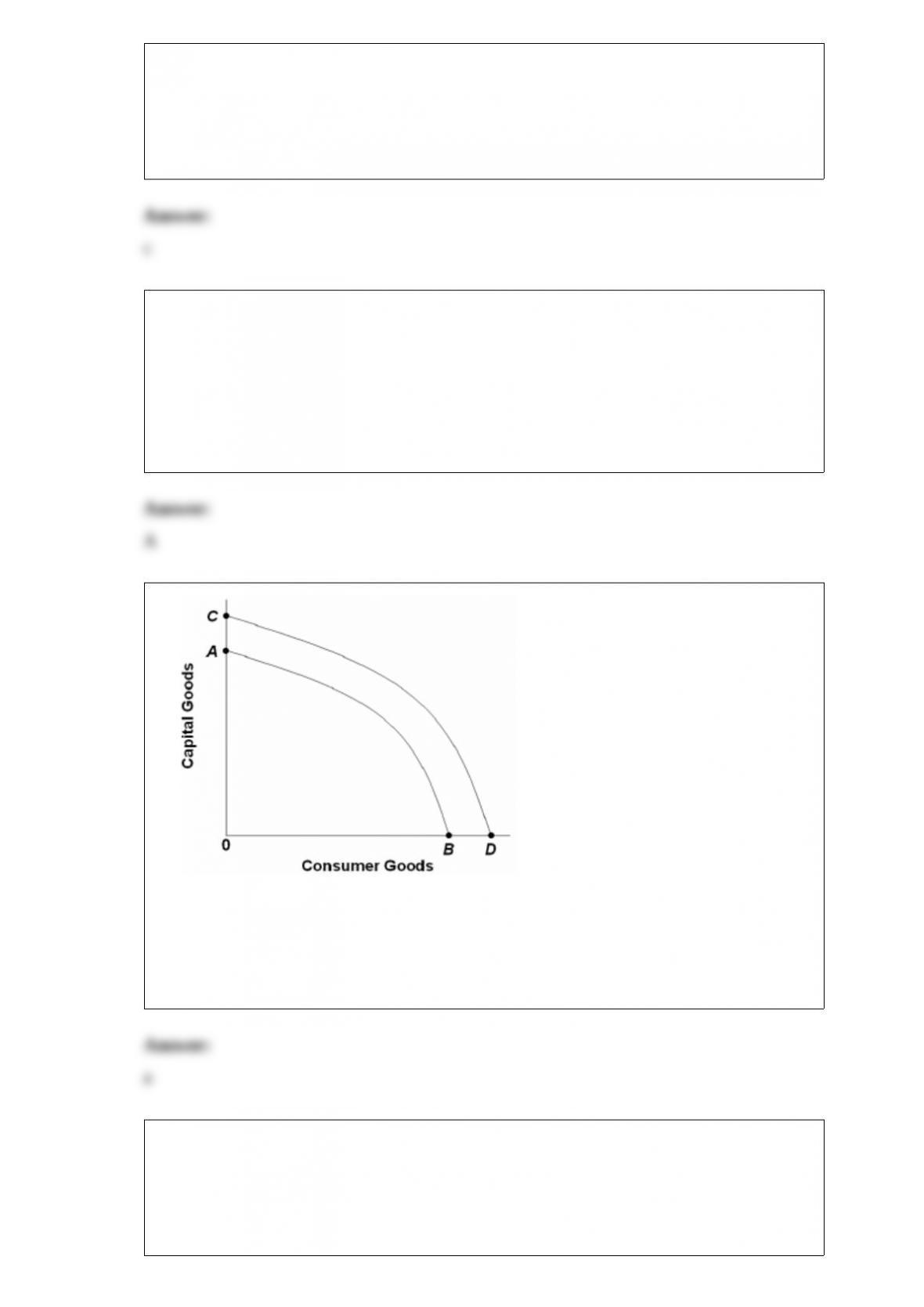
3)
refer to the above graphs. growth of production capacity is shown by the:
a.shift from ab to cd.
b.shift from cd to ab.
c.movement away from point a and toward point b.
d.movement away from point b and toward point a.
4) The view that excessive growth of the money supply over long periods leads to
inflation:
A.is accepted by the monetarists but not by mainstream macroeconomists.
B.is the main contribution of the rational expectations theory.
C.had been absorbed into the mainstream of macroeconomics.

D.is known as the monetary rule.
5) The marginal benefit to a firm from its R&D expenditures is depicted by its:
A.interest-rate-cost of funds curve.
B.expected-rate-of-return curve.
C.venture capital acquisition curve.
D.retained earnings pay-out curve.
6) if a nation’s real gdp increases from 100 billion to 106 billion and its population
jumps from 200 million to 212 million, it real gdp per capita will:
a.remain constant.
b.fall by 6 percent.
c.rise by 6 percent.
d.fall by 12 percent.
7) An extraordinarily small crop of farm products due to drought causes:
A.a large increase in the price of farm products because the demand for farm products is
price inelastic.
B.only a slight increase in the price of farm products because the demand for farm
products is income elastic.
C.only a slight increase in the price of farm products because the demand for farm
products is income inelastic.
D.a large increase in the price of farm products because the demand for farm products is
price elastic.
8) The real interest rate can be estimated by:
A.subtracting the pure interest rate from the nominal interest rate.
B.dividing the nominal interest rate by the consumer price index.
C.subtracting the nominal interest rate from the rate of inflation.
D.subtracting the rate of inflation from the nominal interest rate.
9) Other things being constant, what will be the effect of each of the following on
disposable income (or real GDP)?
(a)An increase in the amount of liquid assets consumers are holding
(b)A sharp rise in stock prices
(c)A rapid upsurge in the rate of technological advance
(d)A sharp increase in the real interest rate
10)
the above data would graph as:
a.a straight line for alpha, but as a concave curve for omega.
b.a concave curve for alpha, but as a straight line for omega.
c.concave curves for both alpha and omega.
d.straight lines for both alpha and omega.
11) Which of the following statements about U.S. agriculture is true as it relates to the
past several decades?
A.The demand for farm products has declined, the supply of farm products has
increased, and the price of farm products has declined.
B.The demand for farm products has become both more income elastic and more price
elastic.
C.Minimum efficient scale has increased, the price of farm products has declined, and
the number of farms has declined.
D.The price of farm products have increased, minimum efficient scale has declined, and
the supply of farm products has been stagnant.
12) If a portion of the loans extended by commercial banks is taken as cash rather than
as checkable deposits, the maximum money-creating potential of the commercial
banking system will:
A.be equal to twice the reciprocal of the reserve ratio.
B.be unaffected.
C.increase.
D.decrease.
13)
Refer to the above diagrams. The profit-maximizing firm’s total wage cost:
A.is 0abc.
B.is 0wbc.
C.is wab.
D.cannot be determined.
14)
Suppose that a firm’s legal staff concludes that a new product that the firm is developing
is patentable. Graphically, this new information would shift the firm’s expected rate of
return curve on R&D to the:
A.right and reduce its optimal amount of R&D.
B.right and increase its optimal amount of R&D.
C.left and increase its optimal amount of R&D.
D.left and reduce its optimal amount of R&D
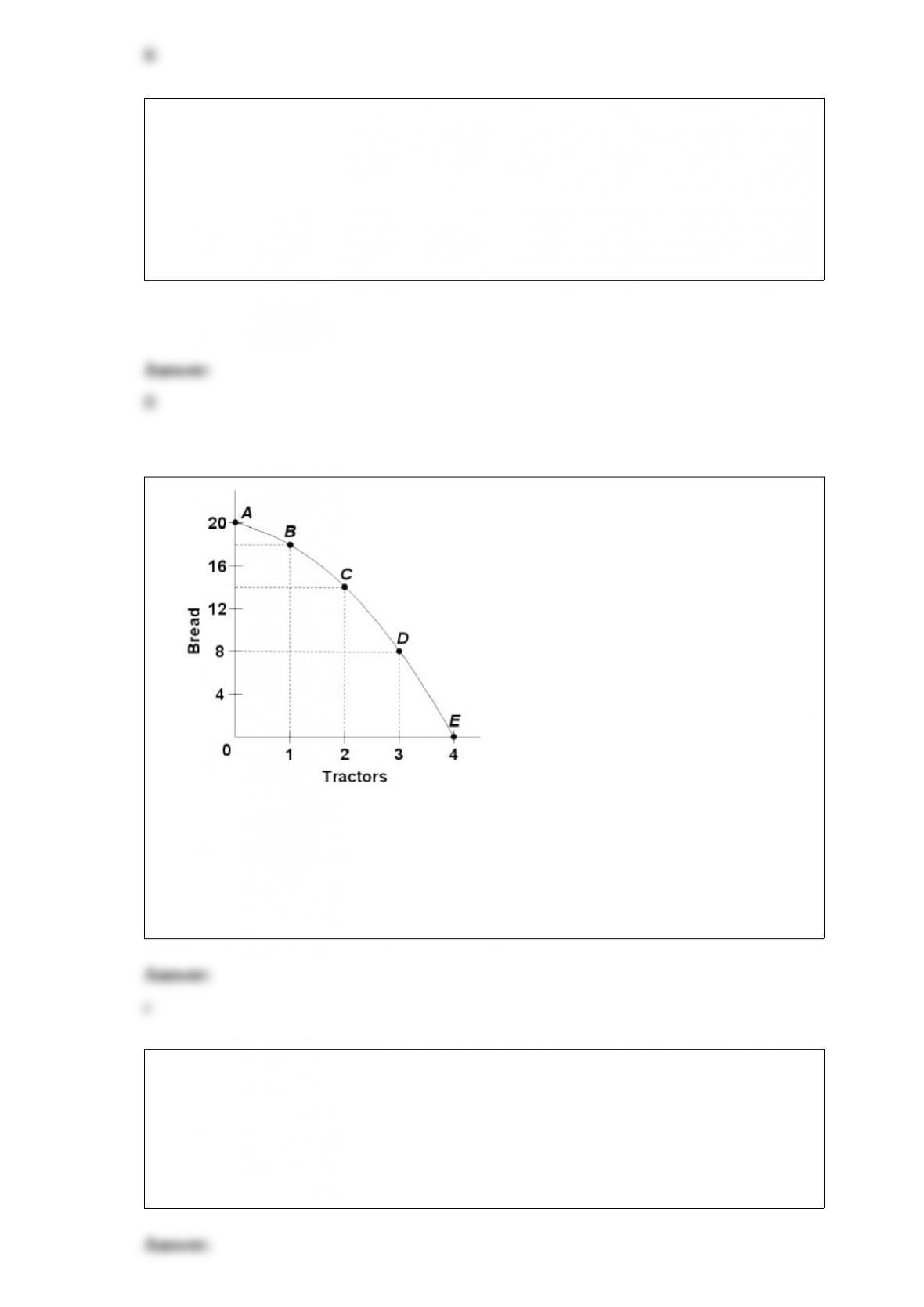
15)
refer to the above diagram. starting at point e, the production of successive units of
bread will cost:
a.a constant 8 units of tractors.
b.a constant 6 units of tractors.
c.1/8, 1/6, 1/4, and 1/2 units of tractors.
d.1/2, 1/4, 1/6, and 1/8 units of tractors.
16) other things equal, which of the following would decrease the rate of economic
growth, as measured by changes in real gdp?
a.an increase in the educational attainment of the labor force
b.a permanent decrease in frictional unemployment
c.an increase in the amount of capital per worker
d.a decrease in the labor force participation rate
17) The socially optimal amount of pollution abatement occurs where society’s
marginal:
A.benefit of abatement exceeds its marginal cost of abatement by the greatest amount.
B.benefit of abatement equals its marginal cost of abatement.
C.benefit of abatement is zero.
D.cost of abatement is at its maximum.
18) If the price level increases in the United States relative to foreign countries, then
American consumers will purchase more foreign goods and fewer U.S. goods. This
statement describes:
A.the output effect.
B.the foreign purchases effect.
C.the real-balances effect.
D.the shift-of-spending effect.
19) The individual firm in a purely competitive labor market faces:
A.a perfectly elastic labor supply curve and a downsloping labor demand curve.
B.a perfectly elastic labor demand curve and an upsloping labor supply curve.
C.labor demand and labor supply curves both of which are perfectly elastic.
D.a downsloping labor demand curve and an upsloping labor supply curve.
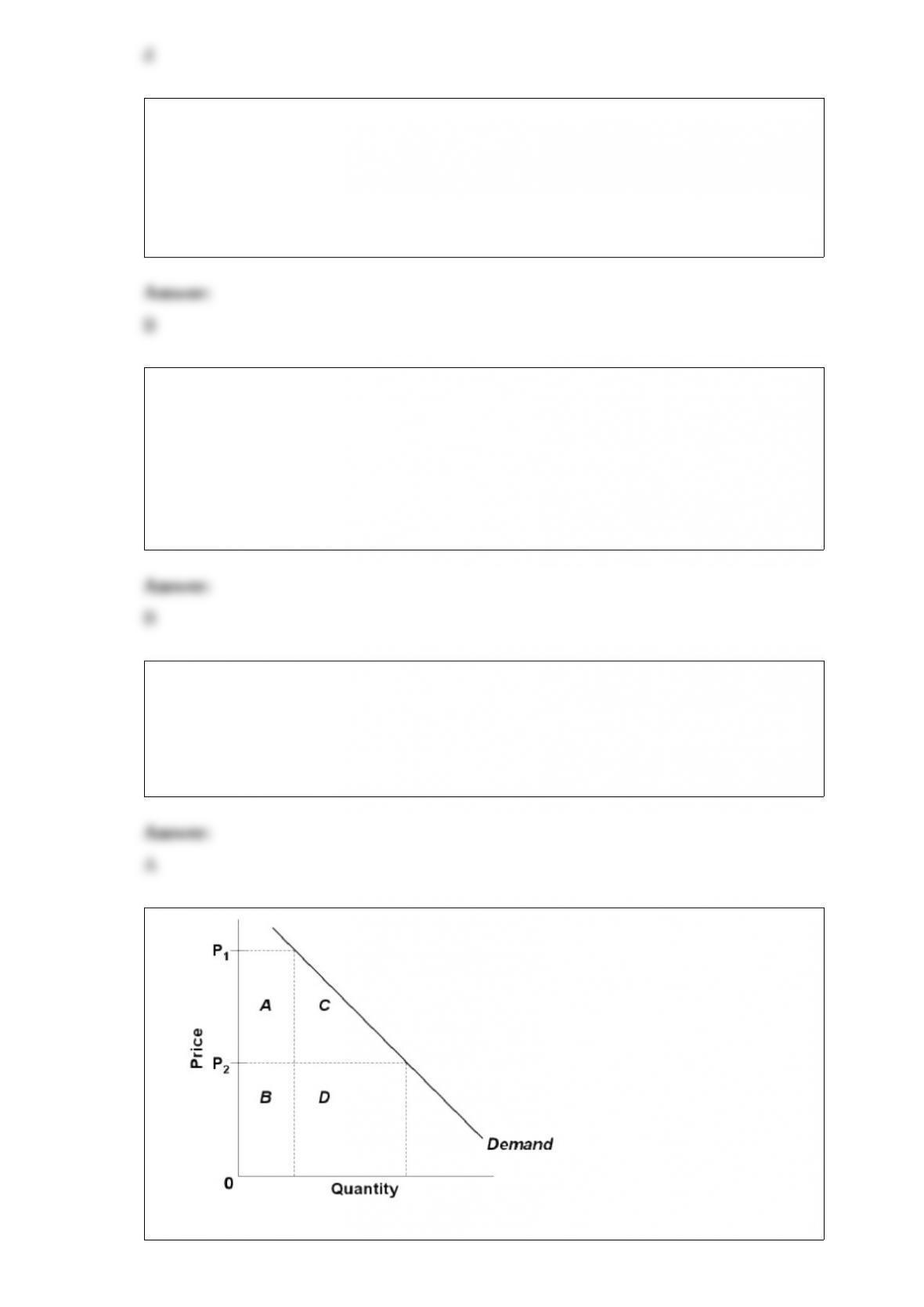
20)
refer to the above diagram. in the p1to p2price range, we can say:

a.that consumer purchases are relatively insensitive to price changes.
b.nothing concerning price elasticity of demand.
c.that demand is inelastic with respect to price.
d.that demand is elastic with respect to price.