
Supply-side government policies emphasize measures to
a. increase total real output while reducing the price level.
b. shift aggregate demand to the classical range of the supply curve.
c. shift the aggregate supply curve to the left.
d. increase taxes to finance increased government expenditures on public works
projects such as highways and mass transit.
e. supplement increased government spending with increased consumer spending on
goods and services.
If the product demand curve and cost functions of a perfectly competitive industry and
a monopolist are the same, then compared to a monopoly, the perfectly competitive
industry’s output and price tend to be, respectively
a. larger and higher.
b. smaller and higher.
c. larger and lower.
d. smaller and lower.
e. the same and lower.
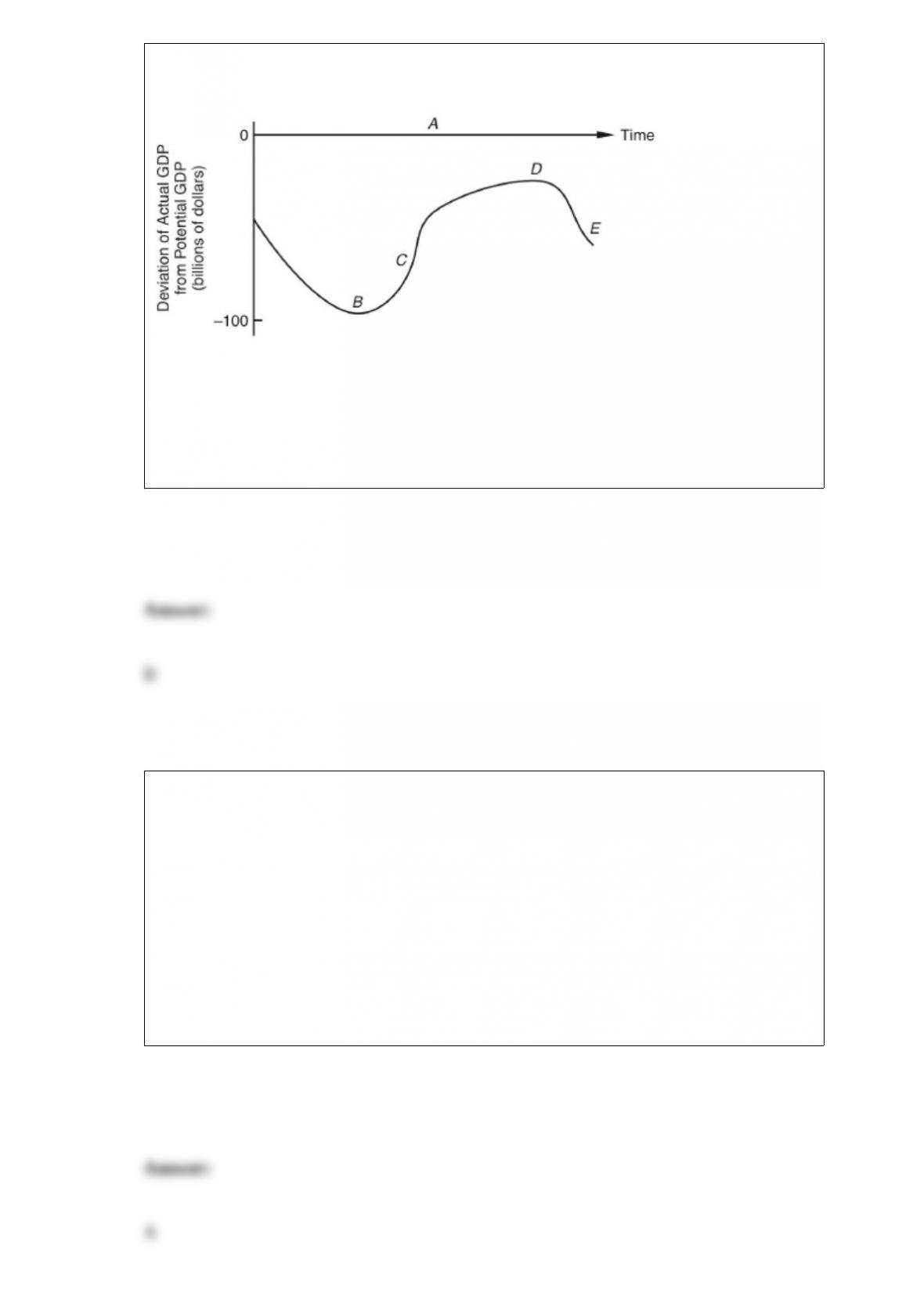
The following questions are based on the following diagram:
The trough of the cycle is best characterized by letter
a. A.
b. B.
c. C.
d. D.
e. E.
The high rates of inflation in the late 1970s and early 1980s fell primarily because of
a. a severe recession brought on by a tight monetary policy.
b. an easy money policy tied to a large federal deficit.
c. price and wage controls.
d. incomes policies.
e. sharp increases in federal tax rates.

The windfall price increase of an imported good that results when a quota is imposed on
that good accrues to
a. consumers who benefit from the lower-priced domestic substitutes.
b. no one, since only a tariff generates an explicit revenue stream.
c. firms in the industry protected by the imposition of the quota.
d. the government because it imposes the quota.
e. the importer who is successful in getting a license to import the good.
Excluded from the tasks an economic system must perform is determining
a. how free resources are to be allocated.
b. the level and composition of society’s output.
c. how each good and service is to be produced.
d. the rate of growth of per capita income.
e. how goods and services are to be distributed.

An asset that earns a fixed sum of money each year for its owner will
a. provide the same rate of return regardless of its cost.
b. provide its owner with a capitalized value equal to its annual payment.
c. have its present value capitalized each time the annual payment is received.
d. yield a lower rate of return when its price declines.
e. decline in price when the market rate of interest rises.
In the face of a balance-of-payments deficit, a country may maintain its exchange rate
at a fixed level by
a. buying gold.
b. buying its own currency on foreign exchanges.
c. encouraging imports.
d. spending more abroad.
e. doing nothing; its exchange rate automatically adjusts by supply and demand.
Suppose you are traveling in England and find that you can get 3 British pounds for
every $5 you convert to British currency. The dollar price of the pound is

a. $0.60.
b. $1.50.
c. $1.67.
d. $3.
e. $5.
If a natural monopoly is forced to break up into many smaller competitive firms, prices
will most likely
a. fall dramatically.
b. fall somewhat.
c. stay about the same.
d. rise.
e. there is not enough information available to answer this question.
In this model of the circular flow, the dollar flows
a. are clockwise.

b. are counterclockwise.
c. on the right side are clockwise and those on the left side are counterclockwise.
d. on the right side are counterclockwise and those on the left side are clockwise.
e. on the right side are greater than those on the left side.
A tax bill passed by Congress
a. automatically becomes law.
b. may still be vetoed by the president.
c. must still go to the Internal Revenue for approval.
d. cannot be amended in any way, whether it becomes law or not.
e. is administered by the Federal Reserve System.
A decrease in the money supply
a. shifts the aggregate demand curve to the left.
b. shifts the aggregate demand curve to the right.

c. shifts the aggregate supply curve to the left.
d. shifts the aggregate supply curve to the right.
e. affects neither the aggregate demand nor the aggregate supply curve, only interest
rates.
A government budget deficit
a. is more inflationary when financed by higher tax rates.
b. is generally considered undesirable in the Keynesian view of economic policy.
c. can never occur when the structural deficit is zero.
d. that is financed by creating new money draws funds that might otherwise have been
spent on consumption and investment.
e. could result from recession-induced decreases in tax revenues rather than from
increases in government spending.
Inflation accelerates or decelerates when the
a. NAIRU equals the natural rate of unemployment.
b. actual rate of unemployment remains below or above the NAIRU.

c. full-employment rate of unemployment remains above or below the natural rate of
unemployment.
d. rate of change in productivity exceeds or falls short of the NAIRU.
e. unemployment rate exceeds or falls short of the rate of inflation.
The price of labor services is generally called
a. profits.
b. capital.
c. an occupation.
d. wages.
e. employment.
A common argument against prices determined in noncompetitive markets is that such
prices
a. do not reflect consumer desires properly.
b. tend to be below competitive market prices, creating surpluses.
c. always work to the advantage of the buyer.

d. eliminate the need for regulation.
e. primarily promote the interest of those lacking market power.
The Malthusian forecast that population growth would outrun the food supply can be
explained in terms of
a. Say’s law.
b. the law of diminishing marginal returns.
c. the law of the jungle.
d. the law of demand.
e. Gresham’s law.
The following questions are based on the following diagram of a perfectly competitive
firm:
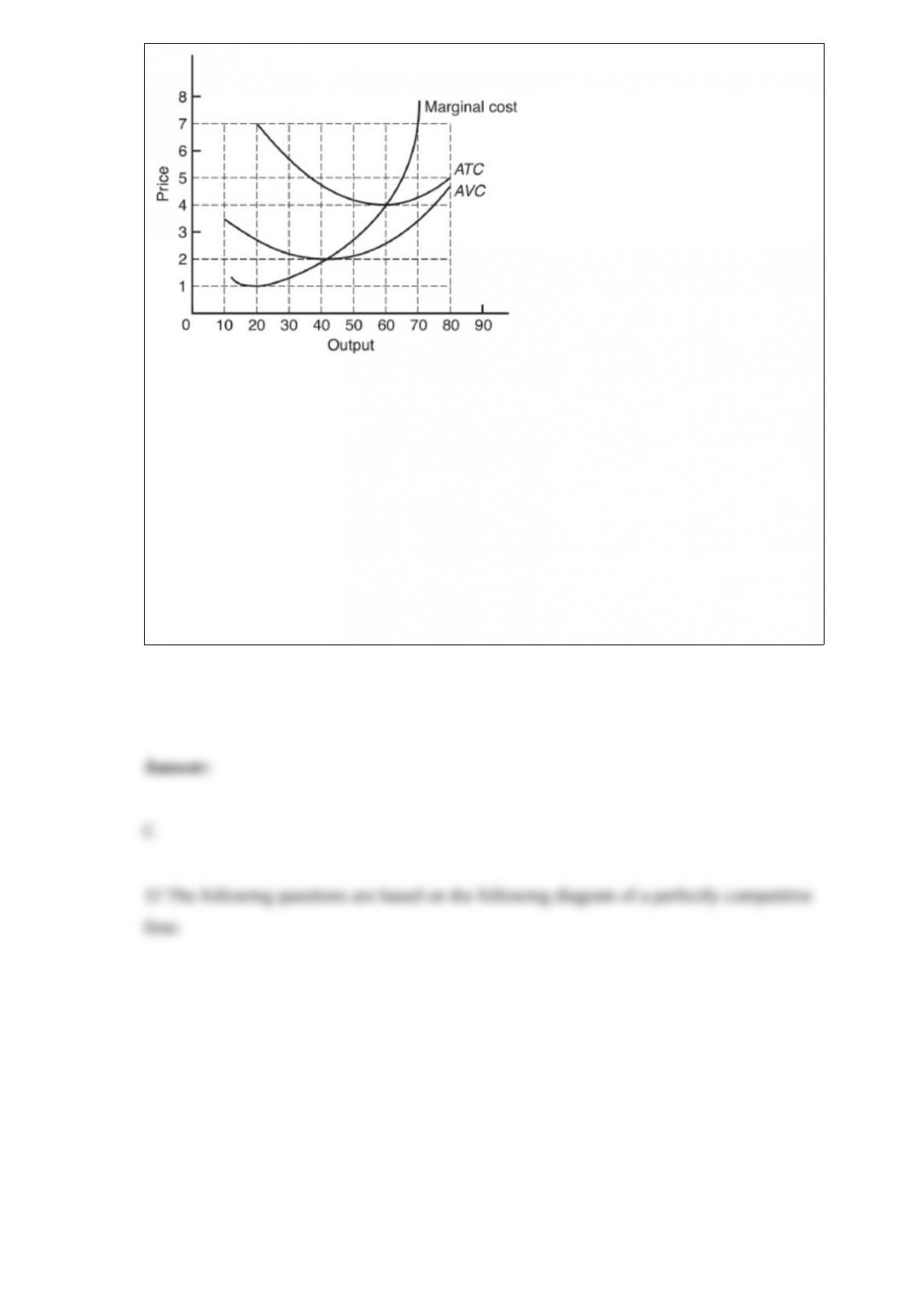
What is the minimum output that the firm would produce in the short run?
a. 20 units
b. 30 units
c. 40 units
d. 50 units
e. 60 units
There appears to be some consensus that the proper economic role of government
includes all of the following EXCEPT
a. providing help for those unable to care for themselves.
b. providing some public goods.
c. maintaining competition.
d. discouraging external economies.
e. maintaining a legal and social framework.

When President Kennedy took office in 1961, the economy was marked by relatively
high unemployment. On the advice of Walter Heller, Kennedy agreed to a tax cut to
deal with the problem. Viewed in historical perspective, the impact of this tax cut of
1964 was
a. great, stimulating investment, greatly reducing unemployment, and increasing GDP.
b. negligible on income and employment but caused a rapid increase in inflation.
c. moderate, insufficient to convince most economists that the decision was correct.
d. very slight, disappointing those who had favored a government spending package in
place of the tax cut.
e. negligible, so slight as to indicate that the decision was a poor one.
The following questions are based on the following diagram:
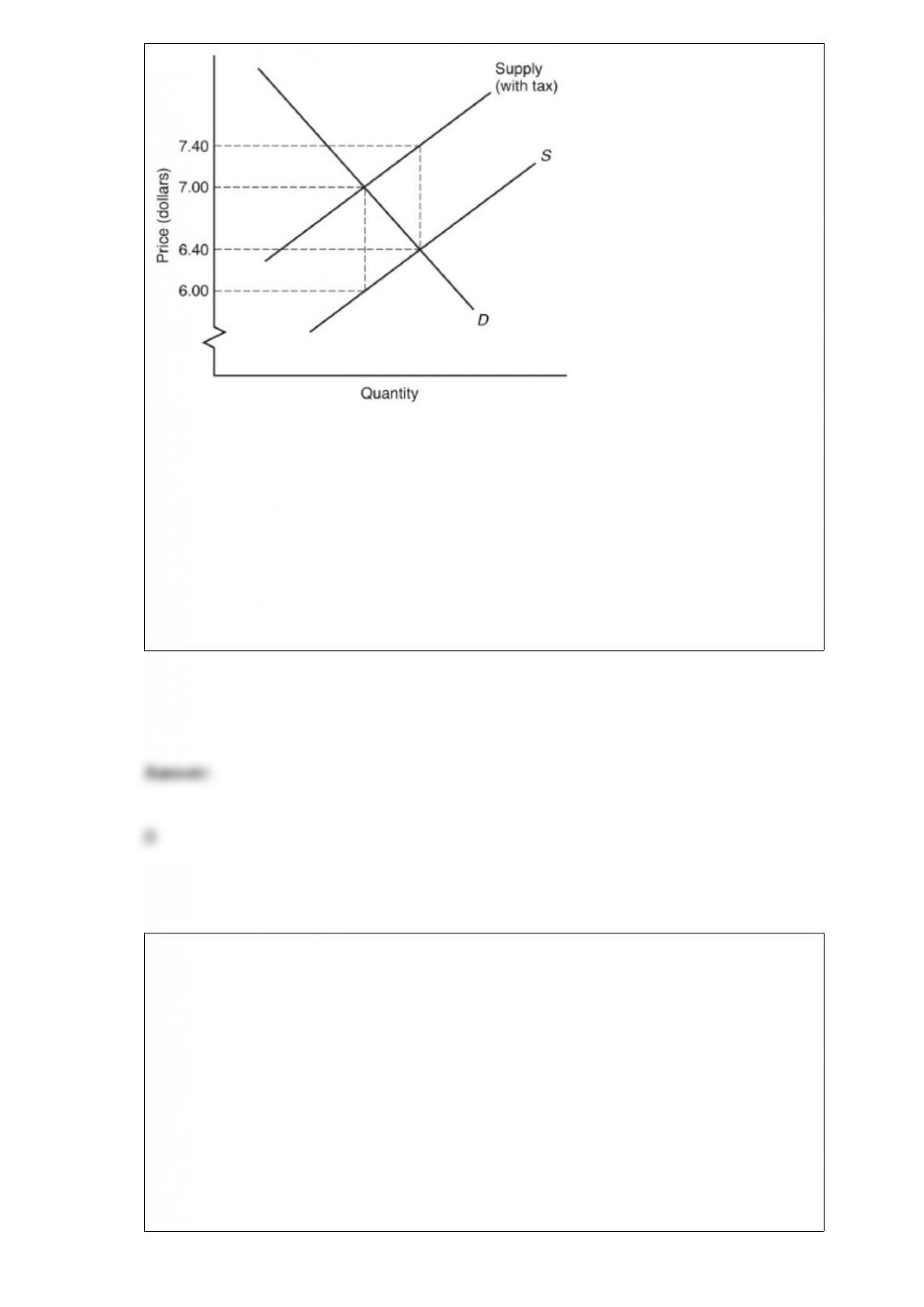
The amount of tax per unit is
a. $1.40.
b. $1.
c. $0.60.
d. $0.50.
e. $0.40.
The fact that there is no way to prevent citizens from benefiting from expenditures on
national defense, whether they pay taxes or not, is an example of a(n)
a. unfair distribution of income.
b. external economy.
c. external diseconomy.
d. public good.
e. transfer payment.

According to economist Richard Gill, the source of our economy’s real income is
a. profits.
b. the goods we produce.
c. the resourcefulness and skill of our people.
d. impossible to identify.
e. the amount of money in circulation.
The major international conference that helped mold international economic relations in
the post”World War II era and created the International Monetary Fund took place
a. at the Smithsonian Institute.
b. in Tokyo, Japan.
c. in Bretton Woods, New Hampshire.
d. in Brussels, Belgium.
e. at Yalta.

The large number of firms in a monopolistically competitive market ensures that
a. there is no room for new competitive entrants.
b. all firms charge identical prices.
c. product differentiation will disappear and output becomes homogeneous.
d. pricing and production actions by a single firm do not lead to retaliatory actions by
rival firms.
e. collusion among producers become commonplace.
An upward shift in the consumption function must
a. reduce equilibrium GDP.
b. be accompanied by a downward shift in the saving function.
c. reduce the value of the multiplier.
d. increase the volatility of the investment process.
e. reduce the amount of consumption at equilibrium.

A budget deficit has its inflationary impact reduced by
a. borrowing from the public.
b. creating new money.
c. borrowing from the central bank.
d. simultaneously reducing taxes.
e. raising the national debt.
Inflationary pressures may be lessened with measures designed to
a. shift the aggregate demand curve to the right.
b. shift the aggregate supply curve to the right.
c. shift the Phillips curve to the right.
d. couple a leftward shift in the aggregate supply curve with a rightward shift in the
aggregate demand curve.
e. make the aggregate supply curve vertical at a lower level of real output.
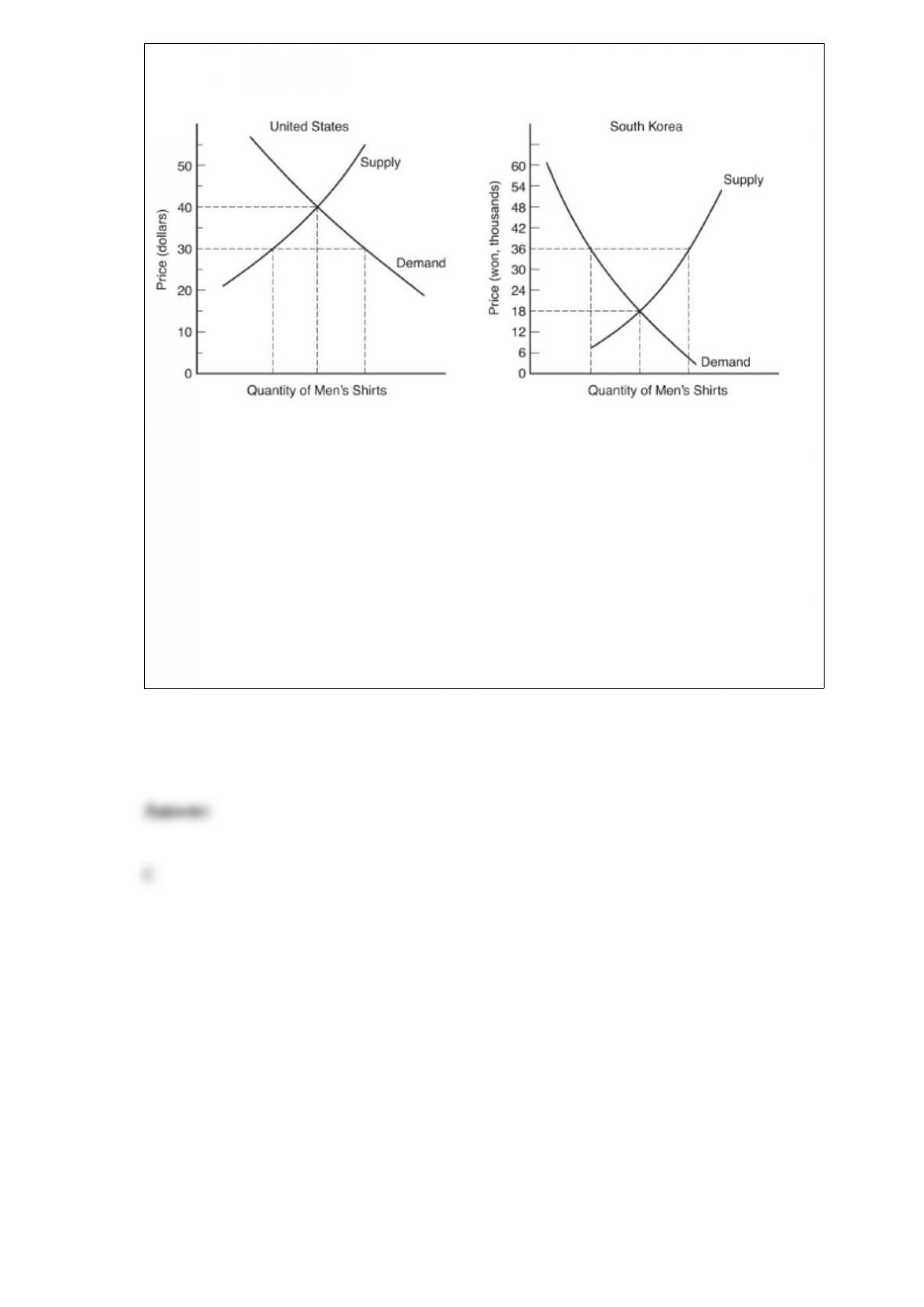
The following questions are based on the following graphs for men’s shirts in South
Korea and the United States. The exchange rate is 1,200 won equals $1.00.
Under free trade, the price of men’s shirts in South Korea tends toward ________ won.
a. 12,000
b. 24,000
c. 36,000
d. 48,000
e. 60,000