
The study of how people make decisions in situations in which attaining their goals
depends on their interactions with others is called
A) game theory.
B) oligopoly.
C) competitive analysis.
D) strategic analysis.
If firms and workers have rational expectations, including knowledge of the policy
being used by the Federal Reserve, the short-run Phillips curve will be
A) negatively sloped.
B) positively sloped.
C) vertical.
D) flatter in the long run than it is in the short run.
Gross domestic product is calculated by summing up
A) the total quantity of goods and services in the economy.
B) the total quantity of goods and services produced in the economy during a period of
time.
C) the total market value of goods and services in the economy.

D) the total market value of final goods and services produced in the economy during a
period of time.
Holding the price of a firm’s output constant, if the marginal product of labor increases,
A) the marginal revenue product of labor decreases.
B) the marginal revenue product of labor also increases.
C) the marginal products of other inputs also increase.
D) the marginal revenue product of labor may increase or decrease.
At a recent company meeting, Geraldine Erwin, sales manager of Dastoria, a flavored
beverage producer announced, “We have increased our sales by 8 percent in just six
months.” Suppose six months ago, its sales amounted to $452,000, what is the value of
its sales today?
A) $36,160
B) $415,840
C) $488,160
D) $565,000

In the legal sector, some practice areas have declined in recent years. For example,
personal-injury and medical-malpractice cases have been undercut by state laws
limiting class-action suits, out-of-state plaintiffs and payouts on damages, and securities
class-action litigation has declined in part because of a buoyant stock market. How does
this affect the market for lawyers?
A) The demand for lawyers shifts to the left.
B) The supply of lawyers shifts to the left.
C) The quantity of lawyers demanded decreases and this is represented by a movement
along the demand curve.
D) Both the demand and supply curves decrease.
If the price of smartphones was to increase, then
A) the demand for smartphone apps would decrease.
B) the demand for smartphone apps would increase.
C) the quantity of smartphone apps demanded would increase.
D) the quantity of smartphone apps demanded would decrease.

Figure 3-6
The figure above represents the market for coffee grinders. Compare the conditions in
the market when the price is $15 and when the price is $21. Which of the following
describes how the market differs at these prices?
A) At each price there is a shortage; the shortage is greater at $15 than at $21.
B) The difference between quantity supplied and quantity demanded is greater at $21
than at $15.
C) At each price there is a shortage; firms will raise the equilibrium price in order to
eliminate the shortage.
D) At each price the demand for coffee grinders exceeds the supply of coffee grinders.
There is a government budget surplus if
A) T – TR > G.
B) G > T.
C) G > TR.
D) TR < T.
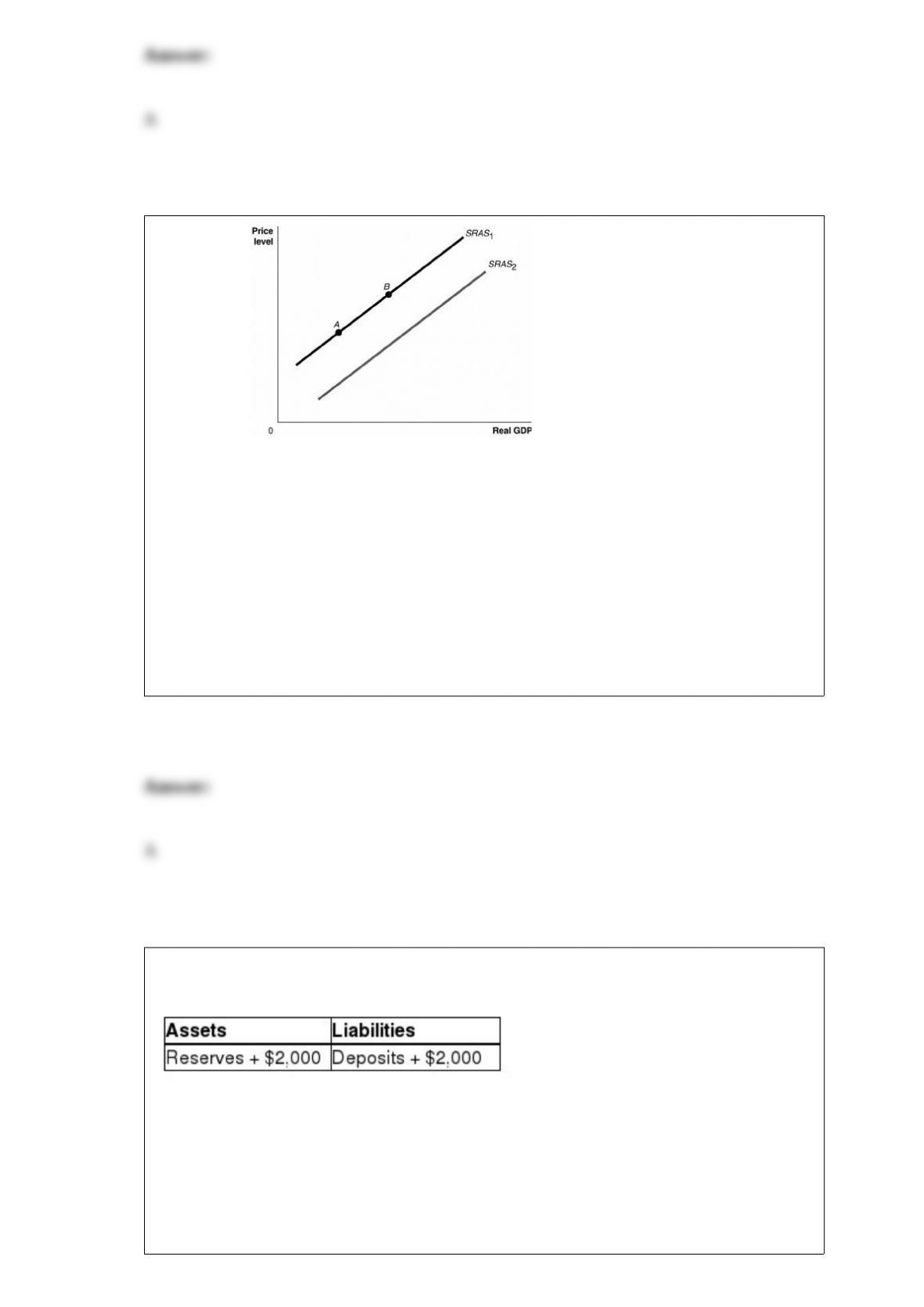
Figure 13-2
Ceteris paribus, an increase in the labor force would be represented by a movement
from
A) SRAS1 to SRAS2.
B) SRAS2 to SRAS1.
C) point A to point B.
D) point B to point A.
Suppose a transaction changes a bank’s balance sheet as indicated in the following
T-account, and the required reserve ratio is 10 percent.
As a result of the transaction, the bank can make a maximum loan of
A) $0.
B) $200.
C) $1,800.

D) $2,000.
Which of the following would shift the supply curve for MP3 players to the left?
A) an increase in the price of an input used to produce MP3 players
B) a decrease in consumer tastes for MP3 players
C) an increase in the number of firms that produce MP3 players
D) an increase in the productivity of the workers who produce MP3 players
The resource income earned by those who supply labor services is called
A) wages and salaries.
B) stock options.
C) profit.
D) bonus.