Canada has a single-payer health care system in which the government provides
national health insurance to all Canadian residents.
If buyers of a monopolistically competitive product feel the products of different sellers
have little differences between them, then the demand for each seller’s product is
relatively elastic.
If gold is used as money in an economy, the money supply is easy to control.
Developing countries with large informal sectors tend to have firms that invest less in
capital equipment.
The ability of a firm or country to produce a good or service at a lower opportunity cost
than other producers is called comparative advantage.
If the Fed attempts to reach and maintain very low rates of unemployment, we would
expect the rate of inflation to rise.
Producer surplus is the difference between the lowest price a firm is willing to accept
for a product and the price it actually receives for the product.
The nominal interest rate minus the inflation rate equals the real interest rate.
Recent rapid economic growth in India and China has reduced the amount of “brain
drain” in those countries.
In 2012, South America had a lower average GDP per capita than any other continent.
If a country is producing efficiently and is on the production possibilities frontier, the
country can produce more of one good without producing less of the other good.
If a corporate bond with face value of $5,000 has an interest rate of 4 percent paid once
a year for a term of 30 years, what is the size of the coupon payment?
A) $4
B) $200
C) $1,250
D) $5,000
What is moral hazard?
A) It refers to the private, self-interested actions that people pursue, which when taken
collectively leads to a loss in economic surplus.
B) It refers to the actions people take after they have entered into a transaction that
makes the other party to the transaction worse off.
C) It refers to the situation in which one party to a transaction takes advantage of
knowing more than the other party to the transaction.
D) It refers to the actions people take before they enter into a transaction so as to
mislead the other party to the transaction.
The multiplier is calculated as the
A) change in real GDP/ change in autonomous expenditure.
B) change in autonomous expenditure/ change in real GDP.
C) change in nominal GDP/ change in autonomous expenditure.
D) change in real GDP/ change in induced spending.
The popularity of digital cameras has enticed large discount stores like Wal-Mart and
Costco to offer digital photo printing services. How does this affect the digital photo
printing market?
A) The demand curve for digital photo printing services shifts to the right.
B) The demand curve for digital photo printing services shifts to the left.
C) The supply curve for digital photo printing services shifts to the right.
D) The supply curve for digital photo printing services shifts to the left.
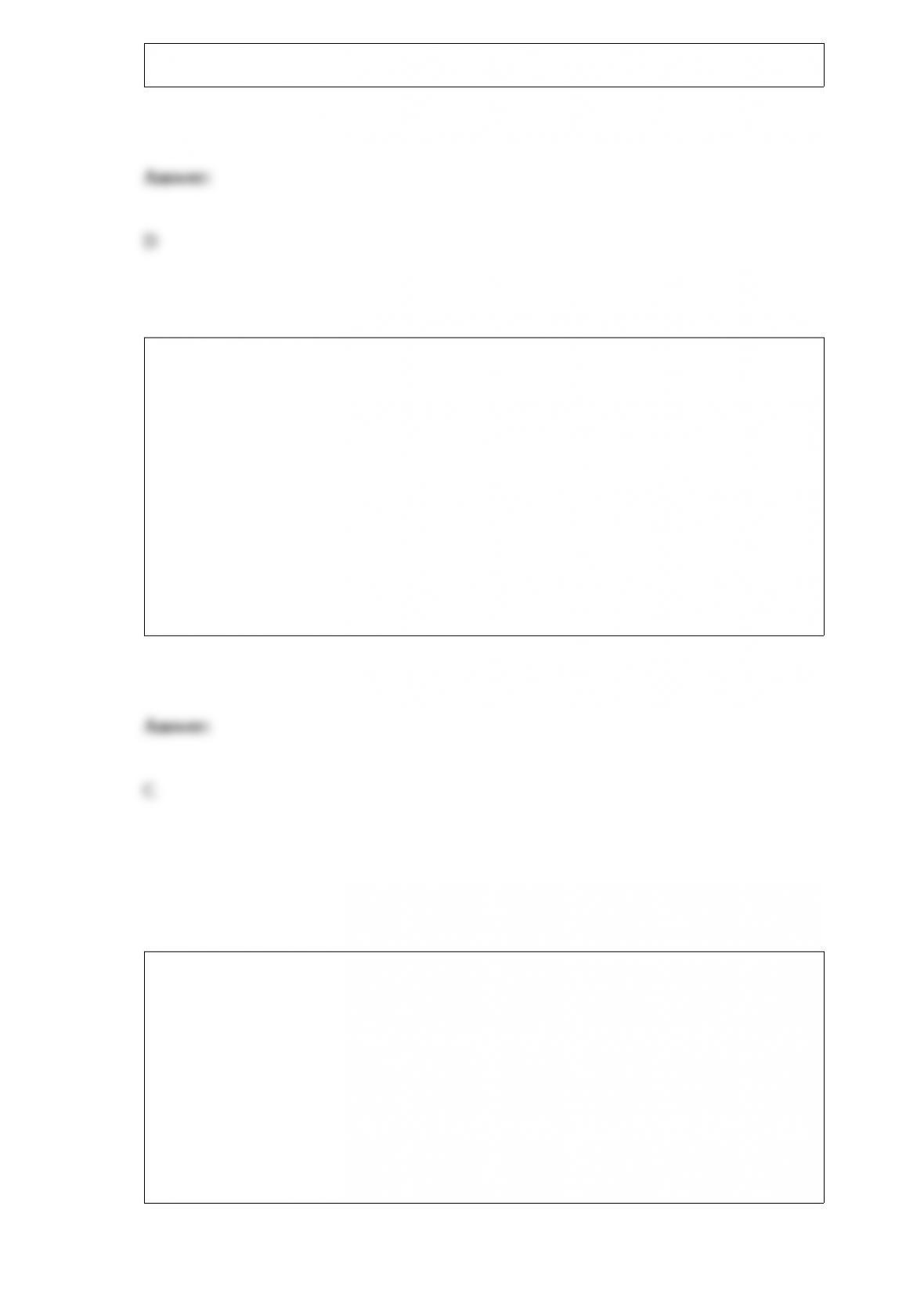
Figure 11-6
Figure 11-6 contains information about the
short run cost structure of a firm. In the figure above which letter represents the average
fixed cost curve?
A) A
B) B
C) C
D) D
At a recent company meeting, Geraldine Erwin, sales manager of Dastoria, a flavored
beverage producer announced, “We have increased our sales by 8 percent in just six
months.” Suppose six months ago, its sales amounted to $452,000. What is the value of
its sales today?
A) $36,160
B) $415,840
C) $488,160
D) $565,000
If the Federal Open Market Committee wants to decrease the money supply through
open market operations, it will
A) buy U.S. Treasury Securities.
B) sell U.S. Treasury Securities.
C) increase the discount rate.
D) decrease the discount rate.
The larger the share of a good in a consumer’s budget, holding everything else constant,
the
A) more price elastic is a consumer’s demand.
B) more vertical is a consumer’s demand curve.
C) more price inelastic is a consumer’s demand.
D) more unit-elastic is a consumer’s demand.
Deflation refers to
A) a decrease in the rate of inflation.
B) a falling price level.
C) Both A and B are correct.
D) None of the above is correct.
Figure 18-8
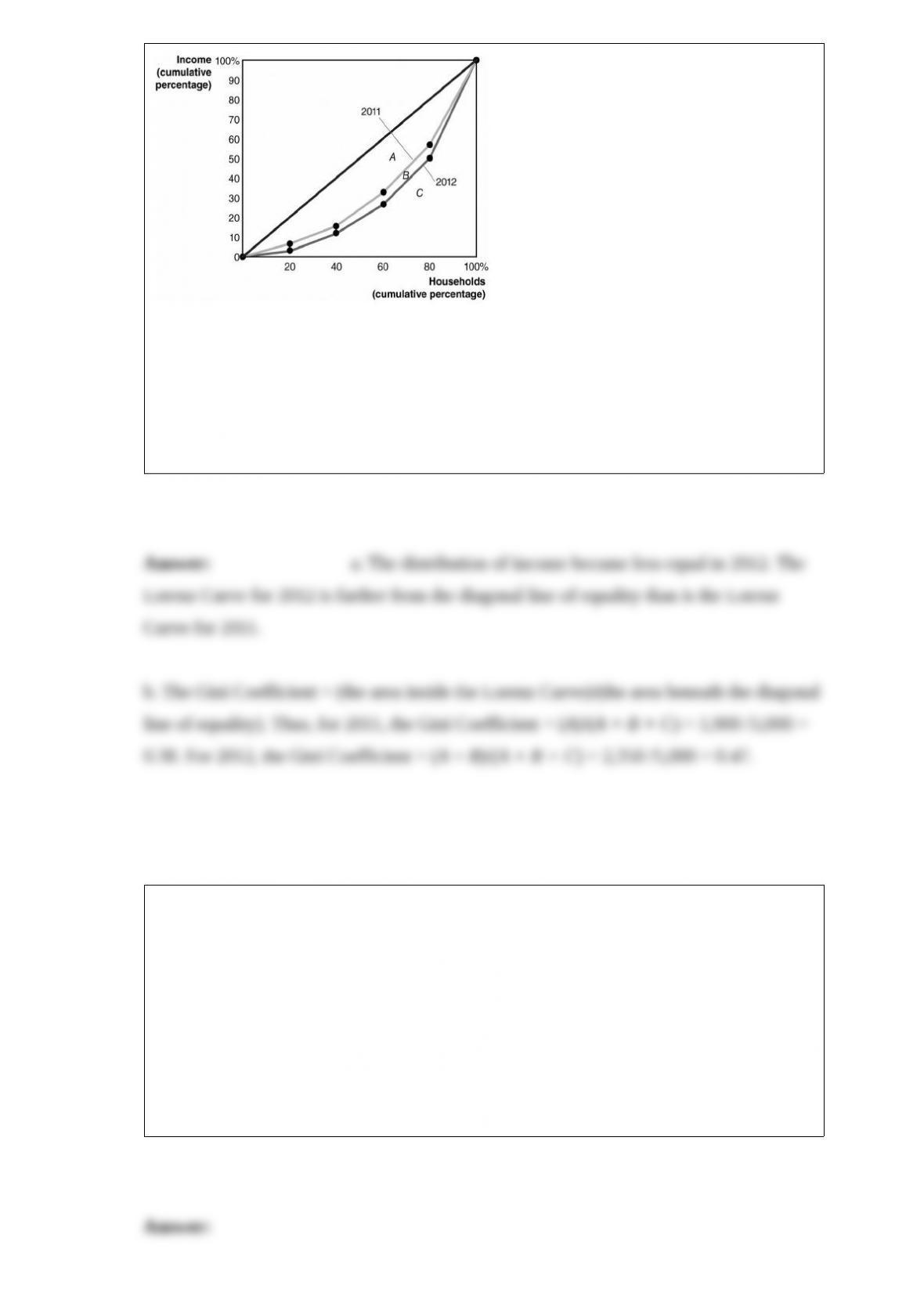
Answer the following questions.
a. Did the distribution of income become more equal in 2012 than it was in 2011, or did
it become less equal? Explain.
b. If area A = 1,900, area B = 450, and area C = 2,650, calculate the Gini coefficient for
2011 and the Gini coefficient for 2012.
If, in a closed economy, real GDP is $30 billion, consumption is $20 billion, and
government purchases are $5 billion, what is total saving in the economy?
A) $5 billion
B) $15 billion
C) $45 billion
D) $55 billion
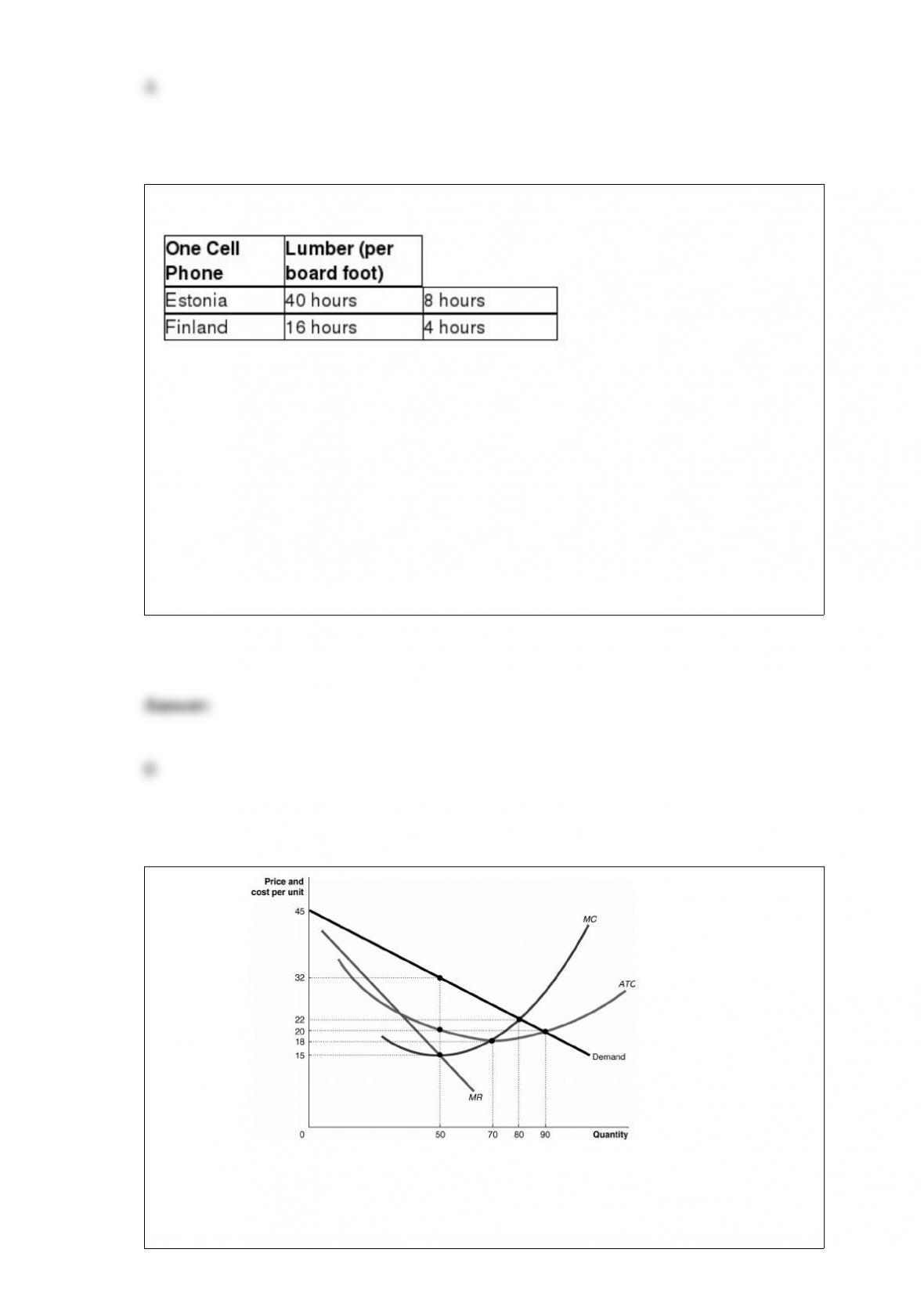
Table 2-5
Table 2-5 shows the number of labor hours required to produce a cell phone and a board
foot of lumber in Estonia and Finland. What is Estonia’s opportunity cost of producing
one cell phone?
A) 0.2 board feet of lumber
B) 5 board feet of lumber
C) 8 board feet of lumber
D) 32 board feet of lumber
Figure 15-7
Use the figure above to answer the following questions.
a. What is the profit-maximizing quantity and what price will the monopolist charge?
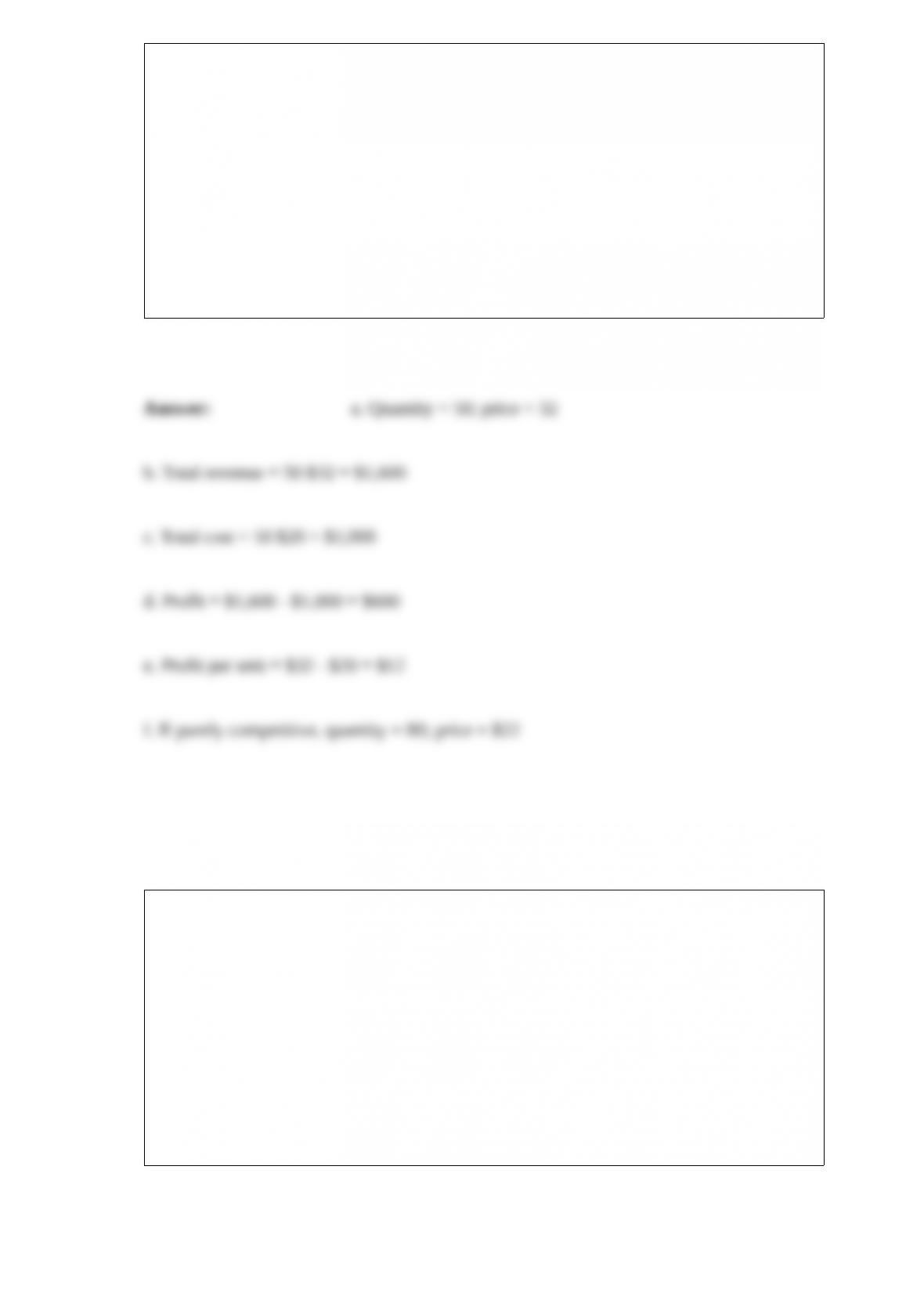
b. What is the total revenue at the profit-maximizing output level?
c. What is the total cost at the profit-maximizing output level?
d. What is the profit?
e. What is the profit per unit (average profit) at the profit-maximizing output level?
f. If this industry was organized as a perfectly competitive industry, what would be the
profit-maximizing price and quantity?
The labor force is the sum of
A) employed workers and discouraged workers.
B) employed workers and unemployed workers.
C) employed workers and individuals not looking for work.
D) employed workers and the working age population.
E) unemployed workers and the working age population.
The central role of ________ in a market economy is bringing together savers and
borrowers.
A) corporations
B) sole proprietors
C) financial intermediaries
D) stock exchanges
Japan has developed a comparative advantage in designing and producing automobiles.
The source of its comparative advantage in these products is
A) abundant supplies of natural resources.
B) a favorable climate.
C) a strong central government.
D) technology.
In the aggregate expenditure model, ________ has both an autonomous component and
an induced component.
A) planned investment spending
B) consumption spending
C) government spending
D) net export spending
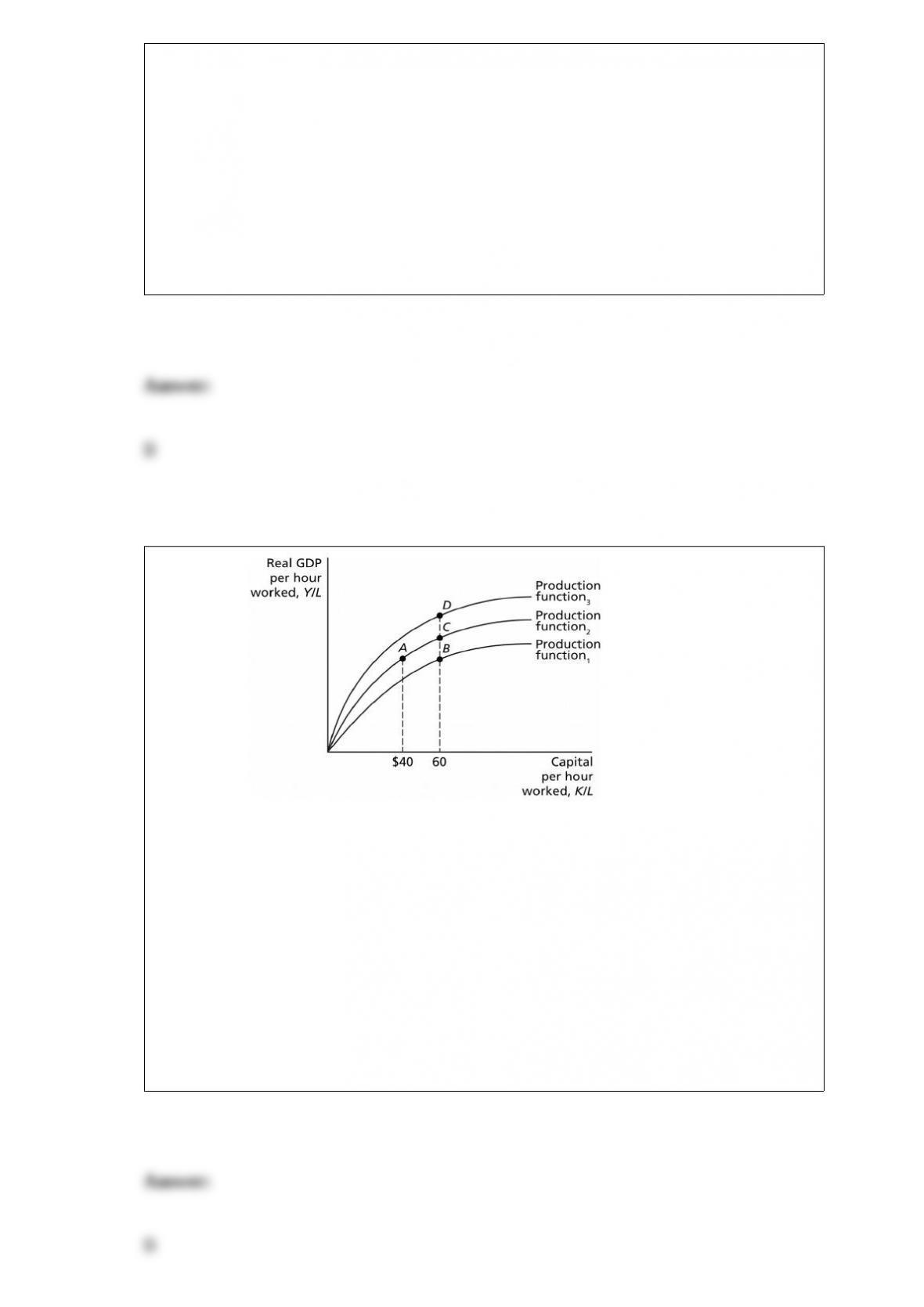
Figure 11-1
Many countries in Africa strongly discouraged and prohibited foreign direct investment
in the 1950s and 1960s. By doing so, these countries were essentially preventing a
moment from
A) A to B.
B) B to C.
C) B to A.
D) D to C.

What is the incentive for a firm to join a cartel?
A) to be able to earn profits in the long run but not in the short run
B) to be able to earn larger profits than if it was not part of the cartel
C) to completely insulate itself from competition
D) to produce a larger amount of output than if it was not part of the cartel
Figure 5-4
Suppose there are several paper mills producing paper for a market. These mills,
located upstream from a fishing village, discharge a large amount of wastewater into the
river. The waste material affects the number of fish in the river, and the use of the river
for recreation and as a public water supply source. Figure 5-4 shows the paper market.
Use this Figure to answer the following question(s).
What does S1 represent?
A) the market supply curve that reflects social cost
B) the market supply curve that reflects only external cost
C) the market supply curve that reflects only private benefit
D) the market supply curve that reflects private cost
Suppose you withdraw $1,000 from your savings account and put it under your
mattress. Briefly explain how this will affect M1 and M2.
What are capital controls? Why might a financial crisis lead to a reconsideration of
using capital controls, and what problems might result from the reinstatement of capital
controls?
What area on a supply and demand graph represents consumer surplus?
Why are individual buyers and sellers in perfect competition called price takers?
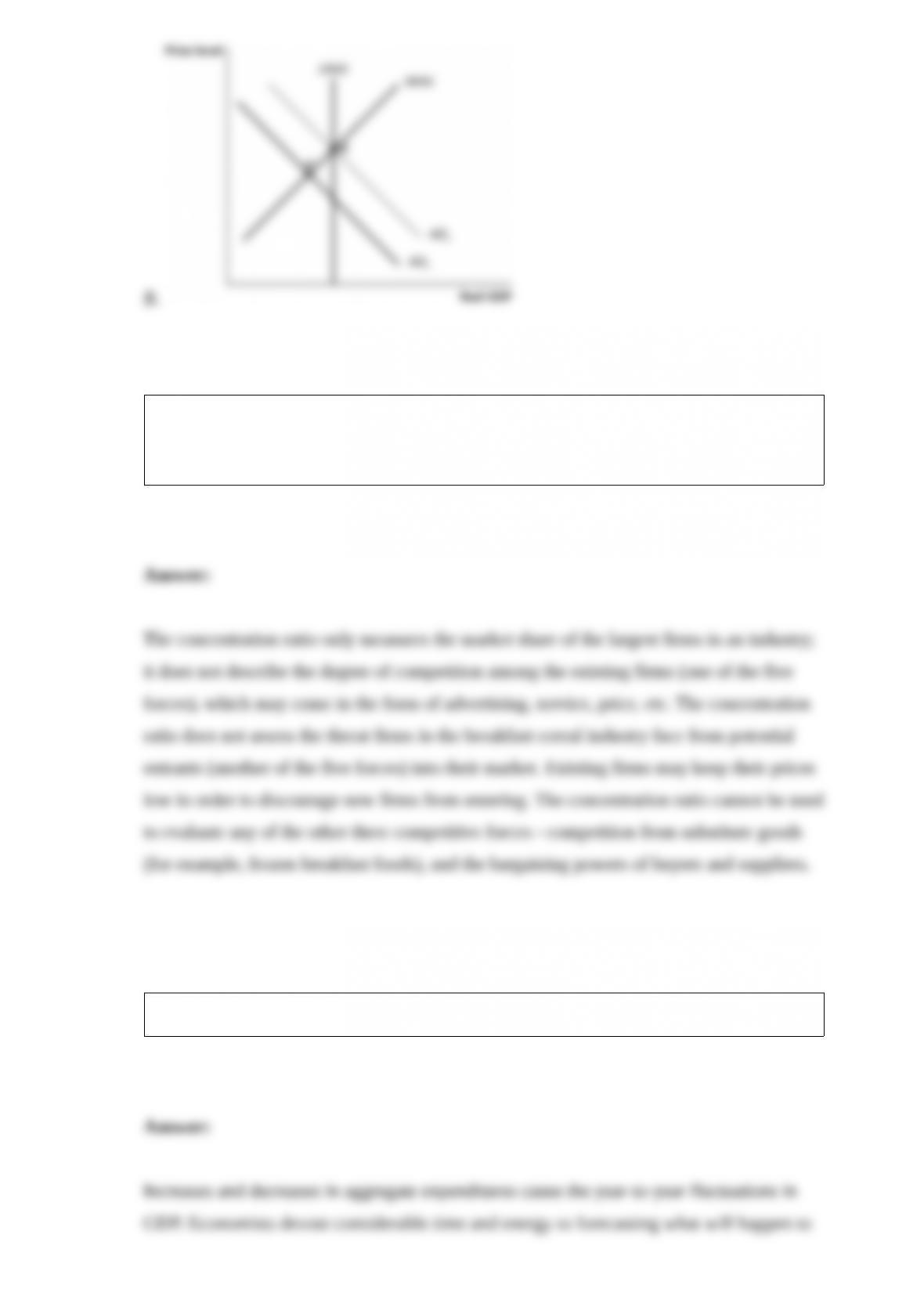
Use a graph to show the effects of an expansionary monetary policy moving an
economy out of recession and to potential real GDP. Explain what happens to aggregate
demand, real GDP, and the price level.
The four-firm concentration ratio in the breakfast cereal industry is 78 percent. How
does the five competitive forces model provide better insight into the degree of
competition in the breakfast cereal industry than just observing the concentration ratio?
Why do economists care about aggregate expenditures?
What is an economic variable?
What is the relationship between market failure and government failure?
How are market price, average revenue, and marginal revenue related for a perfectly
competitive firm and why?