
Average cost curves have the same shape as
a. total cost curves.
b. marginal cost curves.
c. total fixed cost curves.
d. average fixed cost curves.
Taxes are either
a. regressive, proportional, or degressive.
b. regressive, proportional, or progressive.
c. degressive, proportional, or progressive.
d. regressive, progressive, or degressive.
Demand is said to be price elastic at a point on a demand curve if a
a. 1 percent rise in price reduces the quantity demanded by more than 1 percent.
b. 1 percent rise in price reduces the quantity demanded by less than 1 percent.
c. 1 percent rise in price reduces the quantity demanded by more than 10 percent.

d. 10 percent rise in price reduces the quantity demanded by less than 10 percent.
After September 11, 2001, President George W. Bush believed in the need for a fiscal
stimulus. The proper fiscal policy to reflect this could include a(n)
a. increase in taxes.
b. reduction in transfer payments.
c. increase in government purchases.
d. All of the above are correct.
Inaccurate prediction generally invalidates the use of theory in economics.
a. True
b. False

An increase in aggregate demand is most likely to result in
a. inflation.
b. recession.
c. economic stagnation.
d. a decrease in real GDP.
Price discrimination leads to higher prices for all consumers.
a. True
b. False
The demand curve for a monopolistic competitor slopes downward because
a. demand drops to zero after a slight price increase.
b. there are close but not perfect substitutes for the product.
c. customers have no loyalty to the product.
d. the product is undifferentiated.

Firms can make decisions using marginal analysis even if they do not know the shape
of a demand curve.
a. True
b. False
The government of Economica announces that it will purchase its farmers’ surplus of
milk. From this announcement, you can infer that Economica has a
a. free market for milk.
b. price ceiling above the equilibrium price for milk.
c. price floor above the equilibrium price for milk.
d. price floor below the equilibrium price for milk.

If the slope of an indifference curve between two goods decreases as we move from left
to right (dropping all minus signs), we infer that the consumer
a. is less willing to trade away a good when he has a lot of it.
b. is more willing to trade away a good when he has a lot of it.
c. always tries to keep the percentage of his budget spent on each good constant.
d. views one of the goods as inferior.
John Maynard Keynes concluded that investment spending is determined by
a. business confidence.
b. economic expectations.
c. psychological perceptions about the economy.
d. All of the above are correct.
Which factor of production accounts for the highest percentage of the income that the
production process generates in the US?
a. Capital
b. Natural Resource

c. Land
d. Labor
In 2013 ____ of national factor income consisted of employee compensation.
a. 90 percent
b. 50 percent
c. 60 percent
d. 70 percent
Exchange rates vis-a-vis the U.S. dollar have changed little over time.
a. True
b. False

One country has an absolute advantage over another country if it can produce a good
using smaller quantities of resources.
a. True
b. False
As a result of Lehman’s collapse, real GDP first began to fall in
a. the fourth quarter of 2007.
b. the second quarter of 2008.
c. the third quarter of 2008.
d. the first quarter of 2009.
Examples of indirect taxes are
a. income taxes levied by some states.
b. sales taxes and property taxes.

c. poll taxes.
d. corporate profits taxes.
Why do permanent tax cuts have a greater impact on consumption than temporary tax
cuts?
a. Permanent tax cuts have a greater effect on expected long-run inflation.
b. Permanent tax cuts are perceived as minor while temporary tax cuts are larger and
more effective.
c. Permanent tax cuts cause movement along the consumption function, while
temporary tax cuts shift the consumption function.
d. Permanent tax cuts affect expectations of long-run income more than temporary tax
cuts.
The main reason that the deficit grows in a recession is that
a. the government reacts quickly and adjusts taxes to compensate.
b. monetary policy that targets interest rates causes the costs of borrowing to fall.
c. the deficit causes the recession, and reducing the deficit cures the recession.
d. many forms of taxes act as automatic stabilizers.
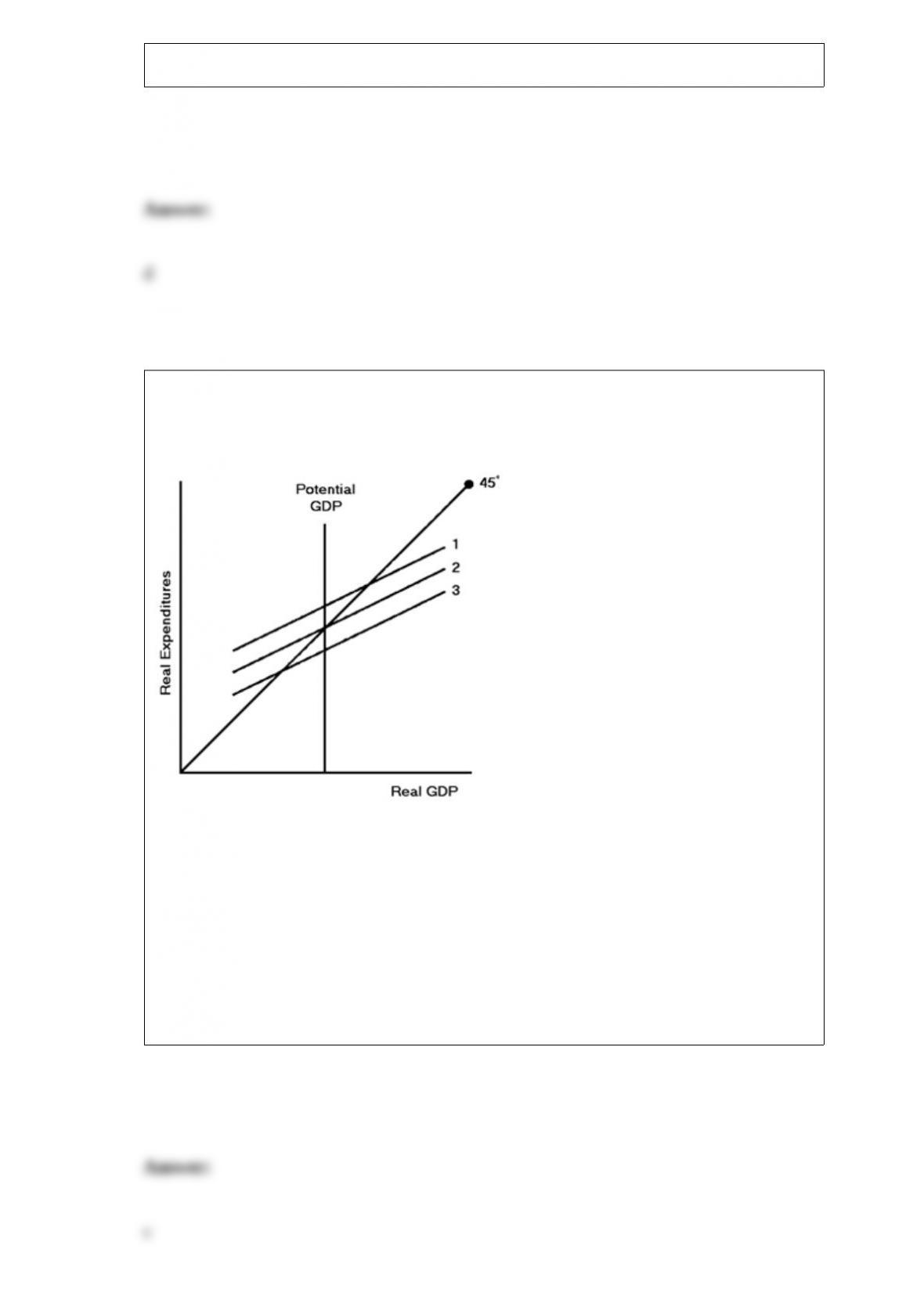
Figure 9-4
In Figure 9-4, which expenditure level will result in a recessionary gap?
a. 1
b. 2
c. 3
d. There will be no deflationary gap.

Because of the American national debt, future Americans will be burdened by heavy
interest payments which will necessitate higher taxes.
a. True
b. False
Chicken and fish are substitutes. Therefore, the cross elasticity of demand between
chicken and fish is
a. negative.
b. positive.
c. zero.
d. Any of the above is possible.
Which of the following is true regarding the effect of deficits from 1980-2005 in the
U.S.?
a. They did not lead to substantial inflation because the Fed did not monetize the
deficits.
b. They did not lead to substantial inflation because the Fed did monetize the deficits.

c. They led to substantial inflation because the Fed did not monetize the deficits.
d. They led to substantial inflation because the Fed did monetize the deficits.
No economist today would claim that
a. marginal productivity analysis is either just or unjust.
b. the marginal productivity theory of distribution is a theory of the demand side of the
pertinent market.
c. payments are made not to factors of production but to the people who happen to own
them.
d. a productive input’s MRP depends in part on how much of it is employed.
One piece of evidence that business fluctuations are caused by demand-side changes
would be that
a. monetary and fiscal policy will move inversely.
b. interest rates and budget deficits will move inversely.
c. unemployment and inflation will move inversely.
d. unemployment and budget deficits will move inversely.

The expected effects of monetary expansion are
a. lower real interest rates.
b. exchange rate depreciation.
c. higher inflation.
d. All of the above are correct.
The major advantage of the corporation is
a. limited liability for owners.
b. greater profit incentive than the other forms of business organization.
c. lower taxes for owners, who are taxed only once.
d. ability of owners to have hands-on management of the firm.

Federal tax loopholes in personal income tax provide benefits only to very high-income
people.
a. True
b. False
Liberals tend to favor increasing taxes as the method of counteracting inflation.
a. True
b. False
What makes the demand curve of the perfectly competitive firm uniquely different from
that of firms in other kinds of market structures?

Should stock market speculation be encouraged or discouraged?
Some companies follow a strategy of sales maximization. They say that this puts them
in close touch with their customers and they can better track the market, responding to
needs more quickly. However, this increases costs because of the need to stock a wider
variety of parts and sizes and colors, etc. What would make this strategy a
profit-maximizing one?
Explain three factors that would cause the dollar to appreciate.
What is division of labor? How does it raise efficiency and productivity?
How does the task of production planning happen in a laissez-faire economy?
P = MC is a recipe for financial loss in an innovative firm established by an innovative
entrepreneur. Explain.
Americans are creating an enormous amount of solid waste daily-over 4 pounds per
person per day. How is the United States coping with this extraordinary problem?
How does a laissez-faire economy decide which consumer gets each of the goods that
has been produced?
Discuss the role of individuals and governments in committing environmental damage.
In the spring of 2002, Argentina was forced to devalue its peso and disband its currency
board that was responsible for the fixed exchange rate between the peso and the U.S.
dollar. Explain the origin of this crisis and the painful remedies that Argentina has had
to endure.
Define discrimination. Why does discrimination occur and what evidence exists that it
does occur?
Explain why firms that enjoy economies of scale or scope are candidates for regulation.
Plot the demand for caviar given the following information on quantity consumed and
total utility; then explain why caviar sells for such a high price.
Explain how a diversified portfolio can reduce fluctuations in returns even when the
economy as a whole is experiencing contractions and expansions.
Because the U.S. economy failed to snap back from a mild recession in 2001, the Fed
pushed the federal funds rate down to 1%. What effect did this have on the economy?