1) unanticipated inflation benefits some groups in the economy.
2) the smaller the number of good substitutes for a product, the greater will be the price
elasticity of demand for it.
3) about two-thirds of all federal spending is for national defense.
4) That government that has the smallest budget is the most efficient in the economic
sense.
5) The Fed increases interest rates mainly by selling government securities.
6) when total utility is at a maximum, marginal utility is zero.
7) If the reserve requirement is 10 percent, the monetary multiplier will be 10.
8) in determining gdp by the expenditures method it is appropriate to use net investment
rather than gross investment as a measure of investment spending.
9) The following information. Assume that by devoting all its resources to the
production of X, nation Alpha can produce 40 units of X. By devoting all its resources
to Y, Alpha can produce 60Y. Comparable figures for nation Beta are 60X and 40Y.
Refer to the above information. If Alpha had produced 20X and 30Y and Beta had
produced 30X and 20Y before specialization and trade, then we can say that the gains
from specialization and trade are 10X and 10Y.
10) producing a good in the least costly way is known as allocative efficiency.
11) a tax subsidy is involved in employer-financed health insurance because:
a.all working adults are covered by medicare.
b.all working adults are covered by medicaid.
c.employer payments for health insurance are not subject to income or payroll taxes.
d.corporations that provide health insurance pay lower corporate income tax rates.
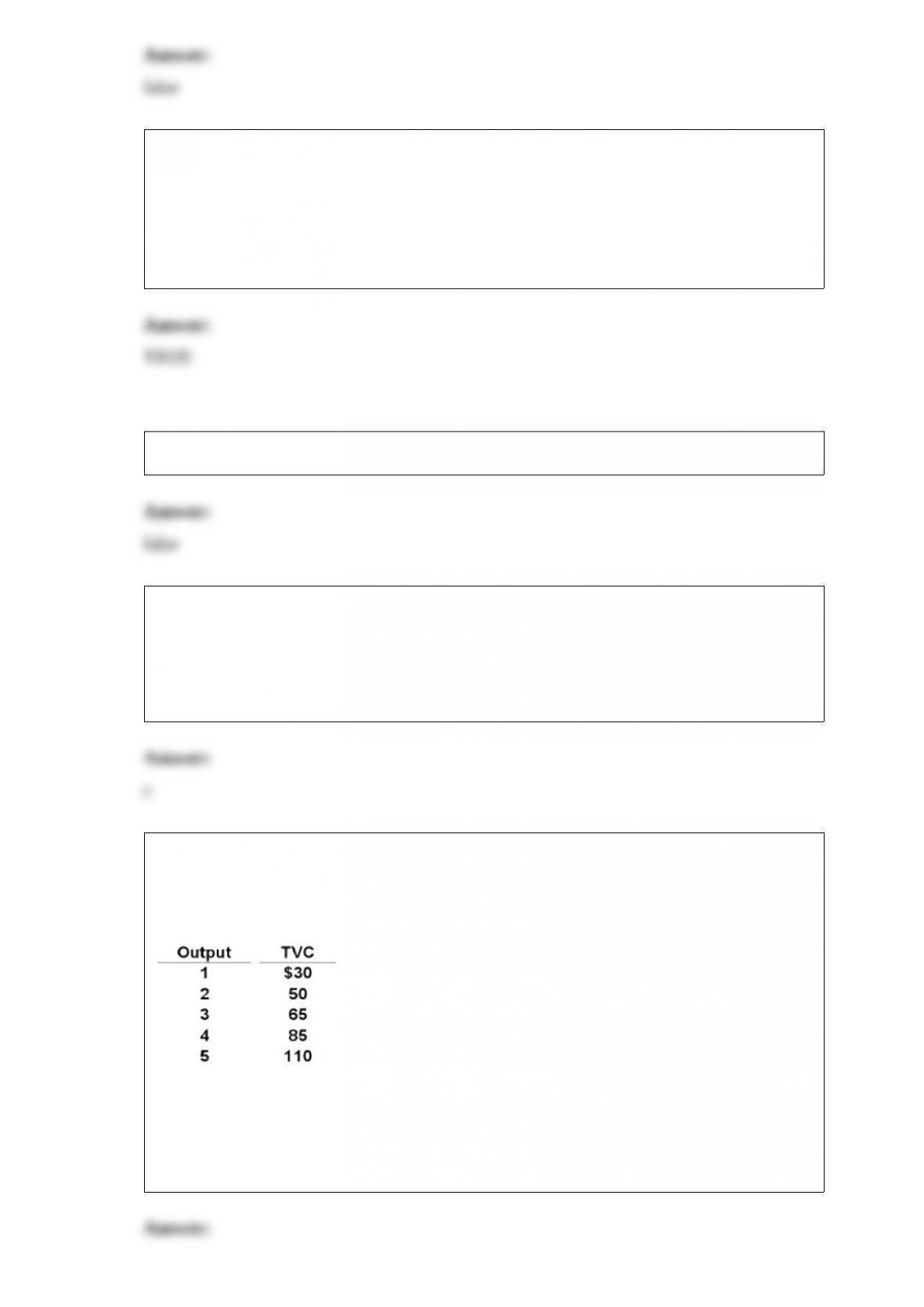
12) the sunshine corporation finds that its costs are $40 when it produces no output. its
total variable costs (tvc) change with output as shown in the accompanying table. use
this information to answer the following question(s).
refer to the above information. the total cost of producing 3 units of output is:
a.$65.
b.$105.
c.$145.
d.$185.
13) The increased-domestic-employment argument for tariff protection holds that:
A.domestic inflation is a desirable policy goal because it stimulates exports.
B.domestic deflation is a desirable policy goal because it stimulates imports.
C.an increase in tariffs will reduce net exports and stimulate domestic employment.
D.an increase in tariffs will increase net exports and stimulate domestic employment.
14) an economic hypothesis:
a.has the same meaning as an economic principal or economic law.
b.is usually a normative statement.
c.is a possible explanation of cause and effect.
d.is a stronger generalization than an economic law.
15) In 1999 and 2000 the Fed increased the Federal funds rate several times. The Fed’s
purpose was to:
A.prevent rising inflation.
B.reduce the unemployment rate.
C.stimulate economic growth.
D.strengthen the international value of the dollar.
16) The crowding-out effect suggests that:
A.tax increases are paid primarily out of saving and therefore are not an effective fiscal
device.
B.government borrowing to finance the public debt increases the real interest rate and
reduces private investment.
C.it is very difficult to have excessive aggregate spending in a capitalist economy.
D.consumer and investment spending always vary inversely.
17) Economists call the pursuit of a transfer of wealth through government at someone
else’s expense:
A.the paradox of voting.
B.the Coase theorem.
C.rent-seeking behavior.
D.the benefits-received principle.
18) personal income is most likely to exceed national income:
a.when gross and net investment are equal.
b.during a period of recession or depression.
c.when gross investment exceeds net investment.
d.during a period of extended inflation.
19) Evidence of a chronic balance of payments deficit is:
A.a decline in amount of the nation’s currency held by other nations.
B.an excess of exports over imports.
C.diminishing reserves of foreign currencies.
D.an increase in the international value of the nation’s currency.
20) Assume that Brazil and Mexico have floating exchange rates. Other things
unchanged, if the price level is stable in Mexico but Brazil experiences rapid inflation:
A.gold bullion will flow into Brazil.
B.the Brazilian real will depreciate.
C.the Mexican peso will depreciate.
D.the Brazilian real will appreciate.
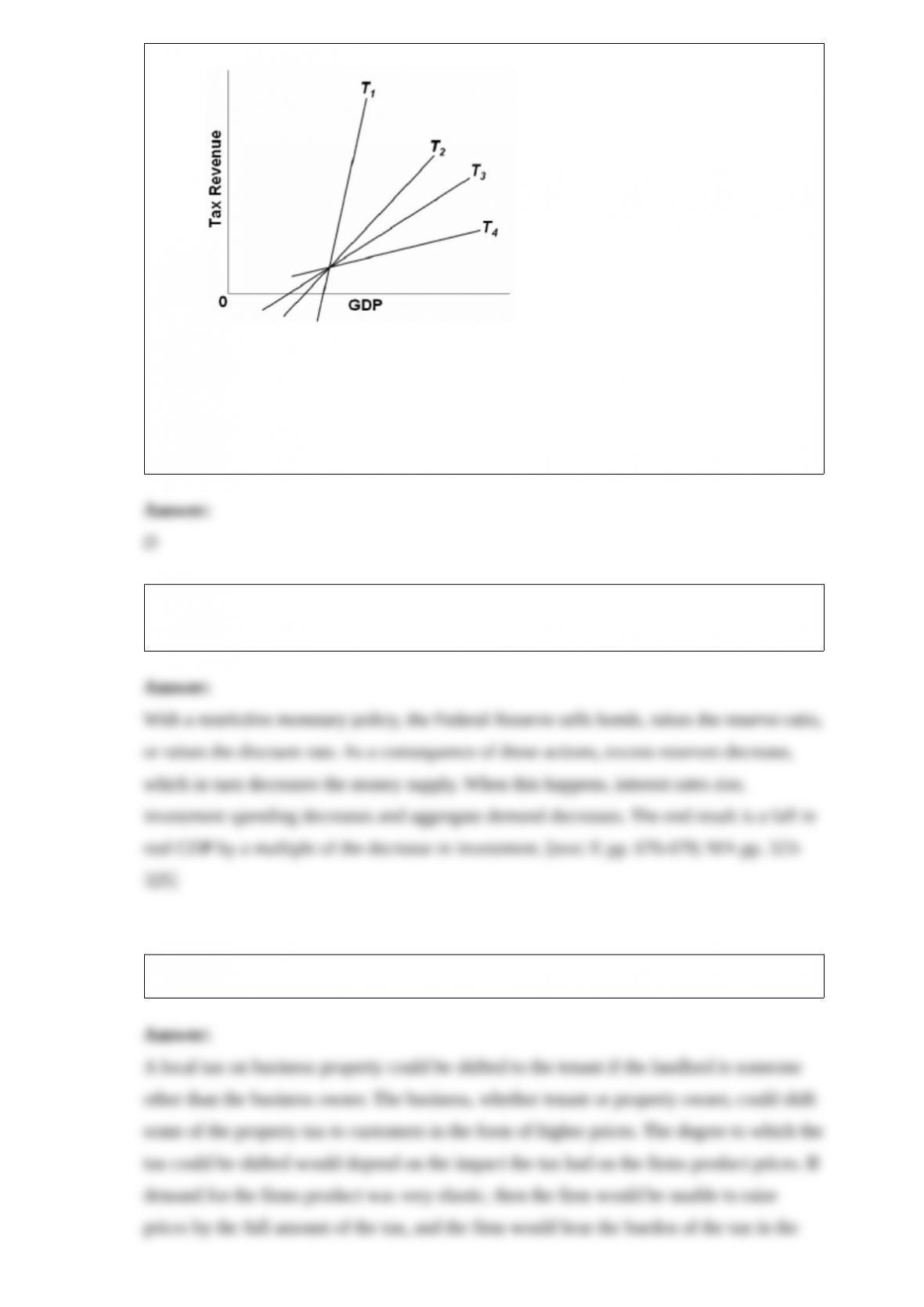
21)
Refer to the above diagram. Which tax system has the most built-in stability?
A.T4
B.T3
C.T2
D.T1
22) Suppose the economy is experiencing inflation. What would be the interpretation of
how a restrictive monetary policy would address this problem?
23) Discuss probable incidence of a local tax on business property.
24) What is the relationship between bank assets, liabilities and net worth?
25) What role can government play in fostering economic growth in developing
countries?
26) There is no such thing as risk-free return. Evaluate.
27) Assume that M is $200 billion and V is If V increases by 15%, what will be the
change in nominal GDP?