
Which of the following statements is true?
a. The less you have of any one good, the less you would be willing to pay for one more
unit of it.
b. The less you have of any one good, the more you would be willing to pay for one
more unit of it.
c. The amount you have of any one good does not influence the price you would be
willing to pay for it, but it does affect the marginal utility received from consuming a
particular unit.
d. none of the above
The demand curve facing a monopolistic competitor will be more elastic than the
demand curve facing a monopolist because
a. there are barriers to exit for the monopolist, but not for the monopolistic competitor.
b. the monopolistic competitor attains resource-allocative efficiency, but the monopolist
does not.
c. there are substitute goods for what the monopolistic competitor produces, but not for
what the monopolist produces.
d. the monopolist is a price searcher, but the monopolistic competitor is not.
If MPPX/PX < MPPY/PY, the firm should buy
a. more of factor X and less of factor Y.

b. less of factor X and more of factor Y.
c. more of factor Y and the same amount of factor X.
d. less of factor X and factor Y.
e. more of factor X and factor Y.
When firm A hires one worker it pays $10 an hour and its total labor cost is $10. When
it hires a second worker, it has to pay $11 to each of its two workers and its total labor
cost is $22. When it hires a third worker, it has to pay $12 to each of its three workers
and its total labor cost is $36. For firm A,
a. its marginal factor cost is greater than the wage rate it pays, except for the first
worker it hires.
b. its marginal factor cost is greater than the wage rate it pays, except for the first two
workers it hires.
c. its supply curve of labor lies above its marginal factor cost curve.
d. it is likely that marginal revenue product is always greater than marginal factor cost.
e. none of the above
In the case of nonexcludable goods, economists contend that the market ___________
produce these goods because of the ________________________.
a. will; free rider problem

b. will not; law of diminishing marginal utility
c. will not; law of diminishing marginal returns
d. will not; free rider problem.
Which of the following is not true about production possibilities frontiers?
a. moving from one point to another on a PPF incurs a tradeoff
b. economic growth is shown by shifting the PPF outward
c. unemployment of resources is shown by shifting the PPF inward
d. a PPF can shift inward or outward
The price elasticity of demand would most likely be highest for which of the following
goods?
a. food (in general)
b. cars (in general)
c. clothing (in general)
d. Ford cars
e. a, b, or c
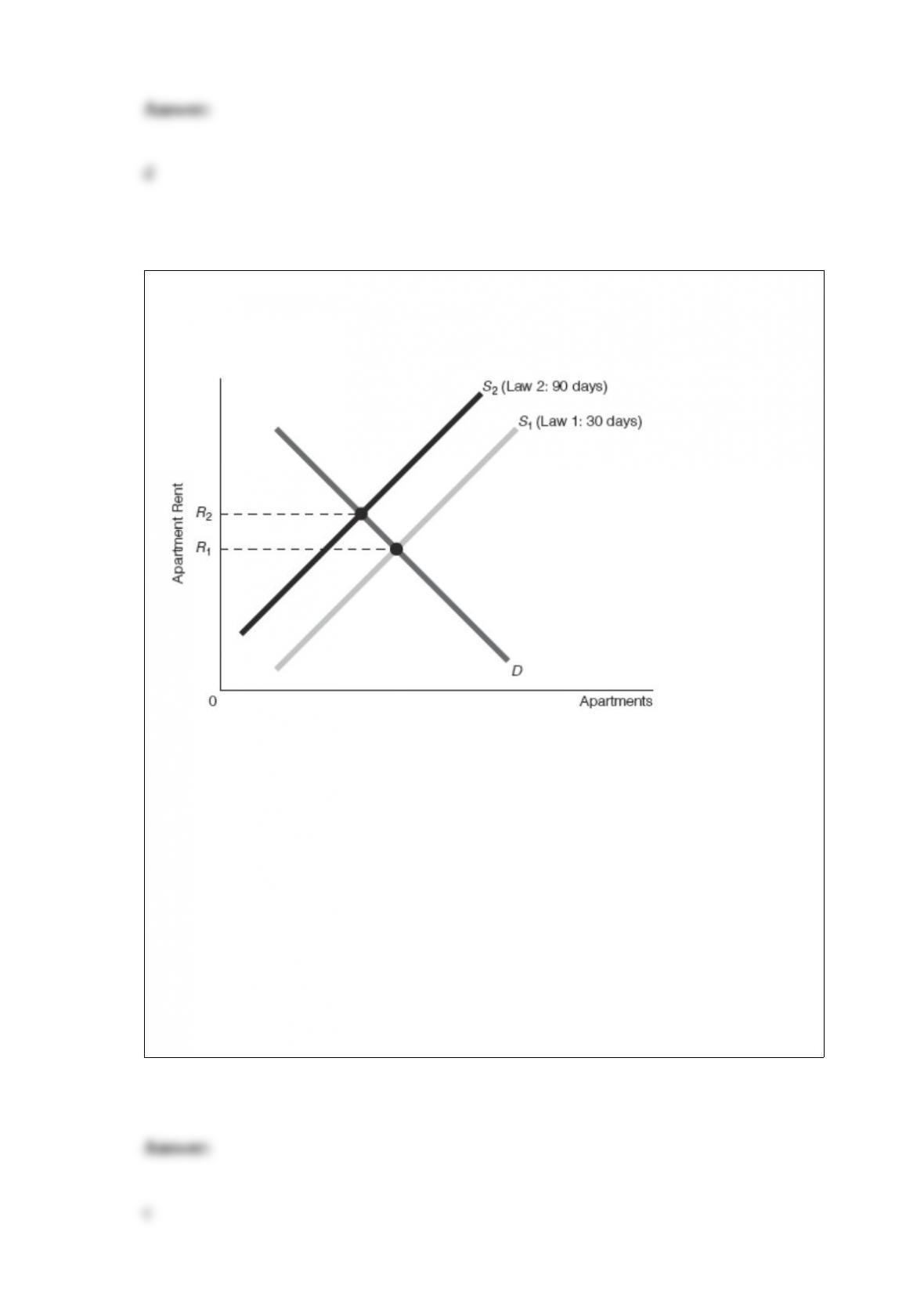
Exhibit 5-6
Under law 1 a renter has 30 days to vacate an apartment after being served with an
eviction notice.Under law 2, the renter has 90 days to vacate after being served with an
eviction notice.This graph shows that the supply of apartments is____________ under
law 1 than under law 2, and thus apartment rent is _______________ under law 1 than
under law 2.
a. less; lower
b. less; higher
c. greater; lower
d. greater; higher

The efficient number of gifts that a gift-giver wants to give is the number at which the
marginal benefits of giving a gift are__________________the marginal costs of giving
a gift.
a. greater than
b. less than
c. equal to
d. less than or equal to
Microeconomics is the branch of economics that deals with
a. highly aggregated markets or the entire economy.
b. the production side of the economy, exclusively.
c. the buying side of the economy, exclusively.
d. human behavior and choices as they relate to relatively small units — an individual, a
firm, an industry.
Which combination of factors would lead to large price and total revenue changes?
a. inelastic demand for a product and large swings in supply

b. elastic demand for a product and small swings in supply
c. inelastic demand for a product and constant supply
d. a and c
e. none of the above
A subsidy may be used as a corrective device in the case of a positive externality
because it will __________ marginal private benefits and __________ demand.
a. increase; decrease
b. increase; increase
c. decrease; decrease
d. decrease; increase
Exhibit 23-3
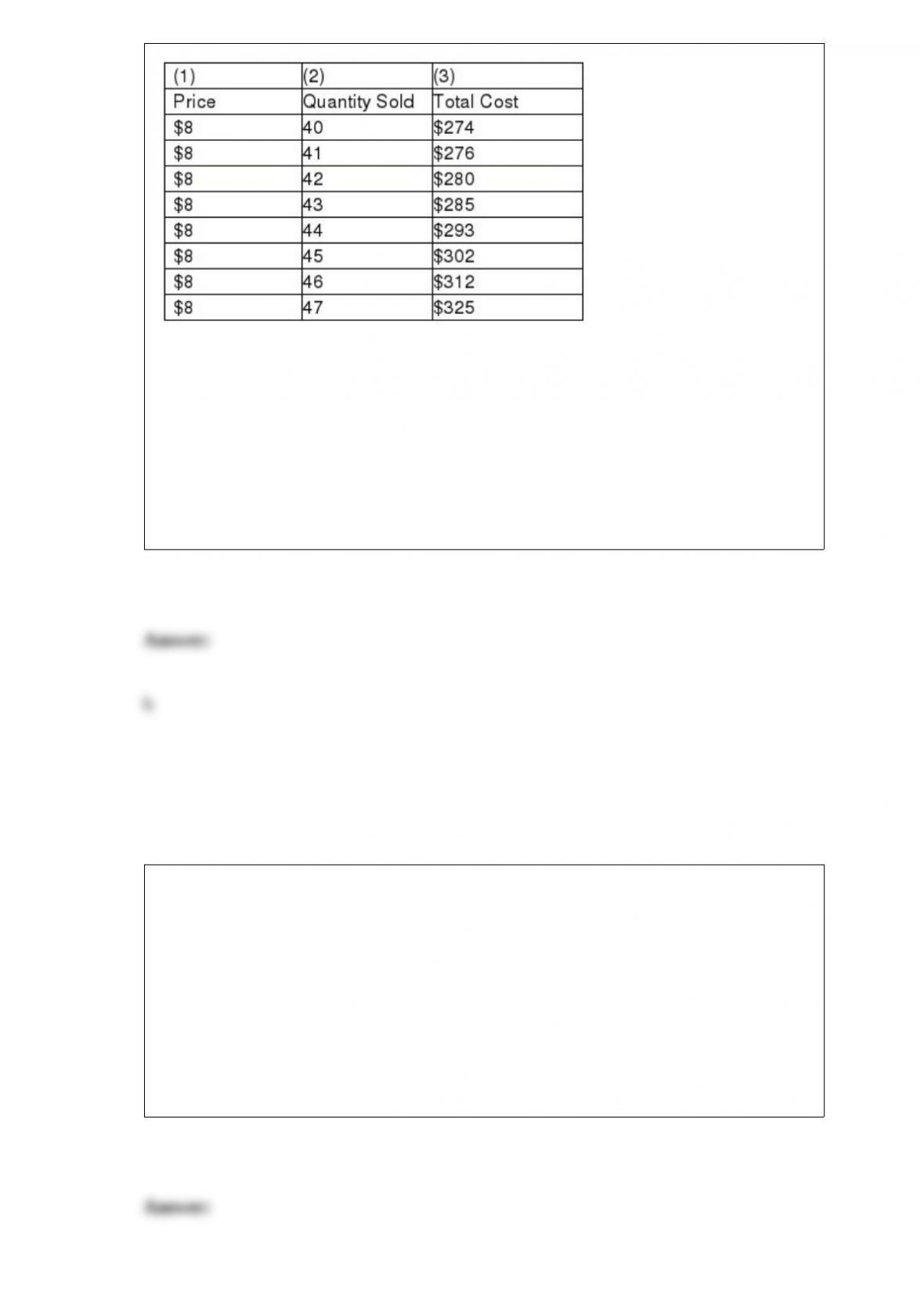
What is the maximum profit?
a. $65
b. $59
c. $20
d. $376
The condition often used in economics to isolate the relationship between two variables
is
a. causation.
b. abstraction.
c. ceteris paribus.
d. efficiency.

According to the text, farming today in the U.S. is __________ productive compared to
a century ago, resulting in there being __________ farmers today than at the turn of the
previous century.
a. about as; fewer
b. about as; more
c. much more; fewer
d. much more; more
The higher the price of medical care in general, the lower the
____________________________ medical care and the
______________________specific items that make up medical care (such as, x-rays).
a. quantity demanded of; higher the demand for
b. demand for; higher the demand for
c. quantity demanded of; lower the demand for
d. demand for; higher the quantity demanded of