1) If in a certain year the indices of prices received and paid by farmers were 115 and
142 respectively, the parity ratio (in percentage terms) would be:
A.123.
B.81.
C.69.
D.27.
2) the smoot-hawley act:
a.bound the world’s nations to a gradual process of tariff reduction.
b.established very high tariffs on goods imported to the united states.
c.exempted american exporters from the sherman antitrust act.
d.established the reciprocal trade agreements program.
3) The largest single share of all income earned by Americans consists of:
A.wages and salaries.
B.interest.
C.rents.
D.corporate profits.
4)
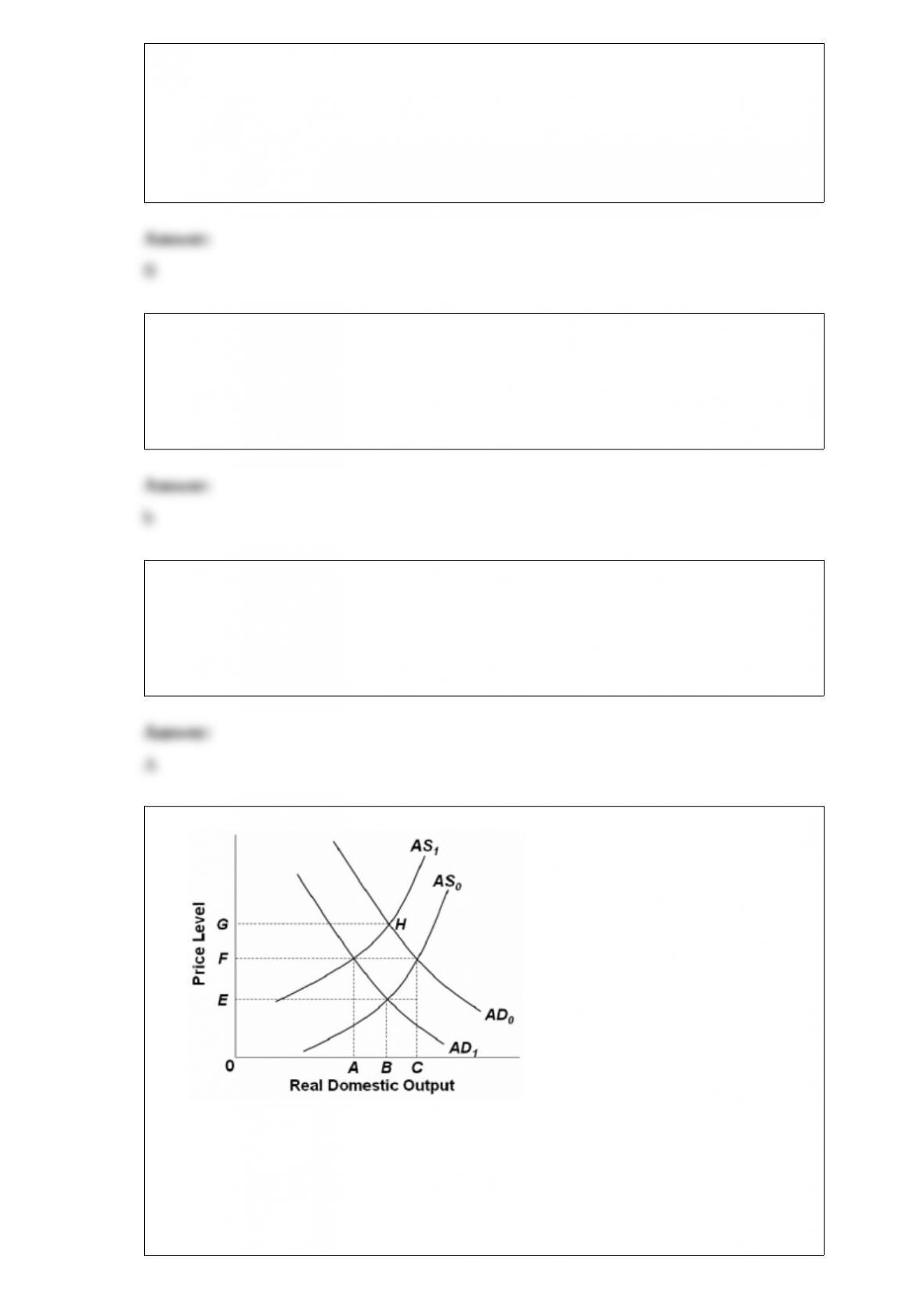
Refer to the above diagram. A shift of the aggregate demand curve from AD1 to AD0
might be caused by a(n):
A.decrease in aggregate supply.
B.decrease in the amount of output supplied.
C.increase in investment spending.
D.decrease in net export spending.
5) In the insider-outsider theory:
A.insiders are workers who retain employment during recession.
B.insiders are managers who have more information about their firms’ performance
than outsiders.
C.insiders are “principals” and outsiders are “agents.”
D.outsiders are foreigners.
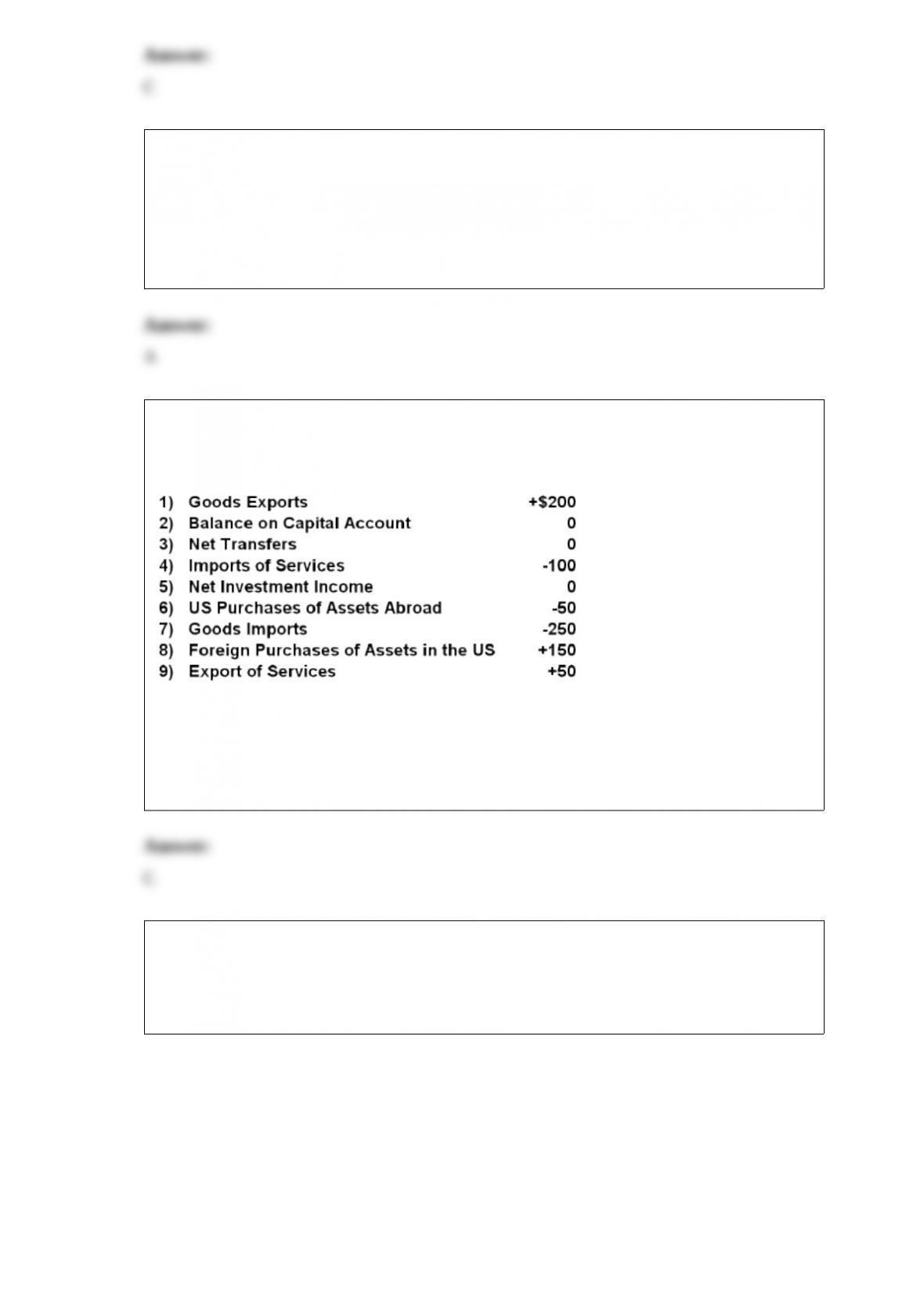
6) The plus items below are “export-type” entries and the minus items are “import-type”
entries in the balance of payments for the hypothetical country of Zippo.
Refer to the above information. Zippo has a:
A.current account surplus.
B.financial account deficit.
C.financial account surplus.
D.surplus on goods and services.
7) The following is a demand and supply model for a business firm producing baseball
caps. Assume that 100 baseball caps is the optimal ad most profitable level of
production for the firm. Answer the next four questions assuming that the price of
baseball caps is inflexible.
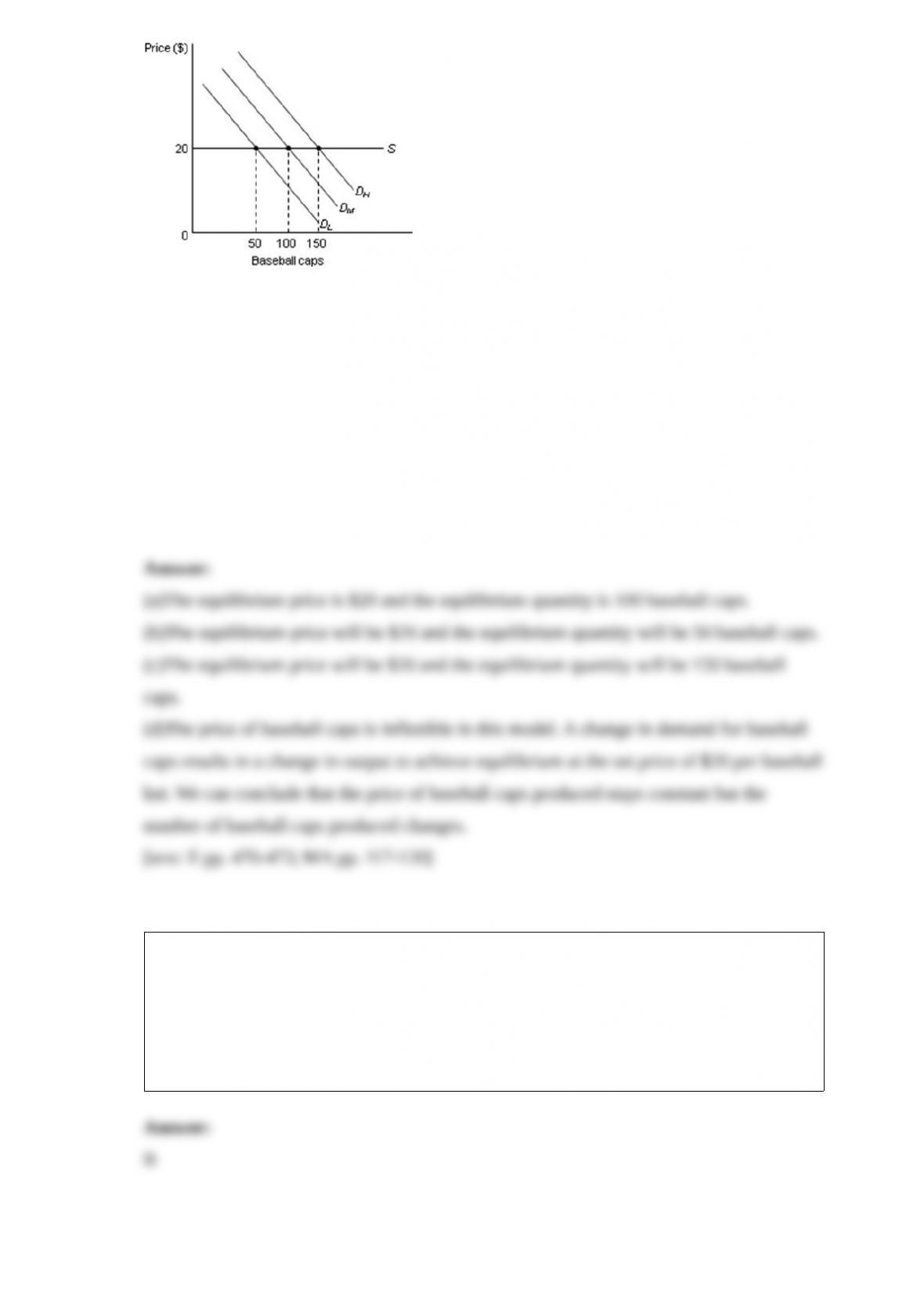
(a)What are the equilibrium price and quantity at the medium level of demand (DM)?
(b)What will be the equilibrium price and quantity if there is a demand shock that
unexpectedly lowers demand (DL)?
(c)What will be the equilibrium price and quantity if there is a demand shock that
unexpectedly increases demand (DH)?
(d)What can you conclude will happen to prices and output when this model is shocked by
changes in demand?
8) A monopsonist:
A.boosts the wage rate above the competitive level to attract more workers.
B.reduces the number of workers it employs so that it can pay each worker a lower
wage rate.
C.is a “wage taker.”
D.pays a wage rate equal to MRP.
9)
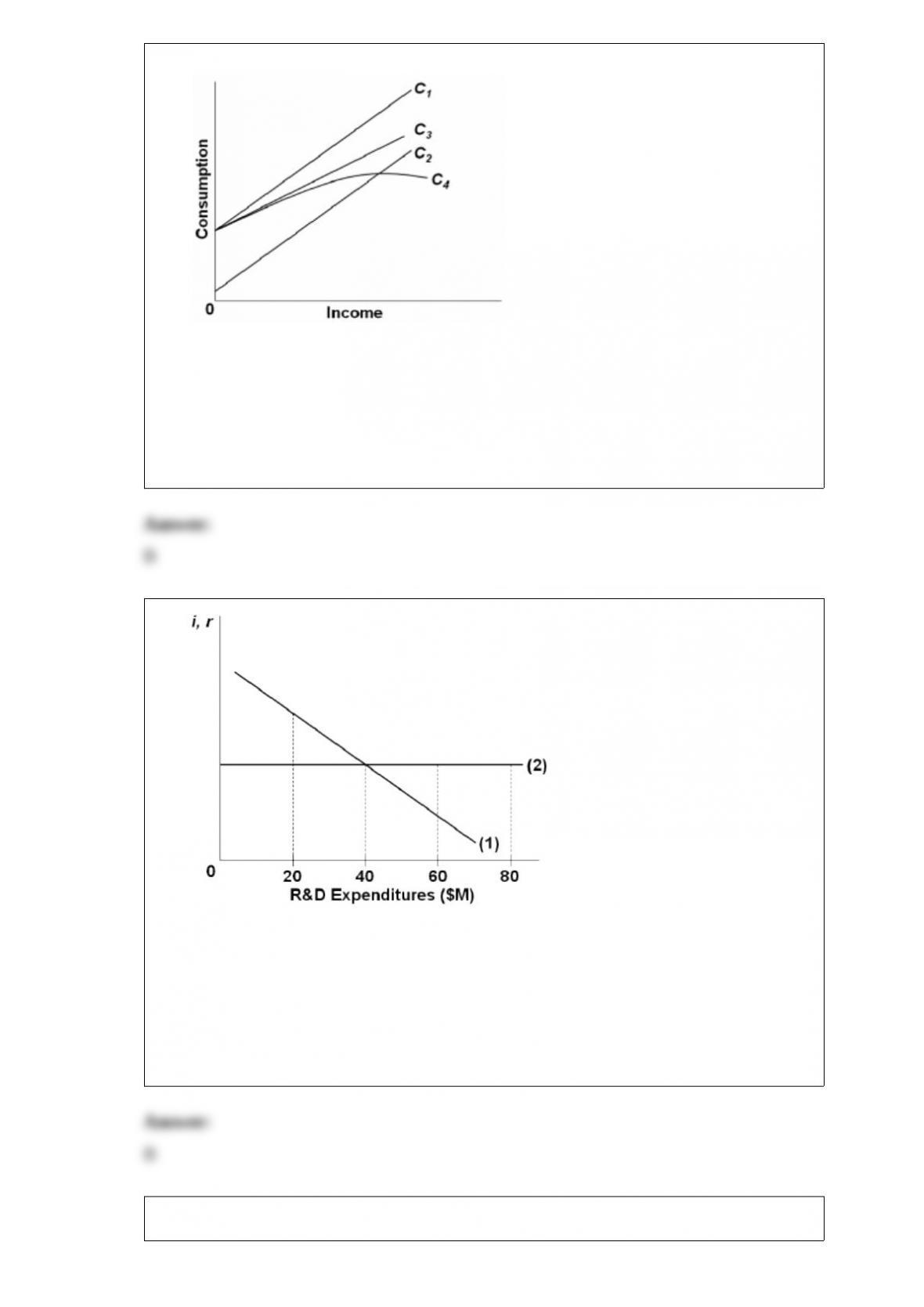
(Advanced analysis) Refer to the above diagram, in which C3 is the before-tax
consumption schedule. The after-tax consumption schedule represented by C2 reflects:
A.a lower MPC than is embodied in C3.
B.a regressive tax system.
C.a proportional tax system.
D.a progressive tax system.
10)
Assume that a firm’s interest-rate-cost of funds curve for R&D is perfectly elastic.
Which of the following would decrease a firm’s optimal R&D expenditures and, in
equilibrium, increase the expected rate of return on the last dollar of R&D?
A.a rightward shift of the expected-rate-of-return curve
B.an upward shift of the interest-rate-cost of funds curve
C.a leftward shift of the expected-rate-of-return curve
D.a downward shift of the interest-rate-cost of funds curve
11) environmental pollution is accounted for in:
a.gdp.
b.pi.
c.di.
d.none of these.
12) other things equal, in which of the following instances would the increase in labor
productivity be the greatest?
a.the stock of real capital and inputs of labor increase proportionately
b.the increase in the stock of real capital exceeds the increase in inputs of labor
c.the increase in inputs of labor exceeds the increase in the stock of real capital
d.inputs of labor increase and the stock of real capital remains constant
13)
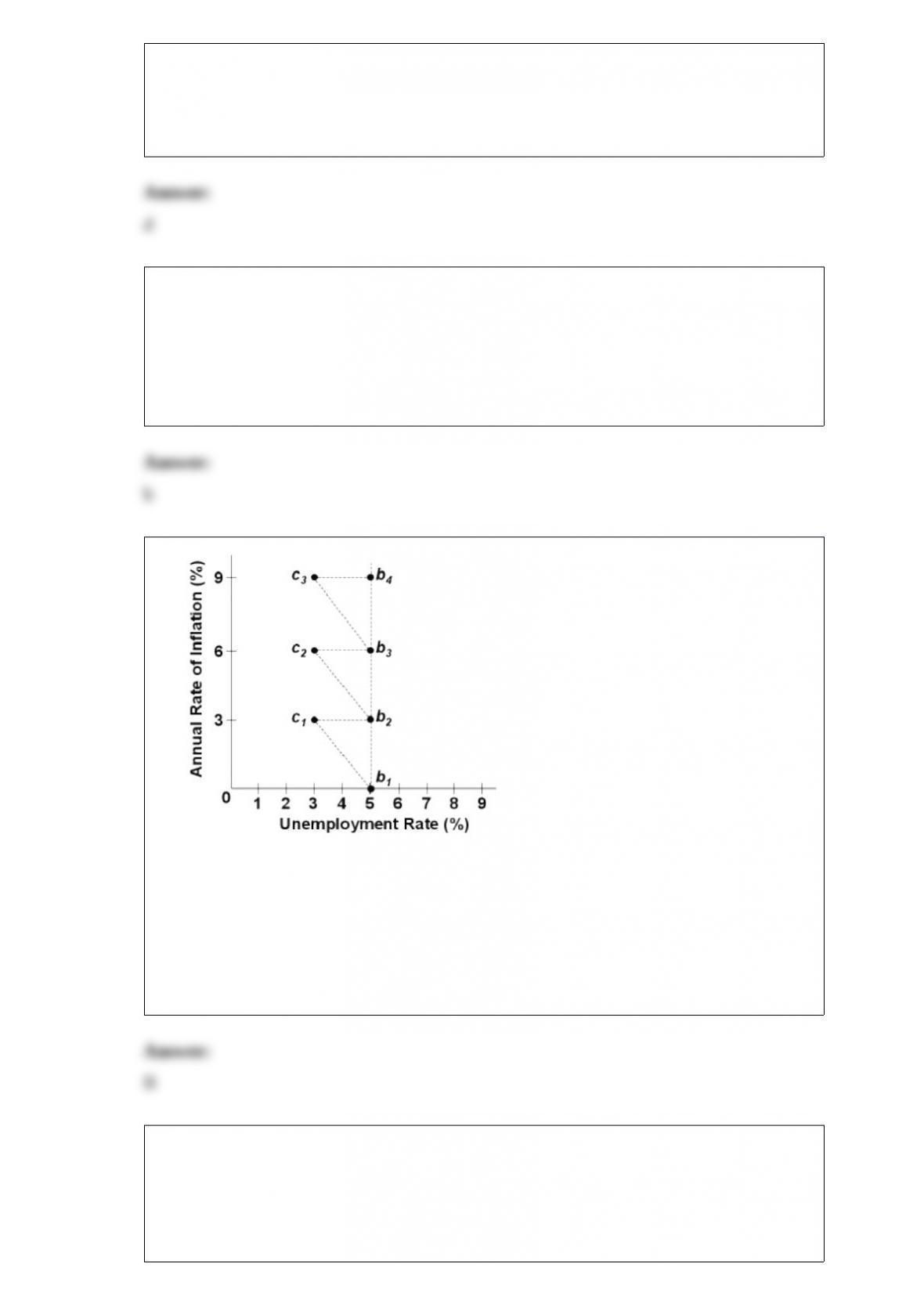
Refer to the above diagram and assume the economy is initially at point b1. The
long-run relationship between the unemployment rate and the rate of inflation is
represented by:
A.the line connecting b1 and c1.
B.the line through b1, b2, b3, and b4.
C.the line connecting c1 and b2.
D.any line parallel to the horizontal axis.
14) One cause of income inequality in the United States is:
A.the free public school system.
B.differences in preferences for market work relative to nonmarket activities as well as
differences in preferences for types of work.
C.antidiscrimination laws.
D.the social security system.
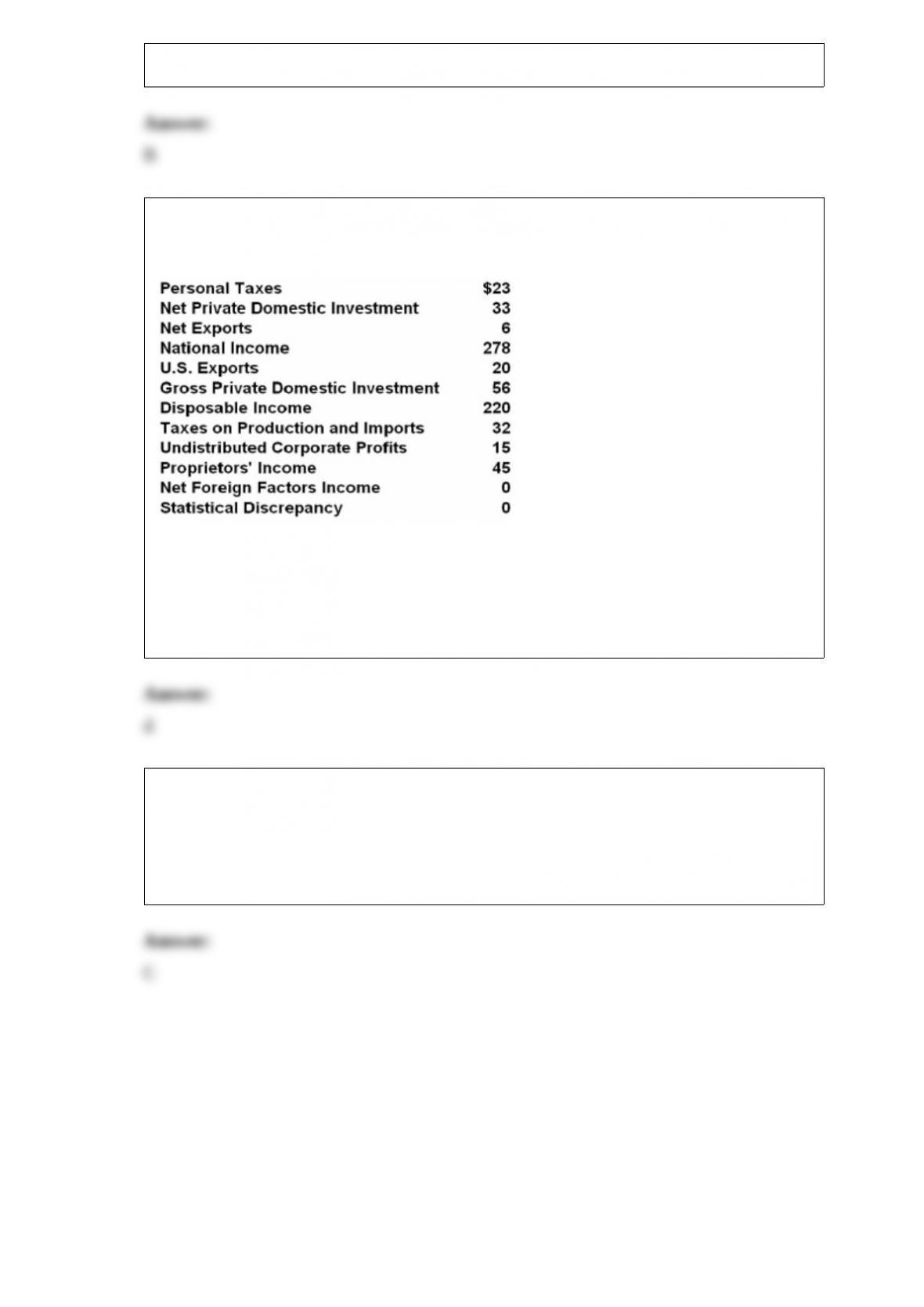
15) answer the next question(s) on the basis of the following national income data. all
figures are in billions of dollars.
refer to the above data. u.s. imports are:
a.$26.
b.$16.
c.$24.
d.$14.
16) In the United States, the rate of unionization is:
A.higher in mining than in government.
B.lower in transportation than agriculture.
C.higher in transportation than in retail trade.
D.lower in government than in finance, insurance, and real estate.
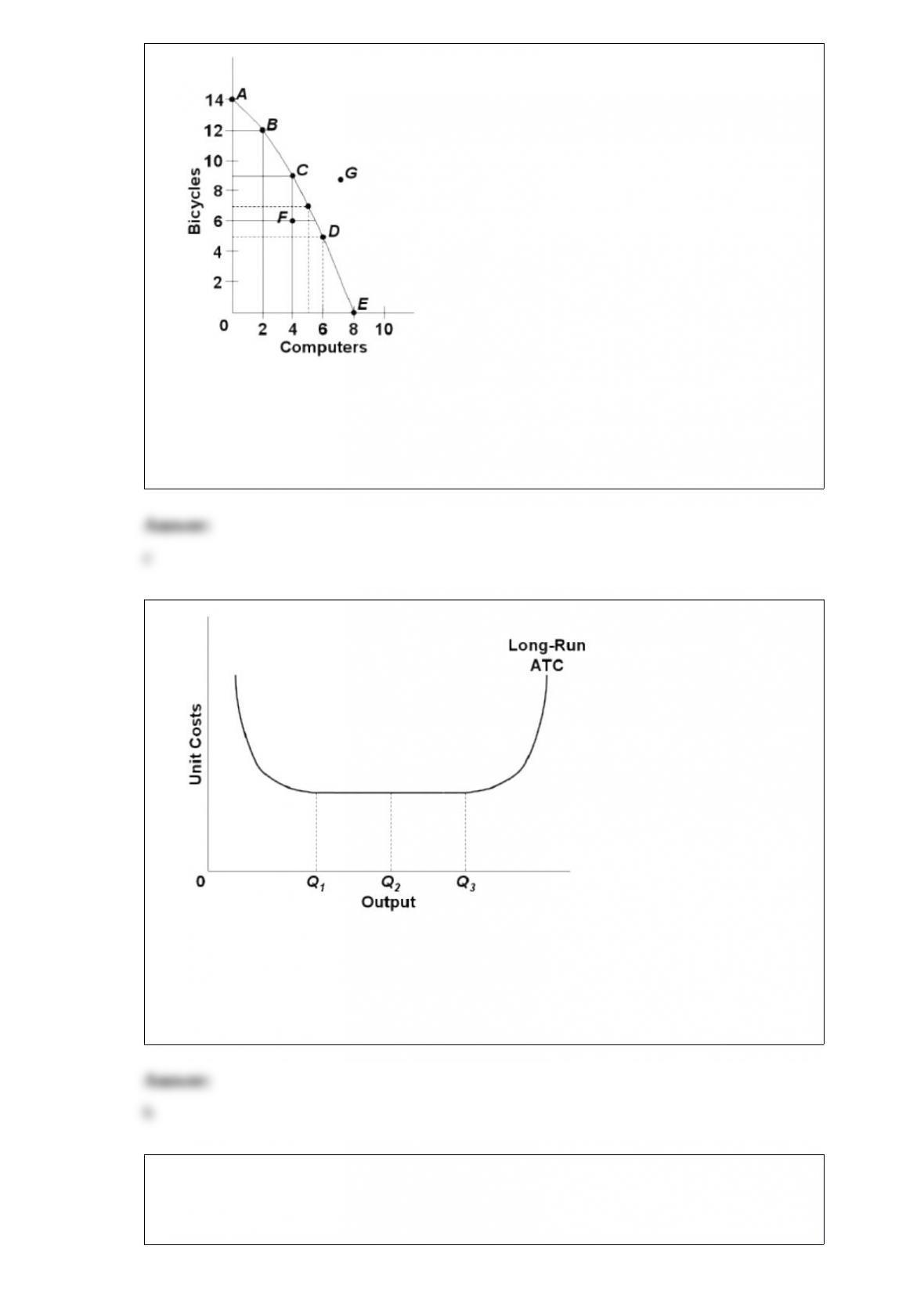
17)
refer to the above diagram. this production possibilities curve is:
a.convex to the origin because opportunity costs are constant.
b.linear because opportunity costs are constant.
c.concave to the origin because of increasing opportunity costs.
d.convex to the origin because of increasing opportunity costs.
18)
refer to the above diagram. constant returns to scale:
a.occur over the 0q1 range of output.
b.occur over the q1q3 range of output.
c.begin at output q3.
d.are in evidence at all output levels.
19) According to mainstream economists, the Fed’s adherence to a traditional monetary
rule rather than to discretionary monetary policy is likely to:
A.reduce the severity of business cycles.

B.increase the amount of instability in the economy.
C.increase the rate of inflation.
D.crowd out much needed investment spending during times of rapid inflation.
20) If the MPC is 2/3, the initial impact of an increase of $12 billion in lump-sum taxes
will be to cause:
A.a rightward shift in the investment demand schedule.
B.an $8 billion downshift in the consumption schedule.
C.a $4 billion upshift in the consumption schedule.
D.a $12 billion downshift in the consumption schedule.