1) Assume the Environmental Protection Agency imposes an excise tax on polluting
firms. In which of the following situations would we expect the additional costs to be
borne most heavily by consumers?
A.demand is highly elastic and supply is highly inelastic
B.demand and supply are both highly elastic
C.demand and supply are both highly inelastic
D.demand is highly inelastic and supply is highly elastic
2) assuming conventional supply and demand curves, changes in the determinants of
supply and demand will:
a.in all likelihood alter both equilibrium price and quantity.
b.alter equilibrium quantity, but not equilibrium price.
c.alter equilibrium price, but not equilibrium quantity.
d.have no effect on equilibrium price or quantity.
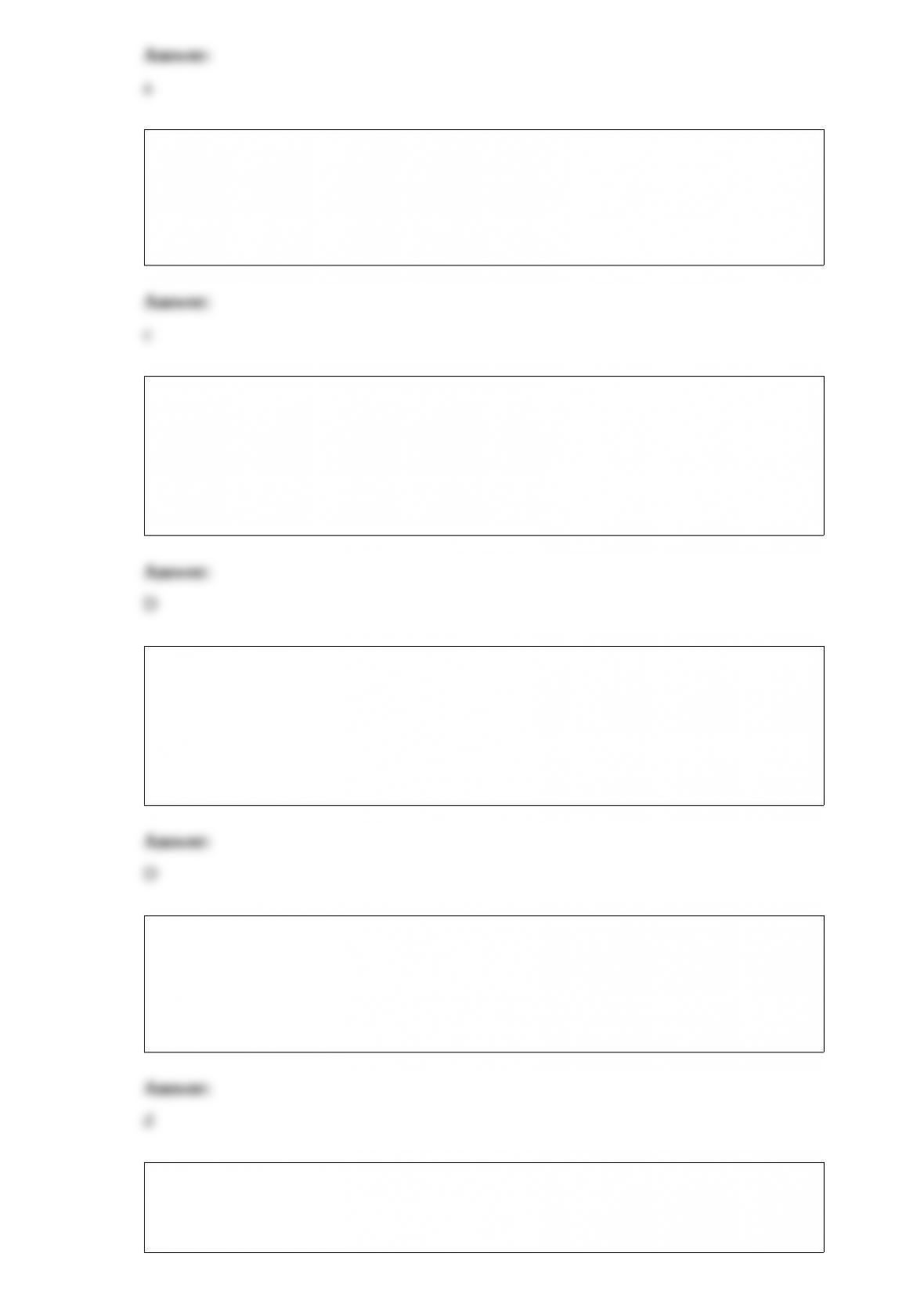
3) The following consolidated balance sheet of the commercial banking system.
Assume that the reserve requirement is 10 percent. All figures are in billions and each
question should be answered independently of changes specified in any preceding ones.
Refer to the above data. Suppose the Fed wants to reduce the money supply by $400
billion to drive up interest rates and dampen inflation. Assuming that the money
multiplier is operating to full effect, to accomplish the desired reduction the Fed could:
A.sell $20 billion of U.S. securities to the banks.
B.buy $20 billion of U.S. securities from the banks.
C.sell $40 billion of U.S. securities to the banks.
D.buy $40 billion of U.S. securities from the banks.
4) an increase in consumer desire for strawberries is most likely to:
a.increase the number of strawberry pickers needed by farmers.
b.reduce the supply of strawberries.
c.reduce the number of people willing to pick strawberries.
d.reduce the need for strawberry pickers.
5) in which of the following cases will total revenue increase?
a.price falls and demand is inelastic
b.price falls and supply is elastic
c.price rises and demand is inelastic
d.price rises and demand is elastic
6) Under a system of fixed exchange rates, a nation that has chronic balance of
payments deficits may:
A.initiate protectionist trade policies.
B.run short of international monetary reserves.
C.be forced to invoke contractionary monetary and fiscal policies.
D.do all of these.
7) Research studies indicate that:
A.U.S. producers gain more from tariffs than U.S. consumers lose.
B.the costs of trade restrictions are proportionately higher for high-income groups than
for low-income groups.
C.the revenue from tariffs equals the total cost that tariffs impose on consumers.
D.U.S. consumers lose more from tariffs than U.S. producers gain.
8) the supply curve for a monopolist is:
a.perfectly elastic.
b.upsloping.
c.that portion of the marginal cost curve lying above minimum average variable cost.
d.nonexistent.
9) Per capita incomes must first grow for birth rates to decline. This statement describes
the:
A.human capital view of population growth.
B.traditional view of population growth.
C.capricious universe view.
D.demographic transition view of population growth.
10) Adherents of the traditional monetary rule advocate that the:
A.functional finance approach to fiscal policy be adopted.
B.money supply should be increased by a constant rate year after year.
C.money supply should be reduced during inflation and increased during recession.
D.money supply should be increased during inflation and reduced during recession.
11) a group of plants that is owned and operated by a single firm and that consists of oil
fields, refineries, and gasoline stations best illustrates a:
a.trust.
b.holding company.
c.vertically integrated firm.
d.multinational corporation.
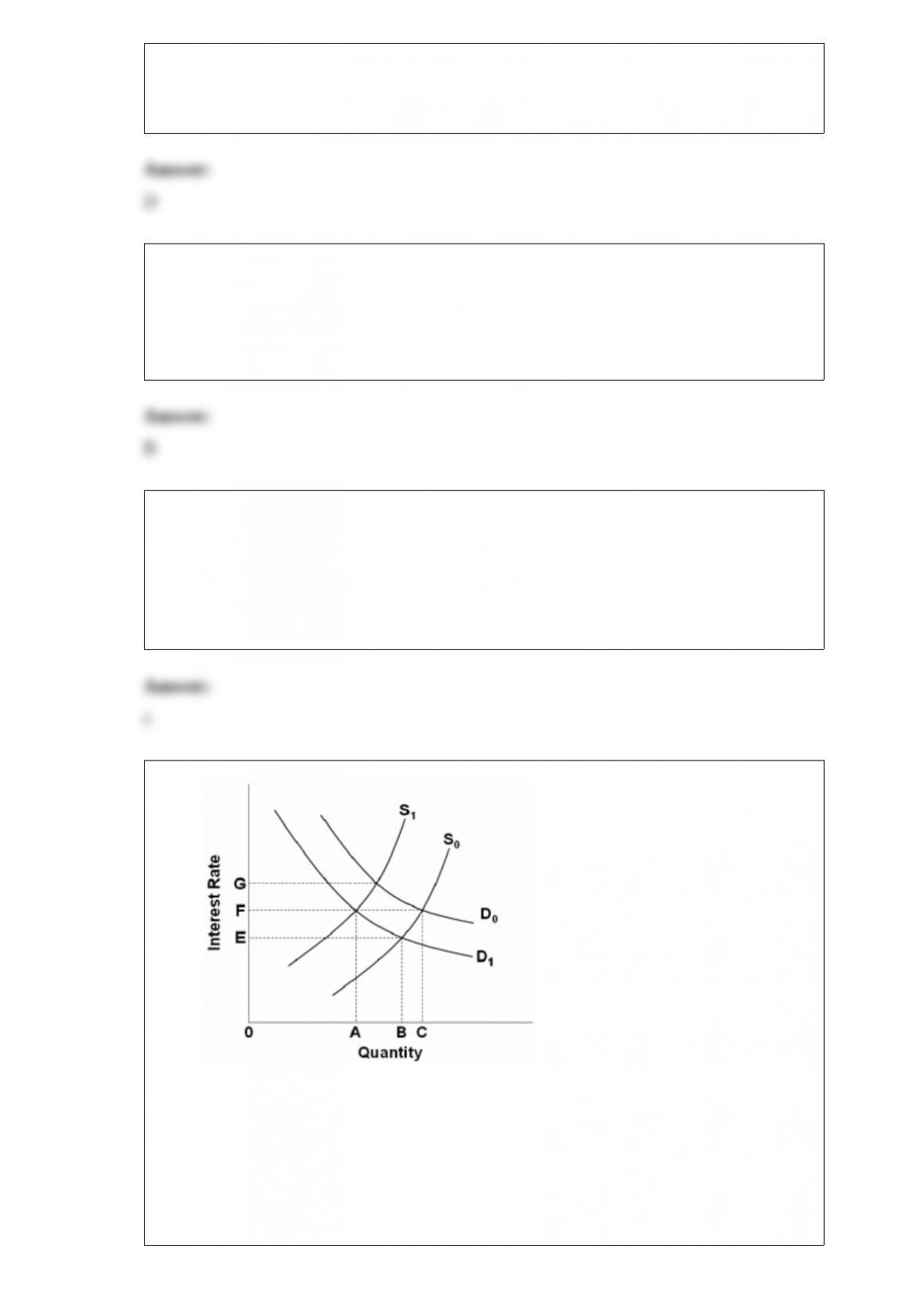
12)
Refer to the above diagram. If the supply of loanable funds is S1 and the demand for
loanable funds is D1, the equilibrium interest rate and quantity of funds borrowed will
be:
A.G and A.
B.F and A.
C.F and C.
D.E and A.
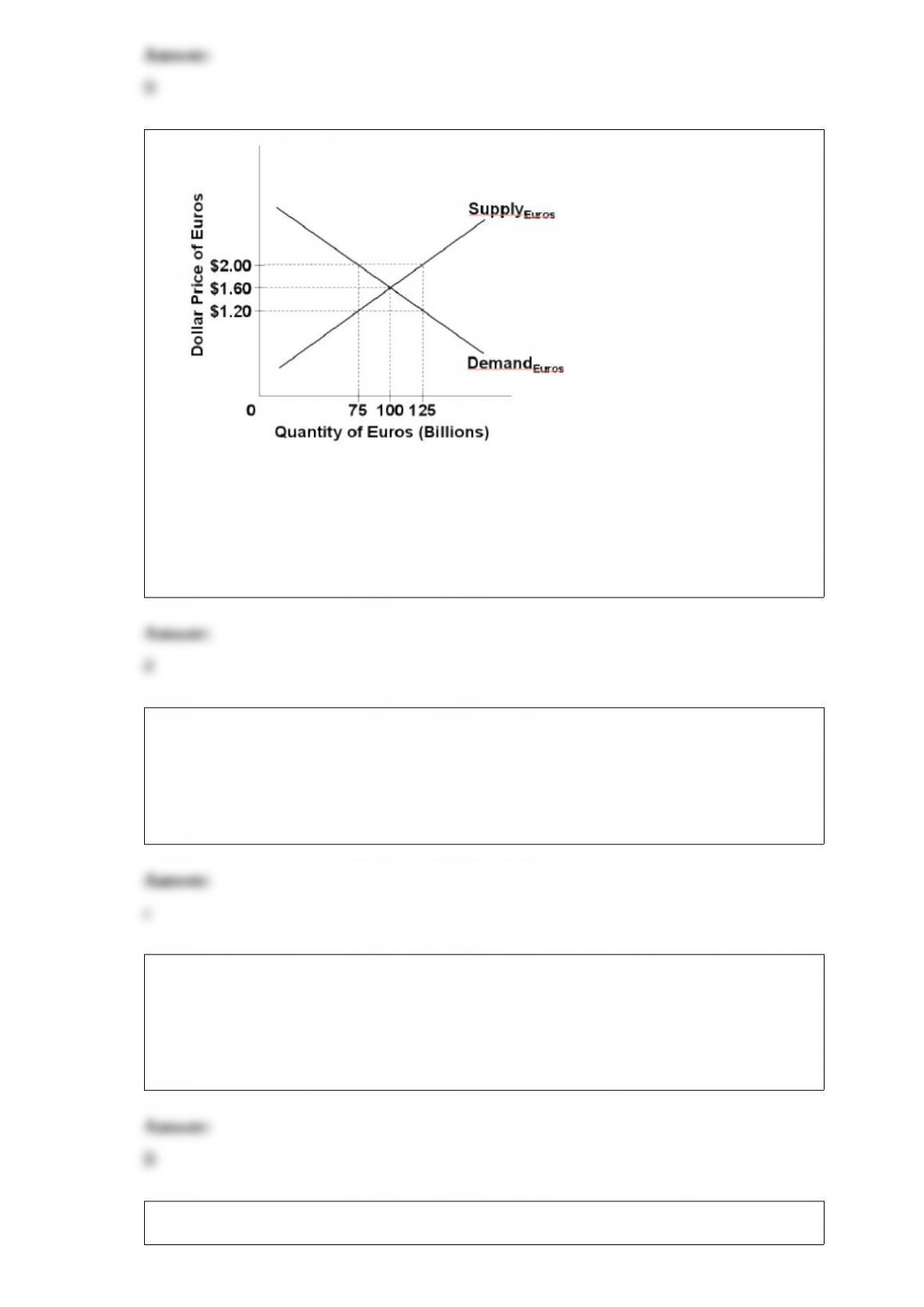
13)
refer to the above diagram. which of the following would most likely cause an increase
in the dollar price of euros from $1.60 to $2.00?
a.an increased number of euro zone citizens visiting the united states.
b.greater u.s. exports of financial services to germany and france.
c.rising incomes in euro zone nations.
d.rising incomes in the united states.
14) normal profit is:
a.determined by subtracting implicit costs from total revenue.
b.determined by subtracting explicit costs from total revenue.
c.the return to the entrepreneur when economic profits are zero.
d.the average profitability of an industry over the preceding 10 years.
15) The equality-efficiency tradeoff suggests that:
A.welfare programs stimulate incentives to work.
B.inefficiencies result when income is transferred from rich to poor.
C.noncash transfers are superior to cash transfers.
D.economic growth is the best means of reducing poverty.
16) the voluntary relocation of employable migrants from low-paying nations to
high-paying nations reduces:
a.wage rate disparities among nations.
b.business or capitalist income in the world.
c.labor productivity in the world.
d. total wage income in the world.
17) which of the following is not an important source of revenue for the federal
government?
a.corporate income taxes
b.property taxes
c.payroll taxes
d.personal income taxes
18) Trace the cause-effect chain that results from an expansionary monetary policy.
19) (Consider This) How was the practice of clipping coins during feudalism
contributing to inflation? Who benefited from this inflation?
20) Why is a balance-of-payments deficit not necessarily good or bad if it occurs in one
given year, but potentially very harmful if maintained over a number of years?
21) How can the United States compete successfully with relatively low-wage nations
such as India and China?
22) Why are horizontal mergers more likely to be opposed than vertical and
conglomerate mergers?
23) Why shouldnt Japan make its main production sector agriculture?
24) How does price elasticity affect the price-quantity combination and segment of the
demand curve that the monopolist would prefer for price and output?
25) What are the major barriers to entry that explain the existence of monopoly?