
1) Suppose a person pays $80 of annual interest on a loan that has a 5 percent annual
interest rate. The loan amount is:
A.$400.
B.$1,600.
C.$160.
D.$85.
2) Compensating differences in wages pay workers for:
A.differences in worker training and skills.
B.differences in the nonmonetary characteristics of jobs.
C.geographic immobilities.
D.discrimination in hiring and firing.
3) value added refers to:
a.any increase in gdp that has been adjusted for adverse environmental effects.
b.the excess of gross investment over net investment.
c.the difference between the value of a firm’s output and the value of the inputs it has
purchased from others.
d.the portion of any increase in gdp that is caused by inflation as opposed to an increase
in real output.
4) the natural rate of unemployment:
a.is fixed over time.
b.is found by adding the cyclical and structural unemployment rates.
c.may change from one decade to another.
d.cannot be influenced by public policy.
5) when the production or consumption of a good involves an externality:
a.resources are necessarily overallocated to the product.
b.resources are necessarily underallocated to the product.

c.someone not involved in buying or selling the good is affected.
d.the market will efficiently allocate resources to its production.
6) The Social Security trust fund currently is in:
A.deficit, and it inclusion in the Federal budget increases the stated size of the budget
deficit.
B.deficit, and it inclusion in the Federal budget reduces the stated size of the budget
deficit.
C.surplus, and its inclusion in the Federal budget reduces the stated size of the budget
deficit.
D.surplus, and it inclusion in the Federal budget increases the stated size of the Federal
budget deficit.
7) Inflation in the U.S. economy tends to be:
A.a finite, one-time event resulting from a shock.
B.ongoing, as increases in aggregate demand outpace increases in aggregate supply.
C.a finite, one-time event as the Fed actively works to eliminate all inflation.
D.ongoing, as aggregate supply is continually shifting to the left.
8) marginal utility can be:
a.positive, but not negative.
b.positive or negative, but not zero.
c.positive, negative, or zero.
d.decreasing, but not negative.
9) In the table below, assume a monopsonist has the marginal-revenue-product schedule
for a particular type of labor given in columns 1 and 2 and that the supply schedule for
labor is that given in columns 1 and 3.
(a)Compute the firms total labor costs at each level of employment and the marginal
labor cost of each unit of labor, and enter these figures in columns 4 and 5.
(b)How many units of labor will the firm hire? What will be the wage rate?
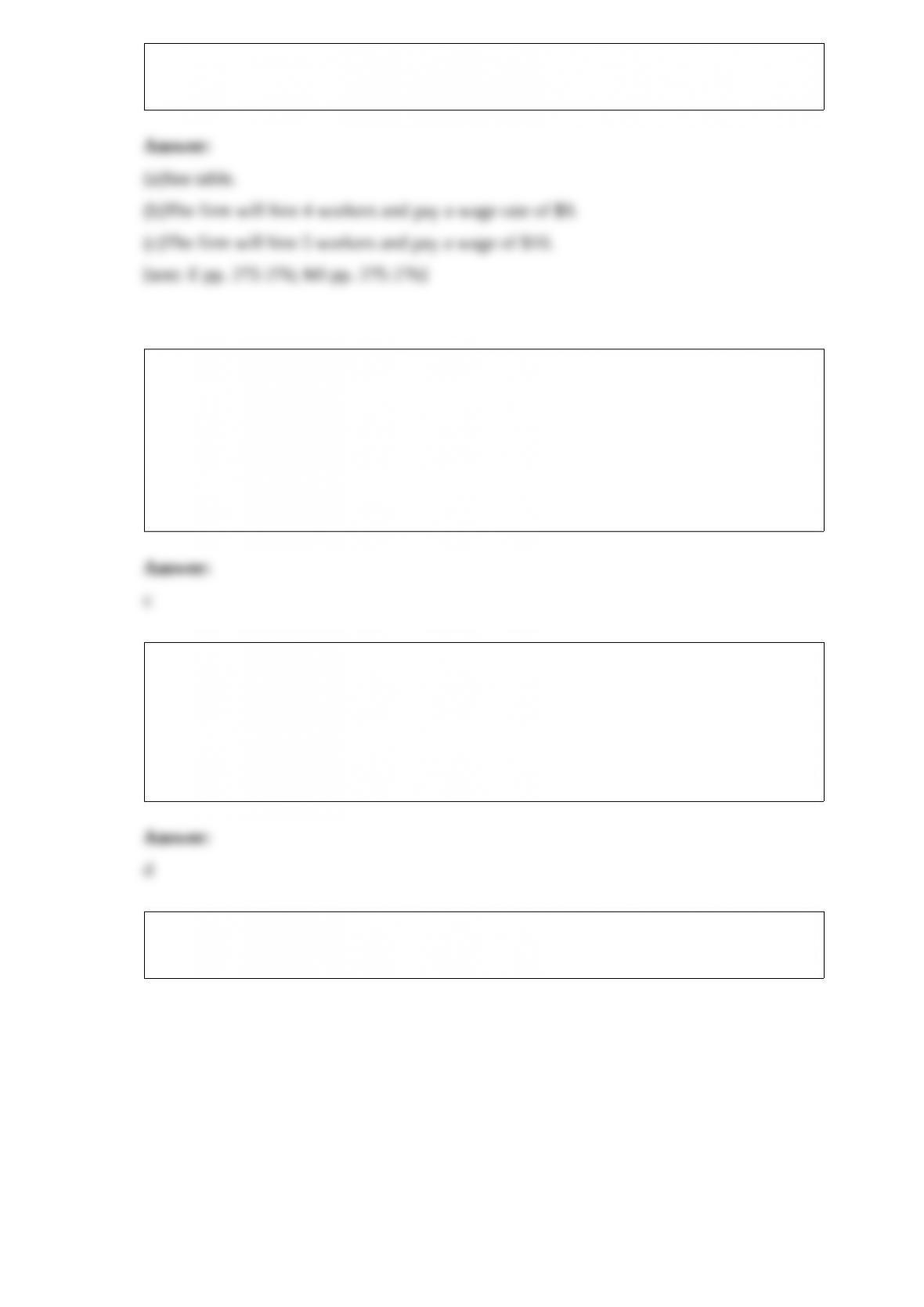
(c)If this firm hired labor in a competitive labor market, what would be the wage rate
and number of workers hired?
10) susie has lost her job in a vermont textile plant because of import competition. she
intends to take a short course in electronics and move to oregon where she anticipates
that a new job will be available. we can say that susie is faced with:
a.secular unemployment.
b.cyclical unemployment.
c.structural unemployment.
d.frictional unemployment.
11) gdp data are criticized as being inaccurate measures of economic welfare because:
a.they do not take into account changes in the amount of leisure.
b.they do not take into account all changes in product quality.
c.they do not take into account the adverse effects of economic activity on the
environment.
d.of all of these considerations.
12) Answer the next five questions on the basis of the following hypothetical data for a
nation Malthusia. All numbers are in billions of dollars.
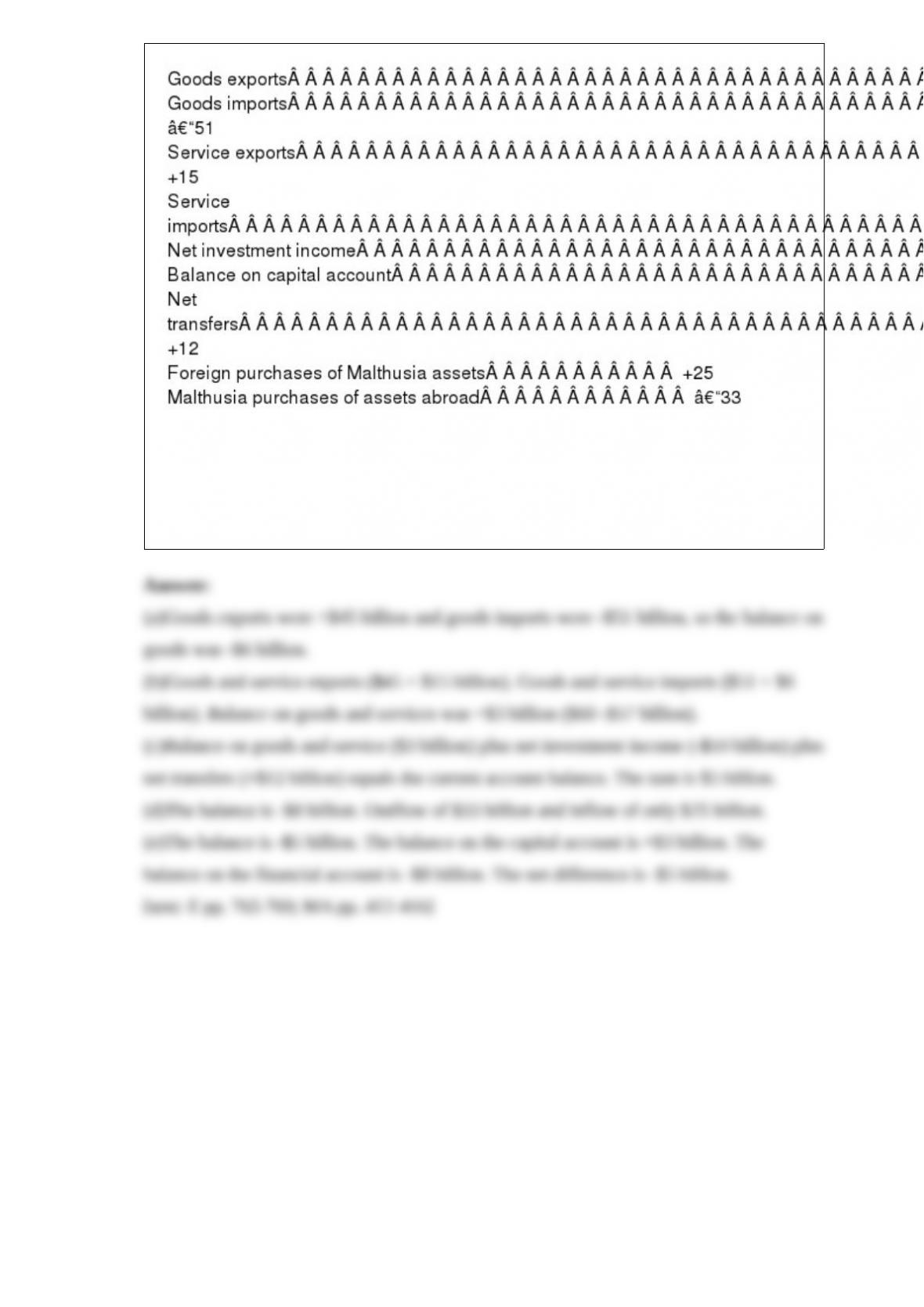
(a)What was the balance on goods?
(b)What was the balance on goods and services?
(c)What was the balance on the current account?
(d)What is the balance on the financial account?
(e)What is the balance on the capital and financial account?